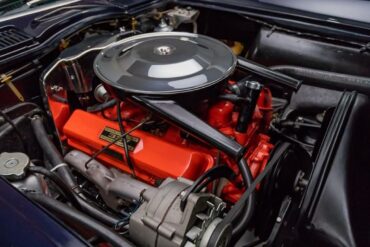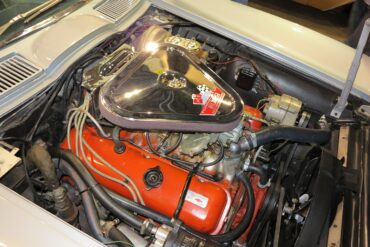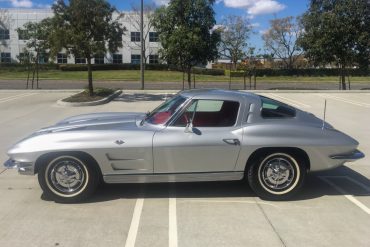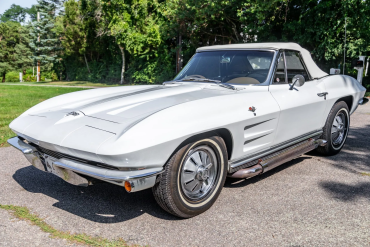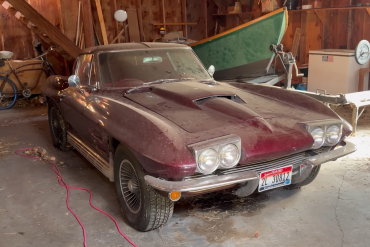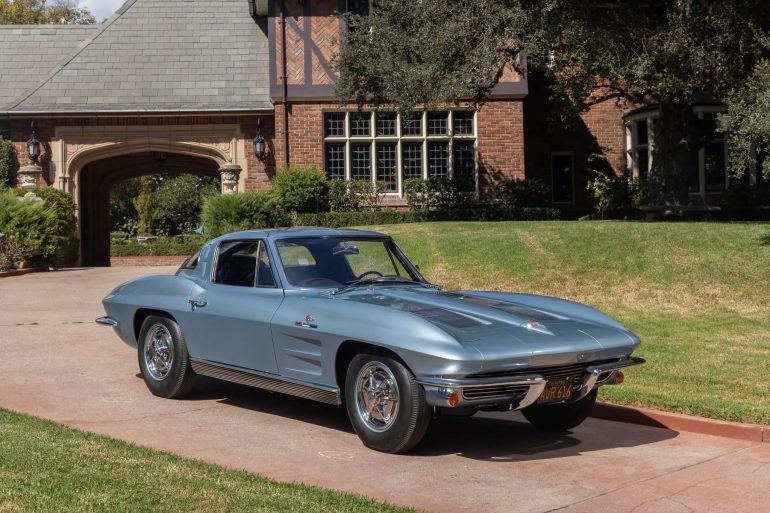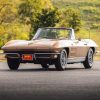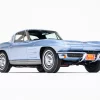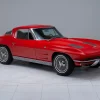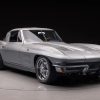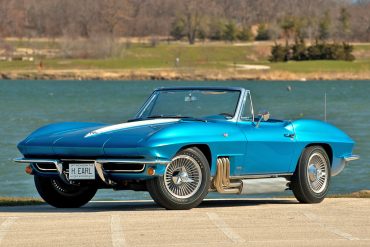
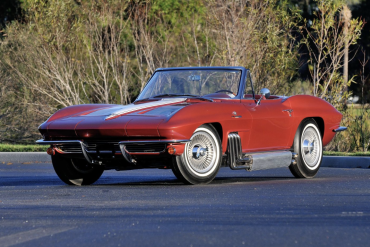
Two near-identical 1963 Sting Ray convertibles left GM Design under special work orders: one for the Chicago Auto Show, one for retired styling chief Harley Earl. Earl's car later brought $925,000 at Mecum.



C2 CORVETTE - 1963
The first Sting Ray: a new chassis with independent rear suspension, the one-year-only split-window coupe, four 327s up to 360 hp, the Z06 race package and the Grand Sport, and 21,513 built, 50 percent more than any Corvette before it.
Quick: Story · Specials · Z06 · Grand Sport · Price & Options · VIN · Specs · Technical · Pics & Videos · The Market · All Content · FAQs
Model & Gen: 1963 Corvette (C2)
Body Type: Sport Coupe (split window) or Convertible
VIN: 30837S100001 – 30837S121513
Original Price: $4,257 coupe / $4,037 convertible
Colors: 7 (Tuxedo Black, Ermine White, Riverside Red, Silver Blue, Daytona Blue, Saddle Tan, Sebring Silver)
Engine: 327 ci V-8, 250 to 360 hp (fuel injection optional)
Transmission: 3-speed manual standard; 4-speed manual and 2-speed Powerglide optional
Units Produced: 21,513
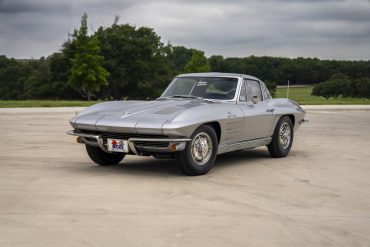
The 1963 Corvette Sting Ray is the car that turned the Corvette from an American sports car into a world one. Bill Mitchell’s body, developed from his Sting Ray racer and Larry Shinoda’s drawings, came as a convertible or, for the first time, a coupe, with hidden headlights, a shorter 98-inch wheelbase and, on 1963 coupes only, the split rear window that Mitchell insisted on and Zora Arkus-Duntov hated. Underneath was Duntov’s new chassis: a ladder frame with independent rear suspension on a single transverse leaf spring, faster steering, wider drum brakes and weight moved rearward. The engines, three carbureted 327s and the 360-hp fuel-injected L84, carried over from 1962.
Buyers ordered it as a sports car. About four in five took the four-speed, power steering and power brakes appeared for the first time, air conditioning reached 278 cars, and leather was available with the Saddle interior. For racers Duntov wrote RPO Z06, a $1,818.45 package of Al-Fin brakes, stiff suspension and a 36.5-gallon tank on fuel-injected four-speed coupes: 199 were built. Outside the option list, he built five Grand Sports to take on the Cobra before GM shut the program down.
Production reached 21,513, split almost evenly between coupes and convertibles, a 50 percent jump on the record 1962, and Chevrolet added a second shift at St. Louis to meet two-month waiting lists. The split window lasted one year, the coupe would not outsell the convertible again until 1969, and the 1963 became the most collectible Corvette of its generation.
The 1963 Chevy Corvette was the final result of more than a half-decade's worth of research both on and off the racetrack. Conceived by Bill Mitchell and Zora Arkus-Duntov, the second-generation Corvette literally evolved from a racecar - namely the Stingray racer that Mitchell created (and privately funded out of his own pocket.)
Even its title, which was an axiom deliberately given to the race car because of its resemblance to an actual stingray, stuck and further defined the C2 for all time as the “Corvette Sting Ray.”
The car was an instant marketing success. Given its improved and re-imagined styling from the C1, and the impressive advancements made to the car's performance and handling, there had been no doubt that the second-generation Corvette would be a triumph. Even so, nobody could have guessed that Mitchell's ingenious design and Duntov's engineering wizardry would produce a sports car that would become as popular or as successful as the 1963 Corvette ended up being.
“Only a man with a heart of stone could withstand temptation like this” was what the inaugural Sting Ray ad copy had read. The words would prove to be prophetic.
When the 1963 Corvette finally made it to market, its sales numbers jumped off the charts, literally skyrocketing Corvette sales to levels never before experienced - even in 1953 when the original C1 had originally been marketed to enthusiastic soldiers returning home from overseas.
“Only a man with a heart of stone could withstand temptation like this”
The car was exactly the “shot in the arm” that the Corvette program had needed. To help with the increasing demand, Chevrolet 's St. Louis factory (where the 1963 C2 Corvette was assembled) increased production by adding a second shift. Even so, the demand continued to outgrow GM 's ability to manufacture the new car, and so customers were forced to wait - sometimes up to two months - to take delivery of their new Corvettes.
Even more impressive than the wait was that many of these customers paid full retail price for the “privilege” of being the first to own a 1963 Corvette.
Perhaps as impressive as the sales numbers that were being reported for the second-generation Corvette almost immediately after the car hit the retail market was the fact that the first-generation Corvettes began to increase in popularity - so much so that the previous used car value of these Corvettes actually increased beyond their original sell prices, making Corvette one of the first postwar cars to outsell its original list price on the collectors market.
While nobody could have predicted it then, the C2 Corvette would become one of the most desirable - and most collectible - Corvettes of all, and none more so than the 1963 model year. While the C2's styling was both aggressive and radically advanced for its time, there were a number of other advancements made to the second-generation Corvette that also attributed to the Sting Ray's success.
The Sting Ray had a newly designed chassis that featured a shorter wheelbase and a faster “Ball-Race” steering (a name that was developed by the ad copy (advertisement) writers in 1963) both of which attributed to providing the car with improved maneuverability and handling.
While having a shorter wheelbase might normally imply a choppier ride, the design of the C2 partially compensated for this by redistributing the weight of the car from front to rear. By moving some of the weight out of the end, steering the car became more manageable - especially given the fact that the 1963 Corvette did not include power steering as a standard feature. At the same time, Corvette engineers moved approximately 80 additional pounds on/over the rear wheels, which improved the car's traction, especially during moments of more aggressive acceleration.
Did you know? The original 1963 Sting Ray Coupe is considered to be one of the most collectible Corvettes of all time because of its unique split rear window design. Surprisingly, many split-window coupes were modified by customizers, some of whom replaced the small, individual panes of glass with a one-piece window made of Plexiglass. Even more surprising is that Chevy began offering replacement one-piece windows through its dealerships. As a result, a good many 1963 Corvette coupes lost a considerable amount of their collector value.
A number of items did carry over from the C1 Corvette. Included in these was a collection of four small-block, 327C.I. V-8 engines, a trio of transmissions, and six axle ratios. The engines that were offered for the 1963 Corvette included three carbureted versions; a 250-, 300-, and 340-horsepower variants, as well as a 360-horsepower fuel-injected powerhouse engine, which was made available to consumers for an extra $430.40. As in the 1962 Corvette before it, the base and step-up engine units utilized hydraulic lifters, a mild cam, a forged-steel crankshaft, 10.5:1 engine compression, a single-point distributor, and a dual exhaust system. Additionally, the 300-horsepower engine produced some additional power via a larger, four-barrel carburetor, plus larger intake valves and exhaust manifold.
The car's standard three-speed transmission also carried over from the 1962 model year, and remained available in 1963 though neither it nor the optional Powerglide automatic transmission were installed into many second-generation Corvettes. Instead, the preferred gearbox continued to be the Borg-Warner manual four-speed transmission.
An optional upgrade priced at $188.30, the Borg-Warner gearbox was delivered with wide-ratio gears when mated to the 250- or 300-horsepower engines, and a close-ratio gearing when mated to the top two powerplants. The standard axle ratio for the three-speed manual transmission or the Powerglide automatic was 3.36:1. Comparatively, the four-speed manual came standard with a 3.70:1 final drive ratio, although 3.08:1, 3.55:1, 4.11:1 and 4.56:1 gear sets were also made available. While most of these were desirable alternatives to the standard gear ratio, the last of these (the 4.56:1 ratio) was quite rare in production model Corvettes.
While the powertrain/drivetrain may have been a carry-over from the first-generation Corvette, there were a number of enhancements to the rest of the C2 Corvette that were vast improvements from its predecessor. Just as the steering/maneuverability had been improved, so too was the Sting Ray's stopping ability.
The new Corvette came equipped (standard) with wider, four-wheel cast-iron 11-inch drum brakes, which provided a more effective braking area, which, in turn, produced shorter stopping distances. Optionally, consumers had the ability to order special, sintered-metallic linings that were segmented for better cooling. They also had the option of ordering finned aluminum (“Al-Fin”) drums, which not only provided faster heat dissipation, but also less unsprung weight. Optional power assist was available for both braking packages.
Other major improvements that were introduced on the 1963 Corvette included positive crankcase ventilation, a smaller flywheel, and an aluminum clutch housing. A more-efficient alternator also replaced the old-fashioned generator.
In 1957, the Automobile Manufacturers Association (AMA) introduced a racing ban that prohibited automotive manufacturers from participating in sanctioned racing events. While General Motors had been an active participant in the ban since its inception, Zora Arkus-Duntov had been against the ban, and had become determined to provide consumers with the ability to build a race-ready Corvette, even after General Motors officially banned their production.
To get around the ban, Duntov had made it possible to turn any Corvette into a racer by informing consumers which options to order when buying their cars. When he and Bill Mitchell completed the design and development of the second-generation Corvette, he had become more determined than ever to ensure that anyone who wanted to race his sophisticated new Sting Ray should have the ability to do so. It was with this rationale in mind that he developed RPO Z06 - a new competition-oriented package.
In order to purchase the Z06 option, consumers first had to specify that they were purchasing a fuelie (fuel-injected) coupe equipped with a four-speed manual transmission and a Posi-traction limited-slip differential. After selecting these options, consumers could add the Z06 option for an additional $1,818.45, which was a formidable up-sell in 1963.
Consumers that ordered the Z06 option received the top-line Al-Fin power brakes with sintered metallic brake linings, a heavy-duty front stabilizer bar, stronger shocks, much stiffer springs, a dual master cylinder, and a long distance 36.5 gallon fuel tank. Additionally, Chevrolet had intended to include a set of beautiful, cast-aluminum wheels with tri-spinner knock-off hubs as part of the Z06 package (and as a separate option.)
However, Chevrolet dropped the wheels from the optional factory equipment for 1963 due to casting problems that made the wheels so porous that they wouldn't hold air in the tires. Interestingly, Chevrolet listed RPO Z06 as an option when building a Convertible as well, but Chevrolet production records show that no such cars were ever built - which is doubly interesting since all previous Corvette racers had been open-cockpit roadsters.
The 1963 Sting Ray was not only a commercial success, but was hailed by the automotive press as one of the best Corvettes of all time. It was praised almost unanimously for its handling, road adhesion, and unrelenting horsepower. Car Life magazine presented its annual Award for Engineering Excellence on the 1963 Corvette Sting Ray. It was noted to have a significant edge over past models in both traction and handling because the new independent rear suspension reduced wheel spin considerably compared to the live-axle cars. Chevy's small-block V-8 engine, which was recognized as being the most consistent component of past Corvette performance, was rated by car buffs as being even better in Sting Rays.
Although the performance aspects of the 1963 C2 Corvette were hailed by the press, there was one item on the new Sting Ray which received a great deal of criticism by the automotive press - namely the rear split-window design.
Although the split-window Sting Ray would become one of the most sought after Corvettes of all time, the initial reviews from the press criticized the rear window as being a failure both from a design standpoint as well as hampering the driver's rear view during vehicle operation.
Bill Mitchell, who envisioned the original split-window design and had become a proponent for it even in the face of earlier, but similar, criticisms from Zora Arkus-Duntov, relented - perhaps prematurely - and eliminated the split-window design for the 1964 (and all following) model years.
Aside from the critical reviews of the rear window, the 1963 Corvette received few other complaints, save for the somewhat inconvenient accessibility of its luggage compartment. This one item notwithstanding, the Corvette was praised for its current creature comforts - an area that was notably lacking on the first-generation Corvettes.
Not only was the new C2 a vast improvement over its predecessor in this regard, but it was considered a step-above many of the best European sports cars. It featured a great deal of “creature comforts” including contoured bucket seats, functional ventilation meeting the rigorous demands of the varying North American climate. Overall, this new Corvette Sting Ray was the most sensational Corvette yet and one of the most refined, well thought out sports cars found in any market.
The optional equipment installations for the 1963 Corvette definitely reflected the consumers’ higher expectations of what they wanted in a sports car. During the initial production year, 15 percent of the Corvettes built were equipped with power brakes, 12 percent with power steering - both of which were features that were absent in the earlier Corvette. At the same time, creature comfort alone did not dictate the demand. Items like air conditioning and leather upholstery were only ordered on a few hundred cars each. However, almost 18,000 of the 1963 Sting Rays were ordered with a manual four-speed gearbox, which equated to about 4 out of every 5 Corvettes built that year.
Serious drivers - and racers of course - were indifferent about the many amenities being offered by Chevrolet. Instead, they sought out the aforementioned Z06 package that had been prescribed by Zora Arkus-Duntov as the key to turning the Sting Ray into a successful race car. Duntov had been determined that the Sting Ray coupe should be a GT class and SCCA contender, and the Z06 had certainly become the key to making it so. Even with the Z06 option in place however, Duntov's ultimate goal was to manufacture a full-blown competition-version of the Sting Ray Corvette - a dream which would be realized, though briefly, in the 1963 Corvette Grand Sport.
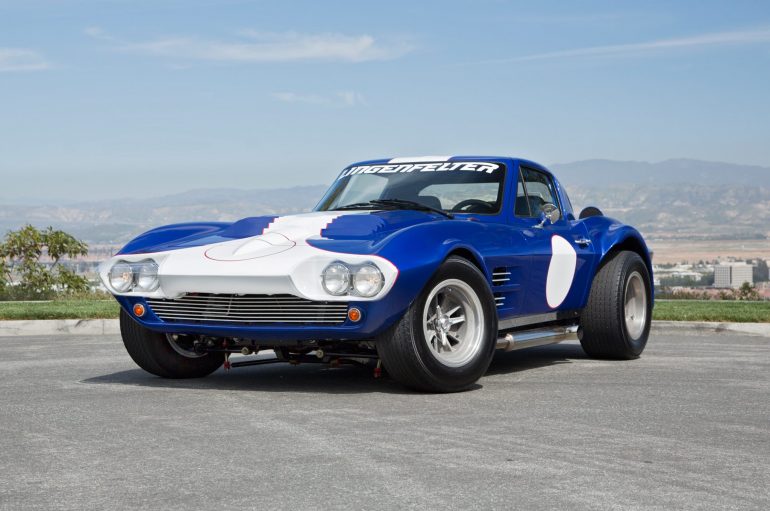
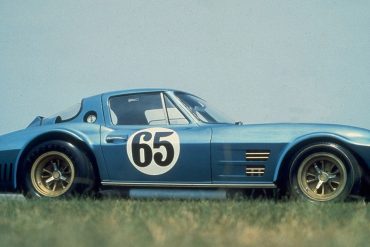
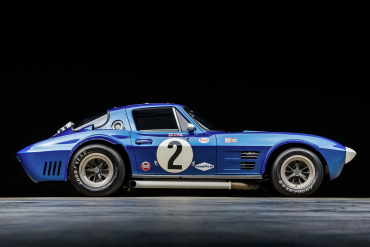
The Grand Sport was built in response to Duntov's general disdain for the AMA ban on racing. Since GM would not allow commercial models to compete in factory sponsored racing events, Duntov circumvented the situation by building a race car version of the second-generation Corvette. The car featured heavily modified variants of the factory components installed in the second-generation coupe, including a 327cubic inch V-8 engine that produced 550 horsepower at 6,400rpm, and a massive 500ft/lb of torque at 5,200rpm. Cosmetically, the car shared similar body-lines to Bill Mitchell's fastback coupe, though it featured key design characteristics essential for its successful operation on the race track.
And race it did, at least briefly. Ultimately, the AMA racing ban would catch up with the Grand Sport Corvette, bringing its promising career as a race car to an end almost before it began. In all, only five Grand Sport Corvettes were manufactured before an internal crackdown within General Motors required that Duntov and his team discontinue any further work on the development of the Grand Sport Race car. Still, for the short period of time that these cars ran on the track, they proved that they were more than capable of competing (and beating) their competition - including the already famous Shelby Cobra, which had dominated the field prior to the Grand Sport’s introduction.
In all, an amazing 21,513 production model Corvettes would be manufactured for the 1963 model year, which was a 50 percent improvement over the record-setting 1962 model year. Production was split almost evenly between the convertible and coupe models, with a total of 10,594 coupes built (base price of $4,257.00), and a total of 10,919 convertibles built (base price of $4,037.00,) with more than half the convertibles being ordered with an optional lift-off hardtop. Still, while the novelty of the Corvette Coupe certainly drew a strong response from consumers, it would not sell as well again for the remainder of the second-generation's production run. In fact, the next time that sales numbers of coupes would outnumber convertibles would be in 1969, when Chevrolet would introduce the first coupe with removable T-top panels.

 The Inaugural Ad for the 1963 Chevrolet Corvette.
 1963 Corvette ad featuring both the Coupe and the Convertible. "It's a Gasser!" (Image Courtesy of GM Media.)
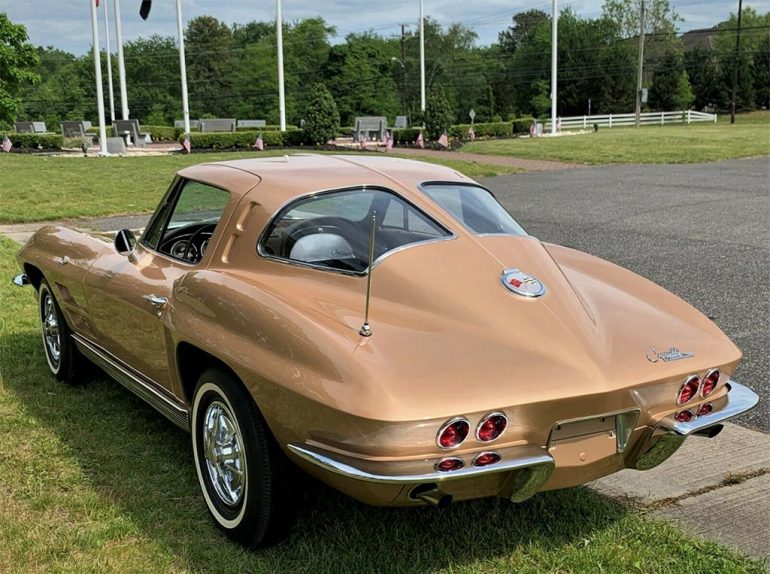
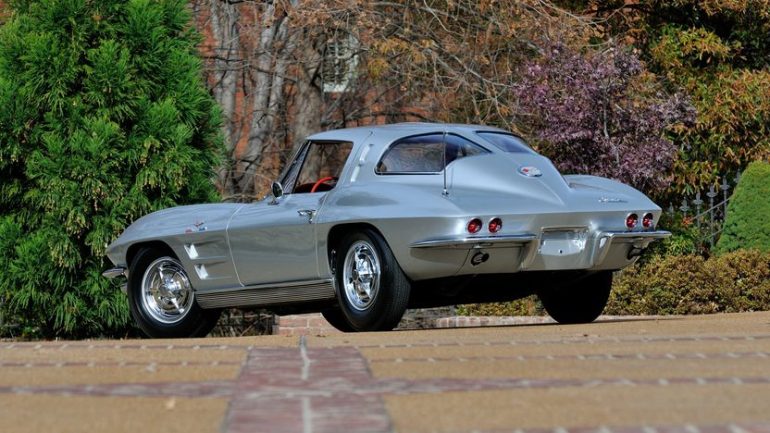
The split rear window lasted one year because Zora Arkus-Duntov thought it blocked the view and Bill Mitchell thought it made the car; Duntov won for 1964, and many owners later had their split windows converted to the one-piece glass, which makes an unmodified 1963 coupe rarer than the 10,594 built. The fake hood vents stayed because the real ones let hot air into the cabin.
DID YOU KNOW
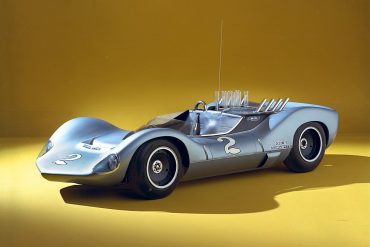
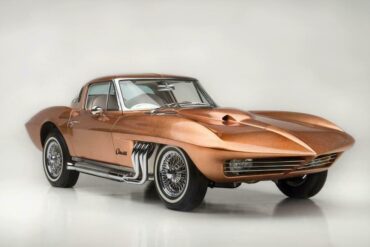
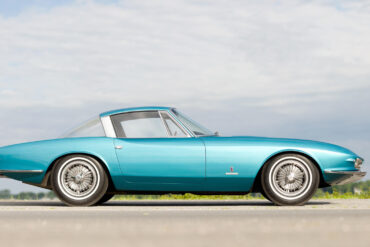
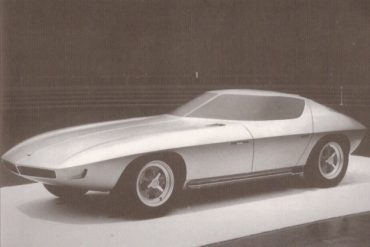
1963 is the year Duntov went around the AMA ban: the Z06 package for customers, the five Grand Sports for the track, and the one-off Rondine and Asteroid show cars built on the new chassis.
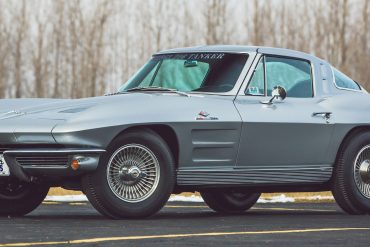
RPO Z06 turned a fuel-injected four-speed coupe into a race car for $1,818.45: Al-Fin power brakes with sintered-metallic linings, heavy-duty springs, shocks and front bar, a dual master cylinder and, on 63 cars, the 36.5-gallon “tanker” fuel tank. Only 199 were built, all coupes.
MORE: ALL 1963 Z06 POSTS


Zora Arkus-Duntov’s answer to the Cobra: five lightweight Grand Sport Corvettes built around a tube frame and a 377-cubic-inch aluminum small block, raced by privateers after GM shut the program down. They are among the most valuable Corvettes ever built.


The Sport Coupe listed at $4,257 and the convertible at $4,037, both with the 250-hp 327 and three-speed manual, and only 3,892 buyers stayed with the base engine.
The engine options were cheap for what they delivered: the 300-hp L75 at $53.80 (8,033 cars), the 340-hp L76 at $107.60 (6,978) and the 360-hp fuel-injected L84 at $430.40 (2,610). The four-speed (RPO M20, $188.30) went into 17,973 cars, the Powerglide (RPO M35, $199.10) into 2,621, all with the 250 or 300, and just 919 cars kept the three-speed.
Positraction (RPO G81, $43.05) was on 17,554 cars, most of them with 3.36 or 4.11:1 gears. The Z06 package was $1,818.45 and required a fuel-injected four-speed coupe with Positraction; 199 were built, 63 of them with the 36.5-gallon tank (RPO N03, $202.30) that gave the “tanker” its name. Later in the year the package was repriced at $1,293.95 without the tank and the cast aluminum knock-off wheels (RPO P48, $322.80), which were withdrawn when the castings proved porous; no 1963 is known to have left the factory on them.
The new comfort options tell the other half of the story: power brakes (RPO J50, $43.05) on 3,336 cars, power steering (RPO N40, $75.35) on 3,063, air conditioning (RPO C60, $421.80) on 278, power windows (RPO A31, $59.20) on 3,742, the AM/FM radio (RPO U69, $174.35) on 9,178 against 11,368 signal-seeking AM sets, tinted glass, back-up lamps, a woodgrain steering wheel and, with the Saddle interior, leather seats (RPO 898, $80.70) on 1,114.
Sintered-metallic brakes (RPO J65, $37.70) went into 5,310 cars and whitewalls onto 19,383. Convertibles could add the auxiliary hardtop (RPO C07, $236.75), which 5,739 of them did, and 124 buyers took the $100 credit for deleting the heater. Seven colors were offered with black, white or beige tops; Sebring Silver was an $80.70 extra-cost paint on 3,516 cars. Chevrolet’s per-color production records for 1963 do not reconcile with the total, so counts by color are not given here.
MORE: PRICING, OPTIONS & COLORS / RPO CODES
| CODE | DESCRIPTION | QUANTITY | RETAIL PRICE |
|---|---|---|---|
| 837 | Base Corvette Sport Coupe | 10,594 | $4,257.00 |
| 867 | Base Corvette Convertible | 10,919 | $4,037.00 |
| 898 | Genuine Leather Seats (Saddle) | 1,114 | $80.70 |
| 941 | Sebring Silver Exterior Paint | 3,516 | $80.70 |
| A01 | Soft Ray Tinted Glass, all windows | 629 | $16.15 |
| A02 | Soft Ray Tinted Glass, windshield | 470 | $10.80 |
| A31 | Power Windows | 3,742 | $59.20 |
| C07 | Auxiliary Hardtop (convertible) | 5,739 | $236.75 |
| C48 | Heater and Defroster Deletion (credit) | 124 | −$100.00 |
| C60 | Air Conditioning | 278 | $421.80 |
| G81 | Positraction Rear Axle, all ratios | 17,554 | $43.05 |
| G91 | Special Highway Axle, 3.08:1 | 2,259 | $2.20 |
| J50 | Power Brakes | 3,336 | $43.05 |
| J65 | Sintered Metallic Brakes | 5,310 | $37.70 |
| L75 | 327ci, 300HP Engine | 8,033 | $53.80 |
| L76 | 327ci, 340HP Engine | 6,978 | $107.60 |
| L84 | 327ci, 360HP Engine (Fuel Injection) | 2,610 | $430.40 |
| M20 | 4-Speed Manual Transmission | 17,973 | $188.30 |
| M35 | Powerglide Automatic Transmission | 2,621 | $199.10 |
| N03 | 36.5 Gallon Fuel Tank (coupe) | 63 | $202.30 |
| N11 | Off-Road Exhaust System | – | $37.70 |
| N34 | Woodgrain Plastic Steering Wheel | 130 | $16.15 |
| N40 | Power Steering | 3,063 | $75.35 |
| P48 | Cast Aluminum Knock-Off Wheels (listed; none delivered) | 0 | $322.80 |
| P91 | Blackwall Nylon Tires, 6.70x15 | 412 | $15.70 |
| P92 | Whitewall Tires, 6.70x15 | 19,383 | $31.55 |
| T86 | Back-Up Lamps | 318 | $10.80 |
| U65 | Signal-Seeking AM Radio | 11,368 | $137.75 |
| U69 | AM/FM Radio | 9,178 | $174.35 |
| Z06 | Special Performance Equipment (coupe; L84, M20 and G81 required) | 199 | $1,818.45 |
| EXTERIOR | SOFT TOP (CONVERTIBLE) |
|---|---|
| Tuxedo Black | Black, White, Beige |
| Ermine White | Black, White, Beige |
| Riverside Red | Black, White, Beige |
| Silver Blue | Black, White, Beige |
| Daytona Blue | Black, White, Beige |
| Saddle Tan | Black, White, Beige |
| Sebring Silver | Black, White, Beige |
Nothing changed under the hood for 1963: the same four 327s as 1962, from the 250-horsepower base engine through the 300-horsepower L75 and 340-horsepower L76 to the 360-horsepower fuel-injected L84, the top two with the Duntov camshaft, solid lifters and 11.25:1 compression.
The Borg-Warner four-speed came with wide-ratio gears behind the hydraulic-lifter engines and close-ratio gears behind the solid-lifter pair, the standard axle was 3.36:1 with the three-speed or Powerglide and 3.70:1 with the four-speed, and six ratios from 3.08 to 4.56:1 were available. Positive crankcase ventilation, a smaller flywheel, an aluminum clutch housing and an alternator in place of the generator were new.
Everything around the engine was new. The ladder frame put the car four inches shorter in wheelbase and moved about 80 pounds onto the rear wheels; the independent rear suspension, a frame-mounted differential with half-shafts, trailing arms and a transverse leaf spring, gave the Corvette traction and ride it had never had.
The recirculating-ball steering was quicker, with a telescoping column and optional power assist, and the drum brakes were wider, with sintered-metallic linings and finned aluminum Al-Fin drums available for racing. Road & Track ran a 360-hp four-speed car to 60 mph in 5.9 seconds and through the quarter mile in 14.9; Motor Trend recorded 6.2 and 14.6, and Car Life’s 300-hp car took 7.2 seconds. Top speed with the L84 was over 130 mph.
The one consistent criticism was the drum brakes, which the C2 would not fix until the discs of 1965.
MORE: FULL SPECIFICATIONS / ENGINE
| SPEC | 1963 CORVETTE |
|---|---|
| Engine | 327 ci (5.4 L) OHV small-block V-8, 4.00 x 3.25 in, cast iron block & heads; four versions carried over from 1962 |
| Base engine | 250 hp @ 4,400 rpm, 350 lb-ft @ 2,800 rpm, Carter WCFB four-barrel, hydraulic lifters, 10.5:1 |
| RPO L75 | 300 hp @ 5,000 rpm, 360 lb-ft @ 3,200 rpm, large Carter AFB four-barrel, 10.5:1; $53.80 |
| RPO L76 | 340 hp @ 6,000 rpm, 344 lb-ft @ 4,000 rpm, AFB four-barrel with the Duntov camshaft and solid lifters, 11.25:1; $107.60 |
| RPO L84 | 360 hp @ 6,000 rpm, 352 lb-ft @ 4,000 rpm, Rochester fuel injection with the Duntov camshaft, 11.25:1; $430.40 |
| Transmission | 3-speed manual standard (2.47/1.53/1.00); Borg-Warner T-10 4-speed (RPO M20, $188.30) wide-ratio 2.54/1.89/1.51/1.00 with the 250 and 300 or close-ratio 2.20/1.64/1.31/1.00 with the 340 and 360, on about four cars in five; 2-speed Powerglide (RPO M35, $199.10) with the 250 and 300 only |
| Axle ratio | 3.36:1 with the 3-speed or Powerglide; 3.70:1 with the 4-speed; 3.08, 3.55, 4.11 and 4.56:1 available; Positraction (RPO G81, $43.05) |
| Front suspension | Independent; upper and lower control arms, coil springs with shock absorbers inside the springs, anti-roll bar |
| Rear suspension | Independent for the first time: frame-mounted differential, half-shafts with trailing arms and lateral struts, single transverse leaf spring |
| Steering | Recirculating ball, 19.6:1 (17.6:1 fast ratio); telescoping column; power steering (RPO N40, $75.35) offered for the first time |
| Brakes | 11-in cast-iron drums front and rear, wider than 1962; sintered-metallic linings (RPO J65, $37.70); power assist (RPO J50, $43.05); finned Al-Fin drums with the Z06 package |
| Wheels & tires | 15 x 5.5 in steel wheels, 6.70 x 15 tires; cast aluminum knock-off wheels (RPO P48) were listed but none were delivered |
| Fuel tank | 20 gal; 36.5-gallon fiberglass tank (RPO N03, $202.30) on 63 coupes |
| Wheelbase | 98 in (4 in shorter than the C1) |
| Overall length / width / height | 175.3 in / 69.6 in / 49.3 in coupe, 49.8 in convertible |
| Curb weight | approx. 3,037 lb coupe / 3,043 lb convertible |
| 0–60 mph | 5.9 sec (360 hp, 4-speed, Road & Track); 6.2 sec (Motor Trend); 7.2 sec (300 hp, Car Life) |
| Quarter mile | 14.6–14.9 sec (360 hp) |
| Top speed | over 130 mph (360 hp) |
| Production | 21,513: 10,594 coupes and 10,919 convertibles; 199 Z06; 5 Grand Sports built separately |
| Assembly | St. Louis, Missouri; engines from Flint, Michigan |
The 1963 VIN keeps the twelve-character format: 30837S for the Sport Coupe and 30867S for the convertible, followed by a sequence number that begins at 100001 and runs through 121513, shared by both bodies, accounting for each of the 21,513 cars built. The leading 3 is the model year, 08 the Corvette series, 37 or 67 the body style and S the St. Louis plant. The VIN plate is on the instrument panel brace under the glove box, and the number is also stamped on the frame.
The engine pad suffix identifies the engine and transmission: RC (250 hp, manual), SC (250 hp, Powerglide), RD (300 hp, manual), SD (300 hp, Powerglide), RE (340 hp, manual) and RF (360-hp fuel injection, manual). The trim tag on the body records the paint and interior codes, and the axle code on the differential housing records the ratio and whether the car had Positraction.
MORE: VIN DECODER / PRODUCTION
| POSITION | MEANING |
|---|---|
| 3 (First Digit) | Model year: 3 = 1963 |
| 0837 / 0867 (Second through Fifth Digits) | Model series and body: 0837 = Sport Coupe, 0867 = Convertible |
| S (Sixth Digit) | Assembly plant: S = St. Louis, Missouri |
| 100001–121513 (Seventh through Twelfth Digits) | Production sequence number, shared by coupes and convertibles |
Seven colors on the first Sting Ray, coupe and convertible: Tuxedo Black, Ermine White, Riverside Red, Silver Blue, Daytona Blue, Saddle Tan and Sebring Silver, with black, white or beige tops and interiors in black, red, saddle or dark blue.
The 1963 is the most valuable production Corvette of its generation and the market is really two markets. Split-window coupes are the collector car: their price depends first on whether the split window is original rather than restored from a one-piece conversion, then on the engine, with the 360-hp fuel-injected L84 at the top and the 340-hp L76 close behind, then on documentation. Convertibles are the driver’s C2 and sell for a fraction of a comparable coupe. Above both sit the 199 Z06 coupes, the 63 tankers within them, and the five Grand Sports, which trade in the millions and are a world of their own.
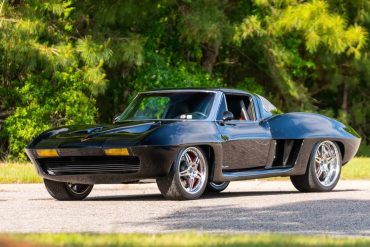
Results tracked by Classic.com for October 2026 show the spread. Original or well-restored split-window coupes sold for $172,500 (a 340-hp car with 196 miles on Bring a Trailer), $231,000 and $250,000 (a 360-hp fuelie with 61,000 miles, also on Bring a Trailer), while custom and restomod coupes brought $230,000 at Richmond Auctions and $297,000 at Mecum Fort Worth, and a modified coupe $125,563. A project coupe sold for $76,563. Convertibles sat far lower: $51,700 for an original hardtop car at Mecum Fort Worth, with modified convertibles bid to $55,000 and $60,000 without selling. Check whether a result includes the buyer’s premium, and treat asking prices and unsold high bids separately from completed sales.
On a coupe, verification starts with the rear window: the split bar and its surrounding glass were commonly replaced with 1964-and-later one-piece glass in the 1960s, and many have since been converted back, so look for evidence of the original split-window structure and trim. Then the engine pad: the suffix (RC, RD, RE, RF, SC or SD) must match the equipment and the block date must precede the car’s build, a fuelie needs a 1963-series Rochester unit, and a Z06 needs the tank sticker or build documentation, since the brake and suspension parts have all been reproduced. The trim tag should agree with the paint and interior. NCRS judging sheets, old photographs, ownership records and restoration invoices all help, and ask to see dates and scores rather than just the award.
The C2 body is bonded to a birdcage of steel around the cockpit, and that structure is where the expensive problems hide: the windshield frame, the door hinge pillars and the rear window frame on coupes rust from inside and are costly to repair, so inspect them carefully. The ladder frame rusts at the kickups over the rear wheels and around the trailing-arm mounts, and the trailing-arm bushings and half-shaft U-joints wear. On the road the independent rear should feel planted, the steering should be light at speed, the drums should pull straight, and a solid-lifter engine should idle lumpily but evenly. Most of these cars see few miles, so budget for tires, brakes and fuel-system work on anything that has sat.
MORE: THE MARKET
Get all the latest news stories, upcoming auctions, prices, videos and more about the 1963 Chevrolet Corvette! The latest headlines here.
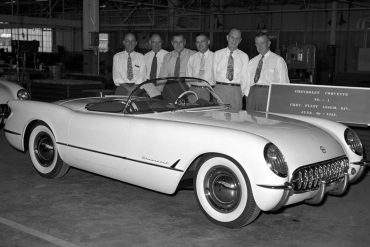
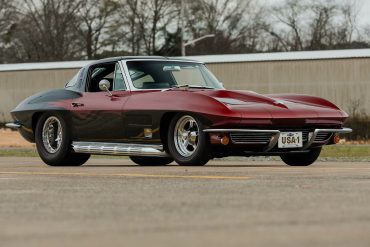
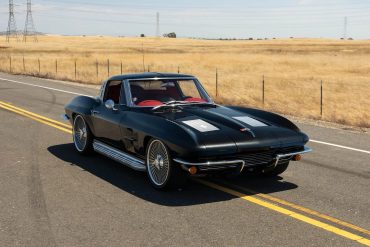
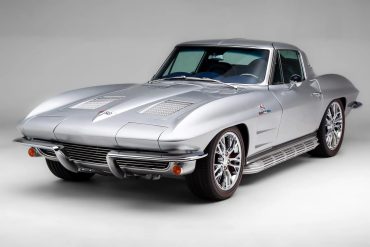
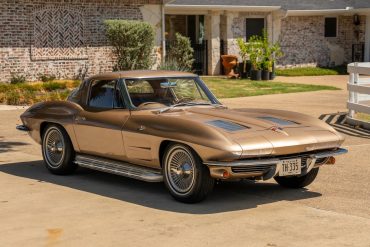
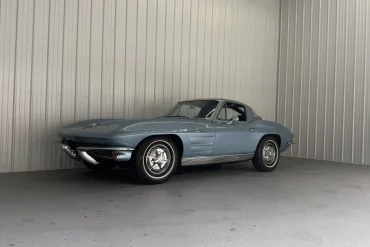


Chevrolet built 21,513 Corvettes for 1963 at St. Louis, Missouri: 10,594 Sport Coupes and 10,919 convertibles, a 50 percent increase over the 14,531 of 1962. It was the only year the C2 coupe nearly matched the convertible. Within that total, 199 coupes carried the Z06 package, 63 of them with the 36.5-gallon tank. The five Grand Sports were built separately and are not in the production count.
In late 2026, original or well-restored 1963 split-window coupes have sold for roughly $170,000 to $250,000 at auction, with fuel-injected cars at the top, and custom or restomod coupes for $125,000 to $300,000. Convertibles sell for a fraction of that, around $50,000 to $60,000 for an original car. Genuine Z06 coupes are a tier above, and Grand Sports sell for tens of millions.
The 327-cubic-inch small-block V-8 in the same four versions as 1962: 250 hp standard, 300 hp (L75), 340 hp (L76) with the Duntov camshaft, and 360 hp (L84) with the camshaft and Rochester fuel injection. A three-speed manual was standard; the Borg-Warner four-speed went into about four cars in five, and the two-speed Powerglide was available with the 250 and 300-hp engines only.
Seven: Tuxedo Black, Ermine White, Riverside Red, Silver Blue, Daytona Blue, Saddle Tan and Sebring Silver, with black, white or beige soft tops and black, red, saddle or dark blue interiors. Leather, in Saddle only, was offered for the first time.
The Sport Coupe was $4,257 and the convertible $4,037 with the 250-hp engine and three-speed manual. The 360-hp fuel-injected engine added $430.40, the four-speed $188.30, Positraction $43.05, power steering $75.35, power brakes $43.05, air conditioning $421.80 and the Z06 package $1,818.45, later $1,293.95 without the big tank. A Z06 coupe came to about $6,700.
Because it was built for one year. Bill Mitchell’s split rear window was criticized for blocking rearward vision from the day the car appeared, and for 1964 Chevrolet replaced it with one-piece glass. Many 1963 coupes were converted to the later window in period, so untouched original split-window cars are rarer than the 10,594 built, and the combination of the first Sting Ray, the first Corvette coupe and a one-year design put them at the top of the C2 market.
Regular Production Option Z06, Zora Arkus-Duntov’s way around GM’s racing ban: for $1,818.45 a fuel-injected four-speed coupe with Positraction received Al-Fin power brakes with sintered-metallic linings, heavy-duty springs, shocks and front anti-roll bar, a dual master cylinder and, originally, a 36.5-gallon fuel tank, later made a separate option. Only 199 were built, all coupes, and the 63 big-tank cars are known as tankers. The aluminum knock-off wheels intended for the package were never delivered.
1963 Corvette Asteroid / 1963 Corvette Advertisements / 1963 Corvette Colors / 1963 Corvette Common Issues / 1963 Corvette Engine / 1963 Corvette Factory Options / 1963 Corvette For Sale / 1963 Corvette Grand Sport / 1963 Corvette Maintenance / 1963 Corvette Mods / 1963 Corvette Owners Manual / 1963 Corvette Performance / 1963 Corvette Posters / 1963 Corvette Pricing / 1963 Corvette Production / 1963 Corvette Recalls / 1963 Corvette Research / 1963 Corvette Rondine / 1963 Corvette Sales Brochures / 1963 Corvette Special Model Overview / 1963 Corvette Specifications / 1963 Corvette Technical Research / 1963 Corvette Service Bulletins / 1963 Corvette VIN Numbers / 1963 Corvette Z06