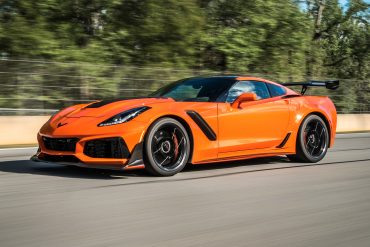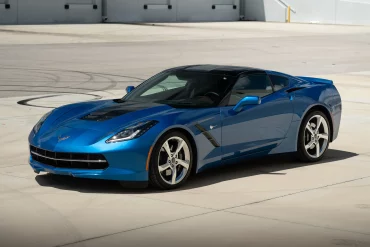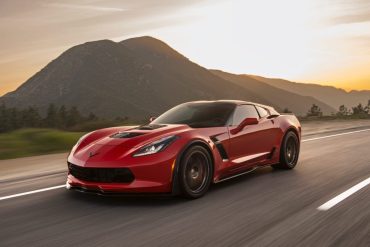
Paul Deutschman's carbon fiber hatch swaps onto any C7 coupe, Stingray, Grand Sport or Z06, adding roughly a pound and room for three golf bags while keeping factory latches.



C7 CORVETTE - 2014
The seventh generation and the Stingray name back: an aluminum frame built at Bowling Green, a carbon-fiber hood and roof, the 455-hp direct-injected LT1, the first seven-speed manual, the Z51 package on 57 percent of cars, two Premiere Editions, the Indy 500 pace car, North American Car of the Year and 37,288 built.
Quick Nav: Story · Specials · C7.R · Price & Options · VIN · Specs · Technical · Pics & Videos · The Market · All · FAQs
Model & Gen: 2014 Corvette (C7)
Body Type: Two-door hatchback coupe with a removable carbon-fiber roof panel and two-door convertible with a power top; the new Stingray on an aluminum frame, with or without the Z51 Performance Package
VIN: 1G1YA2D7?E5100001 – about 135523 (standard series; year code E, 7 = LT1); Premiere Edition coupes 1G1YL2D7?E5300001 – 300500; Premiere Edition convertibles on a third series (550 cars)
Original Price: $51,995.00 coupe; $56,995.00 convertible (both including the $995 destination charge); $54,795.00 and $59,795.00 with Z51; Premiere Edition convertible $77,450.00
Colors: 10 (Torch Red, Arctic White, Black, Cyber Gray, Laguna Blue Tintcoat ($995, new), Crystal Red Tintcoat ($995), Velocity Yellow Tintcoat ($995), Blade Silver, Night Race Blue, Lime Rock Green Metallic ($495, new)); interiors in Jet Black, Gray, Adrenaline Red, Kalahari and, on 3LT, Brownstone; convertible tops in Black, Kalahari, Gray or Blue
Engine: 376 ci (6.2 L) Gen V LT1 V-8, 455 hp / 460 with NPP
Transmission: Tremec TR6070 seven-speed manual with Active Rev Matching standard (13,200 cars: 4,139 MEP, 9,061 MEL with the Z51 ratios); Hydra-Matic 6L80 six-speed paddle-shift automatic $1,350 (MYC, 24,088 cars, 64.6 percent)
Units Produced: 37,288 (26,565 coupes: 11,134 standard + 15,431 Z51; 10,723 convertibles: 5,043 standard + 5,680 Z51); 1,044 Premiere Editions; the first C7, built from August 2013 to August 8, 2014
The 2014 Corvette Stingray was revealed on January 13, 2013, the night before the Detroit show, and went on sale that September as the first all-new Corvette since 2005 and the first to carry the Stingray name since 1976. Everything under the angular new body was new: a hydroformed aluminum frame built in-house at Bowling Green for the first time, 57 percent stiffer and 99 pounds lighter than the C6’s steel frame, so that the convertible, revealed at Geneva in March, needed no extra bracing; a carbon-fiber hood and removable roof panel, composite fenders, doors and quarters and carbon-nano underbody panels; and the Gen V small-block, the 6.2-liter LT1 with direct injection, variable valve timing and cylinder deactivation, SAE-certified at 455 horsepower and 460 lb-ft (460 and 465 with the dual-mode exhaust), behind the first seven-speed manual in a Corvette, a Tremec TR6070 with Active Rev Matching, or a six-speed paddle-shift automatic. Chevrolet quoted 3.8 seconds to 60, 12.0 at 119 in the quarter and 1.03 g for a Z51 manual, and the EPA 17/29 mpg.
The Z51 Performance Package ($2,800) brought an electronic limited-slip differential, a dry-sump oiling system, firmer Bilstein suspension with Magnetic Selective Ride Control optional, bigger slotted brakes, closer gear ratios, differential and transmission coolers, an aero package and 19/20-inch wheels, and 21,111 of the year’s 37,288 buyers took it. Inside were two eight-inch screens, a five-position Driver Mode Selector, GT or Competition Sport seats on magnesium frames and an interior that finally matched the price, in 1LT, 2LT or 3LT trim at $51,995 and $56,995 delivered. Two Premiere Editions marked the launch, 500 Laguna Blue 3LT Z51 coupes on their own 300001 VIN series and 550 Lime Rock Green convertibles at $77,450, and a Laguna Blue Z51 coupe paced the 2013 Indianapolis 500 with Jim Harbaugh driving.
Bowling Green built 37,288 2014s between August 2013 and August 8, 2014, the most since 2007 and almost three times 2013’s 13,466: 26,565 coupes and 10,723 convertibles, 24,088 of them automatics and 19,725 3LTs, with Torch Red the best-selling of ten colors. The Stingray was named North American Car of the Year on January 13, 2014, a year to the day after its reveal, and took Automobile of the Year, a Car and Driver 10Best place and Road & Track’s Performance Car of the Year; the Pratt & Miller C7.R made its debut at the Rolex 24 that month, won four GTLM races in a row through the summer and finished second at Le Mans. The 2015 Z06 and the eight-speed automatic were already on the way.
January 13, 2013: Chevrolet unveiled the all-new 2014 Corvette Stingray on the eve of the Detroit Auto Show. The car, which had been kept carefully concealed by Chevrolet since its announcement that a seventh-generation Corvette was under development, was revealed to the world over a live internet feed. The reveal was streamed live on YouTube and Facebook and watched by more than 60,000 people worldwide.
January 19, 2013: Chevrolet sold the right to the first retail 2014 Corvette Stingray, VIN 001, at the Barrett-Jackson auction in Scottsdale, Arizona. Rick Hendrick bought it for $1,050,000. The Corvette Stingray was donated by Chevrolet, with every dollar going to the College for Creative Studies in Detroit. The car was introduced by General Motors’ vice president of global design, Ed Welburn, and Corvette marketing manager John Fitzpatrick.
March 1–2, 2013: The Stingray had its West Coast unveiling at the Petersen Automotive Museum in Los Angeles, which marked the Corvette’s 60th anniversary with a two-day tribute; at the anniversary gala, exterior design manager Kirk Bennion walked the audience through how the new car broke with tradition.
Chevrolet said the Stingray would go on sale in the third quarter of 2013 and, with no price yet announced, that anyone who could afford the current C6 would be able to afford the C7.
March 7, 2013: Two months after General Motors introduced the all-new C7 Corvette Stingray Coupe, the company revealed the 2014 Stingray Convertible at the Geneva Motor Show.
According to Chevrolet, the Stingray was the most powerful standard Corvette yet, and the new soft-top convertible carried the same power and technology as the coupe. That was something of a feat because without the fixed roof structure, convertibles tend to be much less structurally rigid than their coupe counterparts.
The convertible got around this because the C7 had been designed as an open car from the start: its hydroformed aluminum frame, with aluminum and magnesium structural and chassis parts, was 57 percent stiffer and 99 pounds (45 kg) lighter than the C6’s steel frame, so the convertible needed no extra bracing. The only structural changes made room for the folding top and repositioned the seat-belt mountings.
The convertible top was fully electric and could be operated remotely with the key fob. It could also be opened or closed at speeds of up to 31 mph (50 km/h), and the three-ply fabric top carried sound-absorbing padding and a glass rear window.
April 26, 2013: Chevrolet announced pricing. The Stingray coupe would start at $51,995 and the convertible at $56,995, both including the $995 destination charge: $1,420 more than the outgoing 2013 coupe and convertible at $50,575 and $55,575.
For $2,800 the Z51 Performance Package added an electronic limited-slip differential, a dry-sump oiling system, firmer suspension with 45-mm Bilstein dampers, larger slotted brake rotors, closer gear ratios, differential and transmission coolers, an aero package and 19-inch front and 20-inch rear wheels; 21,111 of the 37,288 cars had it.
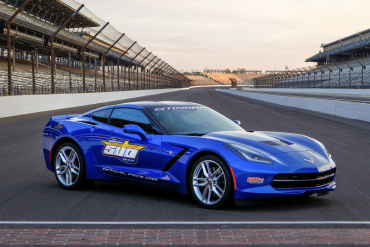
May 2, 2013: It was announced that the all-new 2014 C7 Corvette Stingray would be the official pace car of the Indianapolis 500 on Memorial Day weekend. It was the 12th time a Corvette had served in this role since 1978. It is an honor to help inaugurate the all-new Corvette Stingray at the hallowed Brickyard and further the legacy between Chevrolet and the Indianapolis 500, said Jim Campbell, GM’s vice president of performance vehicles and motorsports. The 2014 Corvette Stingray's performance was influenced by racing, making this prestigious assignment even more fitting.
The pace car, a Laguna Blue Z51 coupe driven by San Francisco 49ers coach Jim Harbaugh on May 26, ran its 6.2-liter LT1 V-8 unmodified; GM was still quoting an estimated 450 horsepower, a figure that became an SAE-certified 455 (460 with the performance exhaust) before the car went on sale.
August 12, 2013: The configurable cluster display in the 2014 Corvette Stingray could show up to 69 different pieces of information, ranging from an interactive performance timer to a tire tread temperature display. Three configurable themes prioritized that information for daily commuting, weekend canyon carving and track events.
Flanked by three analog gauges for speed, fuel level, and engine-coolant temperature, the eight-inch liquid-crystal display in the center of the cluster was organized into sport, tour and track themes that changed with the Driver Mode Selector. Each theme was designed for a specific driving scenario and could be configured through applications found in the “app tray.”
“The new Corvette Stingray features many advanced technologies, so our challenge when designing the driver’s displays was to ensure that those technologies could be easily found in common driving scenarios,” said Jason Stewart, General Motors interaction designer.
“The touring theme places more emphasis on multimedia and infotainment; the sport theme emphasizes performance features with a prominent shift indicator and a large radial tachometer; track theme offers a race-inspired layout containing a sweeping tachometer, Corvette racing inspired shift lights and permanent lap-time displays,” Stewart said. “Each of these three themes can also be configured so that drivers can personalize their experience in the Stingray.”
August 17, 2013: Chevrolet’s new C7.R race car, based on the 2014 Stingray, made its first public appearance, in camouflage, during the Pebble Beach Concours d’Elegance weekend, turning laps at Mazda Raceway Laguna Seca with Corvette Racing’s Tommy Milner at the wheel.
Built by Pratt & Miller, the C7.R was revealed in full alongside the 2015 Z06 at the Detroit show in January 2014 and made its racing debut at the Rolex 24 at Daytona on January 25–26, 2014, the first race of the new TUDOR United SportsCar Championship; it went to Le Mans that June and finished second in GTE Pro.
Callaway Competition of Germany also began work on a GT3 race car based on the Stingray, the Corvette C7 GT3-R, which raced in the ADAC GT Masters from 2014.
The seventh-generation Corvette went on sale in September 2013, the first to wear the Stingray name since 1976, the coupe first and the convertible a few months behind it. Tom Peters’ design studio under Ed Welburn gave it a sharper, more angular body with a tapered rear, functional vents on the hood, fenders and rear quarters, HID headlamps with LED running lights and the first Corvette taillamps in decades that were not round; Tadge Juechter’s engineers put it on an aluminum frame built in-house at Bowling Green for the first time, 57 percent stiffer and 99 pounds lighter than the C6’s steel frame, under a carbon-fiber hood and removable roof panel, composite fenders, doors and quarters and carbon-nano underbody panels, with the engine set back for a 50/50 weight balance at 3,298 pounds for the coupe and 3,362 for the convertible. The interior was the first in decades that reviewers praised without qualification: hand-wrapped leather, real aluminum and carbon fiber, two eight-inch screens, a 360-mm wheel, GT or Competition Sport seats on magnesium frames and a five-position Driver Mode Selector that adjusted twelve settings from Weather to Track.
Under the hood was the Gen V small-block, the 6.2-liter LT1 built at Tonawanda, with direct injection, continuously variable valve timing and Active Fuel Management that shut down four cylinders on the highway: 455 horsepower at 6,000 rpm and 460 lb-ft at 4,600, or 460 and 465 with the NPP dual-mode exhaust, both SAE-certified, on an 11.5:1 compression ratio. The standard gearbox was a Tremec TR6070 seven-speed manual with Active Rev Matching, the first seven-speed in a Corvette, and the option a Hydra-Matic 6L80 six-speed automatic with paddles for $1,350; the LT1 reached 60 mph in 3.8 seconds and ran the quarter in 12.0 at 119 mph by GM’s figures for a Z51 manual, pulled 1.03 g and returned an EPA-rated 17 mpg city and 29 highway with the manual (16 and 28 with the automatic), the best highway figure of any Corvette to that point, thanks to Eco mode and the tall seventh gear. The Z51 Performance Package ($2,800) went on 57 percent of the year’s cars, Magnetic Selective Ride Control with Performance Traction Management ($1,795, Z51 only) on 13,386 of them.
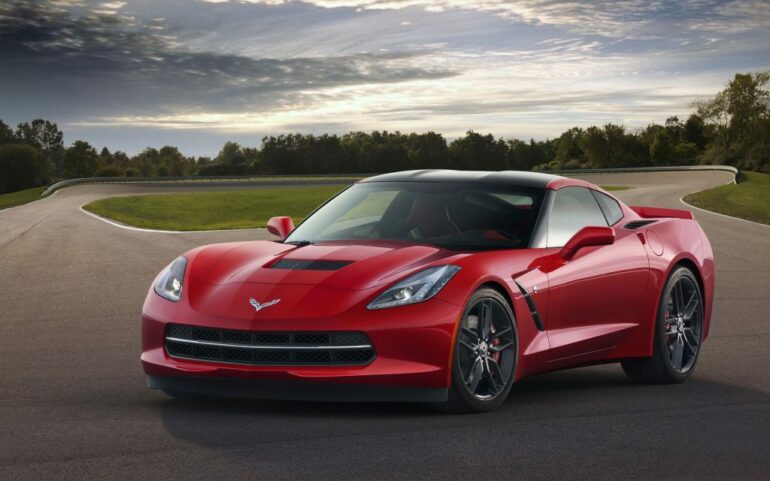
Two launch editions marked the year. The Premiere Edition coupe, revealed at the National Corvette Museum’s 60th anniversary celebration on June 28, 2013, was 500 Laguna Blue Tintcoat 3LT Z51 coupes with Magnetic Ride, the performance exhaust, a visible carbon-fiber roof, a black hood stinger stripe, a Brownstone suede interior, Stingray sill plates and wheel caps, Corvette luggage by Thule and a numbered dash plaque, on their own VIN series from 300001; the Premiere Edition convertible, announced on November 26, 2013 at $77,450, was 550 Lime Rock Green cars to the same specification with their own series and plaques. GM’s production sheet counts 1,044 Premiere Editions under RPO SRZ. The Stingray was named North American Car of the Year on January 13, 2014, a year to the day after its reveal, and Automobile’s Automobile of the Year, a Car and Driver 10Best car and Road & Track’s Performance Car of the Year besides; Chevrolet called it the most awarded car of 2013.
Bowling Green built 37,288 2014 Corvettes before the model year ended on August 8, 2014, 26,565 coupes and 10,723 convertibles, the most since 2007’s 40,561 and almost three times the 13,466 of 2013: 15,431 Z51 coupes, 11,134 standard coupes, 5,680 Z51 convertibles and 5,043 standard convertibles; 19,725 3LTs, 12,529 2LTs and 4,736 1LTs; 24,088 automatics, 64.6 percent; 31,173 with the performance exhaust and 30,427 with navigation. Torch Red led the ten colors for the first time in years with 7,197 cars, ahead of Arctic White (6,153) and Black (5,929); 34,678 cars stayed in the United States, 1,193 went to Canada, 597 to Europe, 447 to the Middle East, 224 to Japan, 112 to Mexico, 31 to Russia and 15 to Britain. The year ended with the Performance Build Center moving from Wixom to Bowling Green to build the 2015 Z06’s supercharged LT4, and with the C7.R’s first season: four straight GTLM wins at Long Beach, Laguna Seca, Watkins Glen and Canadian Tire Motorsport Park for Antonio Garcia and Jan Magnussen in the No. 3 car and second at Le Mans for the No. 73, though the Viper and Porsche took the 2014 titles.
Did you know? On February 12, 2014, a month after the Stingray won North American Car of the Year, a sinkhole opened under the National Corvette Museum’s Skydome in Bowling Green and swallowed eight Corvettes, among them a 1962, the 1984 PPG pace car, the 1992 1-millionth Corvette, the 1993 ZR-1 Spyder, the 2009 ZR1 “Blue Devil” prototype and the 2009 1.5-millionth car; the museum left the hole open as an exhibit for the rest of the year and drew record crowds.
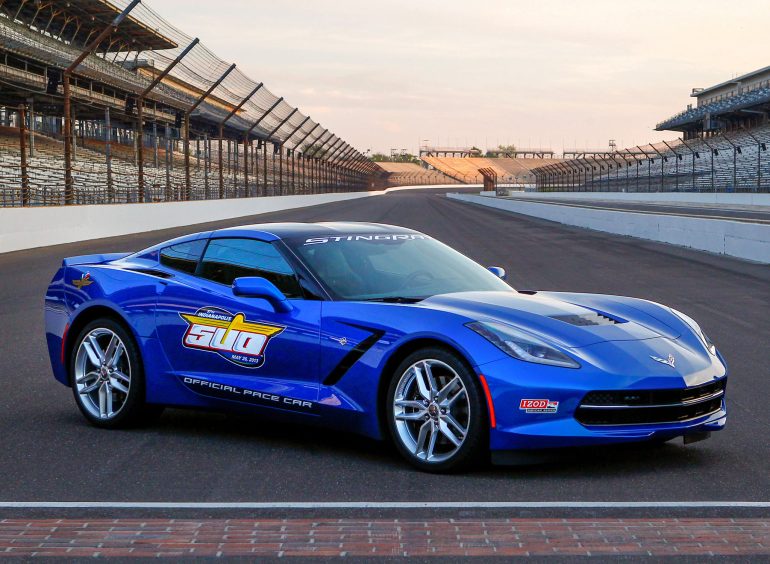 2014 Chevrolet Corvette Stingray Indy 500 Pace Car
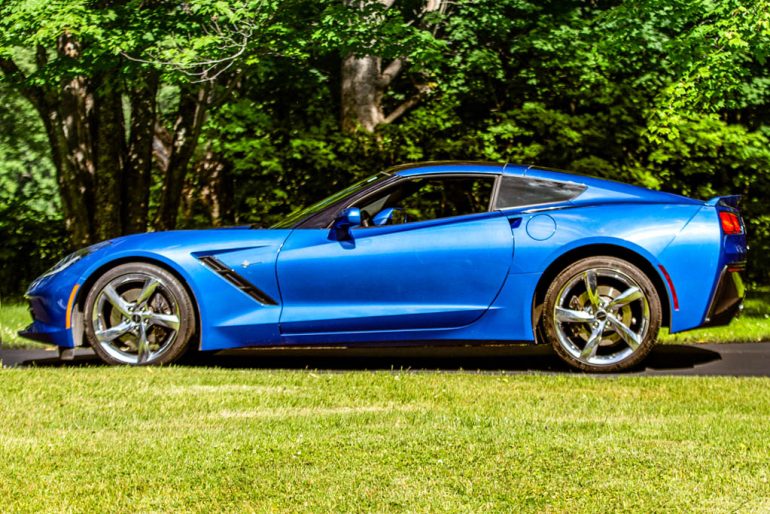
 2014 Chevrolet Corvette Stingray Convertible Premiere Edition
The 2014 Stingray paced the Indianapolis 500 before it was on sale: a Laguna Blue Z51 coupe led the field on May 26, 2013, four months before the first customer cars, with San Francisco 49ers coach Jim Harbaugh driving, the 12th Corvette pace car since 1978, with nothing changed under the hood. The 2014 race itself was paced by a Camaro Z/28, so there is no 2014 Indy pace car Corvette; the Stingray that led the 2013 race carried an estimated 450 horsepower on its press material because the SAE-certified 455 and 460 figures came later that spring.
DID YOU KNOW
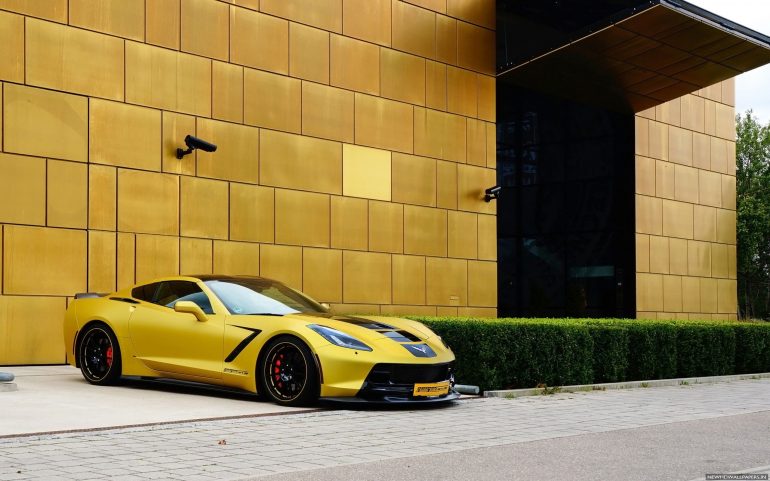
The C7.R has its own section below; the Premiere Edition coupe and convertible, the Z51 and the 2013 Indy 500 pace car are here until their tags exist. Also here: the Callaway SC627 and AeroWagen conversions and the 2014 tuner cars.
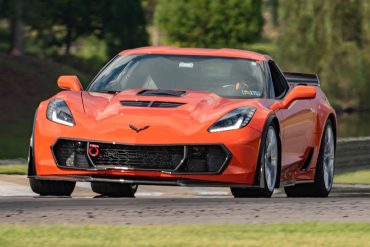

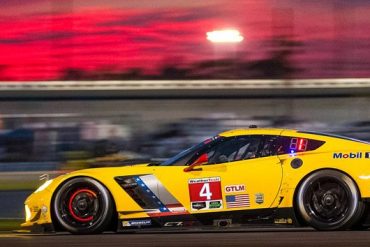
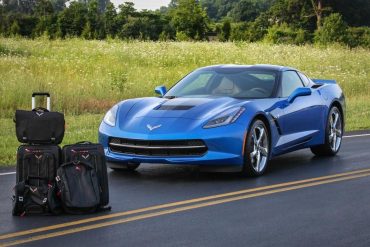
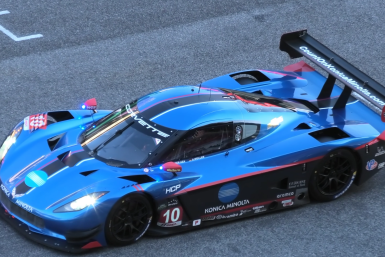
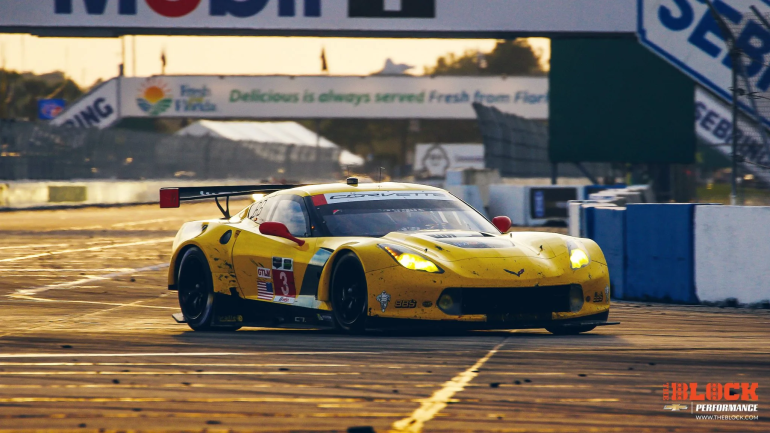
The C7.R was the first Corvette race car to share its frame with the road car: Pratt & Miller built it on the production aluminum structure (the Z06’s, with its own stiffening), under a 5.5-liter, 491-hp naturally aspirated V-8 with direct injection, at 2,447 pounds before driver and fuel. It ran in camouflage at Laguna Seca in August 2013, was revealed in full beside the 2015 Z06 at Detroit on January 13, 2014, and made its debut at the Rolex 24 at Daytona on January 25–26, the first race of the merged TUDOR United SportsCar Championship, finishing fifth and tenth in GTLM. From April it was the class of the field: four straight wins at Long Beach, Laguna Seca, Watkins Glen and Canadian Tire Motorsport Park for Antonio Garcia and Jan Magnussen in the No. 3 Jake-badged car, while at Le Mans in June the No. 73 of Garcia, Magnussen and Jordan Taylor finished second in GTE Pro and the No. 74 of Oliver Gavin, Tommy Milner and Richard Westbrook fourth. The season ended with the No. 3 second in the GTLM team standings, nine points behind the SRT Viper, Porsche taking the manufacturers’ title by five; the championships came in 2015 and 2016. Callaway Competition’s C7 GT3-R, the customer GT3 car, raced in Germany from 2014.
MORE: THE C7.R STORY
Chevrolet announced prices on April 26, 2013: $51,995.00 for the Stingray coupe and $56,995.00 for the convertible, both including a $995 destination charge (up from $975), which made them $1,420 more than the outgoing 2013 coupe and convertible at $50,575.00 and $55,575.00.
The Z51 Performance Package was $2,800.00, so a Z51 coupe listed at $54,795.00 and a Z51 convertible at $59,795.00; the three equipment groups were 1LT (standard; 4,736 cars), 2LT ($4,210.00; 12,529) and 3LT ($8,005.00; 19,725, 53 percent of the year).
The automatic was $1,350.00, Magnetic Selective Ride Control with Performance Traction Management $1,795.00 on Z51 cars, the dual-mode exhaust $1,195.00, Competition Sport seats $1,995.00 ($2,495.00 with sueded inserts), carbon-fiber interior trim $995.00, the sueded upper trim $995.00, the transparent roof $995.00, the visible carbon roof $1,995.00, the dual-roof packages $1,995.00 and $2,995.00, chrome wheels $1,995.00, machine-faced $1,495.00, black Z51 wheels $495.00, colored calipers $595.00, navigation $795.00, museum delivery $990.00, the hood stinger stripe $500.00, a customer-chosen VIN $5,000.00, and the four premium paints $995.00 for Laguna Blue, Crystal Red and Velocity Yellow Tintcoat and $495.00 for Lime Rock Green. The Torch Red Z51 3LT show car from Detroit added up to $73,360; the Premiere Edition convertible listed at $77,450.00 and the coupe, whose price GM never published separately, at about the same with its 3LT, Z51, FE4, NPP, C2Z, IWE, FAY and DTW content. The site’s options post prints the coupe at “$51,195”, a transposition of $51,995.
GM’s production sheet shows what buyers chose. Sixty-five percent took the automatic (24,088) against 13,200 manuals, 9,061 of them Z51 cars with the MEL close ratios; 21,105 cars had Z51 (21,111 by body style) and 13,386 of those Magnetic Ride, leaving 7,719 on the FE3 steel springs; 31,173 had the performance exhaust (84 percent), 30,427 navigation (included on every 3LT), 34,715 the GT seats and 2,573 the Competition Sport seats, which arrived late in the year. Red calipers went on 16,258 cars, black on 9,173, gray on 9,471 and yellow on 2,424; among Z51 cars black wheels (10,142) beat chrome (7,197) and silver (2,834), while on standard cars chrome (10,291) led silver (4,586) and machine-faced (1,156).
Coupe roofs: 13,722 kept the body-color carbon panel, 6,973 took the transparent panel, 3,393 the visible carbon, 1,529 and 969 the two dual-roof packages; convertible tops were Black on 8,054, Kalahari 2,088, Gray 373 and Blue 224. Carbon-fiber interior trim went on 7,495 cars, the sueded upper trim on 5,108, the Carbon Flash spoiler and mirrors on 5,034, the hood stinger on 2,536 and full-length stripes on 820; 1,827 had a personalized plaque, 1,231 took museum delivery and 261 a color override.
Dealer-installed accessories (covers, sill plates, mats, Stingray center caps, a five-piece luggage set) carried their own codes. 34,678 cars were sold in the United States and 2,610 exported, 1,193 of them to Canada.
MORE: PRICING, OPTIONS & COLORS / RPO CODES
| CODE | DESCRIPTION | QUANTITY | RETAIL PRICE |
|---|---|---|---|
| 1YX07 | Base Corvette Stingray Coupe with the Z51 Performance Package, 1LT; price includes destination | 15,431 | $54,795.00 |
| 1YX67 | Base Corvette Stingray Convertible with the Z51 Performance Package, 1LT; price includes destination | 5,680 | $59,795.00 |
| 1YY07 | Base Corvette Stingray Coupe, 1LT (455-hp LT1, seven-speed manual, removable carbon-fiber roof panel, HID headlamps, GT seats, MyLink with 8-in screen, Bose 9-speaker, dual-zone climate control, Driver Mode Selector); price includes the $995 destination charge | 11,134 | $51,995.00 |
| 1YY67 | Base Corvette Stingray Convertible, 1LT (power top operable to 31 mph and from the key fob); price includes destination | 5,043 | $56,995.00 |
| 1LT | Preferred Equipment Group (standard) | 4,736 | – |
| 21T | Convertible top, Kalahari | 2,088 | – |
| 2LT | Preferred Equipment Group: interior-color console and door panels, power lumbar and bolsters, heated and ventilated seats, Bose 10-speaker, memory package, auto-dimming mirrors, Universal Home Remote, color head-up display, cargo net and shade, theft deterrent | 12,529 | $4,210.00 |
| 34T | Convertible top, Blue | 224 | – |
| 37T | Convertible top, Gray | 373 | – |
| 3LT | Preferred Equipment Group: 2LT plus custom leather-wrapped interior, Nappa leather seats, navigation, interior-color instrument panel, Brownstone interior available | 19,725 | $8,005.00 |
| 41T | Convertible top, Black | 8,054 | – |
| AE4 | Competition Sport bucket seats ($2,495 with sueded microfiber inserts) | 2,573 | $1,995.00 |
| AQ9 | GT bucket seats (standard) | 34,715 | – |
| BV4 | Personalized console plaque with owner’s name and VIN | 1,827 | $200.00 |
| C2M | Dual roof package: visible carbon-fiber and transparent panels (coupe) | 969 | $2,995.00 |
| C2Q | Dual roof package: body-color carbon-fiber and transparent panels (coupe) | 1,529 | $1,995.00 |
| C2Z | Removable visible carbon-fiber roof panel with body-color surround (coupe) | 3,393 | $1,995.00 |
| CC3 | Removable transparent roof panel (coupe) | 6,973 | $995.00 |
| CFA | Removable body-color carbon-fiber roof panel (standard, coupe) | 13,722 | – |
| D30 | Color combination override | 261 | $590.00 |
| DTH | Full-length dual stripes, Carbon Flash | 559 | – |
| DTN | Full-length dual stripes, Cyber Gray | 37 | – |
| DTP | Full-length dual stripes, Blade Silver | 112 | – |
| DTQ | Full-length dual stripes, Inferno Orange | 37 | – |
| DTR | Full-length dual stripes, Crystal Red | 75 | – |
| DTW | Hood stinger stripe, Carbon Flash | 2,461 | $500.00 |
| DTZ | Hood stinger stripe, Cyber Gray | 75 | $500.00 |
| EF7 | Delivered in the United States (Canada Z49 1,193, Europe C4E 597, Middle East 447, Japan CV5 224, Mexico CV3 112, Russia CZ3 31, United Kingdom CU9 15) | 34,678 | – |
| FAY | Carbon-fiber interior trim and instrument panel (2LT, 3LT) | 7,495 | $995.00 |
| FE1 | Standard suspension with 35-mm Bilsteins (cars without Z51) | 16,183 | – |
| FE3 | Z51 Performance suspension (Z51 cars without Magnetic Ride) | 7,719 | – |
| FE4 | Magnetic Selective Ride Control with Performance Traction Management (B4Z); Z51 only | 13,386 | $1,795.00 |
| G7H | Laguna Blue Tintcoat paint | 3,281 | $995.00 |
| G7J | Lime Rock Green Metallic paint | 1,566 | $495.00 |
| G8A | Velocity Yellow Tintcoat paint | 2,125 | $995.00 |
| GBE | Crystal Red Tintcoat paint | 3,020 | $995.00 |
| IWE | Sueded microfiber-wrapped upper interior trim (3LT) | 5,108 | $995.00 |
| J6A | Black-painted brake calipers (standard with Z51; the price applies elsewhere) | 9,173 | $595.00 |
| J6D | Dark Gray Metallic calipers (standard without Z51; the price applies elsewhere) | 9,471 | $595.00 |
| J6E | Yellow-painted brake calipers | 2,424 | $595.00 |
| J6F | Red-painted brake calipers | 16,258 | $595.00 |
| LT1 | 376 ci (6.2 L) direct-injected V-8, 455 hp / 460 lb-ft (standard) | 37,288 | – |
| MEL | Tremec TR6070 seven-speed manual, Active Rev Matching, Z51 close ratios (standard with Z51) | 9,061 | – |
| MEP | Tremec TR6070 seven-speed manual with Active Rev Matching (standard on cars without Z51) | 4,139 | – |
| MYC | Hydra-Matic 6L80 six-speed paddle-shift automatic | 24,088 | $1,350.00 |
| NPP | Dual-mode performance exhaust, 460 hp / 465 lb-ft | 31,173 | $1,195.00 |
| PIN | Customer-selectable VIN sequence number (sold orders only) | – | $5,000.00 |
| Q7E | 19/20-in chrome aluminum wheels (Z51) | 7,197 | $1,995.00 |
| Q7S | 19 x 8.5 / 20 x 10-in five-split-spoke silver-painted aluminum wheels (standard with Z51) | 2,834 | – |
| Q7T | 19/20-in black-painted aluminum wheels (Z51) | 10,142 | $495.00 |
| QG6 | 18 x 8.5 / 19 x 10-in five-spoke silver-painted aluminum wheels (standard without Z51) | 4,586 | – |
| QX3 | 18/19-in five-spoke chrome aluminum wheels | 10,291 | $1,995.00 |
| R8C | National Corvette Museum delivery, with personalized plaque | 1,231 | $990.00 |
| RQ1 | 18/19-in five-spoke machine-faced aluminum wheels | 1,156 | $1,495.00 |
| SRZ | Premiere Edition: 500 Laguna Blue coupes (own VIN series from 300001) and 550 Lime Rock Green convertibles ($77,450 delivered), 3LT, Z51, FE4, NPP, C2Z, DTW, IWE, FAY, Brownstone suede, Stingray sill plates and wheel caps, Thule luggage, numbered plaque | 1,044 | – |
| TTV | Carbon Flash-painted rear spoiler and mirrors (Z51; not with Black paint) | 5,034 | $100.00 |
| UY4 | Navigation system (included with 3LT) | 30,427 | $795.00 |
| Z51 | Z51 Performance Package: electronic limited-slip differential (G96), dry-sump oiling (Z52), FE3 suspension with 45-mm Bilsteins, J55 slotted-rotor brakes with 13.6-in fronts, close-ratio gearing, differential (KNR) and transmission coolers, aero package, 19 x 8.5 / 20 x 10-in wheels on P245/35ZR19 and P285/30ZR20 Michelin Pilot Super Sport ZPs, black calipers; 21,111 by body (15,431 coupes + 5,680 convertibles) | 21,105 | $2,800.00 |
| CODE | EXTERIOR | COUPE | COUPE Z51 | CONVERTIBLE | CONV. Z51 | TOTAL | SHARE | INTERIORS OFFERED |
|---|---|---|---|---|---|---|---|---|
| GKZ | Torch Red | 2,082 | 3,132 | 943 | 1,034 | 7,197 | 19.3% | Jet Black, Gray, Kalahari, Brownstone (3LT), Adrenaline Red |
| G8G | Arctic White | 1,759 | 2,608 | 883 | 903 | 6,153 | 16.5% | Jet Black, Gray, Kalahari, Brownstone (3LT), Adrenaline Red |
| GBA | Black | 1,737 | 2,346 | 933 | 914 | 5,929 | 15.9% | Jet Black, Gray, Kalahari, Brownstone (3LT), Adrenaline Red |
| GBV | Cyber Gray Metallic | 1,236 | 1,883 | 454 | 506 | 4,064 | 10.9% | Jet Black, Gray, Kalahari, Brownstone (3LT), Adrenaline Red |
| G7H | Laguna Blue Tintcoat ($995, new; Premiere Edition coupe, pace car) | 946 | 1,682 | 308 | 341 | 3,281 | 8.8% | Jet Black, Gray, Kalahari, Brownstone (3LT) |
| GBE | Crystal Red Tintcoat ($995) | 913 | 1,126 | 514 | 454 | 3,020 | 8.1% | Jet Black, Gray, Kalahari, Brownstone (3LT), Adrenaline Red |
| G8A | Velocity Yellow Tintcoat ($995) | 668 | 895 | 257 | 318 | 2,125 | 5.7% | Jet Black, Gray, Kalahari, Brownstone (3LT) |
| GAN | Blade Silver Metallic | 824 | 741 | 282 | 233 | 2,088 | 5.6% | Jet Black, Gray, Kalahari, Brownstone (3LT), Adrenaline Red |
| GXH | Night Race Blue Metallic | 624 | 633 | 308 | 267 | 1,827 | 4.9% | Jet Black, Gray, Kalahari, Brownstone (3LT) |
| G7J | Lime Rock Green Metallic ($495, new; Premiere Edition convertible) | 356 | 355 | 156 | 710 (sheet; 699 by the total) | 1,566 | 4.2% | Jet Black, Gray, Kalahari, Brownstone (3LT) |
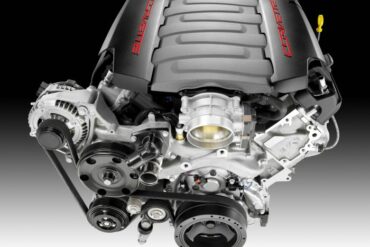
The LT1 (VIN 7) was the first Gen V small-block: 376 cubic inches (6.2 liters) from a 4.06 x 3.62-inch bore and stroke, an all-aluminum block with nodular-iron main caps and six-bolt mains, aluminum heads with 59-cc chambers, hollow intake and sodium-filled exhaust valves, a forged crank, powder-metal rods and 11.5:1 compression, with direct fuel injection at up to 2,175 psi, continuously variable valve timing and Active Fuel Management that ran the car on four cylinders at a cruise, built at GM’s Tonawanda plant in New York. GM certified 455 horsepower at 6,000 rpm and 460 lb-ft at 4,600 (460 and 465 with the NPP exhaust) on a 6,600-rpm redline and premium fuel recommended but not required; Z51 cars added a dry-sump oiling system with a 9.75-quart capacity.
The standard transmission, a rear-mounted Tremec TR6070 seven-speed with Active Rev Matching, had ratios of 2.66, 1.78, 1.30, 1.00, 0.74, 0.50 and 0.42 (MEP) or, with Z51, 2.97, 2.07, 1.43, 1.00, 0.71, 0.57 and 0.48 (MEL), both on a 3.42:1 axle; the Hydra-Matic 6L80 automatic (4.03, 2.36, 1.53, 1.15, 0.85, 0.67) used a 2.56:1 axle, 2.73:1 with Z51, with the electronic limited-slip differential on Z51 cars only. EPA figures were 17/29/21 for the manual and 16/28/20 for the automatic (the site’s spec post gives 28 highway for the manual).
The chassis was all new: a hydroformed aluminum frame with aluminum and magnesium structural parts, short-long-arm double wishbones at both ends with cast-aluminum arms, transverse composite springs and monotube dampers (35-mm Bilsteins, 45-mm on Z51, Magnetic Ride optional with Z51), variable-ratio electric power steering at 12.0–16.4:1 and 2.53 turns, and Brembo four-piston brakes on 12.6-inch front and 13.3-inch rear rotors, 13.6-inch slotted fronts with Z51. Wheels were 18 x 8.5 and 19 x 10 inches on P245/40ZR18 and P285/35ZR19 Michelin Pilot Super Sport ZP run-flats, or 19 x 8.5 and 20 x 10 on P245/35ZR19 and P285/30ZR20 with Z51.
The wheelbase grew an inch to 106.7 inches, the length to 176.9, the width to 73.9, the height fell to 48.6, and the tracks were 63.0 and 61.7 inches; GM quoted 3,298 pounds for the coupe and 3,362 for the convertible, a 50/50 weight distribution, 15 cubic feet of cargo space in the coupe and 10 in the convertible, and an 18.5-gallon tank.
Chevrolet’s own numbers for a Z51 manual coupe were 3.8 seconds to 60, 12.0 seconds at 119 mph in the quarter, 1.03 g and 107 feet from 60 to 0; Car and Driver got 3.9 and 12.2 at 117 with a 190-mph estimated top speed, Motor Trend 3.9 and 12.2 at 117.3 with 1.11 g, and a 2014 automatic convertible ran 3.7 and 12.1 at 119 for Car and Driver.
MORE: FULL SPECIFICATIONS / ENGINE
| SPEC | 2014 CORVETTE |
|---|---|
| Engine | 376 ci (6.2 L) Gen V LT1 small-block V-8, VIN 7: 4.06 x 3.62 in, aluminum block and heads, 11.5:1, direct injection, continuously variable valve timing, Active Fuel Management; 455 hp @ 6,000 rpm, 460 lb-ft @ 4,600 rpm; with NPP dual-mode exhaust ($1,195.00; 31,173 cars) 460 hp / 465 lb-ft; 6,600-rpm redline; built at Tonawanda; dry-sump oiling with Z51 |
| Transmission | Rear-mounted transaxle via torque tube: Tremec TR6070 seven-speed manual with Active Rev Matching, 2.66, 1.78, 1.30, 1.00, 0.74, 0.50, 0.42 (MEP; 4,139) or 2.97, 2.07, 1.43, 1.00, 0.71, 0.57, 0.48 with Z51 (MEL; 9,061); Hydra-Matic 6L80 six-speed automatic with paddles, 4.03, 2.36, 1.53, 1.15, 0.85, 0.67 (MYC, $1,350.00; 24,088) |
| Axle ratio | 3.42:1 manual; 2.56:1 automatic, 2.73:1 automatic with Z51; electronic limited-slip differential with Z51 |
| Frame and body | Hydroformed aluminum frame built at Bowling Green with aluminum and magnesium structural parts; carbon-fiber hood and roof panel, composite fenders, doors and quarters, carbon-nano composite underbody; 57 percent stiffer and 99 lb lighter than the C6 steel frame |
| Front suspension | Short/long-arm double wishbone, cast-aluminum arms, transverse composite leaf spring, monotube dampers (35-mm Bilstein; 45-mm with Z51; Magnetic Selective Ride Control optional with Z51), 26.7-mm hollow anti-roll bar (28 mm Z51) |
| Rear suspension | Short/long-arm double wishbone, cast-aluminum arms, transverse composite leaf spring, monotube dampers; 26-mm anti-roll bar with Z51 |
| Steering | Variable-ratio rack-and-pinion with electric assist, 12.0–16.4:1, 2.53 turns lock to lock, 37.7-ft turning circle |
| Brakes | Brembo four-piston fixed calipers, 12.6-in front / 13.3-in rear vented rotors; Z51 13.6-in slotted fronts and slotted rears, black calipers; ABS, StabiliTrak, Performance Traction Management with FE4 |
| Wheels and tires | 18 x 8.5 / 19 x 10 in on P245/40ZR18 and P285/35ZR19 Michelin Pilot Super Sport ZP run-flats (XBK); Z51 19 x 8.5 / 20 x 10 in on P245/35ZR19 and P285/30ZR20 (YFJ) |
| Wheelbase | 106.7 in (up 1.0 in) |
| Overall length | 176.9 in; width 73.9 in; height 48.6 in; track 63.0 front / 61.7 rear |
| Curb weight | 3,298 lb coupe / 3,362 lb convertible (GM); 50/50 weight distribution |
| Fuel economy | EPA 17 city / 29 highway / 21 combined manual; 16 / 28 / 20 automatic; 18.5-gal tank |
| 0–60 mph | 3.8 sec (GM, Z51 manual); 3.9 (Car and Driver, Motor Trend); 3.7 (Car and Driver, automatic convertible) |
| Quarter mile | 12.0 sec @ 119 mph (GM); 12.2 @ 117 (Car and Driver, Motor Trend) |
| Lateral acceleration | 1.03 g (GM); 1.08–1.11 g (Car and Driver, Motor Trend) |
| Braking 60–0 | 107 ft (GM); 104 ft (Motor Trend) |
| Top speed | About 190 mph (Car and Driver estimate) |
| Production | 37,288 (26,565 coupes, 10,723 convertibles; 21,111 with Z51) |
| Assembly | Bowling Green, Kentucky; LT1 from Tonawanda, New York |
The site’s 2014 VIN post is a placeholder, so this section is built from GM’s scheme and documented cars. The C7 brought a new set of fifth-character codes: A and B for 1LT with the manual and the automatic, C and D for 2LT, E and F for 3LT, then G/H, J/K and L/M for the same three trims with the Z51 package, and a 9 for export cars outside the United States and Canada. The sixth character is the body, 2 for the coupe and 3 for the convertible; the seventh is D for the AJ7 restraint system of active belts with frontal and seat-mounted side airbags; the eighth is 7 for the LT1, the first new engine letter since the C6’s W; the tenth is E for 2014 and the eleventh 5 for Bowling Green. The standard sequence began at 100001: a Corvette Forum member who watched the last 2014 built on August 8, 2014 logged it as 135523, and VetteFacts gives 137562, so the series end is given here as about 135523 and flagged. The Premiere Edition coupes were numbered on their own series, 300001 to 300500 (the first, 1G1YL2D7XE5300001, was sold by the Chevrolet Collection at Barrett-Jackson Scottsdale in 2016; L for Z51 3LT manual), and the Premiere Edition convertibles carried a separate series and numbered plaques of their own; GM’s sheet counts 1,044 cars under SRZ against the 1,050 announced. A customer-chosen sequence number was available under RPO PIN for $5,000 on sold orders.
The VIN plate is on the left windshield pillar and repeated on the driver’s door certification label and the console service parts label, which lists the RPOs: Z51 with G96, Z52, FE3 or FE4, J55, KNR and MEL or MYC on a Z51 car; SRZ on a Premiere Edition with 3LT, Z51, FE4, NPP, C2Z, IWE, FAY and DTW; the paint code (G8G Arctic White, GAN Blade Silver, GBV Cyber Gray, GBA Black, GKZ Torch Red, GBE Crystal Red, G8A Velocity Yellow, G7H Laguna Blue, GXH Night Race Blue, G7J Lime Rock Green); the interior trim (141/143/145 Gray, 191/193/195 Jet Black, 343/345 Kalahari, 701/703/705 Adrenaline Red, 555 Brownstone, with 2, 4 or 6 as the last digit for sueded inserts) and the top on convertibles (41T Black, 21T Kalahari, 37T Gray, 34T Blue). The engine carries a VIN derivative on the block and a Tonawanda build date; the manual transmission a Tremec tag. The 2013 Indianapolis 500 pace car was a production Laguna Blue Z51 coupe with strobes and safety equipment, not a separate series.
MORE: VIN DECODER / PRODUCTION
| POSITION | MEANING |
|---|---|
| 1G1 (First through Third) | Country, maker, make: 1 = built in the USA, G = General Motors, 1 = Chevrolet |
| Y (Fourth) | Car line: Y = Corvette |
| A–M or 9 (Fifth) | Trim and transmission: A/B = 1LT manual/automatic, C/D = 2LT, E/F = 3LT; G/H = Z51 1LT, J/K = Z51 2LT, L/M = Z51 3LT (every documented Premiere Edition coupe is an L); 9 = export outside the United States and Canada |
| 2 or 3 (Sixth) | Body: 2 = hatchback coupe (26,565), 3 = convertible (10,723) |
| D (Seventh) | Restraint system: D = RPO AJ7, active belts with dual frontal and seat-mounted side airbags |
| 7 (Eighth) | Engine: 7 = 376 ci (6.2 L) LT1, 455 hp (the only 2014 engine) |
| x (Ninth) | Check digit, calculated from the other sixteen characters |
| E (Tenth) | Model year: E = 2014 |
| 5 (Eleventh) | Assembly plant: 5 = Bowling Green, Kentucky (the aluminum frame built there too, for the first time) |
| 100001– / 300001–300500 (Twelfth through Seventeenth) | Production sequence: one series for standard and Z51 coupes and convertibles from 100001 to about 135523 (a forum observer’s reading of the last car built, August 8, 2014; VetteFacts says 137562), a second for the 500 Premiere Edition coupes from 300001, and a third for the 550 Premiere Edition convertibles; 37,288 cars in all |
Ten colors: Torch Red (7,197, the most popular for the first time in years), Arctic White (6,153), Black (5,929), Cyber Gray (4,064), Laguna Blue Tintcoat (3,281, $995, new, every Premiere Edition coupe and the pace car), Crystal Red Tintcoat (3,020, $995), Velocity Yellow Tintcoat (2,125, $995), Blade Silver (2,088), Night Race Blue (1,827) and Lime Rock Green Metallic (1,566, $495, new, every Premiere Edition convertible; dropped for 2015). Interiors in Jet Black, Gray, Adrenaline Red, Kalahari and the 3LT-only Brownstone, in Mulan leather, perforated Nappa or with sueded microfiber inserts; tops in Black (8,054), Kalahari (2,088), Gray (373) or Blue (224).
The 2014 is the cheapest way into the C7, and the market treats it as a used car rather than a collectible: the first year has the 6L80 six-speed automatic instead of the 2015-on 8L90 eight-speed, no Z06, no Grand Sport and the usual first-year wrinkles, so a 2015 or 2016 Stingray brings a little more for the same miles. Classic.com lists the C7 Stingray as one market across 2014–2019 without a separate 2014 benchmark; in the year to October 2026 ordinary 2014 coupes sold at auction from $30,250 to $58,750, with most 3LT Z51 cars between $40,000 and $53,500 and low-mileage examples at the top. The Premiere Edition is the only 2014 with a premium: $74,500 for a 386-mile coupe on Bring a Trailer in May 2026 and $71,500 for a 3,000-mile car at Barrett-Jackson Scottsdale in January, against $44,000 for a 12,000-mile car in November 2025. Convertibles are scarce at auction and sell a little under equivalent coupes; manuals (35 percent of production) bring a modest premium over automatics.
Classic.com results, November 2025 to July 2026, with the two October 2026 lots still open at the time of writing (the site’s pagination skipped August and September). Bring a Trailer sold a 36-mile 3LT Z51 automatic for $58,750 in January, a 2,000-mile 3LT manual for $53,500 in May, a 14,000-mile 3LT automatic for $52,000 in July, a 5,000-mile 3LT Z51 automatic for $50,000 in November 2025, a 14,000-mile 3LT manual for $48,000 in March, a 14,000-mile 3LT automatic for $42,114 in May, a 10,000-mile 1LT manual for $42,500 in May, a 33,000-mile 2LT Z51 automatic for $41,500 in February, a 22,000-mile 3LT Z51 manual for $40,001 in November 2025, a 21,000-mile 3LT manual for $40,000 in April, a 41,000-mile 3LT Z51 manual for $39,750 in December 2025, a 5,000-mile 2LT automatic for $38,250 in January, a 17,000-mile 3LT automatic for $35,250 in April, an 8,000-mile 1LT automatic for $34,900 in December 2025, a 53,000-mile 2LT manual for $33,000 in January and a 37,000-mile 3LT automatic for $31,500 in December 2025, and bid an 8,000-mile 3LT manual to $43,350 without selling in May. Mecum sold a 9,000-mile 3LT manual for $53,350 at Houston in April, a 9,000-mile 1LT automatic for $51,700 at Kissimmee in January, a 9,000-mile 3LT manual for $50,600 at Tulsa in June, a 9,000-mile 3LT automatic for $49,500 at Harrisburg in July, and at Indianapolis in May a 172-mile customized 3LT automatic for $132,000 and a 3,000-mile custom car for $55,000, with a 9,000-mile 3LT manual bid to $42,000 unsold; Barrett-Jackson sold a 32,000-mile 3LT manual for $40,700 in June; Hemmings a 5,000-mile 3LT manual for $46,525 in March; Cars & Bids a 17,000-mile Z51 manual for $41,750 in November 2025, a 41,000-mile modified 3LT automatic for $35,000 in April, a 19,000-mile 1LT automatic for $34,000 and a 44,000-mile 2LT manual for $30,250 in January, with a 15,000-mile 3LT manual bid to $43,250, a 38,000-mile 2LT manual to $33,550 and a 56,000-mile 2LT Z51 manual to $32,500 unsold; Hagerty bid a 42,000-mile 3LT manual to $35,001 unsold in July. Dealers asked $28,900 to $59,999. Auction figures are hammer prices; add the buyer’s premium when comparing with asking prices.
Verifying a Z51: the fifth VIN character is G, H, J, K, L or M, and the service parts label shows Z51 with G96, Z52, FE3 or FE4, J55, KNR, XBK replaced by YFJ (the 19/20-inch tires) and Q7S, Q7E or Q7T wheels; the car has 19 x 8.5 and 20 x 10-inch wheels, slotted rotors with 13.6-inch fronts, a dry-sump tank behind the right headlamp, coolers for the differential and transmission under the rear and the stand-up rear spoiler and front-splitter extensions of the aero package. A base car wearing Z51 wheels and a spoiler is a $2,000 look-alike. Verifying a Premiere Edition: SRZ on the label, Laguna Blue (G7H) with 3LT, Z51, FE4, NPP, C2Z, IWE, FAY and DTW, a numbered plaque on the dash, a 300001-series VIN on the coupe, Stingray sill plates and center caps, and ideally the Thule luggage; convertibles are Lime Rock Green (G7J) with the same content and their own series. A museum-delivered car (R8C, 1,231) has the museum plaque; a build sheet and window sticker are available from the National Corvette Museum for any 2014.
Inspection: the 2014’s list is the C7’s first-year list. The carbon-fiber roof panel’s rattles and seals, the convertible top’s alignment and sensors, MyLink screens that go dark on early cars (software), the torque tube and rear differential on hard-used Z51 cars, Magnetic Ride dampers that leak and are expensive to replace, run-flat tires that age out before they wear out, the rear-mounted battery’s drain when the car sits, curb-rashed wheels, the 6L80’s shift quality and the seven-speed’s clutch on cars that have been launched; the early parking-brake cable recall; and any tune, since the LT1 is a popular one. A documented 3LT Z51 manual coupe with Magnetic Ride and the performance exhaust is the driver’s 2014; a Laguna Blue Premiere Edition coupe with its luggage and plaque the collectible; and a late-build 2LT Z51 automatic under $40,000 the bargain of the generation.
MORE: THE MARKET
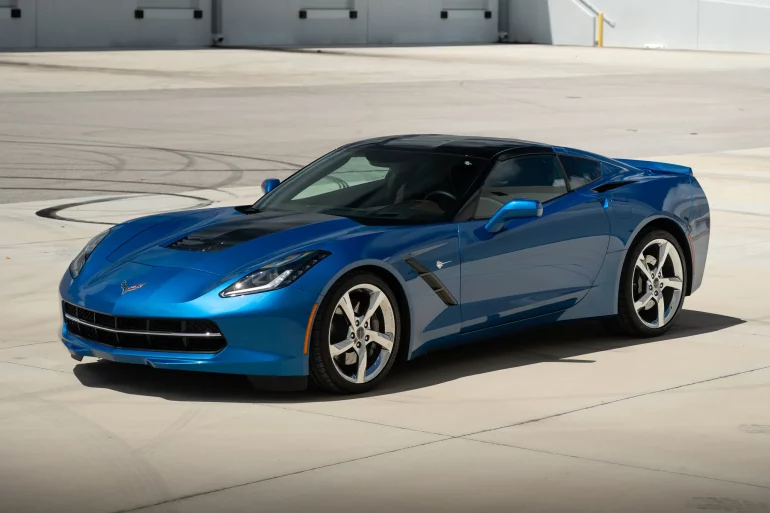
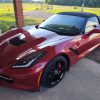
Get all the latest news stories, upcoming auctions, prices, videos and more about the 2014 Chevrolet Corvette! The latest headlines here.
Chevrolet built 37,288 2014 Corvette Stingrays at Bowling Green, Kentucky, between August 2013 and August 8, 2014, the most in a year since 2007’s 40,561 and almost three times the 13,466 of 2013: 26,565 coupes (11,134 standard and 15,431 with the Z51 package) and 10,723 convertibles (5,043 and 5,680). 1,044 were Premiere Editions, 24,088 had the automatic, 19,725 were 3LTs, 31,173 had the performance exhaust and 34,678 stayed in the United States.
The Stingray coupe listed at $51,995 and the convertible at $56,995, both including the $995 destination charge, when Chevrolet announced prices on April 26, 2013; the Z51 Performance Package added $2,800 (so $54,795 and $59,795), the 2LT group $4,210, the 3LT group $8,005 and the automatic $1,350. Magnetic Ride was $1,795, the dual-mode exhaust $1,195, Competition Sport seats $1,995, the visible carbon roof $1,995, chrome wheels $1,995 and premium paints $495 to $995; the Torch Red Z51 3LT show car from Detroit came to $73,360 and the Premiere Edition convertible to $77,450.
Every 2014 Corvette has the new 6.2-liter (376 ci) LT1, the first Gen V small-block, with direct injection, continuously variable valve timing and Active Fuel Management: SAE-certified at 455 horsepower at 6,000 rpm and 460 lb-ft at 4,600, or 460 and 465 with the NPP dual-mode exhaust, built at Tonawanda. The standard transmission was a Tremec TR6070 seven-speed manual with Active Rev Matching, the first seven-speed in a Corvette (13,200 cars); the option was a Hydra-Matic 6L80 six-speed automatic with paddle shifters (24,088 cars, $1,350), replaced by the 8L90 eight-speed for 2015. GM quoted 3.8 seconds to 60 and 12.0 at 119 mph for a Z51 manual, and the EPA 17/29 mpg.
RPO Z51 ($2,800; 21,111 cars, 57 percent of the year) turned the Stingray into the track car: an electronic limited-slip differential, a dry-sump oiling system, firmer FE3 suspension with 45-mm Bilstein dampers (Magnetic Selective Ride Control with Performance Traction Management optional at $1,795, taken by 13,386), larger slotted brake rotors with black calipers, close-ratio gearing (MEL) or a 2.73:1 axle with the automatic, differential and transmission coolers, an aero package with a taller spoiler and splitter extensions, and 19 x 8.5 and 20 x 10-inch wheels on Michelin Pilot Super Sport ZP tires. A Z51 car carries G, H, J, K, L or M as the fifth VIN character and Z51 on its service parts label.
Two launch editions. The Premiere Edition coupe, revealed at the National Corvette Museum on June 28, 2013, was 500 Laguna Blue Tintcoat 3LT Z51 coupes with Magnetic Ride, the performance exhaust, a visible carbon-fiber roof, a Carbon Flash hood stinger, a Brownstone suede interior with carbon trim, Stingray sill plates and wheel caps, Corvette luggage by Thule and a numbered dash plaque, on their own VIN series from 300001. The Premiere Edition convertible, announced on November 26, 2013 at $77,450, was 550 Lime Rock Green cars to the same specification with their own series and plaques. GM’s production sheet counts 1,044 cars under RPO SRZ. In 2026 Premiere Edition coupes sold at auction for $44,000 to $74,500.
Yes, before it was on sale: a Laguna Blue 2014 Stingray Z51 coupe paced the 97th Indianapolis 500 on May 26, 2013, driven by San Francisco 49ers coach Jim Harbaugh, the 12th Corvette pace car since 1978, with no changes under the hood (only strobes and safety equipment). It is a 2014 model that paced the 2013 race, so there is no 2013 pace-car Corvette and, since a Camaro Z/28 paced the 2014 race, no 2014 pace car either; Chevrolet built no pace-car replica edition for the Stingray.
In the year to October 2026 ordinary 2014 Stingray coupes sold at auction for $30,250 to $58,750, most 3LT Z51 cars between $40,000 and $53,500 and the lowest-mileage cars at the top; convertibles are scarce at auction and bring a little less than coupes, manuals a little more than automatics, and dealers asked $28,900 to $59,999. The Premiere Edition coupe is the only 2014 with a premium, $71,500 and $74,500 for delivery-mileage cars in 2026. Classic.com groups the C7 Stingray as one 2014–2019 market without a separate 2014 benchmark; auction figures are hammer prices before the buyer’s premium.
2014 Corvette Advertisements / 2014 Corvette Colors / 2014 Corvette Engine / 2014 Corvette Factory Options / 2014 Corvette For Sale / 2014 Corvette Maintenance / 2014 Corvette Mods / 2014 Corvette Owners Manual / 2014 Corvette Performance / 2014 Corvette Posters / 2014 Corvette Pricing / 2014 Corvette Production / 2014 Corvette Recalls / 2014 Corvette Research / 2014 Corvette RPO Codes / 2014 Corvette Sales Brochures / 2014 Corvette Special Model Overview / 2014 Corvette Specifications / 2014 Corvette Technical Research / 2014 Corvette Service Bulletins / 2014 Corvette VIN Numbers