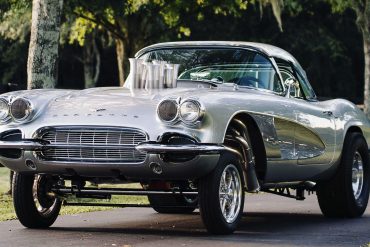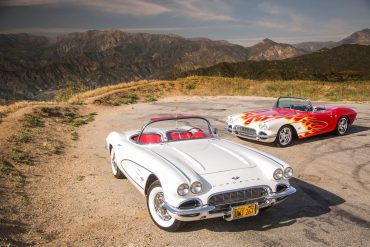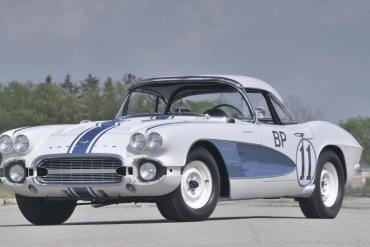
Ordered by Don Yenko for Gulf Oil VP Grady Davis and driven by 'The Flying Dentist' Dick Thompson, this Sebring-package 1961 Corvette won the SCCA B-Production national title and later entered the Corvette Hall of Fame.



C1 CORVETTE - 1961
Bill Mitchell’s ducktail: the Sting Ray racer’s rear end on the C1 body, four round taillights for the first time, a 315-hp fuelie at the top, and the last year for the 283, two-tone coves and dual quads. 10,939 built.
Quick Nav: The Story · Specials · Price & Options · VIN · Specs · Technical · Pics & Videos · The Market · All Content · FAQs
Model & Gen: 1961 Corvette (C1)
Body Type: 2 Door Convertible (removable hardtop optional)
VIN: 10867S100001 – 10867S110939
Original Price: $3,934 base
Colors: 7 (Ermine White, Roman Red, Honduras Maroon, Fawn Beige, Tuxedo Black, Jewel Blue, Sateen Silver)
Engine: 283 ci V-8, 230 to 315 hp (last year of the 283)
Transmission: 3-speed manual standard; 4-speed manual and 2-speed Powerglide optional
Units Produced: 10,939
The 1961 Corvette is where Bill Mitchell’s Corvette begins. The rear end of his Sting Ray racer and XP-700 show car, the “ducktail” with four round taillights and a crease down the deck lid, was grafted onto the 1958–60 body, the exhaust moved from the bumpers to below them, and the grille lost its chrome teeth for a fine mesh with body-color headlight bezels. Trunk space went up by a fifth, the body was the best-built C1 yet, and from the back the car already looked like a C2.
Underneath it was a 1960 with a few important upgrades. An aluminum radiator and fan clutch became standard, the four-speed gained an aluminum case, and the five 283s now topped out at 315 horsepower from the 11.0:1 fuel-injected engine; 1,462 buyers paid $484.20 for it. The four-speed went into 7,013 of the 10,939 cars, Positraction into 6,915, and nearly nine in ten cars left St. Louis with a manual gearbox. Windshield washers, sun visors, courtesy lights and the parking-brake warning light became standard, though air conditioning, power steering and power brakes were still not offered.
It was the last year for three things that defined the late C1: the 283 engine, the dual four-barrel carburetor options, and the contrasting-color coves, which 3,351 buyers ordered for the final time. The one-year-only Jewel Blue and the two-tone ducktail make the 1961 one of the easiest C1s to recognize.
By late 1960, the Corvette had demonstrated again that it was a serious contender on the race track, both in the mainstream media and in the automotive marketplace. CBS television, in cooperation with General Motors, introduced the series “Route 66”. (While it was common in that era for automotive manufacturing companies to sponsor television programming, this particular series featured a story about two guys who sought adventure in their shiny, new Corvette).
Bill Mitchell had begun the process of developing a prototype for an all new Corvette that would go on to become known as the Mako Shark I. He had also championed a team of Chevrolet designers in developing both cosmetic and performance upgrades to the existing C1 body styling.
With Corvette sales consistently increasing over the previous two model years, General Motors executives decided to review some of Mitchell’s designs and made the decision to “green light” a restyling of Corvette for the 1961 model year.
The most pronounced of Mitchell’s changes was the introduction of a freshened rear end design. The “ducktail” design (as it has become known amongst Corvette enthusiasts) was virtually lifted from the Stingray race car as well as Mitchell’s XP-700 show car
From a practicality standpoint, the redesign of the rear end of the Corvette enabled an increase in available luggage space by twenty percent (20%). The new rear end also showcased a pair of small, round taillights on each side of the license plate recess. (These re-designed tail lights would become synonymous with Corvette and would be a standard feature (in one form or another) on all future generations of Corvette).
A simple vertical crease line ran down the middle of the rear deck lid, passing evenly through the traditional, big, round Corvette emblem. The rear end of the car now featured a pair of small chrome bumpers that framed a third, small, chrome, “arch” bumper that wrapped around the license plate well.
On the front end of the car, Mitchell redesigned the layout of the dual headlamp system, providing Corvette with a more streamlined version of the existing four lamp nose. Headlight bezels were no longer available in chrome, but instead were painted to match the rest of the body. Likewise, the chrome “teeth” grill was replaced with a fine wire mesh insert that was finished in argent silver. The round Corvette emblem that resided on the front nose of the car was replaced with individual block letters that spelled out the car’s name. This was topped with a larger version of the Corvette’s crossed-flags insignia.
Other improvements were made to the Corvette’s body as well, though some were not physical changes to the actual lines of the Corvette so much as an evolution in the quality of how those body lines were put together.
With improvements in fiberglass manufacturing combined with refined assembly processes improving the car’s fit and finish, the 1961 Corvette was quickly recognized by critics and enthusiasts alike as the best built Corvette yet.
While the exterior received subtle improvements to it’s overall appearance, the interior of the 1961 Corvette went virtually unchanged from it’s predecessors. To increase space within the two seat cockpit, the transmission tunnel was slightly narrowed, though this single change did little to affect the overall appearance of the car‘s interior. Cosmetically, even the color options stayed largely the same. Four interior colors were made available: black, red, fawn, and blue.
Of course, as the Corvette continued to evolve, so did the standard features that came with it. With a base price of $3934, the Corvette now included windshield washers, sun visors, a thermostatically controlled radiator fan and a parking brake warning light. The installation of a heater was still an option in 1961, as was the addition of a four speed manual transmission. With respect to the latter, nearly seventy five percent (75%) of all Corvette customers paid the extra $188.30 to purchase the four-speed manual transmission, which was now clad in aluminum that shaved fifteen pounds from the overall weight of the car.
Interestingly, air conditioning, power steering and power brakes were still unavailable, even as optional equipment, on the 1961 Corvette. However, the “Wonder Bar” signal-seeking AM radio remained available, as did the Positraction limited-slip differential, “wide” whitewall tires, electric windows, and a power operated manual top.
Did you know? The 1961 Corvette would be the last Corvette to offer a consumer the option of purchasing bodyside cover in contrasting paint colors. A mere $16.15 option in 1961, this was an option that most consumers readily ordered when purchasing a new Corvette. The 1961 Corvette was also the last model year to offer the option of wide whitewall tires as well as the last model year to offer the 283 cubic inch V-8 that helped launch Corvette into stardom!
Mechanically, the 1961 Corvette was much like it’s 1960 predecessor. However, an aluminum radiator took the place of the previous copper-core unit. By adding an aluminum radiator, Chevrolet improved the cooling capabilities while further reducing the car’s overall weight. Side mount coolant-expansion tanks were added as a running change.
The available engines were essentially just carryovers from the 1960 Corvette. There were five, different versions of Chevy’s respected 283 cubic-inch V-8 engine made available to consumers, of which two were fuel injected. The three speed manual transmission gearbox remained the standard option but was now offered with a wider choice of axle ratios. Powerglide automatic transmissions continued to be made available as an optional transmission, though the automatic transmission did not have enough sheer strength to handle the additional torque associated with the larger engines.
Besides, most Corvette enthusiasts were now actively seeking out manual transmissions, proved by the fact that nearly 90 percent of all the Corvettes sold in 1961 were built with a manual gearbox. While Corvette continued to delay the incorporation of an independent rear-suspension, this did nothing to hurt the vehicle in sales or in performance.
Automotive testers were enamored with the quality of the ’61’s handling ability, and none of them identified any specific deficiencies or lacking in quality of handling due to the absence of an independent rear suspension. By the standards of that time, the Corvette was now recognized as one of the most roadworthy cars in the world.
In 1961 hopes were high for big growth in Corvette production and while the numbers didn’t move much, Chevy was still able to produce 10,939 units for the 1961 model year. This model year had some important updates including the first to include aluminum radiators as standard equipment. Cosmetically a big improvement was moving the exhaust to exit the car under the rear bumper instead of out of the bumper itself which stopped the bumpers from getting dirty from exhaust fumes and gasses. The rear was completely redesigned to include the 4 tail lights that we now expect on a Corvette, the first year for that. The front of the car was the first that did not have the heavy teeth of previous years. See full production number breakdown.
 The Re-Imagined Rear End of the 1961 Chevrolet Corvette.
 Bill Mitchell with the 1960 Stingray (left) and the 1961 Mako Shark I Concept (right).
 The Front End of the 1961 Corvette. (Note that the headlight bezels match the rest of the car)

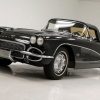
 1961 Chevrolet Corvette | Image Courtesy of FavCars
The 1961 was the last Corvette you could order with two-tone coves, the last with dual four-barrel carburetors, and the last with the 283. Jewel Blue was offered this year only. And 17 cars were delivered in non-standard colors or in primer, which is why the color totals come up 17 short of 10,939.
DID YOU KNOW
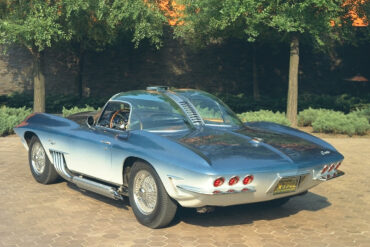
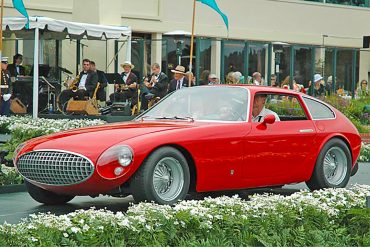
1961 brought the Mako Shark I, the XP-755 that previewed the Sting Ray, along with the four-seat XP-796 study, the Vignale coupe and the Gulf Oil race cars.
The base price rose to $3,934, and more came with it: windshield washers, sun visors, courtesy lights, a parking-brake warning light and the thermostatic fan clutch were now standard, which is why they disappear from the option list.
The engines carried their prices over: the 245-hp dual-quad (RPO 469, $150.65, 1,175 cars), the 270-hp dual-quad with the Duntov camshaft (now RPO 468, $182.95, 2,827 cars), and fuel injection at $484.20 in 275-hp (RPO 353, 118 cars) and 315-hp (RPO 354, 1,462 cars) forms, so 1,580 of the 10,939 cars were fuelies.
The four-speed (RPO 685, $188.30) went into 7,013 cars and the Powerglide (RPO 313, $199.10) into 1,458. Positraction (RPO 675) dropped to $43.05 and went into 6,915 cars. The metallic brakes (RPO 686) rose to $37.70 (1,402 cars), and the racing package became RPO 687, heavy-duty brakes and special steering at $333.60 on 233 cars.
The comfort options were the familiar ones: the removable hardtop ($236.75) on 5,680 cars, the heater ($102.25) on 10,671, the signal-seeking radio ($137.75) on 9,316, power windows ($59.20) on 698 and the power top ($161.40) on 442.
Seven colors were offered, with Ermine White the most popular at 3,178 cars, and 3,351 buyers paid $16.15 for the two-tone coves for the last time: 954 Roman Red/White, 647 Honduras Maroon/White, 429 Tuxedo Black/Silver, 419 Jewel Blue/White, 385 Ermine White/Silver, 358 Fawn Beige/White and 159 Sateen Silver/White.
The color totals add up to 10,922; the other 17 cars were delivered in non-standard colors or primer.
MORE: PRICING, OPTIONS & COLORS / RPO CODES
| CODE | DESCRIPTION | QUANTITY | RETAIL PRICE |
|---|---|---|---|
| 867 | Base Corvette Convertible | 10,939 | $3,934.00 |
| 101 | Heater | 10,671 | $102.25 |
| 102 | AM Radio, signal seeking | 9,316 | $137.75 |
| 242 | Positive Crankcase Ventilation (California) | – | $5.40 |
| 276 | Wheels, 15 x 5.5 (5) | 337 | $0.00 |
| 290 | Whitewall Tires, 6.70 x 15 | 9,780 | $31.55 |
| 313 | Powerglide Automatic Transmission | 1,458 | $199.10 |
| 353 | 283ci, 275HP Engine (Fuel Injection) | 118 | $484.20 |
| 354 | 283ci, 315HP Engine (Fuel Injection) | 1,462 | $484.20 |
| 419 | Auxillary Hardtop | 5,680 | $236.75 |
| 426 | Power Windows | 698 | $59.20 |
| 440 | Two-Tone Exterior Paint | 3,351 | $16.15 |
| 468 | 283ci, 270HP Engine (2x4 Carburetors) | 2,827 | $182.95 |
| 469 | 283ci, 245HP Engine (2x4 Carburetors) | 1,175 | $150.65 |
| 473 | Power Operated Folding Top | 442 | $161.40 |
| 675 | Positraction Rear Axle | 6,915 | $43.05 |
| 685 | 4-Speed Manual Transmission | 7,013 | $188.30 |
| 686 | Metallic Brakes | 1,402 | $37.70 |
| 687 | Heavy Duty Brakes and Special Steering | 233 | $333.60 |
| 1408 | Blackwall Tires, 6.70 x 15 Nylon | – | $15.75 |
| 1625 | 24 Gallon Fuel Tank | – | $161.40 |
| EXTERIOR | TOTAL | COVE (OPTIONAL) / CARS | SOFT TOP | WHEELS | INTERIOR |
|---|---|---|---|---|---|
| Ermine White | 3,178 | Sateen Silver / 385 | Black, White | White | Blue, Black, Fawn, Red |
| Roman Red | 1,794 | Ermine White / 954 | Black, White | Red | Black, Red |
| Honduras Maroon | 1,645 | Ermine White / 647 | Black, White | Maroon | Black, Fawn |
| Fawn Beige | 1,363 | Ermine White / 358 | Black, White | Beige | Black, Fawn, Red |
| Tuxedo Black | 1,340 | Sateen Silver / 429 | Black, White | Black | Blue, Black, Fawn, Red |
| Jewel Blue | 855 | Ermine White / 419 | Black, White | Blue | Blue, Black |
| Sateen Silver | 747 | Ermine White / 159 | Black, White | Silver | Blue, Black, Red |
The 283 made its last appearance in five versions, the two fuel-injected engines now at 11.0:1 compression: the base 230-horsepower single four-barrel, the 245 and 270-horsepower dual-quads, and the 275 and 315-horsepower Ramjet engines.
The 315-hp RPO 354 was the fastest Corvette engine yet, and it was the one fuelie buyers wanted, by 1,462 to 118. The base engine kept its stamped steel valve covers with the Chevrolet script; every optional engine got the seven-fin cast aluminum covers, which is the quick visual check under the hood.
The chassis changes were about durability and heat: an aluminum radiator replaced the copper-core unit, the thermostatic fan clutch became standard, and the four-speed got an aluminum case that saved weight. The transmission tunnel was narrowed by 20 percent for more room in the cockpit.
Period tests put a 270-hp four-speed car at 5.9 seconds to 60 mph and 131 mph, and the 315-hp fuelie at 5.5 seconds; a base 230-hp three-speed took 7.7 seconds and ran 109 mph. The racing option list was reorganized: RPO 686 metallic brakes on their own, RPO 687 heavy-duty brakes with quick steering, the 24-gallon tank and blackwall nylon tires. Testers found nothing to criticize in the handling of a car still on a live axle, which says something about how well Duntov’s team had developed it.
MORE: FULL SPECIFICATIONS / ENGINE
| SPEC | 1961 CORVETTE |
|---|---|
| Engine | 283 ci (4.6 L) OHV small-block V-8, 3.875 x 3.00 in, cast iron block & heads; last year of the 283 in a Corvette |
| Base engine | 230 hp @ 4,800 rpm, 300 lb-ft @ 3,000 rpm, single four-barrel, 9.5:1; 5,357 cars |
| RPO 469 | 245 hp @ 5,000 rpm, 300 lb-ft @ 3,800 rpm, dual four-barrels, 9.5:1; 1,175 cars, $150.65 |
| RPO 468 | 270 hp @ 6,000 rpm, 285 lb-ft @ 4,200 rpm, dual four-barrels with the Duntov camshaft, 9.5:1; 2,827 cars, $182.95 |
| RPO 353 | 275 hp @ 5,200 rpm, 305 lb-ft @ 4,400 rpm, Rochester fuel injection, 11.0:1; 118 cars, $484.20 |
| RPO 354 | 315 hp @ 6,200 rpm, 295 lb-ft @ 4,700 rpm, fuel injection with the Duntov camshaft, 11.0:1; 1,462 cars, $484.20 |
| Transmission | 3-speed manual standard (2,468 cars); Borg-Warner T-10 4-speed, now with an aluminum case (RPO 685, 7,013 cars, $188.30); 2-speed Powerglide (RPO 313, 1,458 cars, $199.10) |
| Axle ratio | 3.70:1 standard; Positraction (RPO 675, $43.05, 6,915 cars) in 3.70, 4.11 or 4.56:1 |
| Suspension | Independent front with coil springs and anti-roll bar; live axle on semi-elliptic leaf springs with trailing radius rods and rear anti-roll bar |
| Brakes | 11-in drums; sintered-metallic linings (RPO 686, $37.70, 1,402 cars); heavy-duty brakes and special steering (RPO 687, $333.60, 233 cars) |
| Cooling | Aluminum radiator standard, replacing the copper-core unit; thermostatic fan clutch standard |
| Tires | 6.70 x 15 in; blackwall nylon (RPO 1408, $15.75) and 15 x 5.5 in wheels (RPO 276, 337 cars) optional |
| Fuel tank | 16.4 gal; 24-gallon fiberglass tank (RPO 1625, $161.40) |
| Wheelbase | 102 in |
| Overall length | 176.7 in |
| Curb weight | 3,035 lb / 1,377 kg (manual); 3,135 lb (Powerglide) |
| 0–60 mph | 7.7 sec (230 hp, 3-speed); 5.9 sec (270 hp, 4-speed); 5.5 sec (315 hp fuel injection, 4-speed) |
| Top speed | 109 mph (230 hp); 128–131 mph (270 / 315 hp) |
| Production | 10,939, all convertibles; 5,680 with the removable hardtop; 1,580 fuel-injected |
| Assembly | St. Louis, Missouri |
The 1961 Corvette adopted a new twelve-character VIN: 10867S followed by the sequence number, which begins at 100001 and runs through 110939, accounting for each of the 10,939 cars built. The leading 1 is the model year, 08 the Corvette series, 67 the convertible body style and S the St. Louis plant. The VIN is stamped on a stainless steel tag fastened to the steering column in the engine compartment, and the number is also stamped on the frame.
The engine pad suffix identifies the engine: CQ (230 hp, manual), DG (230 hp, Powerglide), CT (245 hp, manual), DJ (245 hp, Powerglide), CU (270 hp, manual), CR (275-hp fuel injection, manual) and CS (315-hp fuel injection, manual). The axle code on the housing records the ratio and whether the car had Positraction. Only one body style, the convertible, was built.
MORE: VIN DECODER / PRODUCTION
| POSITION | MEANING |
|---|---|
| 1 (First Digit) | Model year: 1 = 1961 |
| 08 (Second & Third Digits) | Chevrolet Corvette series code |
| 67 (Fourth & Fifth Digits) | Body style: 67 = convertible, the only body built in 1961 |
| S (Sixth Digit) | Assembly plant: S = St. Louis, Missouri |
| 100001–110939 (Seventh through Twelfth Digits) | Production sequence number |
Seven colors on the first ducktail body, with 3,351 two-tone cars in the last year the coves could be ordered in a contrasting color: Ermine White (3,178), Roman Red (1,794), Honduras Maroon (1,645), Fawn Beige (1,363), Tuxedo Black (1,340), Jewel Blue (855) and Sateen Silver (747).
The 1961 and 1962 are the C1s the market likes best after the 1957: the ducktail body, the strongest engines of the generation and build quality that makes them usable cars. Within 1961 the ranking is familiar. A documented 315-hp fuelie four-speed is the car everyone wants, and a 283/315 with the hardtop and racing options sits at the top; 270-hp dual-quad four-speed cars are the volume collector choice and are often the better value; 245 and 230-hp cars and the 1,458 Powerglides are the entry point. The two-tone coves, Jewel Blue and Honduras Maroon add appeal, and this year a Jewel Blue car is a one-year-only color.
Results tracked by Classic.com for 2026 put original or well-restored 283 dual-quad cars between about $65,000 and $105,000: $64,900, $66,000 and $68,200 at Mecum Indianapolis and Kissimmee, and $104,500 for a 69,000-mile car at Kissimmee in January. Fuel-injected cars sold for $115,000 at an ACC auction in October and $242,000 for a 55,000-mile hardtop car at Mecum Kissimmee in January, which shows how wide the fuelie range is. A project roadster with hardtop sold for $27,000 on Bring a Trailer in October, and dealer asking prices ran $75,000 to $120,000. Check whether a result includes the buyer’s premium, and treat asking prices and unsold high bids separately from completed sales.
Verification starts at the engine pad: the suffix (CQ, CT, CU, CR, CS, DG or DJ) must match the equipment and the block date must precede the car’s build. A 315-hp car should carry a 1961-series Rochester injection unit and the seven-fin aluminum valve covers; a base car has stamped covers. The aluminum-case four-speed is correct for 1961, and the aluminum radiator should be present. Two-tone coves are easy to add in paint, so check the trim tag and build records. NCRS judging sheets, old photographs, ownership records and restoration invoices all help, and ask to see dates and scores rather than just the award.
The 1961 body is the best-built C1, but the ducktail is a new rear clip bonded to the old body, and the seam shows when it has been repaired. Look for cracks around the headlight bezels, the door hinge pillars, the cove edges and the cowl, and check the fit of the deck lid and the four taillight bezels. Underneath, the boxed frame rails rust from the inside, so an inspection on a lift is essential. On the road a fuelie should start hot and cold without drama, the four-speed should not jump out of gear, and with metallic brakes the pedal should firm up once warm. Most of these cars see few miles, so budget for tires, brakes and fuel-system work on anything that has sat.
MORE: THE MARKET

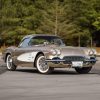
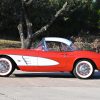
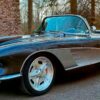
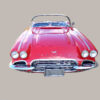
Get all the latest news stories, upcoming auctions, prices, videos and more about the 1961 Chevrolet Corvette! The latest headlines here.
Chevrolet built 10,939 Corvettes for 1961, all convertibles, at St. Louis, Missouri, up from 10,261 in 1960. Of those, 1,580 had fuel injection, 7,013 had the four-speed, 6,915 had Positraction, 5,680 had the removable hardtop and 3,351 had two-tone coves. Only 233 had the RPO 687 heavy-duty brake and steering package.
In 2026, original or well-restored 283 dual-quad 1961 Corvettes have mostly sold for $65,000 to $105,000 at auction, with fuel-injected cars from about $115,000 and the best documented 315-hp fuelies reaching $240,000 or more. Projects start around $27,000. The engine, its paperwork and the four-speed decide the price.
The 283-cubic-inch small-block V-8 in five versions, for the last time: 230 hp with a single four-barrel, 245 or 270 hp with dual four-barrels, and 275 or 315 hp with Rochester fuel injection at 11.0:1 compression. A three-speed manual was standard; the aluminum-case four-speed ($188.30) went into 7,013 cars and the Powerglide automatic ($199.10) into 1,458.
Seven: Ermine White (3,178 cars), Roman Red (1,794), Honduras Maroon (1,645), Fawn Beige (1,363), Tuxedo Black (1,340), Jewel Blue (855, this year only) and Sateen Silver (747). For $16.15, 3,351 buyers had the coves painted silver or white, the last year that option was offered. Seventeen cars were delivered in non-standard colors or primer.
The base price was $3,934 with the 230-hp engine and three-speed manual. Fuel injection added $484.20, the four-speed $188.30, the hardtop $236.75, Positraction $43.05 and the heavy-duty brakes and steering $333.60. A 315-hp fuelie with the four-speed, Positraction, hardtop and RPO 687 came to about $5,200.
The rear end: Bill Mitchell’s ducktail from the Sting Ray racer, with four round taillights, a crease down the deck lid, small chrome bumpers and the exhaust exiting below the body instead of through the bumpers. The grille lost its chrome teeth for a mesh insert and the headlight bezels went body-color. Mechanically, an aluminum radiator and fan clutch became standard, the four-speed got an aluminum case, the transmission tunnel was narrowed and the top fuel-injected engine rose to 315 hp.
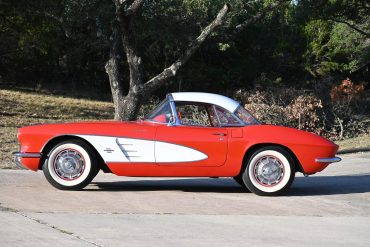
From the side: a 1961 can have contrasting-color coves with chrome trim outlining them; a 1962 has body-color coves with a ribbed aluminum insert in the front vent and no cove trim. The 1962 also has blacked-out grille mesh, rocker moldings and a 327 engine. A 1961 is the only ducktail car with the two-tone option, dual-quad carburetors and the 283.
1961 Corvette Advertisements / 1961 Corvette Colors / 1961 Corvette Factory Options / 1961 Corvette For Sale / 1961 Corvette Mako Shark XP-755 / 1961 Corvette Owners Manual / 1961 Corvette Performance / 1961 Corvette Posters / 1961 Corvette Pricing / 1961 Corvette Production / 1961 Corvette Research / 1961 Corvette RPO Codes / 1961 Corvette Sales Brochures / 1961 Corvette Special Model Overview / 1961 Corvette Specifications / 1961 Corvette Technical Research / 1961 Corvette Vignale Coupe / 1961 Corvette VIN Numbers