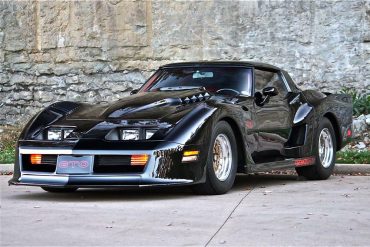
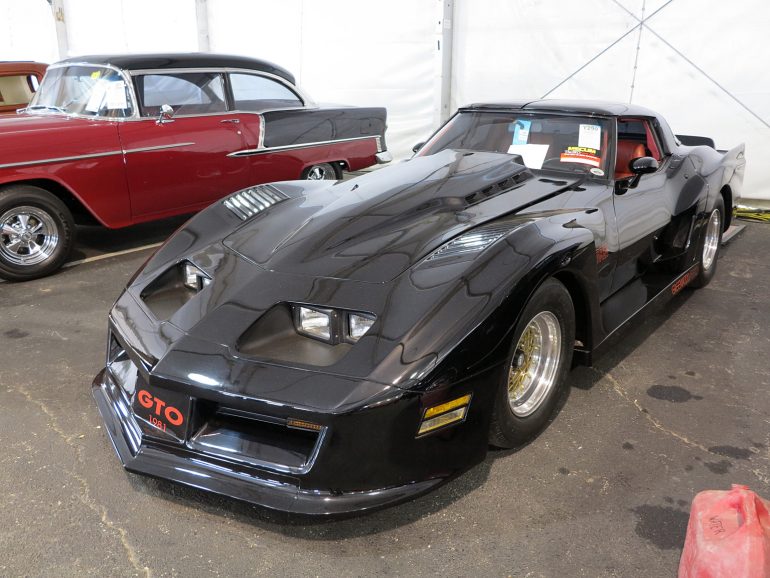
Only two Greenwood GTOs were built, and on the track the Suction Cup car outworked the wilder Daytona. This guide spells out the hood, fender and rear bumper changes that separate the two widebody C3s.



C3 CORVETTE - 1981
The last St. Louis Corvette and the first from Bowling Green were built in the same summer, so 1981 is the only year with two plants, two paint systems and two VIN sequences. One 190-hp L81 with Computer Command Control served every state and the price passed $16,000.
Quick Nav: Story · Specials · Price & Options · VIN · Specs · Technical · Pics & Videos · The Market · All · FAQs
Model & Gen: 1981 Corvette (C3)
Body Type: Fastback Sport Coupe (T-top) only
VIN: 1G1AY8764BS400001 – 1G1AY8764BS431611 (St. Louis)
Original Price: $16,258.52
Colors: 14 solid colors across the two plants (lacquer at St. Louis, enamel and clear coat at Bowling Green) plus four Bowling Green two-tones (RPO D84)
Engine: One engine for every state: 350 ci L81, 190 hp, with Computer Command Control, magnesium valve covers and stainless exhaust manifolds
Transmission: 4-speed wide-ratio (MM4) standard, in 14 percent of cars and sold in California again; 3-speed Turbo Hydra-Matic 350C with lock-up converter (MX1) at no charge
Units Produced: 40,606 (31,611 at St. Louis, 8,995 at Bowling Green)
The 1981 Corvette is the car that moved house. Chevrolet had denied for years that it would leave the 1920 St. Louis plant on Natural Bridge Avenue, then announced on March 26, 1979 that it would, to a former Fedders air-conditioner factory in Bowling Green, Kentucky, expanded to a million square feet, dedicated to one car and fitted with a modern paint shop that St. Louis, under EPA pressure, could not match. The first Bowling Green Corvette was finished on June 1, 1981, with Governor John Y. Brown at the wheel; the last St. Louis car came off the line on August 1. For two months both plants built 1981 Corvettes, St. Louis in lacquer and Bowling Green in enamel under clear coat, with separate paint codes, separate VIN sequences (S and 5 in the eleventh position of the new 17-character number) and, at Bowling Green only, four two-tone combinations (RPO D84) that went on 5,352 of its 8,995 cars.
The car underneath was the 1980 with one engine for everybody. The L48 and L82 were replaced by the L81, a 190-hp 350 with Computer Command Control, an oxygen sensor, magnesium valve covers, stainless tubular exhaust manifolds and an auxiliary electric fan, certified for all fifty states, so Californians got a 350 again and, for the first time since 1975, a four-speed. The automatic became the Turbo Hydra-Matic 350C with a computer-controlled lock-up converter, automatic cars on the standard suspension got a single fiberglass rear spring weighing 8 pounds in place of 44 pounds of steel, and the final-drive ratios dropped to 2.87 and 2.72 for fuel economy. Inside, a quartz clock and electronically tuned radios became standard and the driver’s seat could be ordered with six-way power and, at last, a reclining back.
Chevrolet built 40,606 in a dismal year for the industry, at a base price of $16,258.52, and 86 percent of buyers took the automatic; it was the last year a C3 could be had with a clutch pedal. Today the 1981 is the sleeper of the late Sharks: the lightest, cleanest-running C3, with the 1978–80 improvements and the only manual transmission in the last three years of the generation. A four-speed car, a Bowling Green two-tone or one of the first Kentucky cars has a story the 1980 and 1982 cannot tell, and prices have not caught up with that.
The 1981 model year marked a significant milestone in the history of the Corvette. While the car itself would primarily be a carryover from the previous model year, it was announced that Corvette production would move from the old St. Louis plant to a brand-new, high-tech facility located in Bowling Green, Kentucky.
Although originally developed as an air-conditioning plant, the new manufacturing facility was fully refurbished by General Motors, and would be dedicated solely to the production of Y-body Chevy Corvettes. It would utilize the latest automated manufacturing processes, thereby improving quality control. The new manufacturing plant would include an up-to-date paint shop that would utilize more automated paint processing standards, allowing Chevrolet to apply more durable enamels to the Corvette, as well as a new clear coat finishing process.
Interestingly, rumors of a move to a larger, more modern manufacturing plant began circulating as early as 1973 – especially among the communities along the Mississippi River that drew their livelihood from GM’s St. Louis Manufacturing plant. Reportedly, the talk was the result of “bad blood” between the plant laborers and management. General Motors vehemently denied the rumors that began to propagate.
Additionally, they shot down claims that they were looking for a way out of continuing production at the St. Louis plant. Then-GM Vice President Robert F. Magill, in a letter addressed to a Missouri Congressman in the early 1970s, stated “We can say categorically that we have no plans for closing the assembly plant in St. Louis, and any rumors to that effect are without foundation.” Despite these comments, many began to question the continuation of the St. Louis Plant.
First there was the age of the plant itself. Completed in 1920, Chevrolet’s St. Louis plant was not only outdated, it was also lacking in size and resources.
In 1953, when GM officials were considering relocation of Corvette manufacturing from Flint, Michigan to St. Louis, Missouri, the latter market seemed to provide an ample supply of skilled tradesmen and laborers to staff such a large endeavor.
“We selected St. Louis as the exclusive source of Corvette manufacture because the city has a central location and excellent shipping facilities, and we have always found here an ample supply of competent labor” said Edward Kelley, Chevrolet Motor Division’s general manufacturing manager.
The Flint, Michigan line ceased operation on December 24, 1953. After Christmas, workers on the new production line in Missouri began assembling their first Corvette just days later on December 28, 1953.
Did you know? The 1981 Chevrolet Corvette was the first model year to be built simultaneously in two locations. The first Corvette assembled at the new Bowling Green, Kentucky plant was completed on June 1, 1981. Conversely, the last Corvette to roll off the St. Louis assembly line did so on August 1, 1981. Also, there was a high number of color choices available for the 1981 Corvette. The reason for the increased number of colors (including some duplicate choices) was that different types of paint were used at each of the two assembling plants during production.
In 1979, just over a quarter-century later, the rumor mill began murmuring that the paint facilities in the St. Louis plant were in violation of the federal air-quality standards established by the Environmental Protection Agency (EPA). Not long after, GM admitted that they were considering relocation of their Corvette manufacturing plant to a site that featured a roomier, modernized paint section. On March 26, 1979, GM announced officially that an impending move was going to occur.
What GM executives did not announce was that two of St. Louis’s plant managers had been sent to Bowling Green, Kentucky in 1978 to begin shopping for Corvette’s new home. It was there that they found a 550,000 square-foot complex formerly used by the Fedders Corporation and the Air Temp Division of the Chrysler Corporation. After a deal was negotiated, the manufacturing plant was expanded to approximately 1 million square feet, and improved state-of-the-art assembly equipment was installed.
Furthermore, the facility would be dedicated solely to the production of a single vehicle – the Chevy Corvette – unlike the St. Louis plant, which had been home to various Chevrolet models during its lifetime.
The announcement of the new Bowling Green Assembly Plant began an almost immediate barrage of gossip and rumors that Chevrolet was preparing for the arrival of an all-new Corvette. For enthusiasts of the car, it clearly indicated that production of the Corvette would continue for the foreseeable future, but that a new model was imminent. After all, why go through the trouble of tooling a brand-new plant to continue manufacturing a car that was thirteen years old?
It was with a certain amount of irony, therefore, that production of some of the later model 1981 C3 Corvettes would be completed at the new manufacturing facility. In fact, on June 1, 1981, production of the Corvette began its transition from eastern Missouri to southern Kentucky as the first Corvette was completed at the new Bowling Green Corvette plant.
At the same time, the Corvette assembly line in Chevrolet’s Fisher Mill Building, located on Natural Bridge Avenue in St. Louis, Missouri manufactured its last fiberglass-bodied two-seater Corvette on August 1, 1981.
As production at the St. Louis plant drew to a close, most of its 900 workers eventually relocated to continue working at the new plant. Of the 40,606 Corvettes built for the 1981 model year, 8,995 were manufactured in Bowling Green, Kentucky.
As for the car itself, the 1981 Corvette fell under the umbrella of the progressively rising CAFE (Corporate Average Fuel Economy) standards. Because of this, Corvette production was again evaluated, though in this instance it was to determine what steps could be taken to improve the Corvette’s fuel compliance rating as well as help to improve GM’s compliance as a whole.
It was on this basis that the previous L48 & L82 350 cubic inch engines (offered with the 1980 Corvette) were retired in favor of a single, reworked engine which carried the designation L81. The L81 featured magnesium rocker covers and a stainless steel exhaust manifold.
The new, 350 cubic inch V-8 engine was rated at 190 brake horsepower at 4,000 rpm and 280 lb-ft of peak torque at just 1,600 rpm. The engine featured an auxiliary electric cooling fan that worked in conjunction with a smaller, engine driven cooling fan, which aided in the reduction of noise.
As a result, the 1981 model year was the first since Corvette’s earliest days to offer a single engine option for all models – including Corvettes built for sale in California. Making the L81 engine legal for use in California was simply a matter of incorporating the lightweight tube headers (with oxygen-sensor smog controls) and computer controls used by the LG4 V-8 in 1980.
What was even more significant for California consumers was that the L81 could be mated to a four-speed manual transmission, meaning that manual-trans Corvettes could be sold in that state for the first time since 1975. This is also ironic because the 1981 Corvette was the last third-generation model to be offered with a manual transmission. The 1982 Corvette would only be offered with an automatic.
However, the most substantial improvement to the 1981 Corvette over earlier models was the introduction of Computer Command Control (CCC). Though not unique only to the 1981 Corvette, Computer Command Control used electronics to integrate the emissions and fuel systems in order to reduce smog and fuel consumption. Similarly, CCC was tied into the automatic transmission’s new lockup torque-converter clutch. This provided a direct mechanical linkage between the flywheel and the propshaft in second and third gears at steady-state speed, thus eliminating gas-eating frictional losses through the converter.
Elsewhere on the car, a few weight savings measures were introduced to further help with the improvement of gas mileage. The aforementioned magnesium valve covers used on the L81 were actually incorporated as a weight savings measure. Additionally, Chevrolet introduced a mono-leaf fiberglass rear spring. Added to automatic-transmission Corvettes with standard suspensions, this plastic spring weighed only 8 pounds, compared to the 44-pound steel leaf springs used in 1980.
Cosmetically, the most notable changes to the car’s physical appearance occurred to its interior. The dashboard in the 1981 Corvette received a more modern and user-friendly makeover, including the introduction of a standard quartz clock and electronic tuning for all factory radios. A new six-way power driver’s seat was also introduced, one which finally reclined – a notable shortcoming of the seats in earlier third-generation Corvettes.
Outwardly, the car remained virtually identical as it had in 1980, with the exception of a new paint option – RPO D84 – that was offered exclusively for the 1981 Corvette. As Chevrolet officials were extremely proud of their new paint processes at the Bowling Green manufacturing plant, they chose to showcase them by featuring a two-tone paint option on almost all of the cars built that first year. Four two-tone combinations were offered – Beige/Dark Red, Silver/Dark Blue, Silver/Charcoal, and Autumn Red/Dark Claret – with sales of those combinations totaling 5,352.
Kentucky Governor John Brown drove the first of the Bowling Green Corvettes off the assembly line in 1981. Within a few months of the plant’s start up, it was producing Corvettes at a rate of 15 units per hour. By comparison, the best the St. Louis Plant had ever managed had been 10 units per hour.
However, the choice to move to Bowling Green had been an intentional investment by GM to improve not only production quantity, but production quality as well. While the C3 Corvette had experienced a number of model years that lacked genuine production value, GM’s renewed focus on building a quality sports car was unquestionable.
As was stated in a 1981 Corvette brochure, “The Bowling Green facility, which will build Corvettes exclusively, is an investment in Corvette’s future. It represents the experience and knowledge learned over all those years.”
The price of the 1981 Corvette had again increased from the previous model year to a base price of $16,258.52. Despite a generally dismal sales year for the entire automotive industry, Corvette continued to do well with 40,606 units sold that year.

 The last 1981 Corvette assembled at the St. Louis Corvette Assembly Plant.
 Credit: Hemmings.com

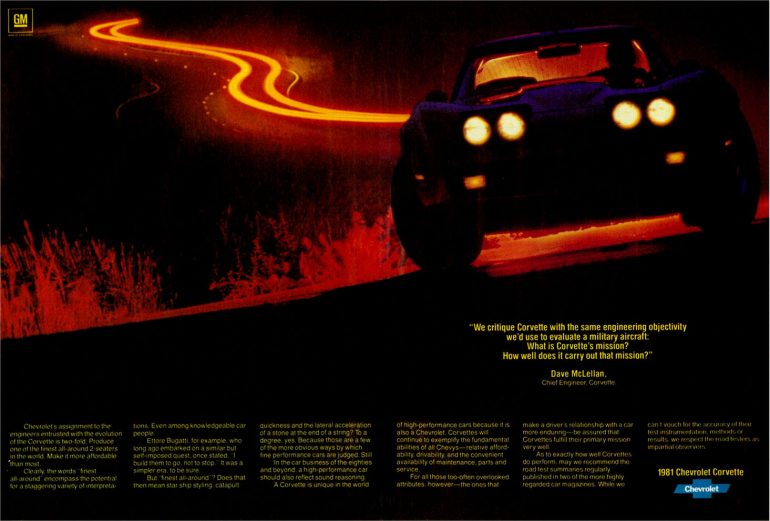
For nine weeks in the summer of 1981 Chevrolet built Corvettes in two states at once. The first Bowling Green car was finished on June 1, the last St. Louis car on August 1, and because Kentucky sprayed enamel with clear coat while Missouri still used lacquer, the same color got two codes and two names: a St. Louis Silver Metallic is code 13 and a Bowling Green one is code 33. One Bright Blue Metallic car and three White Pearlescent cars were built along the way.
DID YOU KNOW
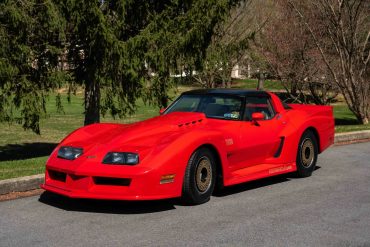
No factory special models in 1981; the Bowling Green two-tones (RPO D84, 5,352 cars) and the first Kentucky-built cars are the year’s collectibles. Greenwood’s GTO and Daytona widebody conversions are the year’s special Corvettes.
The Sport Coupe listed at $16,258.52, nearly $2,000 above the 1980 year-end figure, with the L81, four-speed or automatic, leather, air conditioning, the tilt-telescopic column, power windows, sport mirrors, an AM-FM radio, a quartz clock, the convenience group, power steering and brakes, the alarm and Positraction all standard.
The four-speed (RPO MM4) went into 5,575 cars, 14 percent, and the Turbo Hydra-Matic 350C (RPO MX1) into 35,031. The two-tone paint (RPO D84, $399.00) went on 5,352 Bowling Green cars; the Gymkhana suspension (RPO FE7, $57.00) under 7,803, heavy-duty shocks alone (RPO F51, $37.00) under 1,128, the performance axle (RPO G92, $20.00) into 2,400, the trailer package (RPO ZN1, $110.00) on 916 and the California certification (RPO YF5, $46.00) on 4,951.
Aluminum wheels (RPO N90, $428.00) went on 36,485 cars, 90 percent; the defogger (RPO C49, $119.00) into 36,893; power door locks (RPO AU3, $145.00) into 36,322; the power antenna (RPO U75, $55.00) into 32,903; speed control with resume (RPO K35, $155.00) into 32,522; the new six-way power seat (RPO A42, $183.00) into 29,200; glass roof panels (RPO CC1, $414.00) onto 29,095, 72 percent, and the new electric sport mirrors (RPO DG7, $117.00) onto 13,567.
The electronically tuned radios were the expensive upgrades: 22,892 cassette stereos (RPO UM6, $423.00), 8,262 8-track stereos (UM4, $386.00), 2,349 cassette-and-CB sets (UN5, $750.00) and 792 8-track-and-CB sets (UM5, $712.00), with 5,145 plain stereos (U58, $95.00) and 315 radio-delete credits (UL5, $118.00). The P255/60R15 tires with matching spare (RPO QXH, $491.92) went on 18,004 cars and the P225/70R15 white-letters (QGR, $72.00) on 21,939; the roof-panel carrier (RPO V54, $135.00) on 3,303.
A typical automatic with glass tops, defogger, locks, speed control, aluminum wheels, white-letter tires, cassette, antenna and power seat came to about $18,250; a Bowling Green two-tone with the 60-series tires, FE7, electric mirrors and the cassette-CB set to about $19,600.
The published color totals add up to 40,586, twenty short of production, with three White Pearlescent cars inside the White count.
MORE: PRICING, OPTIONS & COLORS / RPO CODES
| CODE | DESCRIPTION | QUANTITY | RETAIL PRICE |
|---|---|---|---|
| 1YY87 | Base Corvette Sport Coupe | 40,606 | $16,258.52 |
| A42 | Six-Way Power Driver Seat (reclining; new) | 29,200 | $183.00 |
| AU3 | Power Door Locks | 36,322 | $145.00 |
| C49 | Rear Window Defogger (electric) | 36,893 | $119.00 |
| CC1 | Removable Glass Roof Panels | 29,095 | $414.00 |
| D84 | Two-Tone Paint (Bowling Green cars; four combinations) | 5,352 | $399.00 |
| DG7 | Electric Sport Mirrors (new) | 13,567 | $117.00 |
| F51 | Heavy Duty Shock Absorbers | 1,128 | $37.00 |
| FE7 | Gymkhana Suspension (heavy-duty springs and shocks, rear anti-roll bar, thicker front bar) | 7,803 | $57.00 |
| G92 | Performance Axle Ratio (3.07:1 with automatic) | 2,400 | $20.00 |
| K35 | Speed Control with Resume | 32,522 | $155.00 |
| MM4 | 4-Speed Manual Transmission, Wide Ratio (standard; last year) | 5,575 | no charge |
| MX1 | Turbo Hydra-Matic 350C 3-Speed Automatic with Lock-Up Converter | 35,031 | no charge |
| N90 | Cast Aluminum Wheels (set of 4, steel spare) | 36,485 | $428.00 |
| QGR | White Letter Steel-Belted Radial Tires, P225/70R15 | 21,939 | $72.00 |
| QXH | White Letter Steel-Belted Radial Tires, P255/60R15 (with matching spare) | 18,004 | $491.92 |
| U58 | AM-FM Stereo (upgrade from the standard AM-FM radio) | 5,145 | $95.00 |
| U75 | Power Antenna | 32,903 | $55.00 |
| UL5 | Radio Delete | 315 | $118.00 credit |
| UM4 | AM-FM ETR Stereo with 8-Track Tape | 8,262 | $386.00 |
| UM5 | AM-FM ETR Stereo with 8-Track and 40-Channel CB | 792 | $712.00 |
| UM6 | AM-FM ETR Stereo with Cassette | 22,892 | $423.00 |
| UN5 | AM-FM ETR Stereo with Cassette and 40-Channel CB | 2,349 | $750.00 |
| V54 | Roof Panel Carrier (rear luggage rack for the T-tops) | 3,303 | $135.00 |
| YF5 | California Emission Certification | 4,951 | $46.00 |
| ZN1 | Trailer Package (FE7, heavy-duty radiator and alternator) | 916 | $110.00 |
| CODE | EXTERIOR (PLANT) | TOTAL | INTERIOR |
|---|---|---|---|
| 10 | White (St. Louis) | 6,387 | Black, Charcoal, Camel, Dark Blue, Dark Red, Medium Red, Silver Gray |
| 19 | Black (St. Louis) | 4,712 | Black, Charcoal, Camel, Dark Red, Medium Red, Silver Gray |
| 75 | Red (St. Louis) | 4,310 | Black, Charcoal, Camel, Medium Red, Silver Gray |
| 59 | Beige (St. Louis) | 3,842 | Camel, Dark Blue, Dark Red, Medium Red |
| 84 | Charcoal Metallic (St. Louis) | 3,485 | Black, Charcoal, Camel, Medium Red, Silver Gray |
| 33 | Silver Metallic (Bowling Green) | 3,369 | Charcoal, Dark Blue, Dark Red, Silver Gray |
| 13 | Silver Metallic (St. Louis) | 2,590 | Black, Charcoal, Dark Blue, Medium Red, Silver Gray |
| 28 | Dark Blue Metallic (St. Louis) | 2,522 | Camel, Dark Blue, Medium Red, Silver Gray |
| 50 | Beige (Bowling Green) | 2,239 | Charcoal, Camel, Dark Blue, Dark Red |
| 79 | Maroon Metallic (St. Louis) | 1,618 | Black, Charcoal, Camel, Medium Red, Silver Gray |
| 80 | Autumn Red Metallic (Bowling Green) | 1,505 | Charcoal, Camel, Dark Red, Silver Gray |
| 06 | Mahogany Metallic (St. Louis) | 1,092 | Camel, Dark Red |
| 52 | Yellow (St. Louis) | 1,031 | Black, Charcoal, Camel |
| 39 | Charcoal Metallic (Bowling Green) | 613 | Charcoal, Dark Red, Silver Gray |
| 38 | Dark Blue Metallic (Bowling Green) | 496 | Camel, Dark Blue, Silver Gray |
| 74 | Dark Bronze Metallic (Bowling Green) | 432 | Charcoal, Camel |
| 98 | Dark Claret Metallic (Bowling Green) | 341 | Camel, Dark Red, Silver Gray |
| 24 | Bright Blue Metallic (St. Louis) | 1 | Charcoal, Camel, Dark Blue, Silver Gray |
| 33/38 | Two-tone Silver / Dark Blue (Bowling Green, RPO D84) | incl. above | Dark Blue, Silver Gray |
| 33/39 | Two-tone Silver / Charcoal (Bowling Green, RPO D84) | incl. above | Charcoal, Silver Gray |
| 50/74 | Two-tone Beige / Dark Bronze (Bowling Green, RPO D84) | incl. above | Camel |
| 80/98 | Two-tone Autumn Red / Dark Claret (Bowling Green, RPO D84) | incl. above | Dark Red, Silver Gray |
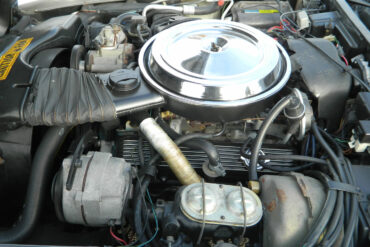
One engine replaced three. The L81 was the L48’s 350 at 8.2:1 with the 1980 California LG4’s electronics: a Rochester E4ME Quadrajet under Computer Command Control, an oxygen sensor in the exhaust and an electronic control module adjusting mixture and timing in a closed loop, which let one calibration pass in all fifty states. It made 190 hp net at 4,200 rpm and 280 lb-ft at 1,600, carried magnesium valve covers and stainless tubular exhaust manifolds to save weight, and ran a small engine-driven fan backed by an electric auxiliary fan for quiet.
The Borg-Warner four-speed, sold in California again, was the last manual gearbox offered on a C3; the Turbo Hydra-Matic 350C’s lock-up converter, commanded by the same computer, locked in second and third at steady speed.
Final drives dropped to 2.87 (automatic) and 2.72 (four-speed) for the EPA cycle, with a 3.07 performance axle (RPO G92) for 2,400 buyers. Period tests put an automatic at about 8 seconds to 60 and 16.2 seconds in the quarter.
The chassis was the 1980 car’s with one famous part: a single transverse rear spring molded in fiberglass-reinforced plastic, 8 pounds in place of the 44-pound steel nine-leaf, fitted to automatic cars with the standard suspension and the first plastic spring on a production car; four-speed and Gymkhana (RPO FE7, $57.00) cars kept steel.
Aluminum wheels went on 90 percent of cars and the P255/60R15 tires on 44 percent. Four-wheel discs, power steering, the aluminum differential housing and crossmember, the 24-gallon tank and the 98-inch wheelbase carried over, and the car weighed about 3,300 lb.
MORE: FULL SPECIFICATIONS / ENGINE
| SPEC | 1981 CORVETTE |
|---|---|
| Engine | 350 ci (5.7 L) small-block V-8, RPO L81, the only engine; hydraulic lifters, catalytic converter, unleaded fuel, HEI ignition, Computer Command Control carburetor with oxygen sensor (closed loop) in all 50 states, magnesium valve covers, stainless tubular exhaust manifolds, auxiliary electric cooling fan with a smaller engine-driven fan |
| RPO L81 | 350/190 hp net @ 4,200 rpm, 280 lb-ft @ 1,600 rpm, 8.2:1, cast crank, two-bolt mains, Rochester E4ME Quadrajet, aluminum intake; casting 14010207 with 462624 heads; California cars identical with the YF5 certification ($46.00; 4,951 cars) |
| RPO FE7 | Gymkhana suspension: higher-rate springs, firmer shocks, thicker front anti-roll bar and rear bar; 7,803 cars, $57.00; heavy-duty shocks alone (RPO F51, $37.00) on 1,128 |
| Transmission | 4-speed wide-ratio Borg-Warner (RPO MM4) standard, 5,575 cars, available in California for the first time since 1975 and for the last time on a C3; 3-speed Turbo Hydra-Matic 350C (RPO MX1) with a computer-controlled lock-up torque converter in second and third, at no charge in 35,031 cars, 86 percent |
| Axle ratio | 2.87:1 with the automatic (3.07:1 with the performance axle, RPO G92, $20.00; 2,400 cars); 2.72:1 with the four-speed; Positraction standard; aluminum differential housing |
| Front suspension | Independent; short-long arm, coil springs, anti-roll bar; aluminum crossmember; FE7 heavy-duty |
| Rear suspension | Independent; frame-mounted differential, half-shafts, trailing arms; transverse spring a single fiberglass-reinforced plastic leaf (8 lb against the 44-lb steel nine-leaf) on automatic cars with the standard suspension; steel spring on four-speed and FE7 cars |
| Brakes | Four-wheel disc, 11.75-in rotors, four-piston calipers, dual-circuit master cylinder, power assist standard |
| Steering | Saginaw recirculating ball, power assist standard, 16.1:1; tilt-telescopic column standard |
| Body | 1980 body unchanged; two-tone paint (RPO D84, $399.00) in four combinations on 5,352 Bowling Green cars; St. Louis cars in lacquer, Bowling Green cars in base-coat enamel with clear coat, with separate color codes at each plant; glass roof panels (RPO CC1, $414.00) on 29,095 cars, 72 percent |
| Interior | Quartz clock standard; electronically tuned (ETR) radios with the AM-FM set standard; six-way power driver’s seat that reclines (RPO A42, $183.00; 29,200 cars); electric sport mirrors (RPO DG7, $117.00; 13,567); speed control with resume (RPO K35); leather standard, cloth and leather at no cost in eight colors |
| Wheels & tires | 15 x 8 in steel Rally wheels or 15 x 8 cast aluminum (RPO N90, $428.00; 36,485 cars, 90 percent); P225/70R15 steel-belted radials standard, raised-white-letter on 21,939 (RPO QGR); P255/60R15 white-letter tires with matching spare (RPO QXH, $491.92) on 18,004 |
| Fuel tank | 24 gal; unleaded fuel only |
| Wheelbase | 98 in |
| Overall length / width / height | 185.3 in / 69.0 in / 48.1 in |
| Track, front / rear | 58.7 in / 59.5 in |
| Curb weight | approx. 3,300 lb |
| 0–60 mph | approx. 8.1 sec (automatic, period tests); approx. 7.8 sec (four-speed) |
| Quarter mile | approx. 16.2 sec @ 85 mph |
| Top speed | approx. 120 mph |
| Production | 40,606 coupes: 31,611 at St. Louis (through August 1, 1981) and 8,995 at Bowling Green (from June 1, 1981) |
| Assembly | St. Louis, Missouri and Bowling Green, Kentucky; engines from Flint |
The 1981 Corvette is the first with the 17-character VIN: 1G1AY8764BS followed by a sequence number from 400001 to 431611 for the 31,611 St. Louis cars, or 1G1AY8764B5 followed by 100001 to 108995 for the 8,995 Bowling Green cars. The 1 is the United States, G General Motors, 1 Chevrolet, A the manual-belt restraint system, Y the Corvette series, 87 the fastback coupe, 6 the L81 (the only engine), the ninth character a check digit that varies from car to car, B the 1981 model year and the eleventh character the plant, S for St. Louis or 5 for Bowling Green. The VIN plate is on the left front hinge pillar, with the trim tag on the same pillar carrying the body build date (St. Louis used month letters A to L from August 1980; Bowling Green used B05 onward), the trim code (642 Camel leather, for instance) and the paint code or, on two-tone cars, both codes.
The engine pad on the right front of the block carries the Flint V prefix, the build date and a suffix: ZDA or ZDC for the L81 with four-speed, ZDD with automatic and ZDB for California automatics. Every engine is casting 14010207 with 462624 heads and an E4ME Quadrajet numbered 17081217 (manual), 17081228 (automatic) or 17081218 (California automatic), with distributor 1103443. The VIN plant character should agree with the paint: a St. Louis car wears a lacquer code (13 Silver, 28 Dark Blue), a Bowling Green car an enamel code (33, 38) and only Bowling Green cars carry the D84 two-tone. The sequence number, the trim-tag date and the engine date should fall in order, and the fiberglass rear spring belongs only on an automatic car without FE7.
MORE: VIN DECODER / PRODUCTION
| POSITION | MEANING |
|---|---|
| 1G1 (First through Third) | Country, maker, make: 1 = built in the USA, G = General Motors, 1 = Chevrolet (the new 17-character VIN) |
| A (Fourth) | Restraint system: A = manual belts |
| Y (Fifth) | Series: Y = Corvette |
| 87 (Sixth & Seventh) | Body: 87 = two-door fastback coupe (the only body) |
| 6 (Eighth) | Engine: 6 = 350/190 L81, the only engine |
| x (Ninth) | Check digit, calculated from the other sixteen characters |
| B (Tenth) | Model year: B = 1981 |
| S or 5 (Eleventh) | Assembly plant: S = St. Louis, Missouri; 5 = Bowling Green, Kentucky |
| 400001–431611 or 100001–108995 (Twelfth through Seventeenth) | Production sequence: 4xxxxx for the 31,611 St. Louis cars, 1xxxxx for the 8,995 Bowling Green cars |
Fourteen solid colors across two plants and four Bowling Green two-tones: White (6,387), Black (4,712), Red (4,310), Beige (3,842 St. Louis and 2,239 Bowling Green), Charcoal (3,485 and 613), Silver (2,590 and 3,369), Dark Blue (2,522 and 496), Maroon (1,618), Autumn Red (1,505), Mahogany (1,092), Yellow (1,031), Dark Bronze (432), Dark Claret (341) and a single Bright Blue; eight interior colors in standard leather or no-cost cloth and leather.
The 1981 shares the bottom of the C3 market with the 1976–80 standard coupes and sits a little under the 1982 Collector Edition, which is the car that draws money in the last two years. Within the year the order is four-speed cars first, as the last C3 manuals and only 14 percent of production, then low-mileage Bowling Green cars, especially two-tones, then St. Louis automatics, with original paint, glass tops and the standard leather mattering more than small mileage differences; a first-week Bowling Green car with documentation is the historical pick. A clean automatic with air and glass tops remains one of the cheapest ways into a Corvette that runs on anything and starts every morning, which is the L81’s real virtue.
Results tracked by Classic.com from May through October 2026: original 1981s sold for $29,000 at GAA in July for an 822-mile car, $20,900 and $18,700 at Mecum Nashville in September for cars with 45,000 and 43,000 miles, $19,250 on Bring a Trailer, $16,500 (a four-speed) and $15,400 at Mecum Harrisburg and $9,900 at Hagerty, with a 9,000-mile car bid to $24,000 at Mecum Nashville without selling; modified cars made $28,000 at Hagerty, $17,600 at Mecum Fort Worth, $15,300 and $13,750 on Bring a Trailer (both four-speeds), and projects $5,500 to $13,950. Dealers’ last asking prices on cars that sold or were withdrawn ran $12,900 to $31,995. In autumn 2026 original coupes were offered at $13,900 to $34,995, the top figure a 35,000-mile four-speed, and customs at $26,500 to $59,900. Check whether a result includes the buyer’s premium (Mecum and Barrett-Jackson results do, Bring a Trailer bids do not), and treat asking prices and unsold high bids separately from completed sales.
Verification is simpler than in any other C3 year because there is one engine: the eighth VIN character is always 6, so the questions are the plant and the gearbox. The eleventh character should be S for St. Louis with a 4xxxxx sequence or 5 for Bowling Green with 1xxxxx, the paint code on the trim tag should belong to that plant, and a two-tone should be a Bowling Green car. The engine pad should carry a V prefix and ZDA, ZDC, ZDD or ZDB on a 14010207 block with the partial VIN matching the car, and a four-speed car should show ZDA or ZDC and a steel rear spring. The plastic rear spring is correct only on an automatic car without the Gymkhana suspension; many have been swapped either way. Original N90 wheels carry Kelsey-Hayes and Mexico markings, and the quartz clock and ETR radio are the dash markers.
The C3 body sits on the C2’s birdcage and rusts in the same places: the windshield frame, the door hinge pillars, the frame kickups over the rear wheels and around the trailing-arm mounts, the lower doors and the steel floor pan, which rusts where carpet holds water. The thin 1980–81 hood and door skins stress-crack, the urethane bumper covers crack and sag as their hardware corrodes, the headlights run on vacuum, which leaks at the actuators and check valves until nothing works, and the original catalytic converter is often gone. The T-top seals leak, glass panels more than fiberglass ones, and the bonded rear glass can delaminate. Early Bowling Green paint, applied while the shop was being sorted out, is known for peeling clear coat; St. Louis lacquer crazes instead. Computer Command Control is simple and well understood, but the ECM, oxygen sensor and E4ME carburetor need someone who knows them. Trailing-arm bushings, half-shaft U-joints and the four-piston calipers (weeping unless sleeved) are the usual mechanical work. Budget for the bumper covers, the vacuum system, seals and brakes on any 1981 that has sat.
MORE: THE MARKET
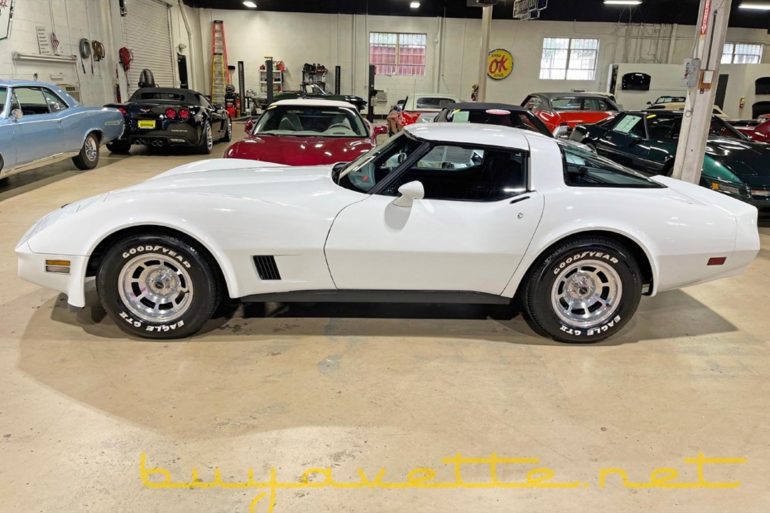
Get all the latest news stories, upcoming auctions, prices, videos and more about the 1981 Chevrolet Corvette! The latest headlines here.


Chevrolet built 40,606 Corvettes for 1981, all fastback T-top coupes: 31,611 at St. Louis, Missouri, which built its last Corvette on August 1, 1981, and 8,995 at the new Bowling Green, Kentucky plant, which built its first on June 1. Of the total, 5,575 had the four-speed, 35,031 the automatic, 36,485 aluminum wheels, 29,095 glass roof panels, 29,200 the new power seat, 7,803 the Gymkhana suspension and 5,352 the Bowling Green two-tone paint.
In 2026, original 1981 Corvettes sold for $9,900 to $20,900 at auction for driven cars, with an 822-mile car making $29,000 at GAA and a 9,000-mile car bid to $24,000 without selling; modified cars sold for $13,750 to $28,000 and projects for $5,500 to $13,950. Dealers asked $13,900 to $34,995 for original coupes, the top figure a four-speed, and up to $59,900 for customs. The 1981 is priced with the 1976–80 standard coupes and below the 1982 Collector Edition.
One: the 190-hp L81 350, the first Corvette engine with Computer Command Control in every state, with an oxygen sensor, a closed-loop Rochester E4ME Quadrajet, magnesium valve covers, stainless tubular exhaust manifolds and an auxiliary electric fan. It replaced the L48, L82 and the California 305 and made 280 lb-ft at only 1,600 rpm. The four-speed was standard and sold in California again, for the last time on a C3; the Turbo Hydra-Matic 350C with a lock-up converter went into 86 percent of cars.
Fourteen solid colors, several with two codes because St. Louis sprayed lacquer and Bowling Green sprayed enamel with clear coat: White (6,387), Black (4,712), Red (4,310), Beige (3,842 and 2,239), Charcoal (3,485 and 613), Silver (2,590 and 3,369), Dark Blue (2,522 and 496), Maroon (1,618), Autumn Red (1,505), Mahogany (1,092), Yellow (1,031), Dark Bronze (432), Dark Claret (341) and one Bright Blue, plus four Bowling Green two-tones (Silver/Dark Blue, Silver/Charcoal, Beige/Dark Bronze, Autumn Red/Dark Claret) on 5,352 cars. Interiors came in silver gray, charcoal, black, dark blue, camel, cinnabar, dark red and medium red leather, or cloth with leather at no cost.
The Sport Coupe was $16,258.52 with the L81, either transmission, leather, air conditioning, tilt column, power windows, sport mirrors, an AM-FM radio, a quartz clock and the convenience group all standard. The two-tone paint was $399.00, aluminum wheels $428.00, glass roof panels $414.00, the 60-series tires $491.92, the power seat $183.00, the cassette stereo $423.00 and the cassette-CB set $750.00. A typical automatic with glass tops, aluminum wheels, cassette and power seat came to about $18,250, and a loaded Bowling Green two-tone to about $19,600.
Production moved from St. Louis to Bowling Green, Kentucky, with both plants building cars in June and July 1981; Bowling Green used enamel and clear coat and offered four two-tones. A single 190-hp L81 with Computer Command Control replaced the L48, L82 and California 305, the four-speed returned to California in its last C3 year, the automatic gained a lock-up converter, automatic cars got a fiberglass rear spring and taller 2.87 gearing, a quartz clock and electronically tuned radios became standard, a six-way reclining power seat and electric mirrors were new options, and the VIN grew to 17 characters.
The eleventh character of the VIN: S means St. Louis and the sequence number starts with a 4 (400001–431611); 5 means Bowling Green and the sequence starts with a 1 (100001–108995). The paint code on the trim tag confirms it, because each plant had its own codes for the shared colors (St. Louis Silver is 13, Bowling Green Silver is 33) and only Bowling Green cars carry the D84 two-tone. Bowling Green cars were built from June 1, 1981 and have enamel paint under clear coat; St. Louis cars, built through August 1, are lacquer.
1981 Corvette Advertisements / 1981 Corvette Colors / 1981 Corvette Engine / 1981 Corvette Factory Options / 1981 Corvette For Sale / 1981 Corvette Maintenance / 1981 Corvette Mods / 1981 Corvette Owners Manual / 1981 Corvette Performance / 1981 Corvette Posters / 1981 Corvette Pricing / 1981 Corvette Production / 1981 Corvette Recalls / 1981 Corvette Research / 1981 Corvette RPO Codes / 1981 Corvette Sales Brochures / 1981 Corvette Special Model Overview / 1981 Corvette Specifications / 1981 Corvette Technical Research / 1981 Corvette Service Bulletins / 1981 Corvette VIN Numbers