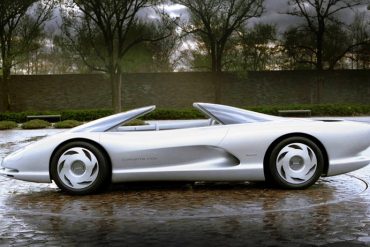
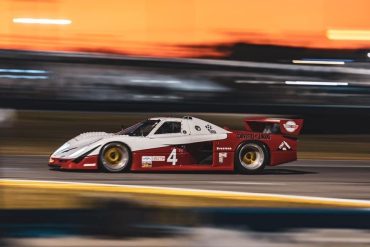
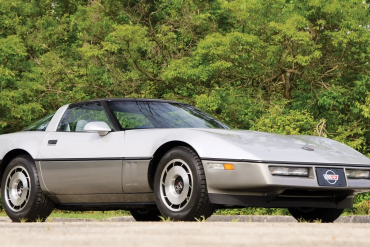
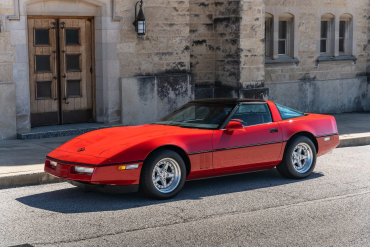
The first of these cars was the 1985 Corvette Indy Concept vehicle. It was developed as a “pushmobile,” meaning that it was a non-functioning, full-size clay mockup that was developed to test market interest in the concept. The car featured the same mid-engine configuration that Zora Arkus-Duntov had always envisioned for the Corvette program.
Quick Nav: Story · Specials · Price & Options · VIN · Specs · Technical · Pics & Videos · The Market · All · FAQs
The Basics
Model & Gen: 1985 Corvette (C4)
Body Type: Two-door hatchback coupe with lift-off one-piece roof panel; no convertible offered
VIN: 1G1YY0787F5100001 – 1G1YY0787F5139729
Original Price: $24,403.00 (16-inch wheels and tires now included)
Colors: 10 solid colors plus three two-tones (RPO D84); Bright Red on one car in four
Engine: 350 ci L98 with Tuned-Port Injection, 230 hp: the first year of the TPI small-block
Transmission: 700-R4 four-speed overdrive automatic (MX0) standard; Doug Nash 4+3 four-speed manual with overdrive (MM4) at no cost, 9,576 cars
Units Produced: 39,729 (all hatchback coupes; no convertible)
The Overview
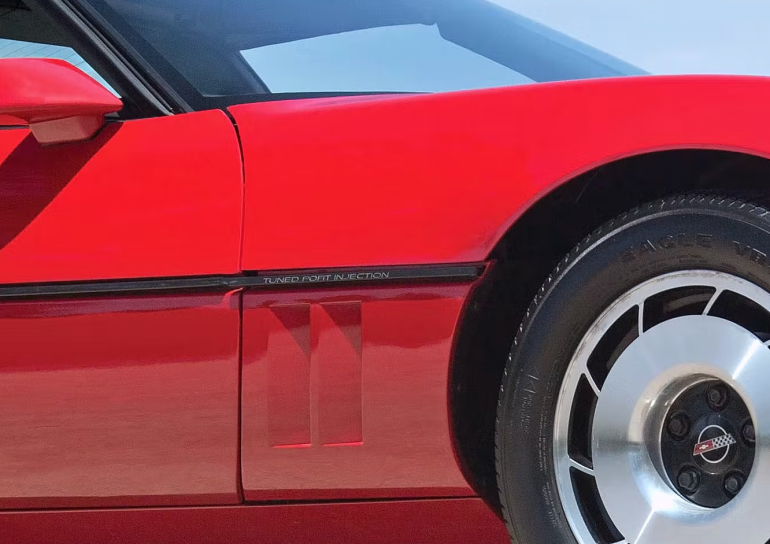
The 1985 Corvette is the 1984 with the complaints answered. The biggest answer was under the clamshell: the Cross-Fire Injection 350 was replaced by the L98, the same cast-iron small-block with Tuned-Port Injection, a GM system built around Bosch parts – a hot-wire mass-airflow sensor, eight Bosch port injectors fed from a cast-aluminum plenum through long, curved tuned runners that packed the cylinders at low and middle speeds. It made 230 hp at 4,000 rpm and 330 lb-ft at 3,200, up 25 hp and 40 lb-ft, and it did it on less fuel; “Tuned Port Injection” badges replaced “Cross-Fire Injection” on the fenders, the only external change. The 700-R4 overdrive automatic stayed standard, and the Doug Nash 4+3, now with a reprogrammed overdrive controller, the switch moved from the console to the shift knob and a stronger 8.5-inch Dana 44 differential, was again a no-cost option, taken by 9,576 buyers, about one in four.
The chassis was tuned to the road rather than the test track. Base spring rates fell 26 percent at the front and 25 percent at the rear, with shock valving to match, and even the Z51 Performance Handling Package was softened, its larger front and rear stabilizer bars restoring the roll stiffness the softer springs gave up; Z51 now put 9.5-inch wheels at all four corners with Delco-Bilstein gas shocks and heavy-duty cooling, and because the 16-inch wheels and Goodyear Eagle VR50 tires were now built into the base price, its cost fell from $600.20 to $470.00. John Heinricy’s engineers dropped the car three-quarters of an inch, cutting the drag coefficient to 0.33, added a degree of caster for straight-line stability, fitted a bigger brake master cylinder and booster, and went after the squeaks and rattles. Inside, the digital instrument graphics were redrawn for legibility and the Lear Siegler sport seats could at last be had in leather.
The press noticed. Car and Driver ran the quarter in 14.1 seconds at 97 mph in an automatic, saw 150 mph, and called the Corvette the fastest production car in America, a claim that reportedly sent Porsche engineers to buy two 1985s and ship them to Weissach for a teardown. The price rose to $24,403 (about $2,000 more than the real 1984 figure once the mandatory wheel package is counted), the seventeen-month first year was over, and production settled to 39,729, still more than any year from 1980 to 1982. Three in four buyers took leather; nine in ten took the Bose stereo. Today the 1985 is the first C4 most people should buy: all the 1984’s hardware with the engine it should have had, the ride it should have had and the same low prices, a few thousand dollars above a 1984 and well below the 1986–87 cars with their convertibles and anti-lock brakes.
The 1985 Corvette Story
While there were few who questioned the technological superiority of the 1984 C4 over earlier generations of Corvette, its lack of robust horsepower and outright performance left many questioning this new version of America’s most beloved sports car. Chevrolet listened to the criticisms and quickly began to revamp the Corvette platform to become a more competitive contender.
After all, the U.S. economy was beginning to rebound from the recession that had plagued the United States (and indeed, the entire world) in the early eighties. The cost of fuel dropped as the world economy saw an oil glut – the result of conservation after the 1970s energy crises. This new oil surplus (and corresponding drop in fuel prices) quickly brought back buyers who were once more looking for big, powerful, performance cars.
In addition, Ronald Reagan and his administration had convinced Japanese automakers to voluntarily limit their car exports to the United States via the Voluntary Restraint Agreement (VRA), which had the intended result of encouraging American consumers to purchase American-made automobiles.
When the C4 Corvette returned for a second year in 1985, it did so with some much needed improvements.
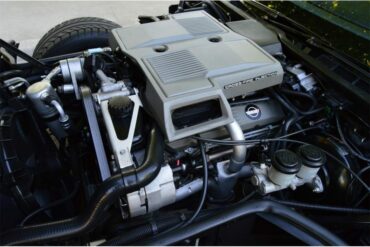
Gone forever was the Cross-Fire Injection System that had been introduced as part of the C4 only a year earlier (and survived a single production year on the C4). Replacing this awkward and somewhat uninspired system was a new “Tuned Port Injection” system built around Bosch components, with a new intake manifold. This new system provided an individual fuel injector for each engine cylinder, featured tuned runners and included a new mass air flow sensor, all of which would aid in the car’s improved performance.
In fact, the introduction of the new “Tuned-Port Injection” system improved the engine output by 25 horsepower, pushing the engine to a total of 230 bhp at 4,000 rpm. Similarly, the engine’s torque was increased by 40 lb-ft, to 330 lb-ft at 3,200 rpm (versus 290 lb-ft at 2,800 rpm on the 1984). The fact that these changes were so extensive, and that they had dramatically improved Corvette’s performance, motivated Chevrolet to use an entirely new designation for the engine – and thus the L98 was born.
Just as the engine had received an overhaul, the Doug Nash 4+3 Overdrive manual transmission underwent a less radical, but equally important, upgrade to help improve its performance. For the 1985 model, the 4+3 received a heavy-duty 8.5-inch differential ring gear (the Dana 44, in place of the 7.875-inch Dana 36) for extra longevity. As a convenience factor, the transmission’s override button was relocated from the console to atop the shift knob. Further, the transmission’s onboard computer was reprogrammed to make the overdrive function less intrusive. Additionally, the electronics governing the lockup torque converter clutch were also revised.
Another item that General Motors sought to resolve in the 1985 Corvette was the car’s harsh, and often unforgiving, ride. Responding to the many complaints they received, Chevrolet softened both the spring and shock rates on all Corvettes – even those with the Z51 suspension package.
With regard to the Z51 package, other suspension changes were introduced as well. This option now included larger fore and aft stabilizer bars which helped to offset total roll stiffness after GM introduced the softer suspension calibrations. Further, the package now put 9.5-inch-wide wheels at the front as well as the rear. Also included were Delco-Bilstein gas-pressurized shocks and a revised heavy duty cooling system. The Delco-Bilstein shocks were also offered as a separate option on the base level Corvette.
Just as General Motors had made improvements to the steering and suspension systems, GM engineers continued to take great interest in how the C4 Corvette handled. After all, the C4 Corvette had been spawned off the design criteria that what it lacked in horsepower would be compensated for in car structure, design and drivability. As production of the 1985 Corvette progressed, the Z51 suspension package option continued to undergo revisionary design work, a process that was led by GM engineer John Heinricy. His intent was to develop the Corvette to a point where it could be classified as a “showroom stock GT car.”
Interestingly, the changes that Heinricy made to the suspension resulted in the 1985 Corvette being lowered ¾ of an inch. This change, though nearly indistinguishable to the naked eye, reduced the drag coefficient to 0.33. With the 3.07:1 rear axle, the 1985 Corvette could reach 150 miles per hour. Of course, achieving 150 miles per hour still required the upgraded rear end, but overcoming this particular speed barrier had been accomplished and solidified the C4 Corvette as a more serious sports car in the eyes of performance enthusiasts.
Did you know? The exterior styling of the C4 Corvette was completely unchanged from 1984 to 1985 with the exception of the side badges on the front fenders of the car, which were changed from Cross-Fire Injection to Tuned-Port Injection. Because of the harsh ride experienced by owners of the 1984 Corvette, the spring rates were decreased in 1985 - a 26% reduction in the front springs, a 25% reduction in the rear.
As GM engineers set out to have Corvette achieve higher speeds, it was determined that the steering caster angle should be increased by one degree (to a total of four degrees) to produce better straight-line stability. Similarly, the braking system was bolstered to produce greater braking power by the addition of a larger brake master cylinder and brake booster as well as different brake pad linings. These minor, but significant changes were just a few of the many considerations that GM engineers were making when responding to the criticisms they had received on the 1984 Corvette.
While the appearance of the C4 Corvette was well received by critics and enthusiasts alike, there were still several small refinements that were made to its cosmetic appearance. The interior received a minor facelift which included revised instrument graphics and optional leather upholstery for the more expensive Lear Siegler sport seats. Though subtle, these changes further solidified the overall aesthetic quality of the car. Additionally, Chevy engineers began seeking out and eliminating the sources of the rattles and squeaks that had been such a constant annoyance to consumers who had purchased the 1984 model.
Despite its many improvements, the 1985 Corvette was still met with a mix of praise and criticism. Reviewers complimented its improved braking and road handling characteristics. At the same time, they criticized the revised short rack steering. In fact, automotive testers claimed that the steering was too quick for around-town use. Further, the ride was still deemed as being overly harsh despite the refinements that had been made to the suspension system. Ultimately though, the overall opinion of the 1985 Corvette was that General Motors had improved on their earlier efforts and had taken the C4 in the right direction.
In 1985, the Chevy Corvette sold for approximately half of the comparably equipped Porsche 928, yet was capable of handling/performing at the same level as the German sports car. In fact, when doing a performance comparison of the 1985 Corvette and the Porsche 928, the Corvette outran the Porsche and was named the Fastest Car In America after hitting top speeds of 150 miles per hour. The result, combined with the Corvette’s return to racing in 1985, was – so the story went – unsettling enough that Porsche’s engineers bought two 1985 Corvettes, shipped them to Germany and took them apart in an attempt to determine what made them so quick!
Car and Driver magazine was among the automotive media that celebrated the new model’s improved automotive refinements. After sampling two Corvettes, one with an automatic transmission and the base suspension and one with the upgraded Z51 suspension and a manual transmission, they recorded results that were considered more than respectable for their time. The automatic ran a quarter mile time of just 14.1 seconds at 97 miles per hour. The manual version ran the quarter mile in 14.4 seconds at 95 miles per hour. Car and Driver went on to proclaim the Corvette America’s fastest production car, with a 150-mph top speed. In less than two years’ time, General Motors had succeeded in improving the performance of the C4 to a point where it could rival the competition worldwide.
One of the great challenges that was about to be set forth by General Motors was the development of an entirely new engine. After all, the current L98 350 cubic inch small-block V8, (with its cast iron block and its rocker operated valve gear), was nearly thirty years old and, despite the refinements of the fuel injection system at the beginning of the model year, was not the performance powerhouse that had become synonymous with earlier generations of Corvette. Still, Federal edicts of the day made the idea of reworking the generations-old V8 into something more powerful an unlikely course of action. Despite that fact, it was in 1985 that GM made the decision to begin the fundamental reworking of the 350 small block – and would ultimately lead to the development of an all new V8 engine.
It was decided that the revised engine would have to be capable of returning the same fuel economy as the L98 engine but would have to achieve the performance levels of Ferrari, Aston Martin and Porsche. In the words of Chevrolet engineer Fred Schaafsma, this new engine (and the Corvette it would power) was to be “…the best performing production car in the world.” Ironically, that reworking would impact the future of Corvette for all time, giving birth to one of the greatest Corvettes ever – the ZR1.
Production Volumes
The cost of these improvements brought a sizable increase in the price of the 1985 Corvette. The cost of the C4 (base price) jumped from $21,800 in 1984 to $24,403 just a year later. With the seventeen-month 1984 model year over, sales fell to 39,729, almost 12,000 fewer than 1984 but still more than any year from 1980 to 1982. Despite the decline in sales, General Motors knew that they were moving in the right direction with this new design, and continued to lay out further design revisions which would help the Corvette gain greater success in the years to come.

The 1985 Corvette featured an all new Tuned Port Injected V8 Engine that carries the designation "L98".
1985 Corvette Digital Dashboard.

The 1985 Corvette Indy Concept "Pushcar" was developed solely for the benefit of introducing the concept at the 1986 Auto Show.When Car and Driver clocked a 1985 Corvette at 150 mph and named it the fastest production car sold in America, ahead of the Porsche 928 at roughly twice the price, the story at the time was that Porsche bought two 1985 Corvettes, shipped them to Germany and took them apart to find out how. The Corvette’s half-price performance also made it the only American car in the magazine’s 1985 Ten Best list.
DID YOU KNOW
Special & Limited Edition Models
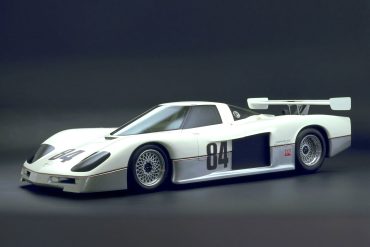
No limited editions in 1985 either: the specials are the Corvette Indy, the mid-engined, four-wheel-drive show car that debuted at Detroit in January 1986 as the first step toward the ZR-1, and the Corvette GTP, the turbo-V6 Lola-based IMSA prototype that was a Corvette in name only.
Price & Options
Core Features & Factory Options
The 1985 Corvette listed at $24,403.00, $2,603 above the 1984’s list price, though the real increase was about $2,000 because the 16-inch wheel and tire package that every 1984 had to carry at $561.20 was now part of the car; the L98, the 700-R4 automatic, air conditioning, power windows, the tilt-telescopic column, the lift-off roof panel, cloth seats, digital instruments and an AM-FM radio were standard, and 39,729 were built, every one a coupe.
The Z51 Performance Handling Package dropped to $470.00 now that the wheels were standard, and its take rate dropped too, from half of 1984’s buyers to 14,802, or 37 percent; 9,333 took the Delco-Bilstein shocks alone (RPO FG3, $189.00), 17,539 heavy-duty cooling (V08, $225.00) and 5,447 the 3.07:1 performance axle for the automatic (G92, $22.00). The Doug Nash 4+3 (RPO MM4) was again free and went into 9,576 cars, up from 6,443.
Two-tone paint (D84, $428.00) went on 6,033 cars and California emissions (NN5, $99.00) on 6,583.
Leather was the story inside: the interior trim counts show 30,955 of the 39,729 cars with leather, on the base seats (RPO AR9, $400.00) or, for the first time, on the Lear Siegler sport seats (AQ9, $1,025.00 with leather, $625.00 in cloth; 5,661 cloth sport seats were built), leaving only 3,112 cars with the standard cloth. The six-way power seat (RPO AG9, $215.00) went into 37,856 cars, cruise control (K34, $185.00) into 38,369, power door locks (AU3, $170.00) into 38,294, the defoggers (Z6A, $160.00) into 37,720, the Delco-Bose stereo (UU8, $895.00) into 35,998 and the glass roof panel with its stronger tint (CC3, $595.00) onto 28,143, nearly double 1984’s count.
Other radios: 2,958 plain cassette stereos (UM6, $122.00), 16 cassette-and-CB sets (UN8, $215.00), the last year for the CB, and 172 radio-delete credits (UL5, $256.00). A typical car with leather, power seat, cruise, locks, defoggers, Bose and the glass roof came to about $27,000, and a Z51 4+3 car with the same equipment about $27,500.
The published color totals add up to 39,729 exactly.
MORE: PRICING, OPTIONS & COLORS / RPO CODES
| CODE | DESCRIPTION | QUANTITY | RETAIL PRICE |
|---|---|---|---|
| 1YY07 | Base Corvette Hatchback Coupe (L98, 700-R4 automatic, 16-inch wheels and P255/50VR16 tires, cloth seats, lift-off roof panel, air conditioning, power windows, digital instruments) | 39,729 | $24,403.00 |
| AR9 | Base Seats, leather | – | $400.00 |
| AG9 | Six-Way Power Driver Seat | 37,856 | $215.00 |
| AQ9 | Sport Seats, leather (inflatable lumbar, power side bolsters; new in leather) | – | $1,025.00 |
| AQ9 | Sport Seats, cloth | 5,661 | $625.00 |
| AU3 | Power Door Locks | 38,294 | $170.00 |
| CC3 | Removable Transparent (glass) Roof Panel, stronger sun screening | 28,143 | $595.00 |
| D84 | Two-Tone Paint (three combinations) | 6,033 | $428.00 |
| FG3 | Delco-Bilstein Gas Shock Absorbers (Z51 shocks without the package) | 9,333 | $189.00 |
| G92 | Performance Axle Ratio, 3.07:1 (automatic cars) | 5,447 | $22.00 |
| K34 | Cruise Control with Resume | 38,369 | $185.00 |
| MM4 | Doug Nash 4+3 Four-Speed Manual with Overdrive (Dana 44 axle, shifter-mounted overdrive switch) | 9,576 | no charge |
| NN5 | California Emission Requirements | 6,583 | $99.00 |
| UL5 | Radio Delete | 172 | $256.00 credit |
| UM6 | AM-FM ETR Stereo with Cassette | 2,958 | $122.00 |
| UN8 | AM-FM ETR Stereo with Citizens Band | 16 | $215.00 |
| UU8 | Delco-Bose AM-FM Stereo with Cassette | 35,998 | $895.00 |
| V08 | Heavy-Duty Cooling (heavy-duty radiator, auxiliary fan, oil cooler) | 17,539 | $225.00 |
| Z51 | Performance Handling Package (heavy-duty springs and shocks, Bilstein shocks, larger stabilizer bars, fast-ratio steering, 9.5-inch wheels front and rear, heavy-duty cooling) | 14,802 | $470.00 |
| Z6A | Rear Window and Side Mirror Defoggers | 37,720 | $160.00 |
| CODE | EXTERIOR | TOTAL | INTERIOR |
|---|---|---|---|
| 81 | Bright Red | 10,424 | Carmine, Graphite, Saddle, Medium Gray |
| 41 | Black | 7,603 | Carmine, Graphite, Saddle, Medium Gray |
| 40 | White | 4,455 | Carmine, Graphite, Saddle, Medium Blue, Medium Gray |
| 18 | Medium Gray Metallic | 2,519 | Graphite, Medium Gray |
| 23 | Medium Blue Metallic | 2,041 | Medium Blue |
| 13 | Silver Metallic | 1,752 | Graphite, Medium Gray |
| 63 | Light Bronze Metallic | 1,440 | Bronze |
| 53 | Gold Metallic | 1,411 | Saddle |
| 66 | Dark Bronze Metallic | 1,030 | Bronze |
| 20 | Light Blue Metallic | 1,021 | Medium Blue |
| 63/66 | Two-tone Light Bronze / Dark Bronze (RPO D84) | 2,393 | Bronze |
| 13/18 | Two-tone Silver / Medium Gray (RPO D84) | 2,170 | Graphite, Medium Gray |
| 20/23 | Two-tone Light Blue / Medium Blue (RPO D84) | 1,470 | Medium Blue |
Specifications & Performance
Engine & Transmission
The L98 was the 350 small-block the C4 should have had from the start: casting 14010207 with 462624 cast-iron heads at 9.0:1, hydraulic lifters and HEI, now topped by Tuned-Port Injection, a GM design built from Bosch components in which a hot-wire mass-airflow sensor in the inlet duct meters air to a cast-aluminum plenum, eight long, curved aluminum runners deliver it to the ports and eight Bosch electronic injectors fire into them in sequence under a new ECM. The long runners trade top-end breathing for torque where a street car lives: 230 hp at 4,000 rpm and 330 lb-ft at 3,200, against the Cross-Fire 350’s 205 and 290, with better fuel economy.
The 700-R4 four-speed overdrive automatic (RPO MX0) was standard with a 2.73:1 axle (3.07:1 with RPO G92); the Doug Nash 4+3 manual (RPO MM4, no charge) carried a 3.07:1 axle in the new 8.5-inch Dana 44 in place of the 1984’s 7.875-inch Dana 36, with its overdrive controller reprogrammed to engage less often and the lock-out switch moved during the year from the console to the top of the shift knob.
Car and Driver’s automatic ran 0–60 in 5.7 seconds and the quarter in 14.1 at 97 mph; their 4+3 Z51 car ran 14.4 at 95, and both would reach 150 mph with the 3.07 axle, which made the Corvette the fastest production car sold in America that year.
The chassis was the 1984 uniframe with aluminum control arms and fiberglass monoleaf springs front and rear, but the base spring rates fell 26 percent at the front and 25 percent at the rear, the shock valving was softened to match and the ride height dropped three-quarters of an inch, taking the drag coefficient from 0.34 to 0.33; caster went from three degrees to four for straight-line stability. The Z51 package was softened too, with larger stabilizer bars front and rear to restore roll stiffness, Delco-Bilstein gas shocks, heavy-duty cooling and 9.5-inch wheels at all four corners in place of 1984’s 8.5-inch fronts; the 13.0:1 fast-ratio steering stayed, and reviewers still found it too quick around town.
The Girlock four-wheel discs got a larger master cylinder and booster with new pad linings. Dimensions were unchanged at a 96.2-inch wheelbase, 176.5 inches long, 71.0 wide and 46.7 high, with a curb weight of about 3,230 lb.
MORE: FULL SPECIFICATIONS / ENGINE
| SPEC | 1985 CORVETTE |
|---|---|
| Engine | 350 ci (5.7 L) small-block V-8, RPO L98, the only engine: Tuned-Port Injection, a GM system built from Bosch components with a hot-wire mass-airflow sensor, cast-aluminum plenum, eight long tuned runners and eight electronic port injectors; “Tuned Port Injection” fender badges replace “Cross-Fire Injection” |
| RPO L98 | 350/230 hp net @ 4,000 rpm, 330 lb-ft @ 3,200 rpm, 9.0:1, 4.00 x 3.48-in bore and stroke, cast-iron heads, hydraulic lifters, HEI; casting 14010207 with 462624 heads; engine suffix ZDF (automatic); up 25 hp and 40 lb-ft on the 1984 L83 |
| Transmission | 700-R4 four-speed automatic with overdrive and lock-up converter (RPO MX0) standard; Doug Nash 4+3 four-speed manual (RPO MM4, no charge, 9,576 cars) with electro-hydraulic overdrive in 2nd, 3rd and 4th, reprogrammed for 1985, lock-out switch moved from console to shift knob during the year |
| Axle ratio | 2.73:1 automatic, 3.07:1 manual and with RPO G92 ($22.00, 5,447 cars); Dana 36 (7.875-in) with the automatic, Dana 44 (8.5-in ring gear) new behind the manual; limited-slip standard |
| Chassis | Welded steel uniframe with bolt-on aluminum front crossmember; aluminum driveline support beam; ride height lowered 0.75 in, caster increased from 3 to 4 degrees |
| Front suspension | Independent; forged-aluminum control arms, transverse fiberglass monoleaf spring with rate reduced 26 percent, tubular shocks (Delco-Bilstein gas shocks with Z51 or RPO FG3), anti-roll bar |
| Rear suspension | Independent five-link; transverse fiberglass monoleaf spring with rate reduced 25 percent, aluminum trailing arms and tie rods, half-shafts, anti-roll bar |
| RPO Z51 | Performance Handling Package, $470.00, 14,802 cars: heavy-duty springs (softer than 1984) with larger front and rear stabilizer bars, Delco-Bilstein shocks, 13.0:1 fast-ratio steering, heavy-duty cooling, 16 x 9.5-in wheels front and rear |
| Brakes | Four-wheel Girlock discs, 11.5-in vented rotors, aluminum calipers; larger master cylinder and booster and new pad linings for 1985 |
| Steering | Rack-and-pinion with power assist, 15.5:1 (13.0:1 with Z51); tilt-telescopic column standard |
| Body | Unchanged 1984 fiberglass hatchback coupe: clamshell hood, lift-off roof panel (glass panel RPO CC3, $595.00, 28,143 cars, stronger sun screening), frameless rear glass hatch, hidden rotating headlamps; Cd 0.33 at the lower ride height; two-tone paint (RPO D84, $428.00) in three combinations on 6,033 cars |
| Interior | Digital instrument panel with revised graphics, cloth base seats (leather RPO AR9, $400.00), Lear Siegler sport seats in cloth (RPO AQ9, $625.00, 5,661) or, new, leather ($1,025.00), six-way power driver seat (RPO AG9, $215.00, 37,856), Delco-Bose sound system (RPO UU8, $895.00, 35,998); 30,955 cars with leather |
| Wheels & tires | 16 x 8.5-in cast aluminum wheels (16 x 9.5 front and rear with Z51) with Goodyear P255/50VR16 Eagle VR50 unidirectional tires, now included in the base price |
| Fuel tank | 20 gal; unleaded only; in-tank electric pump |
| Wheelbase | 96.2 in |
| Overall length / width / height | 176.5 in / 71.0 in / 46.7 in (0.75 in lower than 1984) |
| Track, front / rear | 59.6 in / 60.4 in |
| Curb weight | approx. 3,230 lb |
| 0–60 mph | 5.7 sec (Car and Driver, automatic); about 6.0 sec with the 4+3 |
| Quarter mile | 14.1 sec @ 97 mph (Car and Driver, automatic); 14.4 sec @ 95 mph (4+3 Z51) |
| Top speed | 150 mph with the 3.07:1 axle, the fastest American production car of 1985 |
| Production | 39,729 hatchback coupes; no convertible |
| Assembly | Bowling Green, Kentucky |
Vehicle Identification Numbers (VIN)
39,729 (all hatchback coupes; no convertible) Cars, 1G1YY0787F5100001 TO 1G1YY0787F5139729
The 1985 Corvette carries the 17-character VIN 1G1YY0787F5 followed by a sequence number from 100001 to 139729, one for each of the 39,729 cars. General Motors changed the fourth and fifth positions for 1985: the 1 is the United States, G General Motors, 1 Chevrolet, Y (fourth) the Corvette car line and Y (fifth) the base series (the second Y would become a Z on the 1990–95 ZR-1), 07 the two-door hatchback coupe (the only body style), 8 the L98 Tuned-Port Injection 350 (the only engine), the ninth character a check digit that varies with the car, F the 1985 model year and 5 the Bowling Green plant. The VIN plate sits on top of the dash on the driver’s side, visible through the windshield at the base of the left pillar; the body and trim plate on the left door-hinge pillar carries the build date, the paint code (both codes on two-tone cars) and the trim code, such as 122 for Graphite leather.
The engine pad at the front of the block on the passenger side carries the plant prefix, the build date and a suffix, ZDF on automatic cars; every 1985 engine is casting 14010207 with 462624 heads under the Tuned-Port plenum and runners with the mass-airflow sensor in the inlet duct. With one body, one engine and one plant, verification is about options: a Z51 car should show the 9.5-inch wheels at the front as well as the rear, Bilstein shocks and the heavy-duty cooling; a 4+3 car should have the Dana 44 differential and, on later cars, the overdrive switch on the shift knob; and the fender badges should read “Tuned Port Injection,” not “Cross-Fire Injection.”
MORE: VIN DECODER / PRODUCTION
| POSITION | MEANING |
|---|---|
| 1G1 (First through Third) | Country, maker, make: 1 = built in the USA, G = General Motors, 1 = Chevrolet |
| Y (Fourth) | Car line: Y = Corvette (new coding for 1985; the 1984 carried a restraint-system letter here) |
| Y (Fifth) | Series: Y = Corvette (Z on the 1990–95 ZR-1) |
| 07 (Sixth & Seventh) | Body: 07 = two-door hatchback coupe, the only 1985 body style |
| 8 (Eighth) | Engine: 8 = 350/230 L98 Tuned-Port Injection, the only engine |
| x (Ninth) | Check digit, calculated from the other sixteen characters |
| F (Tenth) | Model year: F = 1985 |
| 5 (Eleventh) | Assembly plant: 5 = Bowling Green, Kentucky |
| 100001–139729 (Twelfth through Seventeenth) | Production sequence number; 39,729 built |
Pictures, Videos, Wallpapers & Galleries
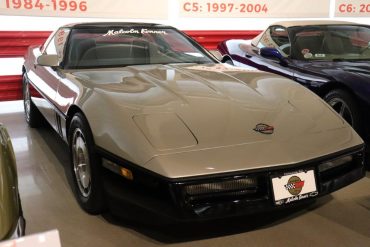
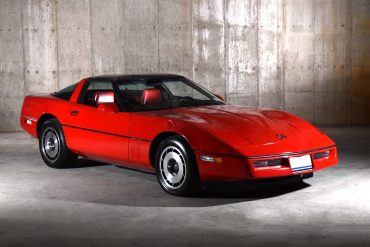
Ten solid colors and three two-tones: Bright Red (10,424), Black (7,603), White (4,455), Medium Gray (2,519), Medium Blue (2,041), Silver (1,752), Light Bronze (1,440), Gold (1,411), Dark Bronze (1,030) and Light Blue (1,021), plus 6,033 two-tones: Light Bronze/Dark Bronze (2,393), Silver/Medium Gray (2,170) and Light Blue/Medium Blue (1,470). Interiors in Graphite, Medium Gray, Medium Blue, Saddle and Bronze cloth or leather and Carmine leather; 30,955 cars had leather, Graphite leather (9,346) the most popular trim.
Market & Buying Guide
For Sale & What They Bring
The 1985 is the C4 to buy if you want the 1984’s looks and hardware without its two first-year faults, and the market prices it that way: a few thousand dollars above a comparable 1984, below the 1986–87 cars with their convertibles, anti-lock brakes and aluminum heads, and far below any ZR-1 or Grand Sport. The cars that bring money are low-mileage, original automatics with leather and the glass roof, and 4+3 Z51 cars with the overdrive still working; two-tones are scarce and sought after, Bright Red and Black are the colors buyers want, and the Lingenfelter and Callaway-modified cars of the period trade on their own merits. The L98 is the engine that made the C4 reliable, so a 1985 needs none of the Cross-Fire apologies a 1984 does, but the digital dash, the 4+3 overdrive and the Bilstein shocks are the same costly weak points.
Results tracked by Classic.com from October 2025 through October 2026 run from $5,500 to $30,800: Mecum sold a car for $30,800 at Kissimmee in January 2026 and a 5,000-mile automatic for $24,200 in Lebanon, Tennessee, in September; Bring a Trailer sold a Miami car for $25,500 in March, a 91,000-mile manual for $14,750 in May, an 8,000-mile 4+3 Z51 for $14,000 in October 2025, a 56,000-mile automatic for $13,500 in August and ordinary cars for $8,200 to $9,500 through the winter and spring; Barrett-Jackson got $17,050 in April, GAA $7,500 and $8,000 in February, Hemmings $6,300 for a 40,000-mile car and Mecum $5,500 for a 93,000-mile car in Kansas City. An 8,000-mile automatic was bid to $13,000 and not sold at Mecum Kissimmee. Dealers’ last asking prices on cars that sold or were withdrawn ran $8,900 to $28,000, and in autumn 2026 the cars on offer were priced from $8,990 for a 135,000-mile car to $23,799 and $24,950 for 11,000- and 8,000-mile manuals, with most between $10,000 and $19,500. Check whether a result includes the buyer’s premium (Mecum and Barrett-Jackson results do, Bring a Trailer bids do not), and treat asking prices and unsold high bids separately from completed sales.
Every 1985 shares one body code, one engine code and one plant, so verification is about options and condition. The VIN should begin 1G1YY0787F5 (the check digit varies) with a sequence number up to 139729, and the trim tag on the door pillar should carry a 1984 or 1985 build date and a paint code that matches the car, two codes on a two-tone. A Z51 car should have 9.5-inch wheels at all four corners, Bilstein shocks and the auxiliary cooling fan; a 4+3 car should have the Dana 44 (the cover is the giveaway) and the overdrive should engage and release with its switch. The engine should carry the Tuned-Port plenum, eight runners and the mass-airflow sensor in the inlet duct, with a ZDF suffix on an automatic car’s pad and the partial VIN matching the car; later L98s with aluminum heads (1986 on) will show different casting numbers.
The digital dash comes first on any C4 inspection: faded or dark LCD panels, lost segments and a dead dimmer are common, and good clusters are scarce and expensive. The L98 itself is strong, but the mass-airflow sensor and its burn-off relay, the cold-start injector, the fuel-pump relay and the oxygen sensor fail, the plenum and runner gaskets leak vacuum, and injectors clog on cars that sit. The 4+3’s overdrive unit leaks and slips and its solenoid fails; many have been bypassed, and the clutch is heavy. The Bilstein shocks are usually worn, the lift-off roof panel and hatch seals leak, the headlight motors strip their plastic gears, the power-antenna masts snap, door-lock actuators and window motors slow, and the uniframe rusts where the battery tray drains onto the frame rail and at the rear kick-ups and trailing-arm mounts. The fiberglass body and the fiberglass springs last; the electronics and the rubber are what the money goes to.
MORE: THE MARKET
Everything We've Published On The 1985 Corvette
Get all the latest news stories, upcoming auctions, prices, videos and more about the 1985 Chevrolet Corvette! The latest headlines here.
FAQs
How many 1985 Corvettes were built?
Chevrolet built 39,729 Corvettes for 1985 at Bowling Green, Kentucky, every one a hatchback coupe. That was almost 12,000 fewer than the seventeen-month 1984 model year but more than any year from 1980 to 1982. Of the cars, 38,369 had cruise control, 38,294 power locks, 37,856 the power seat, 35,998 the Delco-Bose stereo, 30,955 leather, 28,143 the glass roof panel, 17,539 heavy-duty cooling, 14,802 the Z51 Performance Handling Package, 9,576 the Doug Nash 4+3 manual and 6,033 two-tone paint.
How much is a 1985 Corvette worth today?
Between October 2025 and October 2026, 1985 Corvettes sold at auction for $5,500 to $30,800, with most ordinary cars between $8,000 and $15,000: Mecum got $30,800 at Kissimmee and $24,200 for a 5,000-mile car, Bring a Trailer $25,500 for the best of its cars and $8,200 to $14,750 for the rest. Dealers were asking $8,990 to $24,950 in autumn 2026, the top figures for 8,000- and 11,000-mile manuals. A 1985 runs a few thousand dollars above a 1984 and below the 1986–87 cars.
What engine did the 1985 Corvette have?
The L98: the 350 small-block with Tuned-Port Injection, a GM system of Bosch components with a mass-airflow sensor, eight port injectors and long tuned runners on a cast-aluminum plenum, rated at 230 hp at 4,000 rpm and 330 lb-ft at 3,200, up 25 hp and 40 lb-ft on the 1984 Cross-Fire engine. It was the only engine and came with the 700-R4 automatic or the no-cost Doug Nash 4+3 manual. Car and Driver’s automatic ran 0–60 in 5.7 seconds and the quarter mile in 14.1 at 97 mph, and the car would reach 150 mph, the fastest American production car of its year.
What colors did the 1985 Corvette come in?
Ten solid colors and three two-tones. Bright Red (10,424) was the choice of one buyer in four, followed by Black (7,603), White (4,455), Medium Gray (2,519), Medium Blue (2,041), Silver (1,752), Light Bronze (1,440), Gold (1,411), Dark Bronze (1,030) and Light Blue (1,021); the two-tones were Light Bronze/Dark Bronze (2,393), Silver/Medium Gray (2,170) and Light Blue/Medium Blue (1,470). Interiors were Graphite, Medium Gray, Medium Blue, Saddle and Bronze in cloth or leather and Carmine in leather only; Graphite leather (9,346) and Carmine leather (8,272) were the most popular.
How much did the 1985 Corvette cost when new?
The list price was $24,403.00, up $2,603 on the 1984 but only about $2,000 in real terms because the 16-inch wheels every 1984 had to carry at $561.20 were now included. Leather on the base seats was $400.00 and the leather sport seats $1,025.00, the Z51 handling package $470.00, the glass roof $595.00, the Delco-Bose stereo $895.00, the power seat $215.00, cruise control $185.00, power locks $170.00 and two-tone paint $428.00; the 4+3 manual was free. A typical leather, Bose, glass-roof car came to about $27,000.
What changed on the 1985 Corvette?
The engine, the ride and the details. Tuned-Port Injection replaced Cross-Fire Injection, making the 350 the 230-hp L98 with “Tuned Port Injection” fender badges, the only visible change. Spring rates fell about a quarter front and rear, Z51 got bigger stabilizer bars and 9.5-inch wheels at all four corners and dropped to $470.00 because the 16-inch wheels became standard, the car sat three-quarters of an inch lower, caster went up a degree and the brakes got a bigger master cylinder and booster. The 4+3 manual gained a Dana 44 differential, a reprogrammed overdrive and, mid-year, a shifter-mounted switch; the digital dash graphics were redrawn, the sport seats came in leather and the glass roof got a stronger tint.
Is a 1985 Corvette a better buy than a 1984?
For most buyers, yes. The 1985 has the L98 instead of the Cross-Fire 350 (230 hp against 205, with better economy and far fewer driveability complaints), the softened suspension that made the car livable, the stronger Dana 44 behind the manual and the improved dash, for a few thousand dollars more than a 1984. The 1984 remains the cheapest C4 and the only one with Cross-Fire Injection, which gives it a following of its own; the 1986–87 cars add anti-lock brakes, the convertible and aluminum heads at a higher price.
All The Research
1985 Corvette Advertisements / 1985 Corvette Colors / 1985 Corvette Common Issues / 1985 Corvette Engine / 1985 Corvette Factory Options / 1985 Corvette For Sale / 1985 Corvette Maintenance / 1985 Corvette Mods / 1985 Corvette Owners Manual / 1985 Corvette Performance / 1985 Corvette Posters / 1985 Corvette Pricing / 1985 Corvette Production / 1985 Corvette Recalls / 1985 Corvette Research / 1985 Corvette RPO Codes / 1985 Corvette Sales Brochures / 1985 Corvette Special Model Overview / 1985 Corvette Specifications / 1985 Corvette Technical Research / 1985 Corvette Service Bulletins / 1985 Corvette VIN Numbers