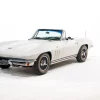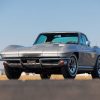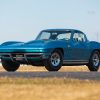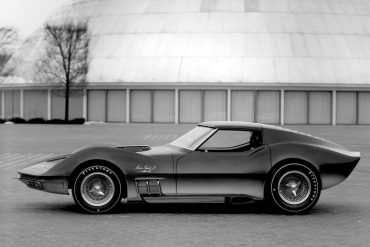
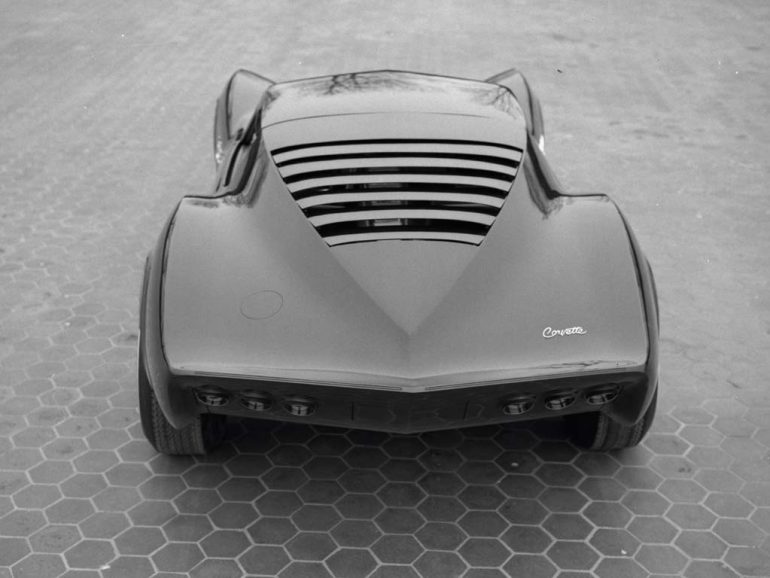
After its 1965 Paris debut, Chevrolet was flooded with requests to build the Mako Shark II. Its retractable bumpers never made production, but its shape became the 1968 Stingray.


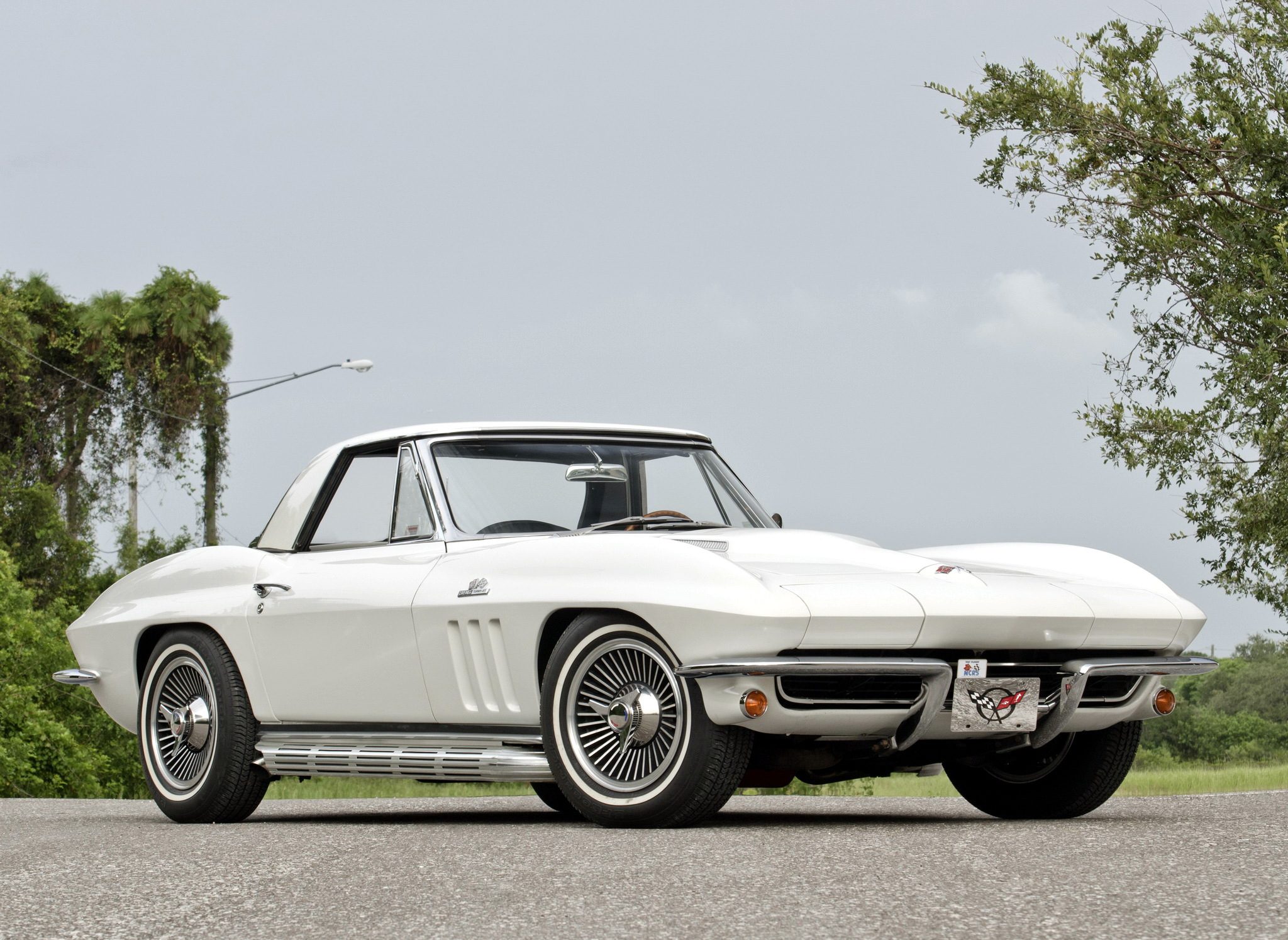
C2 CORVETTE - 1965
Four-wheel disc brakes, the 396 Mark IV big block at mid-year, the new 350-hp L79, side exhaust, knock-offs and a smooth hood: the year the Sting Ray grew up, and 23,564 built, the last with fuel injection until 1982.
Quick Nav: Story · Specials · Price & Options · VIN · Specs · Technical · Pics & Videos · The Market · All · FAQs
Model & Gen: 1965 Corvette (C2)
Body Type: Sport Coupe or Convertible
VIN: 194375S100001 – 194375S123564
Original Price: $4,321 coupe / $4,106 convertible
Colors: 8 (Nassau Blue, Glen Green, Rally Red, Milano Maroon, Silver Pearl, Ermine White, Goldwood Yellow, Tuxedo Black)
Engine: 327 ci V-8, 250 to 375 hp; 396 ci big block, 425 hp (from mid-year)
Transmission: 3-speed manual standard; Muncie 4-speed (M20/M21/M22) and 2-speed Powerglide optional
Units Produced: 23,564
The 1965 Corvette is the C2 with the hardware the chassis had been waiting for. Four-wheel disc brakes, 11.75-inch finned rotors with four-piston calipers, became standard, and only 316 buyers took the $64.50 credit to keep drums. Mid-year, the 396-cubic-inch Mark IV big block arrived as RPO L78 with 425 horsepower, a bulged hood and a new reputation; 2,157 were built in half a season. At the same time the fuel-injected 327 bowed out: 771 L84s were built, and injection would not return to a Corvette until 1982.
In between, the new 350-hp L79 gave the small block a hydraulic-lifter engine that ran like a solid-lifter one, and 4,716 buyers took it. The cosmetics were tidied: the hood lost its depressions and became a single smooth surface, the front fender vents became three functional slots, the grille bars went black, the rocker moldings were redesigned, and inside the instruments got flat black faces and the seats and door panels new patterns. Side-mount exhaust, the telescopic steering column, goldwall tires and leather in eight colors joined the list, and the knock-off wheels sold 1,116 sets.
Production rose for the third straight year to 23,564, two of them built after the line officially closed, with convertibles outselling coupes nearly two to one. Behind the scenes Bill Mitchell’s Mako Shark II was shown in New York in April 1965 and Zora Arkus-Duntov was testing mid-engined prototypes; the C3 argument had begun, and the 1965 is where the C2 peaked as an engineering project.
As the 1965 model year approached, the design team behind the Chevy Corvette continued to refine the overall design of the C2 Sting Ray, making only minor cosmetic changes in the process. Instead, the focus for the second-generation’s third year centralized on some significant mechanical upgrades that would vastly improve the Corvette's already impressive handling and drivability.
At the same time, 1965 would also mark the beginning of the end of the second-generation Corvette as Zora Arkus-Duntov and Bill Mitchell each began championing the effort to develop a third-generation Corvette, although each would bring with him a different interpretation of what that next-generation car would be.
Duntov' s group was actively seeking out ways to develop a mid- or rear-engine Corvette that was synonymous with cars like Porsche's mid-engine Carrera GTS coupe.
By contrast, Mitchell's team had a different vision, one that would be fully realized in the development of the Mako II Concept vehicle, a car that would eventually become known as one of the most famous concept vehicles of all time.
For Duntov, the vision was to design a true mid-engine Corvette that could support a big-block Mark IV engine riding just ahead of the rear wheels. Duntov's group developed a shape for their car's fiberglass body, and even went so far as to assemble a couple of small-scale models in early 1965.
Did you know? The 1965 Mako Shark II was originally called just the “Mako Shark.” However, the moniker was changed to “Mako Shark II” after it was decided to retroactively rename the XP-755 prototype the “Mako Shark I”.
Ultimately, however, a rear- or mid-engine Corvette demanded specific mechanical components that General Motors simply did not provide. While the company had repeatedly attempted to produce a transaxle that was able to withstand the torque of a high-power V-8 engine, the design and the tooling expenses required to develop one that would be used only in a low-volume model would have sent Corvette prices skyrocketing beyond control.
Still, it was decided that if General Motors could not entice consumers with a car that provided leading-edge technology, then Mitchell and company would introduce them to a car that had exotic styling.
Bill Mitchell had actually begun laying out the next generation Corvette in late 1964 with the help of Larry Shinoda and the General Motor's design division. The intent from the onset had been to develop a car that could travel the auto-show circuit to serve as a trial balloon for the next generation Corvette.
Mitchell instructed Shinoda that a suitable preview would have to be ready for the New York International Auto Show before April, 1965. In response to Mitchell's request, Shinoda's team of designers developed a full-size mock up of Mitchell's next vision for the Chevy Corvette, which they dubbed the “Mako Shark II” (so named because of its long, somewhat flattened front-end, which made the car resemble a shark.)
The mock-up, which lacked an engine despite the hood label that read “Mark IV 396”, was rolled out for press release photography in March, 1965. A fully functional Mark Shark II would follow shortly thereafter, fitted with a 427-cubic-inch Mk IV big-block V-8 engine.
Whether viewing the mock-up or the actual prototype, there was no question that the car looked fast. An aggressively pointed prow gave way to a domed hood that signified robust power. In both the mockup and the prototype, the bulging wheelhouses at all four corners of the Corvette only enhanced the already aggressive appearance of the car.
Large, wide Firestone tires were wrapped around the wheels. The mockup featured cast-aluminum side exhaust with finned sidepipes that were painted in crackle black with “fins” which maintained a bright, polished finish.
Changes to this exhaust system were made after the car’s unveiling at the New York Auto Show (prior to the elimination of the side exhaust system from the prototype car completely.)
Measuring three inches longer than the existing Sting Ray, the “Mako Shark II” featured a sleek roofline that rolled back into a tapered exclamation point. That same bodyline continued all the way to the rear of the car, where a pronounced ducktail design defined the rear of the car. The entire car was painted using a careful feathering/blending of colors which only further helped to enhance the appearance that the “Shark II” was some sort of other-worldly design.
Using a blend of browns, blues (including Firefrost Midnight Blue) and grays, the car really started to represent the magnificent beasts of the sea from which so much inspiration was drawn for the car's design.
Even with the development of a new Corvette underway, the current, second-generation Corvette still had the immediate attention of Chevrolet's executives. Given the sales success of the first two model years, there was little doubt by anyone that the 1965 Corvette would be equally successful, or perhaps even surpass previous successes. Given that fact, and the fact that Corvette's best designers were focused on supporting the development of the next generation Corvette, Chevrolet was not making major modifications to the current model.
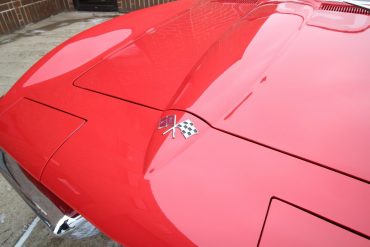
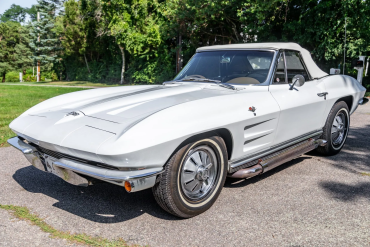
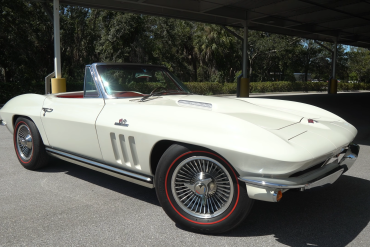
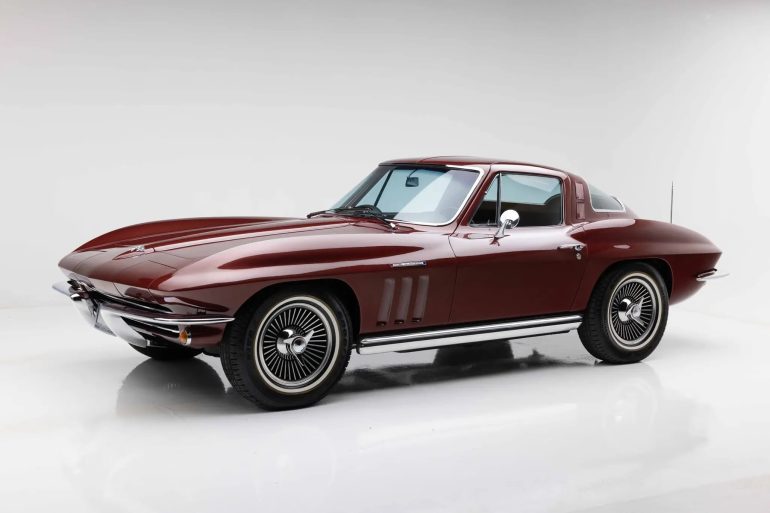
That's not to say there weren't any changes made to the Corvette's appearance. The most notable change to the outward appearance of the car was the removal of the former scoop indentations, which had carried over in the 1964 model (after the faux hood scoops were removed from the 1963 design.)
The new hood, which was now a single, smooth surface, became one of the major differentiating characteristics of the 1965 model year. In addition, the front fenders were redesigned to feature a trio of working exhaust vents (which replaced the previous model's non-functional horizontal “speedline” coves.)
Another notable design change involved refinements to the front grille. For the 1965 model treatment; the inner horizontal grille bars were painted black, but the outer grill remained a bright chrome color, making the overall design unique to the 1965 Corvette. Lastly, the wheel covers and rocker-panel moldings were re-designed for the 1965 model year. The optional knock-off wheel covers now featured a dark gray paint color between the fins.
The interior of the car also received some minor design refinements as well, though these were far more subtle than those made to the Corvette's exterior. In the driver's dashboard, all of the instrument displays were redesigned to include flat black faces.
Elsewhere, the areas around the radio and speaker bezel were now being painted, instead of utilizing the vinyl covering that had been standard on previous models. A more notable improvement involved another change in the design of the car's driver and passenger seats. The new seating surfaces were designed to be slightly larger and more supportive, and the seat backs were now encased in hard plastic backing shells. Complementing the newly evolved seats, the inner door panels were also redesigned and now included fully integrated armrests. Lastly, the interior received new seat belt retractors, a feature that was never before been seen in a Corvette.
While these changes were important to the continued evolution of the Corvette, the focus on the 1965 model year had really been directed at correcting many of the elements found below the car's fiberglass exterior.
A number of noteworthy alterations and additions were made for the 1965 model year - some of which would set a precedent that would carry over to the most current Corvette models being built today. The first of these welcome additions was the introduction of a standard, four-wheel.
The brakes featured a four-piston design with two piece calipers mated to a newly designed brake rotor which utilized cooling fins. The cooling fins helped to dissipate the massive amount of heat being generated during hard braking.
Suspended between the calipers and rotors was an all new semi-metallic brake pad. These pads were designed to remain in constant contact with the brake rotors which aided in keeping the braking surfaces on the rotor free from rust and debris (both of which cause pitting and diminish the lifespan of any brake rotor.)
While the drag created by the contact between the pads and rotors was negligible, the benefits of maintaining the rotor condition helped GM to project a life expectancy of 57,000 miles on the front braking system (which, because of the forward weight transfer, supplied most of the braking effort in all-out stops.) Better still, the expected lifespan of the rear brakes was twice that of the front. Pending federal regulations (at/during the development phase of the 1965 Corvette), a dual master cylinder with separate fluid reservoirs for front and rear lines was also introduced. The newly designed master cylinder helped reduce the overall temperature of the brake fluid, which contributed to brake failure in older models.
The disc brakes were a much needed improvement over the previous braking system. Prolonged testing of the new disc brake system found that repeated stops from 100 miles per hour did not cause any deterioration in the efficiency of the braking system. Equally important was the fact that no matter the condition, all stops were very stable and required a much shorter braking distance than the earlier drum brakes. Despite this, the old drum brake system did remain available to consumers and garnered a $64.50 credit on the overall Corvette purchase price when selected as an option. Despite this, only 316 Corvettes built in 1965 came equipped with the drum brake option.
Another significant improvement and mechanical milestone arrived midway through the 1965 model year. Officially titled the Mark IV, Chevrolet introduced a new, optional, big-block V-8 engine for the first time in a production Corvette. The Mark IV had actually originated in early 1963 as the “mystery” 427 racing engine that had made its first appearance at the Daytona 500. Despite its official title, the engine was marketed as the Turbo Jet and was made available in three varieties, two 396 cubic inch versions, and a 427 (although a fourth, “heavy-duty” 427 was also created for marine use.)
The 396 big-block engines were scheduled to replace Chevy's hallowed, though short-lived 409 cubic-inch by Semon E. “Bunkie” Knudsen (then General Manager of Chevy) that the only viable investment was to develop the most modern engine available, Chevy's engine plant in Tonawanda, New York was retooled to support the production of the Mark IV engine. The engine officially began production in mid-1965.
A number of variants of the Mark IV engine were produced. For its mid-size Chevelle model and all full-size Chevy models, a 325 horsepower and 360 horsepower engine was produced.
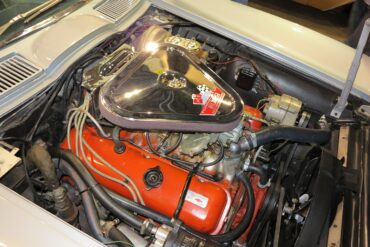
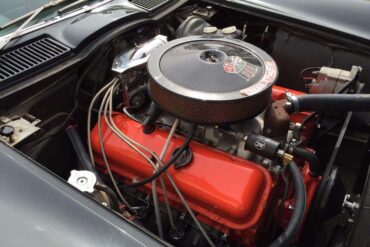
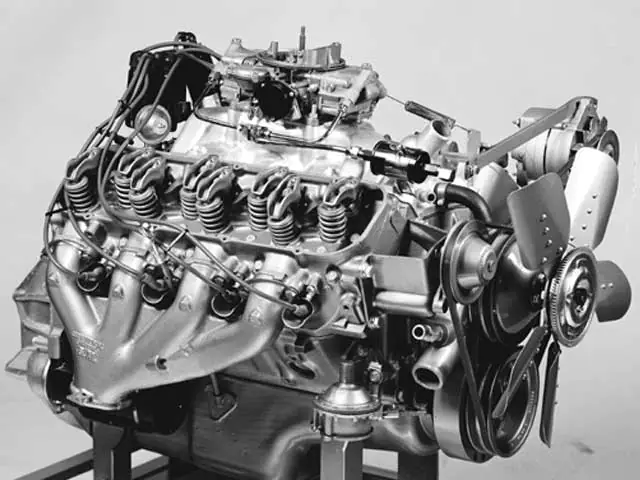
For the Corvette, however, the engine, which was available to consumers under RPO L78, was given 11:1 compression, impact-extruded alloy pistons with chrome rings, solid lifters, a bigger carburetor (and corresponding double-snorkel air cleaner) and an oversized oil pump, all of which helped make this more radical Mark IV engine capable of producing an impressive 425 horsepower.
The big-block also featured free-breathing cylinder heads with staggered valves that had been laid out in a seemingly disorganized fashion, with an appearance reminiscent to porcupine quills, which earned the engine the nickname, 'the porcupine motor.”
The Mark IV engine was an immediate sensation and brought Corvette enthusiasts to their local Chevrolet dealerships in droves. While its introduction late in the model year resulted in limited supply, there was no questioning the long-term potential for an engine that was capable of producing such impressive performance numbers.
Even when equipped with a moderate 3.70:1 rear axle, a Mark IV equipped Corvette could do a standing quarter mile run right around 14 seconds at an impressive 104 miles per hour. Further, given adequate track distance, the car could now reach an overall top speed of nearly 140 mph (again when equipped with the 3.70:1 axle-ratio.)
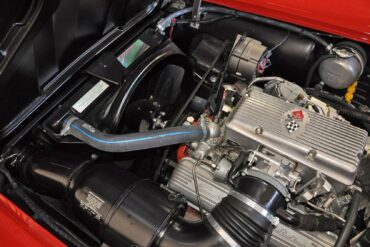
Aside from the late-entry Mark IV, several other engines had remained available for the 1965 model year including a 375 horsepower, 327 cubic-inch small-block V8 that came equipped with fuel injection.
While this small-block engine was an impressive powerhouse in its own right, Chevrolet had definitely recognized that the direction of the powerplant for the Corvettes would center around engine displacement, and so it was decided that all other, smaller engines would ultimately be abandoned in the Corvette line at the end of the 1965 model year. Interestingly, the retirement of the 327ci engine also brought with it the end of the use of fuel injection in Corvettes for the next twenty years.
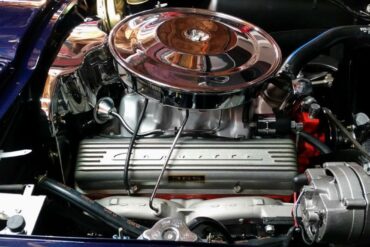
Another new engine did appear in 1965 however. The L79 small block, which was essentially an L76 327 engine featuring a slightly milder hydraulic cam in place of the solid-lifter stick. Operating on an 11:1 compression ratio, the L79 engine was rated at 350 horsepower, and was deemed nearly identical to the L76 on the outside with its chromed air cleaner and finned cast-aluminum valve covers.
In all, the 1965 Sting Ray saw a total of 23,564 units sold, making 1965 the most successful sales year for the Corvette yet. Of all the units built, 15,378 were convertibles, accounting for nearly two-thirds of all Corvettes sold in 1965. By comparison, the coupe sold a mere 8,186 units.
 The 1965 Corvette hood is one of the most notable differences of the model year. Note the complete absence of the hood scoops that were on the original 1963 model.
 The 1965 Corvette Interior featured gauges with flat black faces and painted radio bezels.
 The 1965 Mako Shark II Concept Corvette, designed by Bill Mitchell and Larry Shinoda.
1965 is the only year a Corvette could be ordered with either fuel injection or a big block, and almost no one ordered both ends of the list: 771 fuel-injected L84s against 2,157 396s in half a season. It is also the first Corvette with four-wheel disc brakes, and 316 buyers still paid to have drums instead.
DID YOU KNOW
1965 brought the Mako Shark II, the show car that became the C3, alongside Duntov’s mid-engined experiments and the last of the Grand Sport racing.
The Sport Coupe listed at $4,321 and the convertible at $4,106, and the engine list was the longest yet. The 300-hp L75 at $53.80 was the volume choice on 8,358 cars; the new 350-hp L79 at $107.60 went into 4,716, the 365-hp L76 at $129.15 into 5,011, the 375-hp fuel-injected L84 at $538.00 into 771, and the mid-year 396/425 L78 at $292.70 into 2,157, leaving 2,551 cars with the base 250.
The Muncie four-speed (RPO M20, $188.30) was on 21,107 cars, the heavy-duty M22 on 30, the Powerglide (RPO M35, $199.10) on 2,021, and 406 kept the three-speed. Positraction (RPO G81, $43.05) went into 19,965 cars. The racing options were the 36-gallon tank (RPO N03, $202.30, 41 coupes), the special suspension (RPO F40, $37.70, 975 cars), the off-road exhaust (RPO N11, $37.70, 2,468) and transistor ignition (RPO K66, $75.35, 3,686).
The new options were about looks and comfort: side-mount exhaust (RPO N14, $134.50) on 759 cars, the telescopic steering column (RPO N36, $43.05) on 3,917, the teakwood wheel (RPO N32, $48.45) on 2,259, goldwall tires (RPO T01, $50.05) on 989 and the knock-off wheels (RPO P48, $322.80) on 1,116.
Power steering (RPO N40, $96.85) went into 3,236 cars, power brakes (RPO J50, $43.05) into 4,044, air conditioning (RPO C60, $421.80) into 2,423, power windows (RPO A31, $59.20) into 3,809, the AM/FM radio (RPO U69, $203.40) into 22,113, leather seats into 2,128 and the comfort and convenience group (RPO Z01, $16.15) into 15,397; 316 buyers took the $64.50 drum-brake credit and 39 deleted the heater.
The auxiliary hardtop (RPO C07, $236.75) went onto 7,787 of the 15,377 convertibles. Eight colors were offered with black, white or beige tops; the color totals add up to 23,557, seven short of production.
MORE: PRICING, OPTIONS & COLORS / RPO CODES
| CODE | DESCRIPTION | QUANTITY | RETAIL PRICE |
|---|---|---|---|
| 19437 | Base Corvette Sport Coupe | 8,186 | $4,321.00 |
| 19467 | Base Corvette Convertible | 15,377 | $4,106.00 |
| 402–451 | Genuine Leather Seats (black, red, blue, saddle, silver, green, maroon, white) | 2,128 | $80.70 |
| A01 | Soft Ray Tinted Glass, All Windows | 8,752 | $16.15 |
| A02 | Soft Ray Tinted Glass, Windshield | 7,624 | $10.80 |
| A31 | Power Windows | 3,809 | $59.20 |
| C07 | Auxiliary Hardtop (convertible) | 7,787 | $236.75 |
| C48 | Heater and Defroster Deletion (credit) | 39 | −$100.00 |
| C60 | Air Conditioning | 2,423 | $421.80 |
| F40 | Special Front and Rear Suspension | 975 | $37.70 |
| G81 | Positraction Rear Axle, all ratios | 19,965 | $43.05 |
| G91 | Special Highway Axle, 3.08:1 | 1,886 | $2.20 |
| J50 | Power Brakes | 4,044 | $43.05 |
| J61 | Drum Brakes (substitution credit) | 316 | −$64.50 |
| K66 | Transistor Ignition System | 3,686 | $75.35 |
| L75 | 327ci, 300HP Engine | 8,358 | $53.80 |
| L76 | 327ci, 365HP Engine | 5,011 | $129.15 |
| L78 | 396ci, 425HP Engine (Mark IV big block) | 2,157 | $292.70 |
| L79 | 327ci, 350HP Engine | 4,716 | $107.60 |
| L84 | 327ci, 375HP Engine (Fuel Injection) | 771 | $538.00 |
| M20 | 4-Speed Manual Transmission | 21,107 | $188.30 |
| M22 | 4-Speed Manual, Close Ratio, Heavy Duty | 30 | $171.00 |
| M35 | Powerglide Automatic Transmission | 2,021 | $199.10 |
| N03 | 36 Gallon Fuel Tank (coupe) | 41 | $202.30 |
| N11 | Off-Road Exhaust System | 2,468 | $37.70 |
| N14 | Side-Mount Exhaust System | 759 | $134.50 |
| N32 | Teakwood Steering Wheel | 2,259 | $48.45 |
| N36 | Telescopic Steering Column | 3,917 | $43.05 |
| N40 | Power Steering | 3,236 | $96.85 |
| P48 | Cast Aluminum Knock-Off Wheels (set of 5) | 1,116 | $322.80 |
| P91 | Blackwall Tires, 7.75x15 (nylon cord) | 168 | $15.70 |
| P92 | Whitewall Tires, 7.75x15 (rayon cord) | 19,300 | $31.85 |
| T01 | Goldwall Tires, 7.75x15 (nylon cord) | 989 | $50.05 |
| U69 | AM-FM Radio | 22,113 | $203.40 |
| Z01 | Comfort and Convenience Group | 15,397 | $16.15 |
| CODE | EXTERIOR | TOTAL | SOFT TOP |
|---|---|---|---|
| FF | Nassau Blue | 6,022 | Black, White, Beige |
| GG | Glen Green | 3,782 | Black, White, Beige |
| UU | Rally Red | 3,688 | Black, White, Beige |
| MM | Milano Maroon | 2,831 | Black, White, Beige |
| Silver Pearl | 2,552 | Black, White, Beige | |
| CC | Ermine White | 2,216 | Black, White, Beige |
| XX | Goldwood Yellow | 1,275 | Black, White, Beige |
| AA | Tuxedo Black | 1,191 | Black, White, Beige |
Six engines in one year. The hydraulic-lifter 327s were the base 250 and the 300-hp L75, joined by the new 350-hp L79, essentially the 365-hp L76 with a milder hydraulic cam and the big Holley, which gave almost all the performance with none of the maintenance and became the enthusiast’s small block for years. The solid-lifter 365-hp L76 and the 375-hp fuel-injected L84 carried over, the L84 for the last time. Then in spring 1965 came the Mark IV 396 as RPO L78: 11.0:1 compression, impact-extruded pistons, a forged crank, the staggered-valve “porcupine” heads, a solid-lifter cam and a Holley four-barrel for 425 horsepower and 415 lb-ft, with a domed hood to clear it. On a 3.70 axle it ran the quarter mile in about 14 seconds at over 100 mph.
The chassis finally caught up with the engines. Four-wheel disc brakes with finned rotors and four-piston calipers became standard, the pads riding lightly on the rotors to keep them clean; repeated stops from speed produced no fade, which the drums had never managed. The tires grew to 7.75 x 15, the front fender vents became functional, and side-mount exhaust and a telescopic column joined the options. Period tests put the 396 at 5.4 seconds to 60 mph, the 365-hp L76 at 6.2 and the 300-hp L75 at 7.8. The four-speed went into 90 percent of cars, now in wide-ratio M20, close-ratio M21 and heavy-duty M22 forms, the last on just 30 cars.
MORE: FULL SPECIFICATIONS / ENGINE
| SPEC | 1965 CORVETTE |
|---|---|
| Engines | 327 ci (5.4 L) small-block V-8 in five versions; 396 ci (6.5 L) Mark IV big-block V-8 from mid-year |
| Base engine | 327/250 hp @ 4,400 rpm, 350 lb-ft @ 2,800 rpm, 10.5:1; 2,551 cars |
| RPO L75 | 327/300 hp @ 5,000 rpm, 360 lb-ft @ 3,200 rpm, 10.5:1; 8,358 cars, $53.80 |
| RPO L79 | 327/350 hp @ 5,800 rpm, 360 lb-ft @ 3,800 rpm, hydraulic lifters, 11.0:1, new for 1965; 4,716 cars, $107.60 |
| RPO L76 | 327/365 hp @ 6,200 rpm, 350 lb-ft @ 4,000 rpm, solid lifters, 11.0:1; 5,011 cars, $129.15 |
| RPO L84 | 327/375 hp @ 6,200 rpm, 350 lb-ft @ 4,400 rpm, Rochester fuel injection, 11.0:1; 771 cars, $538.00; the last fuel-injected Corvette until 1982 |
| RPO L78 | 396/425 hp @ 6,400 rpm, 415 lb-ft @ 4,000 rpm, Mark IV big block, 11.0:1, solid lifters, Holley four-barrel, from mid-year; 2,157 cars, $292.70 |
| Transmission | 3-speed manual standard (406 cars); Muncie 4-speed M20 wide-ratio or M21 close-ratio (RPO M20, $188.30; 21,107 cars); M22 heavy-duty close-ratio (30 cars); 2-speed Powerglide (RPO M35, $199.10; 2,021 cars) |
| Axle ratio | 3.36:1 with the 3-speed or Powerglide, 3.70:1 with the 4-speed; 3.08:1 highway axle (RPO G91, 1,886 cars); Positraction (RPO G81, $43.05) on 19,965 cars |
| Front suspension | Independent; short-long arm, variable-rate coil springs, anti-roll bar |
| Rear suspension | Independent; frame-mounted differential, half-shafts, trailing arms, nine-leaf transverse spring |
| Brakes | Four-wheel disc brakes standard for the first time: 11.75-in finned rotors, four-piston calipers; drums available as a $64.50 credit (RPO J61, 316 cars); power assist (RPO J50, $43.05; 4,044 cars) |
| Steering | Recirculating ball; telescopic column (RPO N36, $43.05; 3,917 cars); power steering (RPO N40, $96.85; 3,236 cars) |
| Exhaust | Side-mount exhaust (RPO N14, $134.50; 759 cars), new for 1965; off-road exhaust (RPO N11, $37.70; 2,468 cars) |
| Wheels & tires | 15 x 5.5 in steel wheels, 7.75 x 15 tires (up from 6.70); cast aluminum knock-offs (RPO P48, $322.80; 1,116 cars); goldwall tires (RPO T01, 989 cars) |
| Fuel tank | 20 gal; 36-gallon tank (RPO N03, $202.30) on 41 coupes |
| Wheelbase | 98 in |
| Overall length / width | 175.3 in / 69.6 in |
| Curb weight | 3,145 lb coupe / 3,153 lb convertible |
| 0–60 mph | 5.4 sec (396/425, 4-speed); 6.2 sec (327/365); 7.8 sec (327/300) |
| Quarter mile | approx. 14 sec @ 100+ mph (396/425) |
| Top speed | approx. 130 mph (327/365); 150+ mph claimed (396/425) |
| Production | 23,564: 8,186 coupes and 15,377 convertibles (two cars built after production officially ended) |
| Assembly | St. Louis, Missouri; engines from Flint and Tonawanda |
The 1965 Corvette adopted the thirteen-character VIN used through 1971: 194375S for the Sport Coupe and 194675S for the convertible, followed by a sequence number that begins at 100001 and runs through 123564, shared by both bodies, accounting for each of the 23,564 cars built. The 1 is Chevrolet, 9 the Corvette series, 4 the V-8 engine code, 37 or 67 the body, 5 the model year and S the St. Louis plant. The VIN plate moved to the hinge pillar at the base of the steering column brace, and the number is also stamped on the frame.
The engine pad suffix identifies the engine: HE (250 hp, manual), HO (250, Powerglide), HF (300, manual), HP (300, Powerglide), HT (350 L79), HH (365 L76), HI (365 with transistor ignition), HG (375 L84), HJ (375 with transistor ignition) and IF (396 L78), with further codes for air-conditioned cars. Big-block cars carry a T prefix for Tonawanda on the pad in place of Flint’s F.
MORE: VIN DECODER / PRODUCTION
| POSITION | MEANING |
|---|---|
| 1 (First Digit) | Manufacturer: 1 = Chevrolet |
| 9 (Second Digit) | Series: 9 = Corvette |
| 4 (Third Digit) | Engine: 4 = V-8 |
| 37 / 67 (Fourth & Fifth Digits) | Body: 37 = Sport Coupe, 67 = Convertible |
| 5 (Sixth Digit) | Model year: 5 = 1965 |
| S (Seventh Digit) | Assembly plant: S = St. Louis, Missouri |
| 100001–123564 (Eighth through Thirteenth Digits) | Production sequence number, shared by coupes and convertibles |
Eight colors on the smooth-hood Sting Ray, with Nassau Blue the runaway favorite: Nassau Blue (6,022), Glen Green (3,782), Rally Red (3,688), Milano Maroon (2,831), Silver Pearl (2,552), Ermine White (2,216), Goldwood Yellow (1,275) and Tuxedo Black (1,191).
The 1965 is the C2 with the widest spread of values because it has the widest spread of engines. At the top sit the 771 fuel-injected L84s and the 2,157 first-year big blocks, with a documented 396 coupe or an L84 convertible the cars collectors chase; below them the 365-hp L76 and the 350-hp L79, which is the best-driving small block of the generation; then the 300-hp L75 that most cars have, and the 250s and Powerglides at the entry point. Side exhaust, knock-offs and the 36-gallon tank add value when documented, and all three are easy to add later. Coupes carry a premium over convertibles at every level.
Results tracked by Classic.com for September and October 2026 show the ladder: fuel-injected L84s sold for $101,000 (a coupe on Bring a Trailer) and $89,100 (a convertible at Mecum Nashville); an original 396/425 convertible brought $82,500 at a Hagerty auction and a modified 396 coupe $63,000; L79 convertibles sold for $65,000 and $84,000 on Bring a Trailer and an L76 coupe for $73,500. A 300-hp convertible was bid to $65,000 at Mecum without selling, and modified coupes to $68,000 to $75,000. Dealer asking prices ran $78,000 to $90,000. Check whether a result includes the buyer’s premium, and treat asking prices and unsold high bids separately from completed sales.
Verification starts at the engine pad: the suffix must match the equipment, the block date must precede the car’s build, and a 396 should carry a Tonawanda T prefix and the correct 3855962 block casting. L79 and L76 share a block, so the cam, intake and carburetor decide which is which; an L84 needs a 1965-series Rochester unit, the rarest and most faked engine of the year. The disc brakes should be the original four-piston calipers, often sleeved in stainless, and a drum-brake car needs the J61 documentation to be believed. NCRS judging sheets, old photographs, ownership records and restoration invoices all help, and ask to see dates and scores rather than just the award.
The C2 body is bonded to a steel birdcage, and that is where the expensive problems hide: the windshield frame, the door hinge pillars and, on coupes, the rear window frame rust from inside and are costly to repair. The ladder frame rusts at the kickups over the rear wheels and around the trailing-arm mounts, trailing-arm bushings and half-shaft U-joints wear, and the 1965 calipers weep brake fluid unless they have been sleeved. On the road the independent rear should feel planted, the discs should stop the car straight with a firm pedal, and a big block should idle lumpily, pull hard above 3,500 rpm and run cool in traffic. Most of these cars see few miles, so budget for tires, brakes and fuel-system work on anything that has sat.
MORE: THE MARKET
Get all the latest news stories, upcoming auctions, prices, videos and more about the 1965 Chevrolet Corvette! The latest headlines here.





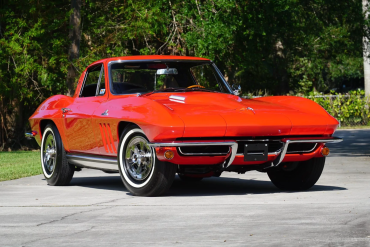
Chevrolet built 23,564 Corvettes for 1965 at St. Louis, Missouri: 8,186 Sport Coupes and 15,377 convertibles, with two cars completed after production officially ended. It was the third record year in a row. Of those, 2,157 had the 396 big block, 771 had fuel injection, 4,716 had the new 350-hp L79, 21,107 had the four-speed, 1,116 had knock-off wheels and 759 had side-mount exhaust.
In late 2026, fuel-injected 1965 Corvettes sold for about $89,000 to $101,000 at auction, original 396 big-block cars for around $82,500, L79 cars for $65,000 to $84,000, and 300-hp cars for roughly $60,000 to $70,000, with coupes above convertibles at each level. Modified cars ran $60,000 to $75,000. The engine, its paperwork and the body style decide the price.
Six: the 327 in 250, 300, 350 (new L79), 365 and 375-hp fuel-injected (L84) versions, and from mid-year the 396-cubic-inch Mark IV big block (L78) with 425 hp, the first big block in a Corvette. 1965 was the last year for fuel injection until 1982. A three-speed manual was standard, the Muncie four-speed went into 90 percent of cars, and the Powerglide automatic was available with the 250 and 300.
Eight: Nassau Blue (6,022 cars), Glen Green (3,782), Rally Red (3,688), Milano Maroon (2,831), Silver Pearl (2,552), Ermine White (2,216), Goldwood Yellow (1,275) and Tuxedo Black (1,191), with black, white or beige soft tops. Leather was available in eight interior colors for the first time.
The Sport Coupe was $4,321 and the convertible $4,106 with the 250-hp engine and three-speed manual. The 396/425 added $292.70, fuel injection $538, the L79 $107.60, the four-speed $188.30, Positraction $43.05, knock-off wheels $322.80, side exhaust $134.50 and air conditioning $421.80. A 396 coupe with the four-speed, Positraction, knock-offs and side exhaust came to about $5,300.
Four-wheel disc brakes became standard, the 396 big block and the 350-hp L79 joined the engine list, and fuel injection made its last appearance. Outside, the hood lost its depressions, the fender vents became three functional slots, the grille bars went black and the rocker moldings were redesigned; side-mount exhaust, knock-off wheels, goldwall tires and a telescopic steering column were new options. Inside, flat-black instrument faces, new seat and door panel designs and leather in eight colors. The VIN went to thirteen characters.
Usually the fuelie, because there are fewer: 771 L84s against 2,157 L78s, and the L84 is the last fuel-injected Corvette of the era. But the 396 was only built for half the year, carries the first big-block hood and badging, and in a coupe with documentation it can match or beat a fuel-injected convertible. Both sit well above the small-block carbureted cars, and both are faked often enough that the engine pad and block casting matter more than the badge.
1965 Corvette Advertisements / 1965 Corvette Colors / 1965 Corvette Common Issues / 1965 Corvette Engine / 1965 Corvette Factory Options / 1965 Corvette For Sale / 1965 Corvette Maintenance / 1965 Corvette Mako Shark II (XP-830) / 1965 Corvette Mods / 1965 Corvette Owners Manual / 1965 Corvette Performance / 1965 Corvette Posters / 1965 Corvette Pricing / 1965 Corvette Production / 1965 Corvette Recalls / 1965 Corvette Research / 1965 Corvette RPO Codes / 1965 Corvette Sales Brochures / 1965 Corvette Special Model Overview / 1965 Corvette Specifications / 1965 Corvette Technical Research / 1965 Corvette Service Bulletins / 1965 Corvette VIN Numbers