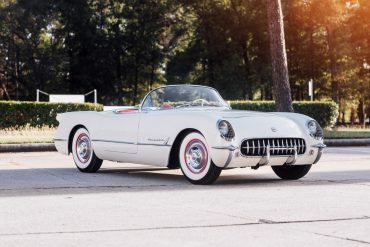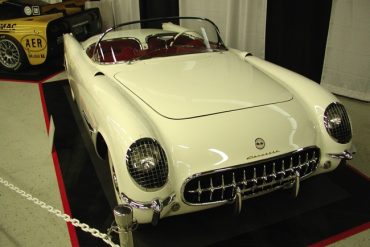
Before the first production Corvette there was EX-122, the Motorama show car built from Harley Earl's Project Opel. Public response in January 1953 pushed GM from prototype to production in six months.


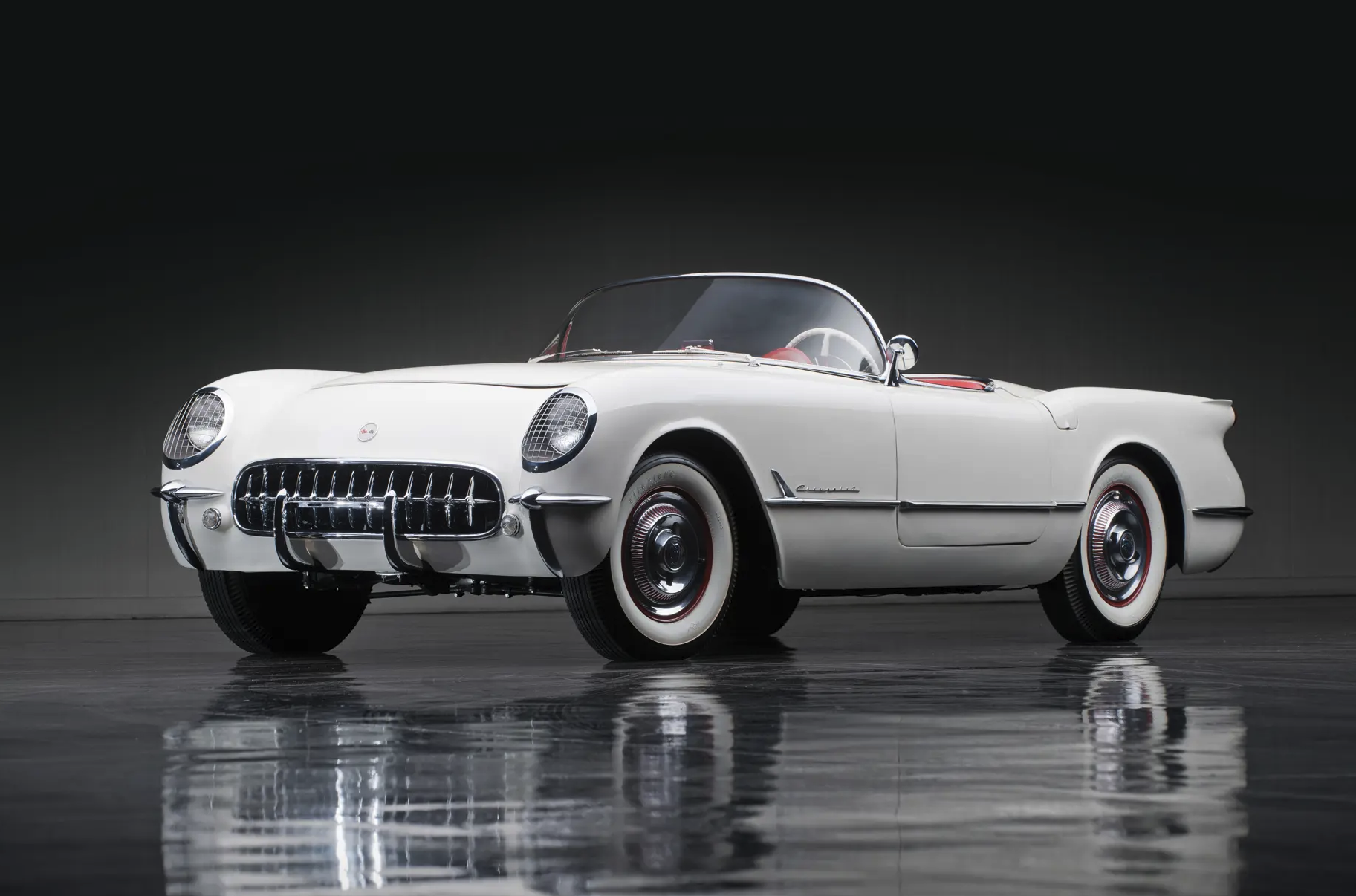
C1 CORVETTE - 1953
The first Corvette: 300 hand-built Polo White roadsters, a 150-hp Blue Flame six, and the start of everything.
Quick Nav: The Story · Specials · Price & Options · VIN · Specs · Technical · Pics & Videos · The Market · All Content · FAQs
Model & Gen: 1953 Corvette (C1)
Body Type: 2 Door Convertible
VIN: E53F001001 – E53F001300
Original Price: $3,498
Engine: “Blue Flame” Inline-6
Transmission: 2 Speed Auto
Units Produced: 300
After the incredible success of the prototype at the 1953 Motorama in New York City, Corvette went from being the fantastic concept car designed by Harley J. Earl to an, (as yet unrealized), production car that was already commanding great deals of attention. Hoping to capitalize on the favorable public opinion and the overwhelmingly positive reviews by the press, General Motors put the Corvette on a fast track to production.
While the reality behind Corvette was that Chevy Division chief Tom Keating and then GM president Harlow Curtice had already green-lighted Earl’s concept car for production, the positive public reaction that the car had received only increased the company’s resolve to bring the Corvette to market as soon as possible.
In order to meet the demands to begin production that had been set upon them by the top people at General Motors, the first Corvettes were literally engineered as they were being fabricated.
Manufacturing problems, such as Glass Reinforced Plastic (GRP, more commonly known as “fiberglass” today) molding techniques were far from being perfected and additional experimentation was necessary before production could truly begin. Chevy had to build several different iterations of the Corvette body before the company heads were convinced that fiberglass was truly the way to go.
The first Corvette (serial number E53F001001) reached the end of the assembly line on June 30, 1953. All 300 cars would go on to be built by hand in the back of a customer delivery garage in Flint, Michigan. Because nobody had ever mass-produced a fiberglass car prior to the Corvette, the process of assembling these first cars was performed largely by trial and error. The first two cars were engineering test cars and, according to official records, were later destroyed. Despite the engineering capacity of the facilities available to the Corvette manufacturing team, the initial target of just 50 cars a month was set while GM continued to sort out the production process behind the assembly of the Corvette’s fiberglass body.
Each fiberglass body began as 46 separate pieces that were supplied by the Molded Fiber Glass Company in Ashtabula, Ohio. Workers had to fit all of these into wooden jigs, then glue them together into the larger subassemblies. All of this increased the probability for error and vastly increased assembly time. Even worse, many of the pieces did not fit together well as delivered because of molding flaws that required still more hand labor to correct.
To eliminate further confusion and additional manufacturing delays, all of the first 300 Corvettes were built the same way, enabling workers to concentrate on putting the bodies together properly without feeling rushed and without the distraction of trim and equipment variations.
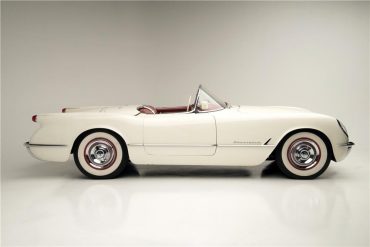
As a result, all 1953 Corvettes were painted Polo White and had Sportsman Red interiors (like the concept car before them), with black tops, 6.70 x 15 four ply whitewall tires, Delco signal-seeking radios, a standard array of analog instruments which included a 5000-rpm tachometer and a counter for total engine revolutions ( a feature that would continue through 1959).
When introduced in 1953, the Corvette featured the “Blue Flame”six cylinder engine (also known as the “Stovebolt Six“ by the engineering teams at GM). Although other of General Motors car models featured V8 engines, they were not willing to share these more powerful engines with the new Chevrolet concept car.
The “Stovebolt” six cylinder was renowned for reliability but with an engine rating of only 105 horsepower, it lacked the performance and sportiness that people expected from a two seat sports car. A more radical camshaft, solid lifters, dual valve springs and a higher compression ratio cylinder head all contributed to an increased engine output of 150 brake horsepower, but still left many potential buyers questioning the overall performance capabilities of the first Corvette.
Even before the first production Corvettes rolled off the assembly lines, the car had began to suffer from a type of “identity crisis.” The term sports car generally indicated a car that had race-track level performance, along with the discomfort and added noise that such a car usually entailed. Attempting to appeal to a broader audience than merely that of the sports-car variety entrepreneurs, Corvette was designed to offer “comfort and convenience” which caused the car to fall dramatically short of the expectations of sports car enthusiasts.
At the same time, the more compact, two seat body and it’s obvious sport car appearance alienated the car from those who regarded it as a viable, weekend cruiser. Adding further insult to injury, the car was somewhat crude, offering awkward, clip-on side curtains with Plexi-glass windows that were drafty and prone to leaks. In an effort to enhance the Corvette’s image as a prestige car, dealers restricted sales to VIPs in each community: mayors, celebrities, industrial leaders and favorable customers. It did not take long for word to spread that the year’s entire expected production had already been spoken for.
In other words, Chevy had made the deliberate choice not to sell Corvettes to the public – at least for the time being. For all the demand the Motorama car had generated, neither consumers nor dealers could obtain one.
As a promotional endeavor, Chevrolet began to use the first available production Corvettes as dealer-display attractions. Each of the eight Chevrolet wholesale regions was assigned a car to send from dealer to dealer for one to three day showings during the last three months of the year. While it is common today for limited production cars to sell out before they are even released, this was a practice that was unheard of in the 1950s.
The Corvette was publicized as being glamorous and exciting, especially compared to the rest of Chevrolet’s more commonplace passenger-cars. The intent was to market pre-sales of the Corvette, combining word-of-mouth testimonials from the selected VIP first owners of the 1953 Corvettes with a marketing campaign that lavished praise on the Corvettes styling, performance and grandeur, enticing would-be buyers into paying a premium for a car which was not yet publicly available.
With news stories circulating across the United States about the Corvette being spotted everywhere but not being available to the public anywhere, many potential consumers began to question whether GM was merely trying to pull a “fast one” by luring prospective buyers into dealerships with the promise of a Corvette only to have the dealer attempt to sell them something else.
In fact, some wondered if the new Corvette “dream car” was going to remain a dream for all timeWhile the concept behind the marketing strategy was ingenious, it backfired dramatically in the months that followed. GM had turned to it’s VIP’s as opinion leaders for the Corvette but, unfortunately for GM, the majority of them did not like the car anywhere near as much as the marketers had hoped they would. The car was criticized as possessing too much “jet age” styling, of being “non-functional and faddish”, of containing clumsy add-ons (such as the aforementioned side windows), “off the rack” mechanicals and a price tag that was far in excess of what the car was actually worth.
With a final sticker price of $3,490, the Corvette was out of reach for many of the younger consumers for which the car was being marketed, further bringing into question the viability of this new sports car.
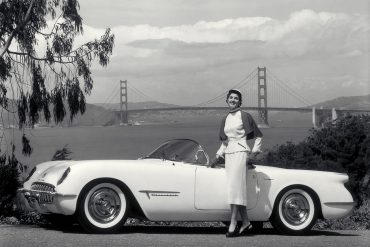
 The First Ever Production Model 1953 Corvette (photo courtesy of GM Media)
 Forty-six separate pieces of GRP comprised the body of the 1953 Corvette (photo courtesy of GM Media)
 The Glass-Reinforced Plastic (GRP) was so lightweight – yet durable – that a single man could lift whole sections of the car without much effort. (Image courtesy of GM Media.)
 The “Blue Flame” 6 Cylinder Engine.
 Promotional ad announcing that the Corvette will begin limited production in late 1953.
 A promotional photo showcasing the 1953 Corvette. (Image Courtesy of GM Media).
Every 1953 Corvette came with a two-speed Powerglide automatic paired with a 150-horsepower six-cylinder engine. America’s most famous sports car began life without a V8 - or a clutch pedal!
DID YOU KNOW
There were a handful of special editions and concepts in the first year of production.
All 1953 Corvettes were Polo White with a red interior and a black canvas top. There were two options offered: a signal seeking AM radio ($145.15) and a heater ($91.40). Although listed as options, all 1953 Corvettes were equipped with both items. The base price was $3,498.00, including the federal excise tax and $248.00 for shipping and handling. The radio had an interesting feature: since fiberglass is electrically inert, the antenna was simply incorporated in the trunk lid. This would not be possible with a conventional steel body.
| CODE | DESCRIPTION | QUANTITY | RETAIL PRICE |
|---|---|---|---|
| 2934 | Base Corvette Roadster | 300 | $3,498.00 |
| 2934 | Polo White with Sportsman Red Interior | 300 | $0.00 |
| 101A | Heater | 300 | $91.40 |
| 102A | AM Radio, signal seeking | 300 | $145.15 |
When introduced in 1953, the Corvette featured the “Blue Flame” six cylinder engine. This is not as the Chevrolet engineering team wanted things, but they had no choice. Although other GM marques featured V8 motors they were not willing to share; a very different situation compared to years later when various divisions would feature the same powerplants. It was renowned for reliability but with a rating of 105 horsepower, performance and sportiness were not included.
The engineering staff responded with the usual engine upgrade methods. A more radical camshaft rubbing on solid lifters, dual valve springs, and a higher compression ratio cylinder head (8.0:1; previous was 7.5:1) all contributed to the effort. The largest gain was achieved via an upgrade to the induction system (right). Three Carter type YH side draft carburetors featuring “bullet” air cleaners with an aluminum manifold were incorporated and the output soared to 150 bhp at 4,200 RPM.
The 1953 Corvette had a glacial 0-60 mph time of 11.2 seconds and hit 100 mph in 39 seconds. The quarter mile was 17.9 seconds @ 77mph. Top speed was 108 mph.
MORE: FULL SPECIFICATIONS
| SPEC | 1953 CORVETTE |
|---|---|
| Engine | 235.5 ci (3.85 L) “Blue Flame” OHV inline-6, cast iron block & head |
| Horsepower | 150 hp @ 4,200 rpm |
| Torque | 223 lb-ft @ 2,400 rpm |
| Fuel delivery | Three Carter sidedraft carburetors |
| Compression ratio | 8.0:1 |
| Transmission | 2-speed Powerglide automatic |
| Axle ratio | 3.55:1 |
| 0–60 mph | 11.2 sec |
| Quarter mile | 17.90 sec @ 77.0 mph |
| Top speed | 108 mph |
| Curb weight | 2,851 lb (1,293 kg) |
| Wheelbase / length | 102 in / 167 in |
The last three digits begin at 001 and run through 300, accounting for each of the 300 Corvettes built in 1953. Each Vehicle Identification Number (VIN) is unique to an individual car. For all 1953 Corvettes, the location of the Vehicle Identification Number (VIN) is located on the driver side door post. The VIN is also stamped in several locations on the Corvette frame.
The first Corvette came off the assembly line on June 30, 1953. There were 300 Corvettes produced in total. The first two were destroyed… they were engineering test cars. This is still the rarest of all model year production Corvettes. It is estimated that about 225 1953 Corvettes still exist.
MORE: VIN DECODER / PRODUCTION
| VIN RANGE | E53F001001 – E53F001300 |
|---|---|
| E (First Digit) | G.M Identification Code for Chevy Corvette |
| 53 (Second & Third Digits) | Model Year |
| F (Fourth Digit) | Location of the Assembly Plant. F – Flint, Michigan |
| 00XXXX (Fifth thru Tenth Digits) | Production Sequence Numbers |
Dig into the numbers behind the 1953 Corvette and check out these hand-curated research papers and data-driven reports, including VIN information, production numbers, pricing/options, color samples, and more.
As introduced in 1953, the Corvette was mostly a thrown together experiment. Production was limited to 300 units total, so sales of the entirely new model were not a problem. All 1953 Corvettes were Polo White with a red interior and a black canvas top.
The 1953 Corvette occupies a special place in the collector market as the first chapter of America’s longest-running sports-car story. Chevrolet built just 300 examples, all assembled by hand in Flint, Michigan, with Polo White paint, red interiors, a black convertible top, and the Blue Flame six-cylinder engine paired with a Powerglide automatic transmission. With essentially the same specification across the entire production run, the meaningful differences between cars today are their authenticity, condition, completeness, and documented history. For a collector, the attraction is the opportunity to own a significant piece of Corvette history, and establishing exactly what survives of the original car is central to assessing its value.
Recent auction results provide useful price references, but each car deserves an individual valuation. In 2026, an older-restored example sold for $236,000 on Bring a Trailer in April, while Mecum reported sales of $302,500 at Kissimmee in January and $368,500 at Glendale in March. The Glendale car was advertised with an extensive specialist restoration, NCRS Top Flight recognition, and detailed claims about correct components. These transactions illustrate the substantial spread buyers can encounter, even within such a small production run. Compare restoration quality, documentation, and completeness alongside the price, and check whether published results include buyer’s premiums. Asking prices and unsuccessful auction bids should be treated separately from completed sales.
A strong purchase starts with verifiable authenticity and a convincing ownership file. Ask a specialist familiar with 1953 production to examine the car’s identity, engine castings and stampings, date codes, and restoration details, distinguishing factory-installed components from correct replacements. Ownership records, early photographs, restoration invoices, and photographs taken during the work all help establish what you are buying. Very early production numbers and significant ownership histories can add another dimension to a car’s appeal, provided those claims are documented. NCRS awards are useful supporting evidence, but request the judging date and score sheets: both restored and original cars qualify for Flight awards, so Top Flight recognition alone does not establish that every component remains factory-installed.
Commission an independent inspection that covers the structure and mechanical condition as thoroughly as the cosmetics. The fiberglass body sits on a steel chassis whose boxed rails and crossmembers can trap water and rust, making an inspection underneath essential. Have the specialist assess previous body repairs, the operation of the triple-carburetor engine and transmission, and the condition of the brakes, cooling system, and electrical equipment. Confirm that items such as the side curtains, jack, and associated accessories accompany the car.
MORE: THE MARKET


Get all the latest news stories, upcoming auctions, prices, videos and more about the 1953 Chevrolet Corvette! The latest headlines here.
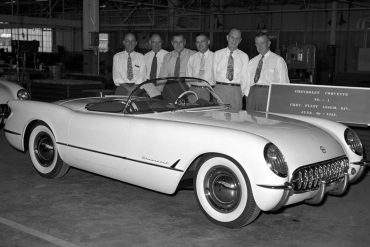


Chevrolet built just 300 Corvettes for the 1953 model year, all assembled largely by hand in Flint, Michigan. The first production car was completed on June 30, 1953. That small production run, combined with its status as the first Corvette, makes the 1953 model an especially significant piece of Corvette history.
The 1953 Corvette is generally a six-figure collector car. As of October 2026, Collector Car Market Review lists values ranging from approximately $111,000 to $330,000, depending on condition. Exceptional examples can command more, while originality, restoration quality, and documentation all influence an individual car’s value. These figures are guide values; actual sale prices vary from car to car.
Every 1953 Corvette came with a 235-cubic-inch “Blue Flame” inline-six producing 150 horsepower, paired with a two-speed Powerglide automatic transmission. The engine used three Carter sidedraft carburetors. Neither a V8 nor a manual transmission was available for the first model year; the Corvette’s first V8 arrived in 1955.
Yes. All 300 production cars left the factory in Polo White, with red interiors and black convertible tops. Buyers had no alternative factory color combinations to choose from. A production 1953 Corvette wearing another exterior color today has been changed from its original factory specification.
The 1953 Corvette carried a base price of $3,498, according to GM’s Heritage records. Chevrolet’s original launch materials listed the radio and heater as optional equipment, so it is useful to distinguish the advertised base price from a car’s final equipped price.
1953 Corvette Advertisements / 1953 Corvette Colors / 1953 Corvette Common Issues / 1953 Corvette Engine / 1953 Corvette Factory Options / 1953 Corvette For Sale / 1953 Corvette Maintenance / 1953 Corvette Mods / 1953 Corvette Order Guides / 1953 Corvette Owners Manual / 1953 Corvette Performance / 1953 Corvette Posters / 1953 Corvette Pricing / 1953 Corvette Production / 1953 Corvette Recalls / 1953 Corvette Research / 1953 Corvette Restomod / 1953 Corvette RPO Codes / 1953 Corvette Sales Brochures / 1953 Corvette Specifications / 1953 Corvette Technical Research / 1953 Corvette Service Bulletins / 1953 Corvette VIN Numbers / 1953 Corvette Guide / 1953 Corvette Model Overview / 1953 Corvette Special Overview