In 1977, GM chairman Thomas Murphy gave the Aero-vette the green light. It was approved for production, and slated to be released in 1980. Despite being greenlit for 1980 production as the upcoming C4 Corvette, Arkus-Duntov's replacement Dave McLellan decided for a number of reasons (cost and tradition among them) to stick with the Corvette's tried and true front-engine configuration
Quick Nav: Story · Specials · Price & Options · VIN · Specs · Technical · Pics & Videos · The Market · All · FAQs
The Basics
Model & Gen: 1977 Corvette (C3)
Body Type: Sport Coupe (T-top) only; no convertible
VIN: 1Z37L7S400001 – 1Z37L7S449213
Original Price: $8,647.65
Colors: 12 (Classic White, Silver, Black, Light Blue, Dark Blue, Chartreuse, Yellow, Bright Yellow, Orange, Medium Red, Tan, Dark Red)
Engine: 350 ci V-8 only: 180 hp (L48) or 210 hp (L82); engines painted orange, then blue from September 1976
Transmission: 4-speed standard (M20 wide or M21 close ratio at no charge); 3-speed Turbo Hydra-Matic (M40) at no charge, in 84 percent of cars
Units Produced: 49,213
The Overview
The 1977 Corvette is a 1976 with the Stingray name taken off and the detail work done. The fender script that had been there since 1969 gave way to crossed-flags emblems, the first time since 1968 the car carried no name but Corvette, and the only other outside change was a luggage rack (RPO V54) shaped to carry the T-tops. Glass roof panels were announced as RPO CC1 and then cancelled over a dispute with the supplier; they arrived a year late. Inside there was more: a new console that took the full range of Delco radios, including the first factory 8-track stereo, restyled instruments, a leather-wrapped steering wheel on a column shortened two inches, a longer shift lever that cleared the parking brake, a single ‘Smart Switch’ stalk for the dimmer and wipers, visors that swung to the side glass, a mirror glued to the windshield and the alarm switch moved into the door lock. Leather seats became standard, with cloth and leather a no-cost alternative.
Mechanically nothing changed: the L48 at 180 hp and the L82 at 210, the four-speed standard and the Turbo Hydra-Matic a no-cost option that 84 percent of buyers took. What did change was the paint on the engine. Between August 23 and September 7, 1976, Flint stopped spraying Chevy Orange and started spraying GM blue, so an early 1977 has an orange engine and a late one blue, and both are correct. The L82 went into 6,148 cars, the aluminum wheels, now $321, onto 12,646, twice the 1976 number, and the price rose by more than $1,000 to $8,647.65 as power steering and brakes, leather and the alarm were folded into the base car.
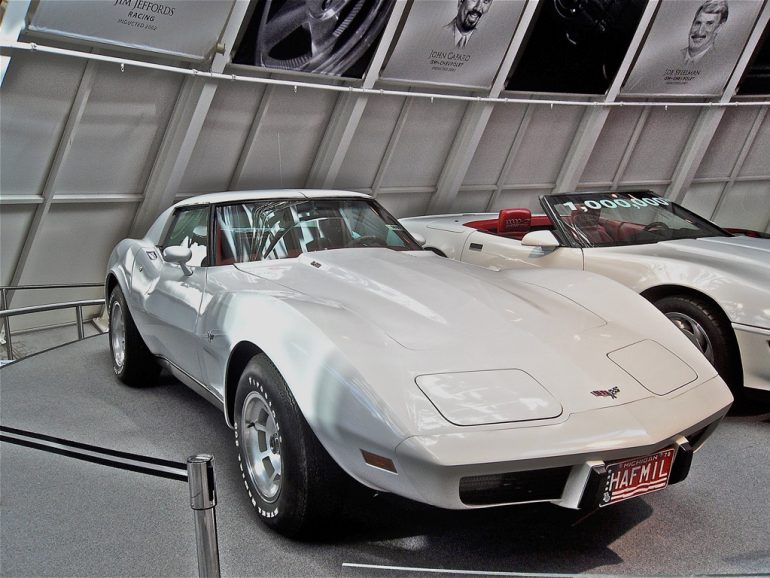
The 500,000th Corvette, a white coupe, left the St. Louis line at 2:01 p.m. on March 15, 1977, with Chevrolet general manager Robert Lund at the wheel; the first 250,000 had taken sixteen years and the second fewer than eight. Production reached 49,213, a record that stood two years, in a market that had lost almost every other American sports car. Today the 1977 sits with the 1975 and 1976 at the bottom of the C3 price range, and it is the better car to drive: the ergonomics the 1978 and later cars are praised for arrived here, a year before the fastback glass pushed prices up.
The 1977 Corvette Story
A significant milestone coinciding with the arrival of the 1977 Corvette happened in a year that was full of impressive milestones. On May 25, 1977, the film world would be changed forever as audiences were transported to a “galaxy far, far away” in George Lucas’s outer space epic, “Star Wars.”
Just four days later, race car driver A.J. Foyt would become the first driver to win the Indianapolis 500 four times. Apple Computer would officially begin its rise to global fortune and fame while the Commodore company introduced the world to its first personal, all-in-one computer, the “Commodore PET”. Even rival automotive manufacturer Porsche was reaching new milestones with the introduction of its first front-engine, V-8 powered car, the 928, at the Geneva Motor Show in March.
For Chevrolet, however, the 1977 model year marked a significant manufacturing milestone – the production of their 500,000th Corvette. It had taken Chevrolet sixteen years to build the first 250,000 Corvettes, but less than eight to build 250,000 more. While the 250,000th Corvette had been a Riverside Gold convertible that had been built on November 7, 1969, the 500,000th Corvette was a white coupe, which was driven off the production line by (then) Chevrolet General Manager, Robert Lund on March 15, 1977.
Ironically, the Corvette had nearly been pulled from Chevrolet’s lineup in those early years of its production, despite the prosperous post-war economy of America in the mid-1950s. Adding to the irony was the fact that the Corvette had actually flourished throughout difficult economic times, even in periods when rival automotive manufacturers were pulling the performance-car models from their ranks.
While it was true that the Corvette’s performance had certainly dwindled – especially over the past couple of years, to a modest shadow of its big-block older brothers from the 1960s, there was no question that the car’s appeal had only grown with each passing year.
The 1977 C3 Corvette arrived with only a few, modest modifications from its previous year. Outwardly, the car was virtually identical to the 1976 model, save for the introduction of a reworked luggage and roof panel rack (RPO V54) that could be used to transport the car’s T-tops (instead of placing them in the Corvette’s lidless trunk.)
Did you know? The 500,000th Corvette, a white 1977 coupe, rolled off the St. Louis assembly line at 2:01 P.M. on March 15th, 1977.
With regard to the T-tops, glass roof panels were introduced as a new option at the start of the model year, though General Motors later canceled the option because of a reputed dispute with the supplier over sales rights. The most notable change from 1976 to 1977, however, was the removal of the Stingray nameplate from the Corvette’s front fenders. It was replaced by Corvette’s traditional crossed-flags insignia.
The changes to the interior were equally subtle, though there were a few more modifications worth noting. First, the interior center radio console was redesigned to accept a broader array of Delco audio decks (including an AM/FM stereo with an 8-track tape player, RPO UM2, for the first time). The instruments on the dashboard were restyled to provide drivers greater visibility. The climate controls were simplified.
Moving down the center column, the manual transmission lever was lengthened, placing the shifter ball higher up in relation to the disengaged handbrake. Previously, the shorter shifter shaft had caused interference when drivers attempted to actuate the parking brake lever. By lengthening the shifter lever, the parking brake accessibility was improved, making it easier to engage and disengage.
Elsewhere, the steering column itself was shortened by two inches to allow for more of an “arms out” driving posture, (which helps drivers reduce the risk of injury during a potentially dangerous situation.)
Additionally, the shorter steering column made it easier to get into and out of the new Corvette. Mated to the steering column was a new leather rimmed steering wheel. For those consumers that ordered the optional tilt-telescopic steering column (RPO N37), the 1976 style steering wheel remained the only choice. While tilt and telescopic adjustments remained optional, Chevrolet did introduce a new feature to the 1977 Corvette – namely the new “Smart Switch” – a steering column stalk that combined the headlight dimmer and wiper/washer functions with the turn signals.
The alarm switch was moved again and was incorporated into the left door-lock button assembly. Additionally, the sun visors were revamped to allow them to swing from the windshield to the side windows. Even the mounting location of the rearview mirror was shifted from above the windshield to the windshield itself. Lastly, for the 1977 model year leather upholstery came standard with the Corvette while cloth seats with leather bolsters were an optional no-cost alternative.
Mechanically, the 1977 Corvette went essentially unchanged from the 1976 model year. As in 1976, the 1977 Corvette came standard with a 180 horsepower, 350 cubic-inch, small-block Chevy engine mated to a 4-speed, wide-ratio manual transmission. Also like the 1976 model, the new Corvette could be ordered with an optional 210-horsepower engine (RPO L82), which California buyers could have only with the automatic transmission.
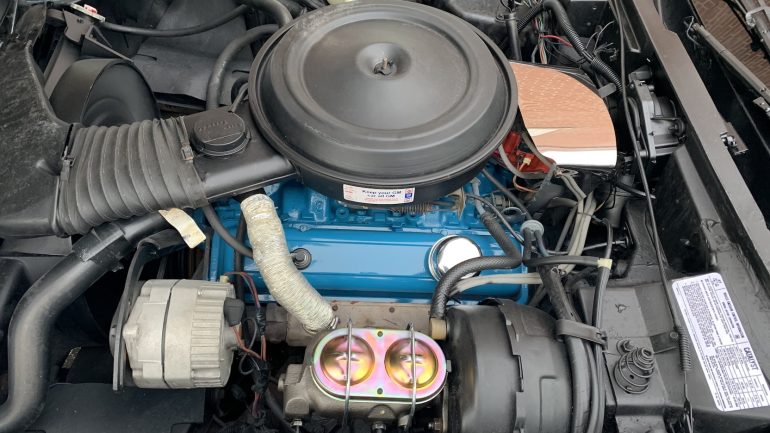
While the engines remained the same, there was an interesting turn of events within General Motors that occurred early in the 1977 model year’s production run. Between August 23 and September 7, 1976, Flint Engine (the plant where the small-block 350 was manufactured) began using blue paint in place of the traditional “Chevy Orange” paint that had normally been applied to Corvette engines. Thus, early 1977 model year Corvettes continued to feature the familiar orange, while later production engines were blue.
Production Volumes
The 1977 Corvette set another new sales record at 49,213 units. The popularity of the Chevy Corvette throughout the 1970s was proven time and again by the year over year increase in sales numbers despite the dramatic increases in cost.
In 1974, the base sticker price of the Corvette had crossed the $6,000 barrier for the first time (it was actually $6,001.50). With each year, the price increase had been notable – $6,810.10 in 1975, $7,604.85 in 1976, and $8,647.65 in 1977, due to the inclusion of so many standard comfort and convenience features. Despite this, there was no question that the popularity of the Corvette was still on the rise – which was remarkable given that the C3 Corvette was a decade old.

The 500,000th Corvette rolled off the production line on March 15, 1977. It can be seen today at the National Corvette Museum in Bowling Green, Kentucky.
The interior of the 1977 Corvette featured a redesigned center console, an improved dashboard, and leather seats as a standard option.
1977 Chevrolet Corvette | Photo Credit: Bring A Trailer
This 1977 Corvette is available for sale at bringatrailer.com
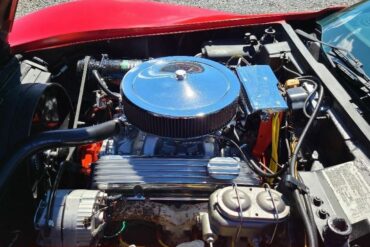
Chevrolet painted Corvette engines orange for more than two decades and then, in the first weeks of 1977 production, switched to blue. Flint made the change between August 23 and September 7, 1976, so an orange engine and a blue engine are both correct on a 1977 Corvette, and the build date on the engine pad decides which one belongs under the hood.
DID YOU KNOW
Price & Options
Core Features & Factory Options
The Sport Coupe, the only body, listed at $8,647.65, up $1,042.80 on 1976 and the biggest jump in Corvette history to that point, because power steering, power brakes, leather seats, the alarm, Positraction, radial tires and the four-speed or Turbo Hydra-Matic were all now standard.
The 210-hp L82 at $495.00 went into 6,148 cars, leaving 43,065 with the 180-hp L48. The Turbo Hydra-Matic went into 41,231 cars, 84 percent, the close-ratio M21 into 2,060 and the standard M20 into about 5,922.
The Gymkhana suspension (RPO FE7, $38.00) went into 7,269 cars, the trailer package (RPO ZN1, $83.00) into 289, the highway axle (RPO G95, $14.00) into 972, the high-altitude equipment (RPO NA6, $22.00) into 854 and the California emission certification (RPO YF5, $70.00) into 4,084.
Air conditioning (RPO C60, $553.00) reached 45,249 cars, 92 percent; the tilt-telescopic column (RPO N37, $165.00, now with the 1976 steering wheel) 46,487; power windows (RPO A31, $116.00, $122.00 late in the year) 44,341; the convenience group (RPO ZX2, $22.00) 40,872; the floor mats (RPO B32, $22.00) 36,763; the heavy-duty battery (RPO UA1, $17.00) 32,882; the rear defogger (RPO C49, $84.00) 30,411; speed control (RPO K30, $88.00, automatics only) 29,161 and the sport mirrors (RPO D35, $36.00) 20,206. The new 8-track stereo (RPO UM2, $414.00) outsold the plain stereo (RPO U58, $281.00) 24,603 to 18,483, with 4,700 AM/FM radios (RPO U69, $187.00) and about 1,400 cars with no radio.
The luggage rack (RPO V54, $73.00) went on 16,860 cars, the aluminum wheels (RPO YJ8, $321.00) on 12,646 and raised-white-letter radials (RPO QRZ, $57.00, later $59.00) on 46,227. A typical automatic, air-conditioned L48 with power windows, tilt column, defogger, stereo, convenience group and mats came to about $9,890; a loaded L82 with aluminum wheels, 8-track, speed control and the rack passed $11,000.
Twelve colors were offered; the totals add up to 49,133, eighty short of production.
MORE: PRICING, OPTIONS & COLORS / RPO CODES
| CODE | DESCRIPTION | QUANTITY | RETAIL PRICE |
|---|---|---|---|
| 1YZ37 | Base Corvette Sport Coupe | 49,213 | $8,647.65 |
| A31 | Power Windows | 44,341 | $116.00 ($122.00 late) |
| B32 | Color-Keyed Floor Mats | 36,763 | $22.00 |
| C49 | Rear Window Defogger (electric) | 30,411 | $84.00 |
| C60 | Air Conditioning | 45,249 | $553.00 |
| D35 | Sport Mirrors (left remote) | 20,206 | $36.00 |
| FE7 | Gymkhana Suspension (heavy-duty springs and shocks) | 7,269 | $38.00 |
| G95 | Optional Rear Axle Ratio (highway) | 972 | $14.00 |
| K30 | Speed Control (automatic only) | 29,161 | $88.00 |
| L82 | 350ci, 210HP Engine | 6,148 | $495.00 |
| M21 | 4-Speed Manual Transmission, Close Ratio | 2,060 | no charge |
| M40 | Turbo Hydra-Matic 3-Speed Automatic | 41,231 | no charge |
| N37 | Tilt-Telescopic Steering Column (with 1976 steering wheel) | 46,487 | $165.00 |
| NA6 | High-Altitude Emission Equipment | 854 | $22.00 |
| QRZ | White Letter Steel-Belted Radial Tires, GR70x15 | 46,227 | $57.00 ($59.00 late) |
| U58 | AM-FM Radio, Stereo | 18,483 | $281.00 |
| U69 | AM-FM Radio | 4,700 | $187.00 |
| UA1 | Heavy Duty Battery | 32,882 | $17.00 |
| UM2 | AM-FM Radio, Stereo with 8-Track Tape | 24,603 | $414.00 |
| V54 | Luggage and Roof Panel Rack | 16,860 | $73.00 |
| YF5 | California Emission Certification | 4,084 | $70.00 |
| YJ8 | Cast Aluminum Wheels (set of 4, steel spare) | 12,646 | $321.00 |
| ZN1 | Trailer Package (heavy-duty cooling, FE7 springs) | 289 | $83.00 |
| ZX2 | Convenience Group (dome-light delay, headlight and low-fuel warnings, underhood and courtesy lights, visor mirror) | 40,872 | $22.00 |
| CODE | EXTERIOR | TOTAL | INTERIOR |
|---|---|---|---|
| 10 | Classic White | 9,408 | Black, Blue, Brown, Buckskin, Red, Smoked Gray, White |
| 19 | Black | 6,070 | Black, Buckskin, Red, Smoked Gray, White |
| 26 | Corvette Light Blue | 5,967 | Black, Blue, Smoked Gray, White |
| 13 | Silver | 5,518 | Black, Blue, Red, Smoked Gray, White |
| 80 | Corvette Tan (Buckskin) | 4,588 | Black, Brown, Buckskin, Red, White |
| 28 | Corvette Dark Blue | 4,065 | Black, Blue, Buckskin, Smoked Gray, White |
| 72 | Medium Red | 4,057 | Black, Buckskin, Red, Smoked Gray, White |
| 66 | Corvette Orange | 4,012 | Black, Brown, Buckskin |
| 83 | Corvette Dark Red | 3,434 | Black, Buckskin, Smoked Gray |
| 56 | Corvette Bright Yellow | 1,942 | Black, Brown |
| 52 | Corvette Yellow (early, replaced by Bright Yellow) | 71 | Black, Brown |
| 41 | Corvette Chartreuse (early, cancelled) | 1 | Black |
Specifications & Performance
Engine & Transmission
The engines carried over from 1976 unchanged in specification: the base L48 at 8.5:1 making 180 hp net at 4,000 rpm and 270 lb-ft at 2,400, and the L82 with its forged crank, four-bolt mains and performance cam at 9.0:1 making 210 hp at 5,200 rpm and 255 lb-ft at 3,600, both on a Rochester Quadrajet, HEI ignition, a single catalytic converter and unleaded fuel, breathing through the duct over the radiator introduced in 1976.
California buyers could again have the L82, but only with the Turbo Hydra-Matic; high-altitude cars (RPO NA6) were L48 automatics. The one visible change was the paint: Flint switched from Chevy Orange to GM blue between August 23 and September 7, 1976, within the first weeks of 1977 production.
Road & Track’s L82 four-speed did 0–60 in 6.8 seconds and the quarter mile in 15.5 at 92.5 mph, the best C3 numbers of the decade so far.
The chassis was the 1976 car’s, with power steering and power brakes now standard from the first car, the Gymkhana suspension (RPO FE7, $38.00) under 7,269 cars and the new trailer package (RPO ZN1) adding heavy-duty cooling to the FE7 springs on 289.
The steering column was shortened two inches and fitted with a leather-wrapped three-spoke wheel, unless the tilt-telescopic column was ordered, in which case the 1976 four-spoke wheel stayed; the ‘Smart Switch’ stalk took over the dimmer, wipers and washers. The shift lever grew taller so a hand on the ball no longer hit the parking brake.
The aluminum wheels (RPO YJ8, $321.00) were the Kelsey-Hayes castings of 1976 and went on 12,646 cars with a steel spare; GR70-15 radials, four-wheel discs and the 98-inch wheelbase were unchanged, and curb weight stayed near 3,530 lb.
MORE: FULL SPECIFICATIONS / ENGINE
| SPEC | 1977 CORVETTE |
|---|---|
| Engines | 350 ci (5.7 L) small-block V-8 in two versions, hydraulic lifters, catalytic converter, unleaded fuel, HEI ignition, SAE net ratings; Flint switched the engine paint from Chevy Orange to blue between August 23 and September 7, 1976, so early cars are orange and the rest blue |
| Base engine (L48) | 350/180 hp net @ 4,000 rpm, 270 lb-ft @ 2,400 rpm, 8.5:1, hydraulic lifters, Rochester Quadrajet, induction from a duct over the radiator; 43,065 cars (87 percent) |
| RPO L82 | 350/210 hp net @ 5,200 rpm, 255 lb-ft @ 3,600 rpm, 9.0:1, hydraulic lifters, forged crank, four-bolt mains, high-performance camshaft, Quadrajet, finned aluminum valve covers; 6,148 cars, $495.00; California cars with the automatic only |
| RPO FE7 | Gymkhana suspension: higher-rate springs and firmer shocks; 7,269 cars, $38.00 (also included in the 289 ZN1 trailer packages) |
| Transmission | 4-speed standard: wide-ratio M20 (about 5,922 cars) or close-ratio M21 (2,060) at no charge; 3-speed Turbo Hydra-Matic (RPO M40) at no charge in 41,231 cars, 84 percent, the TH350 behind the L48 and the TH400 behind the L82; shifter lever lengthened for 1977 |
| Axle ratio | 3.36:1 standard with manuals, 3.08:1 with Turbo Hydra-Matic; 3.55 and 3.70 with the L82 four-speed; Positraction standard; highway ratio (RPO G95, $14.00) on 972 cars |
| Front suspension | Independent; short-long arm, coil springs, anti-roll bar; FE7 heavy-duty |
| Rear suspension | Independent; frame-mounted differential, half-shafts, trailing arms, nine-leaf transverse spring; FE7 heavy-duty |
| Brakes | Four-wheel disc, 11.75-in rotors, four-piston calipers, dual-circuit master cylinder, power assist standard |
| Steering | Saginaw recirculating ball, power assist standard, 16.0:1; column shortened 2 in with a new leather-wrapped three-spoke wheel; tilt-telescopic column (RPO N37, $165.00; 46,487 cars) kept the 1976 four-spoke wheel; ‘Smart Switch’ stalk for dimmer, wipers and washers |
| Body | Stingray fender script replaced by crossed-flags emblems; luggage and roof-panel rack (RPO V54, $73.00; 16,860 cars) carries the T-tops; glass roof panels (RPO CC1) announced and cancelled; alarm switch moved into the left door-lock button; sun visors swing to the side glass; mirror mounted on the windshield |
| Interior | Leather seats standard for the first time, cloth with leather bolsters a no-cost alternative; new console accepting Delco decks including the first 8-track stereo (RPO UM2, $414.00; 24,603 cars) and the speed control (RPO K30); restyled instruments; seven interior colors |
| Wheels & tires | 15 x 8 in slotted steel Rally wheels with trim rings and caps, or 15 x 8 cast aluminum (RPO YJ8, $321.00; 12,646 cars); GR70 x 15 steel-belted radials, raised-white-letter on 46,227 cars (RPO QRZ) |
| Fuel tank | 17 gal; unleaded fuel only |
| Wheelbase | 98 in |
| Overall length / width / height | 185.2 in / 69.2 in / 48.0 in |
| Track, front / rear | 58.7 in / 59.5 in |
| Curb weight | approx. 3,530 lb |
| 0–60 mph | 6.8 sec (L82 four-speed, Road & Track, June 1977); approx. 8.5 sec (L48 automatic) |
| Quarter mile | 15.5 sec @ 92.5 mph (L82, Road & Track); approx. 16.5 sec (L48) |
| Top speed | approx. 130 mph (L82); 118 mph (L48) |
| Production | 49,213 coupes, a record until 1979; the 500,000th Corvette was built on March 15, 1977 |
| Assembly | St. Louis, Missouri; engines from Flint |
Vehicle Identification Numbers (VIN)
49,213 Cars, 1Z37L7S400001 TO 1Z37L7S449213
The 1977 Corvette carries a thirteen-character VIN: 1Z37L7S for the base coupe and 1Z37X7S for the L82, followed by a sequence number from 400001 to 449213. The 1 is Chevrolet, Z the Corvette series, 37 the coupe body (the only one), the fifth character the engine (L for the 180-hp L48, X for the L82), 7 the model year and S the St. Louis plant. The VIN plate is on the left front hinge pillar, with the trim tag on the same pillar carrying the body build date (A for August 1976 through M for August 1977), the trim code (19V black cloth, 192 black leather and so on) and the paint code; the number is stamped on the frame and as a partial VIN on the engine and transmission. Month-end sequence numbers run from 402287 in August 1976 to 445179 in July 1977, so the 500,000th Corvette of March 15 falls between 424662 and 429041.
The engine pad on the right front of the block carries the Flint V prefix, the build date and a suffix: CKZ for the L48 with four-speed and CLA with automatic (CLC and CHD California, CLB and CKD high altitude), CLD for the L82 with four-speed and CLF with automatic. Both engines are casting 3970010 with 333882 heads (374650 also on the L48) and run Quadrajets numbered 17057xxx. The VIN engine letter, the pad suffix and the casting dates should agree, the distributor should be an HEI unit (1103256 on the L82), and the engine color should match the build date: orange before late August 1976, blue after early September.
MORE: VIN DECODER / PRODUCTION
| POSITION | MEANING |
|---|---|
| 1 (First Digit) | Manufacturer: 1 = Chevrolet |
| Z (Second Digit) | Series: Z = Corvette |
| 37 (Third & Fourth Digits) | Body: 37 = Sport Coupe (the only body) |
| L / X (Fifth Digit) | Engine: L = 350/180 L48, X = 350/210 L82 |
| 7 (Sixth Digit) | Model year: 7 = 1977 |
| S (Seventh Digit) | Assembly plant: S = St. Louis, Missouri |
| 400001–449213 (Eighth through Thirteenth Digits) | Production sequence number; 49,213 built |
Pictures, Videos, Wallpapers & Galleries
Twelve colors, with Classic White on one car in five: Classic White (9,408), Black (6,070), Light Blue (5,967), Silver (5,518), Tan (4,588), Dark Blue (4,065), Medium Red (4,057), Orange (4,012), Dark Red (3,434) and Bright Yellow (1,942), plus 71 early cars in Yellow and a single Chartreuse coupe before both were dropped; seven interior colors in standard leather or no-cost cloth and leather.
Market & Buying Guide
For Sale & What They Bring
The 1977 shares the bottom of the C3 market with the 1975 and 1976, and buyers who know the cars prefer it: the same 180 and 210 horsepower as 1976 with the better console, steering wheel, shifter and switchgear that carried into the 1978–82 cars, and twice as many aluminum-wheel cars to choose from. The order is L82 four-speeds with the Gymkhana suspension and aluminum wheels first, then L82 automatics, then the 43,000 L48s that most cars are, with original paint, the standard leather and a working 8-track counting for more than mileage. A clean L48 automatic with air is the entry ticket to C3 ownership; the last Stingray script and the first fastback glass bracket the 1977 on either side, and neither applies to it, which keeps prices down.
Results tracked by Classic.com from October 2025 through October 2026: an L82 four-speed sold for $22,000 on Bring a Trailer on October 22, 2026, a 6,000-mile original automatic for $28,600 at Mecum Kissimmee in January 2026, and original automatics for $12,500 at Cars & Bids and $12,650 at Mecum Fort Worth in October 2026. Modified cars sold for $10,450 and $10,500 on Bring a Trailer, a custom for $9,100 and a project for $4,250 at Hagerty, while unsold high bids at Mecum, Hemmings and AutoHunter ran $6,868 to $19,000. Dealers’ last asking prices on cars that sold or were withdrawn ran $10,950 to $24,995. In autumn 2026 original coupes were offered at $10,000 to $25,394 and customs and restomods at $44,000 to $70,679. Check whether a result includes the buyer’s premium (Mecum and Barrett-Jackson results do, Bring a Trailer bids do not), and treat asking prices and unsold high bids separately from completed sales.
Verification is simple: the fifth VIN character is X on an L82 and L on a base car, so an L82 with an L in the VIN is a dress-up. The engine pad should carry a V prefix and CLD or CLF on a 3970010 block with the partial VIN matching the car for an L82, CKZ or CLA (CLC, CHD, CLB or CKD) for an L48, and the engine color should agree with the build date, orange only on the earliest cars. Original YJ8 wheels carry Kelsey-Hayes and Mexico markings inside the rim. A 1977 should have crossed flags, not Stingray script, on the fenders, the new console with a Delco deck that fits it, a leather-wrapped three-spoke wheel on cars without the tilt column and the alarm switch in the driver’s door-lock button; cloth-and-leather seats were a no-cost option and are rarer than the standard leather.
The C3 body sits on the C2’s birdcage and rusts in the same places: the windshield frame, the door hinge pillars, the frame kickups over the rear wheels and around the trailing-arm mounts, the lower doors behind the steel beams and the steel floor pan added in 1976, which rusts where carpet holds water. The urethane covers at both ends crack and sag as the mounting hardware corrodes, the headlights still run on vacuum, which leaks at the actuators and check valves until nothing works, and the original catalytic converter is often long gone. The T-top seals are the usual leak, and the glued-on mirror and the new stalk switch are 1977 parts worth checking. Trailing-arm bushings, half-shaft U-joints and the four-piston calipers (weeping unless sleeved) are the usual mechanical work, and the HEI, unleaded-fuel engine is easy to live with on modern gasoline. Budget for the bumper covers, the vacuum system, seals and brakes on any 1977 that has sat.
MORE: THE MARKET
FAQs
How many 1977 Corvettes were built?
Chevrolet built 49,213 Corvettes for 1977 at St. Louis, Missouri, all T-top coupes, a record that beat 1976 by 2,655 and stood until 1979. Of those, 6,148 had the L82, 41,231 the Turbo Hydra-Matic, 45,249 air conditioning, 46,487 the tilt-telescopic column, 12,646 aluminum wheels, 24,603 the new 8-track stereo and 7,269 the Gymkhana suspension. The 500,000th Corvette was built on March 15, 1977.
How much is a 1977 Corvette worth today?
In late 2025 and 2026, original 1977 Corvettes sold for $12,500 to $28,600 at auction, the top figure a 6,000-mile automatic at Mecum Kissimmee and an L82 four-speed making $22,000 on Bring a Trailer in October 2026; modified cars sold for $9,100 to $10,500 and projects for around $4,250. Dealers asked $10,000 to $25,394 for original coupes and $44,000 to $70,679 for customs and restomods. The 1977 is one of the least expensive Corvettes, priced with the 1975 and 1976.
What engines did the 1977 Corvette have?
Two 350 small blocks, both hydraulic-lifter with a catalytic converter and unleaded fuel: the L48 at 180 hp in 43,065 cars and the L82 at 210 hp in 6,148, the same ratings as 1976. California buyers could have the L82 only with the automatic. The Turbo Hydra-Matic went into 84 percent of cars, the TH350 behind the L48 and the TH400 behind the L82. Early engines are painted Chevy Orange; from early September 1976 Flint switched to blue.
What colors did the 1977 Corvette come in?
Twelve, two of them briefly: Classic White (9,408 cars), Black (6,070), Light Blue (5,967), Silver (5,518), Tan (4,588), Dark Blue (4,065), Medium Red (4,057), Orange (4,012), Dark Red (3,434) and Bright Yellow (1,942), plus Yellow on 71 early cars and Chartreuse on one before both were dropped. Interiors came in black, blue, buckskin, brown, red, smoked gray and white leather, standard for the first time, or cloth with leather bolsters in the same colors except white at no extra cost.
How much did the 1977 Corvette cost when new?
The Sport Coupe was $8,647.65, up more than $1,000 on 1976 because power steering and brakes, leather seats, the alarm, Positraction and the four-speed or Turbo Hydra-Matic were now all standard. The L82 added $495.00, the aluminum wheels $321.00 and the Gymkhana suspension $38.00; air conditioning was $553.00, power windows $116.00, the tilt-telescopic column $165.00, the AM/FM radio $187.00, the stereo $281.00 and the 8-track stereo $414.00. A typical automatic, air-conditioned L48 with power windows, tilt, defogger, stereo and the convenience group came to about $9,890, and a loaded L82 with aluminum wheels and the 8-track passed $11,000.
What changed on the 1977 Corvette?
The Stingray script was dropped from the fenders and replaced by crossed-flags emblems, and leather seats became standard with cloth and leather as a no-cost option. The console was redesigned to take Delco radios including the first 8-track stereo, the instruments were restyled, the steering column was shortened two inches with a new leather-wrapped wheel and a ‘Smart Switch’ stalk, the shifter was lengthened, the visors swung to the side, the mirror moved to the windshield and the alarm switch moved into the door lock. A roof-panel rack (RPO V54) was new, glass roof panels were announced and cancelled, and engines turned from orange to blue. Power and chassis were unchanged.
Which Corvette was the 500,000th built?
A white 1977 coupe that rolled off the St. Louis line at 2:01 p.m. on March 15, 1977, with Chevrolet general manager Robert Lund driving. The 250,000th had been a Riverside Gold convertible built on November 7, 1969, so the first quarter-million took sixteen years and the second fewer than eight. The 1977 model year as a whole set a record at 49,213 cars.
All The Research
1977 Corvette Advertisements / 1977 Corvette Colors / 1977 Corvette Engine / 1977 Corvette Factory Options / 1977 Corvette For Sale / 1977 Corvette Maintenance / 1977 Corvette Mods / 1977 Corvette Owners Manual / 1977 Corvette Performance / 1977 Corvette Posters / 1977 Corvette Pricing / 1977 Corvette Production / 1977 Corvette Recalls / 1977 Corvette Research / 1977 Corvette RPO Codes / 1977 Corvette Sales Brochures / 1977 Corvette Special Model Overview / 1977 Corvette Specifications / 1977 Corvette Technical Research / 1977 Corvette Service Bulletins / 1977 Corvette VIN Numbers