Become a premium member for just $35/year and get ad-free access!

Record-Breaking $860,000 Sale Of 1969 Corvette Writes A New Chapter Of The L88 Story

59,000 views, 500 comments, 99 bids, a BaT server that is still trying to cool down, and a record that will stand for years to come. CorvSport has the full story, including the top L88 sales

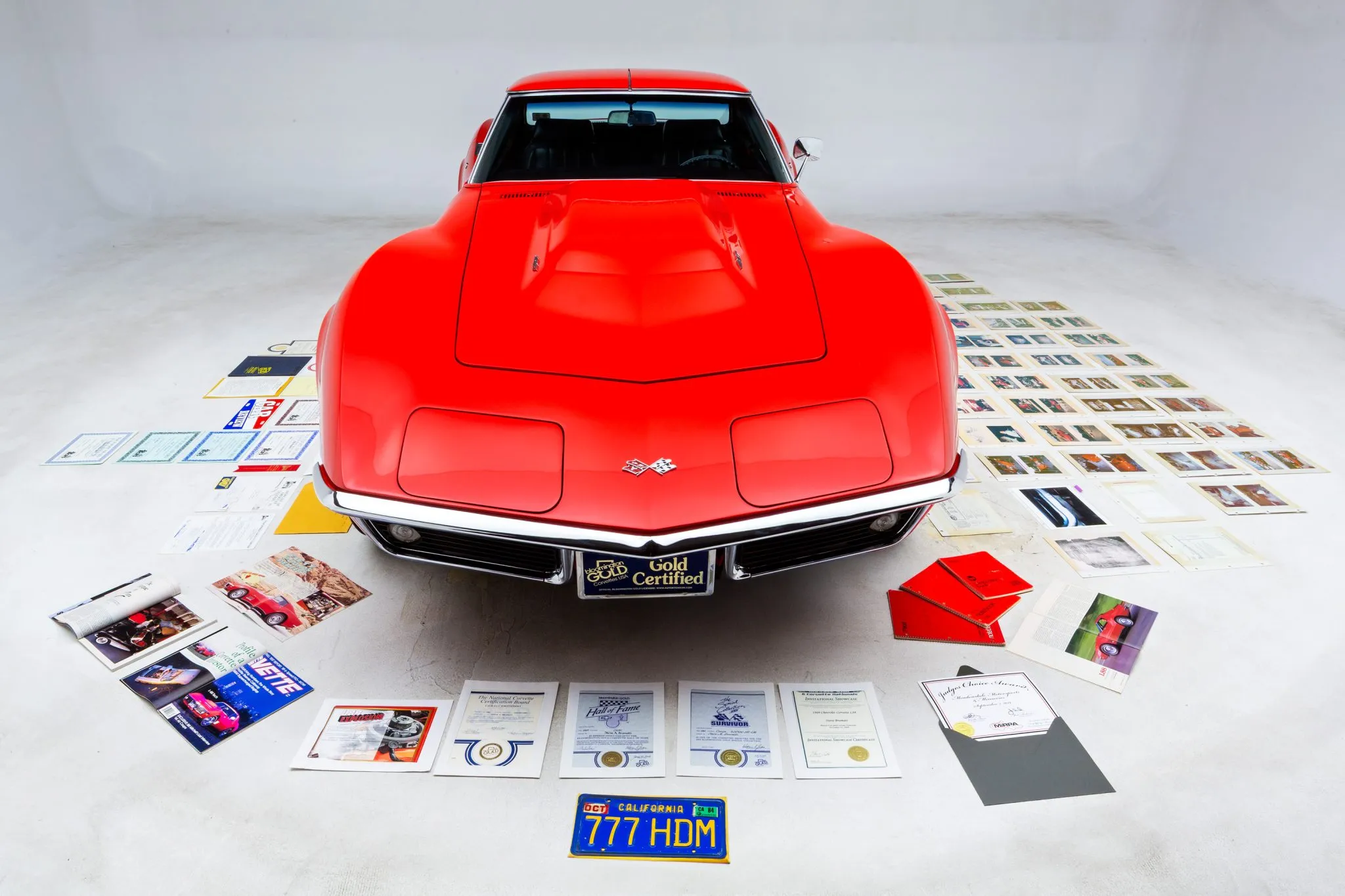
This picture illustrates just how documented this L88 is! Photo Credit: BaT

This story could begin in a dozen different places, but it always finds its way back to one legendary powerplant: the L88. That’s why you’re here. That’s why more than 59,000 enthusiasts set their eyes on this record-setting Bring a Trailer auction. With just 216 total L88 Corvettes leaving St. Louis between 1967 and 1969, this engine sits among the rarest and most coveted in Corvette history. Plenty of publications across the hobby will put their own spin on this sale, but as we sifted through hundreds of comments in search of our angle, we kept returning to the same conclusion. It has always been about that monstrous L88.

So, before we dive into this new record-setting chapter in the RPO L88 legacy—and bring you bonus coverage of the biggest L88 sales and market activity spanning all three model years—it’s worth taking a step back to revisit what makes this engine one of the most celebrated and mythical creations ever to wear crossed flags.

This feature is free, and you can enjoy an ad-free experience, get exclusive content, and support CorvSport for only $2.92/month!

The L88 Story: Duntov’s Unfinished Business

Every proper legend needs a mastermind, and the L88’s belongs to none other than Zora Arkus-Duntov. If Corvette engineering had a Mount Rushmore, Duntov would occupy the entire cliff face. Racer. Visionary. Political headache for GM. He spent his career walking the line between corporate obedience and performance-driven rebellion.

By the late 1950s, he was convinced that the Corvette could only survive—and triumph—through racing success. Yet GM’s decision to comply with the AMA’s 1957 ban on factory-backed racing shut the door on any official Corvette competition program. To Duntov, that wasn’t a rule. It was an obstacle.

Quietly, often cleverly, and occasionally at great personal risk, he kept engineering race-worthy Corvettes under RPO (Regular Production Option) codes that slid through corporate filters. Some were mild. Some were wild. And then, in 1967, came the one that changed everything: the L88.

A Big-Block Firestorm Begins

GM was already deep into its big-block era when the L88 arrived. The 427ci lineup was healthy, powerful, and widely respected. The L32 made 390 horsepower, the L72 made 425 horsepower, and both carried the weight of proven performance. But Duntov didn’t want “great.” He wanted a weapon.

He saw the 427 block not as a finished product, but as raw material. With a higher compression ratio, an aggressive race-spec camshaft, big flowing heads, and an enormous carburetor, the L88 would become something GM had never openly offered before: a production race engine disguised as a factory option. It was the ultimate wink to the insiders—and a warning to everyone else.

Born To Dominate: The L88 Configuration

The L88 wasn’t just a hotter version of an existing big-block. It was the ultimate evolution of GM’s 427 architecture—lightened, strengthened, and engineered to live at RPM levels where mere mortal enthusiasts feared to tread. Here’s what made it special:

♦ L88 Technical Highlights

  • Forged steel cross-drilled crankshaft with four-bolt mains
  • Forged, shot-peened connecting rods with 7/16″ bolts
  • Aluminum pistons with floating pins
  • Massive 12.5:1 compression ratio
  • Aggressive solid-lifter camshaft producing 0.562/0.584 in. lift
  • Aluminum cylinder heads with huge 2.19″ intake and 1.84″ exhaust valves
  • Large rectangular intake ports and square exhaust ports
  • Holley 850-cfm carburetor—the biggest Holley ever fitted to a production GM engine
  • Third valve-spring dampener for stability above 7,000 RPM
  • Mandatory high-octane fuel only (Sunoco 260 or equivalent)

On paper, GM rated the L88 at 430 horsepower at 5,200 RPM. In reality, that number was pure theater. The engine was widely understood to deliver 540–580 horsepower, but rating it lower kept the inexperienced—and the insurance companies—away. After all, the cheaper L72 carried a “425 HP” badge, and GM didn’t want weekend hobbyists accidentally buying a barely disguised race engine.

1967 L88 Engine with orange valve covers
The 1967 L88 Engine was a beast!

The L88 Driving Experience: Too Wild For The Street

To call the L88 a street car is almost misleading. Yes, you could register it. Yes, you could drive it home. But everything about the option screamed competition. It was loud. It was ill-tempered. It hated low-octane fuel. As a matter of fact, vehicle documentation stated, “…Under no circumstances should regular gasoline be used.” And its power came alive far higher in the rev range than anything GM wanted the public to think was “reasonable.”

It was engineered for those who knew what they were buying—and who had no hesitation about dropping the hammer. Quarter-mile times fell under 12 seconds with the right setup. That wasn’t just fast for the late ’60s. It was disruptive.

Specs That Still Intimidate Today

While modern Corvettes have eclipsed the L88’s performance in measured numbers, few engines carry its emotional gravity. Nearly six decades later, the L88’s raw output still reads like a dare.

♦ L88 Specs Index:

  • Horsepower: 430 hp @ 5,200 rpm (underrated)
  • Torque: 460 lb-ft @ 4,000 rpm
  • Compression Ratio: 12.5:1
  • Displacement: 427 cubic inches
  • Bore: 4.25″
  • Stroke: 3.76″

It wasn’t meant for commuting. It wasn’t meant for Sunday cruises. It wasn’t meant to sit quietly in a garage. It was meant to be pushed—to the track, to the limit, and sometimes beyond.

This 1967 L88 Corvette comes equipped with the original 427 cubic inch engine including all original internals!
This 1967 L88 Corvette comes equipped with the original 427 cubic-inch engine, including all original internals!

Built for Three Years, Revered Forever

Production lasted just three short years: 1967 through 1969. In total, only 216 L88 Corvettes were ever produced. The 1969 L88 led the charge with 116 examples, with 1968 at 80, and the inaugural year landing at only 20 (which helps explain some of the insane hammer prices we’ve highlighted below). Many went straight to the racetrack—a blessing for Corvette’s legacy, but a curse for future collectors. Engines were blown. Cars were wrecked. A few were retired gracefully. But even among the survivors, originality became its own kind of scarcity. Yet those who kept their L88s intact—or rebuilt them correctly—owned rolling proof of Duntov’s determination. And racing didn’t just give the L88 credibility. It gave it mythology. Now, let’s meet the new king of the 1969 L88s.

Our $860,000 Star: A Perfect Storm For A Record

Now, to the star of our show. After this remarkable sale, we’ll take you down memory lane through every L88 Bring a Trailer appearance, revisit the Top 3 1969 L88 sales at Mecum, and then count down the Top 5 all-time sales of the legendary L88. But first, let’s focus on the Corvette that captivated more than 59,000 enthusiasts. The story behind this example is nothing short of extraordinary. Its provenance, pedigree, documentation, awards, presentation, and marketing all aligned to create what can only be described as a perfect storm. This was, after all, the famed 1969 L88 wearing the stereo-delete plate, personally autographed by Zora Arkus-Duntov. When the virtual gavel finally fell at a record-setting $860,000, it eclipsed every other 1969 L88 sale, including the next-highest 1969 example—a Convertible that crossed the block for $759,000 during Mecum’s 2025 Kissimmee big tent event.

This picture illustrates just how documented this L88 is! Photo Credit: BaT

A Few Questions Along The Way

Of course, no six-figure collector car story is complete without a few twists. The conversation took an interesting turn when seller Joe Verrillo of Verrillo Motor Car stated that this was the first time the car had ever been publicly offered after spending decades quietly changing hands between private collectors. That claim quickly sparked discussion in the comments, as one enthusiast pointed out the very same Corvette had appeared on Hemmings’ classifieds in March of this year with an asking price listed simply as “Inquire.” Others questioned why the L88 was withdrawn from Mecum’s 2026 Indy auction after it had already been assigned both a lot number and a scheduled run day. Whether coincidence or strategy, those unanswered questions only added another layer to an already fascinating story.

There was no questioning the value this signature added to the sale. Photo Credit: BaT

The Final Minutes Everyone Was Watching

None of that background noise, however, slowed the handful of determined enthusiasts chasing the opportunity to own one of the most desirable Corvettes ever built. We watched the closing moments unfold live as bids climbed steadily higher and community comments poured in by the minute. The excitement was impossible to ignore. CorvSport followed every refresh of the screen as the countdown reached five minutes… then four… then three… while serious money continued flying in from behind computer keyboards across the country. As bidding pushed toward the $700,000 mark, several spectators confidently predicted it would take at least $1 million to buy the car. As it turned out, the peanut gallery had no idea what the final number would actually be.

The heart of the $860,000 record. Photo Credit: BaT

Sixty Minutes That Felt Like Forever

Making matters even more suspenseful was the silence from the selling dealer. As six-figure bids continued to roll in, there were no clues, no hints, and no indication of whether the reserve had been met. Then came Bring a Trailer’s signature drama. The final two minutes stretched into more than an hour as the clock repeatedly reset to two minutes with every new bid placed inside the closing window. At times, it genuinely felt like the auction would never end. Every refresh brought another bid, another extension, and another wave of anticipation as enthusiasts wondered who would blink first.

There was no blinking when it came to this car’s rock-star status. This was just one of the dozens of magazine covers. Photo Credit: BaT

The Comments Became Part Of The Story

Perhaps the most compelling chapter wasn’t the bidding itself, but what unfolded below the auction listing. By the time we published, more than 500 comments had transformed the listing into a living piece of Corvette history. One BaT member, “addictedtojunk,” stunned readers by revealing he had personally owned this exact L88 back in the 1980s. Moments later, the conversation was elevated even further when world-renowned automotive photographer, prominent Corvette historian, author, and NCRS Master Judge Richard Prince joined the discussion with his own perspective. It quickly became clear that this auction wasn’t simply about selling a Corvette—it had become a gathering place for the people who had helped preserve the L88’s remarkable legacy. Rather than curate, summarize, or dilute those voices, we believe they’re best experienced exactly as they appeared.

♦ Richard Prince had a few comments, but this is the one that hit the hardest.

♦ Here are two of the gems from the prior owner of this exact L88.

♦ And after the sale…

♦ Now, how about those awards?

  • NCRS Top Flight Award (Chapter) – April 1987
  • Bloomington Gold Survivor Certification – June 1996
  • NCRS Top Flight Award (Regional) – August 1996
  • NCRS Performance Verification Award – February 1997
  • Bloomington Gold Certification – June 1996, June 2004
  • Bloomington Gold Special Collection – 2006
  • Bloomington Gold Hall of Fame – June 2008
  • Muscle Car and Corvette Nationals Invitational L88 Showcase – November 2009
  • Bloomington Gold L88 Explosion – 2018
  • NCRS Top Flight Award (Chapter) – September 2019
  • NCRS Top Flight Award (Regional) – April 2026

Before we move into the market segment of our L88 story, we’ll let the pictures of this Monza Red 1969 Coupe tell the rest of this chapter. For the full BaT listing, click here. There are scores of pictures — you will not be disappointed.

L88 Sales & Duds From Bring a Trailer

♦ 1967:

As you can see, no authentic 1967 L88s have been offered on BaT. Collectors leave the coveted C2 iteration for the big dogs, Mecum and Barrett-Jackson. But, not to worry, we have the top ’67 sales just below.

♦ 1968:

BaT attracted some 1968 examples but still managed only one sale.

♦ 1969:

The 1969 L88 fared better on BaT, with three sales, including today’s record setter.

The Top 3 All-Time Mecum 1969 L88 Sales

Mecum gave BaT a run for its money, but still fell short by just over $100,000. Also, keep in mind that these Mecum numbers include the buyer’s premium, whereas BaT keeps the sales data raw (meaning the $860,000 final price for our new record setter was the actual bid price).


The Top All-Time Sales Of The L88 Legends

5 — 1967 L88 Convertible

Hammer Price: $2,500,000

The fifth-most-expensive L88 sale tracks perfectly with the arc of the engine’s legend—a historically significant car with deep racing roots, a museum-grade restoration, and a resume of awards long enough to fill a display case. The first 1967 L88 ever built—and the only one of the twenty C2 L88s finished in Tuxedo Black—commanded $2.5 million at Mecum Kissimmee, 2021, sold through the show’s Mecum Gallery Exposition in Florida. Though it was displayed on the auction grounds, the transaction itself didn’t occur on the block. This is fitting for a Corvette that’s always lived slightly outside the lines. Originally purchased new at Hanley Dawson Chevrolet in Detroit by Tony DeLorenzo, the car launched its competitive life with DeLorenzo and Dick Thompson before continuing its racing career through the 1970s. Its journey later led to Wayne Walker of Zip Corvette, who entrusted the Naber Brothers with returning the car to factory configuration.

What elevates this L88 beyond rarity is its remarkable documentation and accolades—credentials that track directly with the engine’s legacy of purpose-built excellence. The car has Bloomington Gold Certification, four Bloomington Special Collection appearances, a Bloomington Gold Hall of Fame induction, multiple NCRS Top Flights, the NCRS American Heritage award, and MCACN Triple Diamond honors. Its story even includes a celebrated reunion at the 2003 Monterey Historic Races with DeLorenzo behind the wheel one last time. Over the last 15 years, this L88 has been a recurring presence in the high-end Corvette marketplace, from a no-sale at $1.55 million at RM Arizona in 2007, to a $1.25 million result at Mecum Monterey in 2010, to a private offering in 2018 alongside the final 1969 L88 convertible. The $2.5 million Kissimmee result doesn’t just reflect its pedigree—it reinforces the trajectory we’ve been tracking all along: the L88’s journey from underground factory race weapon to one of the most coveted blue-chip Corvettes ever to hit the market.

4 — 1967 L88 Coupe

Hammer Price: $2,695,000

When this Sunfire Yellow 1967 Corvette L88 crossed the block at Mecum Glendale, 2021, for $2,695,000, it wasn’t just another headline sale—it was a reaffirmation of how deeply the L88 legend runs through Corvette history. As one of only twenty L88s built for 1967 and the only known example finished in Sunfire Yellow, this coupe had presence before bidders even raised a paddle. Its ten-year, nut-and-bolt restoration brought the car back to factory-correct form, anchored by an original L88 block, original trim tag, and key performance options including the Muncie M22 “Rock Crusher,” J56 heavy-duty brakes with J50 vacuum assist, F41 suspension, and K66 transistorized ignition. Certification from Al Grenning further cemented its authenticity—an essential piece of provenance in the upper atmosphere of L88 valuations.

Awards tell the second half of the story, and this L88’s trophy case is staggering: Bloomington Gold certification, multiple NCRS honors including Top Flight and Performance Verification, the Duntov Mark of Excellence, and the coveted Triple Diamond. It even appeared in the 2018 Bloomington Gold L88 Explosion display, a fitting stage for such a significant car. With just 354 miles showing since its restoration, this Sunfire Yellow L88 stood as a near-flawless benchmark of what a factory-correct 1967 L88 coupe should look like—and the price reflected it. In today’s market, where surviving L88s continue to set the tone for blue-chip Corvette collecting, this one sits comfortably near the top, a reminder that rarity, documentation, and precision restoration remain the pillars of million-dollar results.

3 — 1969 L88 Convertible Race Car

Hammer Price: $2,860,000

Few Corvettes carry a résumé as decorated—or as downright legendary—as the “Rebel” L88, which sold for a whopping $2,860,000 at Barrett-Jackson’s 2014 Scottsdale extravaganza. Ordered new by professional racer Or Costanzo and delivered by Ferman Chevrolet in Tampa in early 1969, this rare lightweight L88 was one of only four built that year. Equipped with open-chamber heads (months before they were publicly available) and a dual-disc clutch, the car was engineered for all-out competition from day one. Costanzo and co-driver Dave Heinz campaigned the car aggressively from 1969 through 1971, including back-to-back appearances at the 12 Hours of Sebring. Their efforts paid off: multiple IMSA wins in 1971 and an IMSA championship that solidified the L88’s growing reputation as a dominant force. Then came Daytona—where Heinz and “Marietta” Bob Johnson scored an 8th-overall, 1st-in-GT1 finish after being secretly outfitted with Goodyear’s first-ever racing radials, a fact Goodyear proudly revealed later in a full-page Wall Street Journal advertisement.

The “Rebel” wasn’t just competitive; it was historic. The Rebel’s finishes at Daytona and Sebring in 1972—4th overall and 1st in GT1 at Sebring—stood as the highest Corvette placements for nearly thirty years. The Daytona record fell only when the C5-R factory team arrived in 2001; the Sebring record still stands. Fully restored to its 1972 Sebring specification, the car has since returned to the spotlight through vintage racing appearances, displays at the National Corvette Museum, and multiple Bloomington Gold Special Collection showings. It even earned the NCRS American Heritage Award in 2000. Today, the “Rebel” is regarded as the most recognizable, culturally significant L88 race car ever campaigned—a star of print, paddock, and Corvette history alike.

2 — 1967 L88 Convertible

Hammer Price: $3,520,000

Few Corvettes embody the L88 spirit of factory-built fury quite like the Marlboro Maroon convertible that stormed across the Mecum Dallas block for $3,520,000 in September 2013. One of just twenty L88s built for 1967, this car didn’t just participate in the L88 legend — it helped write it. Purchased new by Pacific Northwest racer Jim Elmer and documented with its factory tank sticker, early photos, and even the time slip from its first run at Puyallup Dragway, this L88 wasted no time proving its purpose. Elmer drove it straight into the record books, winning the 1967 NHRA A/Sports Nationals at Indianapolis before campaigning it across the Northwest, where it repeatedly ran brutal 11.12-second passes at 127 mph on nothing but headers and 7-inch slicks. When Rob Robinson became the car’s second owner, the momentum didn’t stop — Robinson kept the car in the national points hunt for years, cementing its status as a true competition-bred missile.

By the time the Marlboro Maroon L88 made its way to restorer Tim Thorpe and then to Buddy and Nova Herin in 1996, it was already racing royalty. The Naber Brothers handled the final restoration, returning the car to its factory color combination — a hue so precise that DuPont recreated the exact shade of Marlboro Maroon, a formulation now used as an NCRS reference standard. With original body panels, factory side exhaust, Kelsey Hayes bolt-on wheels, Firestone redlines, and a cockpit retaining much of its original interior, the car stands as one of the most authentic L88 survivors in existence. Add its NCRS Top Flight pedigree and Bloomington Gold participation, and this sale becomes more than a number — it’s the valuation of a purebred L88 champion whose racing credentials and provenance align perfectly with the engine’s mythic status. Even by L88 standards, this one is special, and its $3.52M hammer price reflects exactly that.

1 — 1967 L88 Coupe

Hammer Price: $3,850,000

The most expensive L88 ever to cross a public auction block did so under the bright lights of Barrett-Jackson’s 2014 Scottsdale extravaganza, where this singular 1967 red-on-red L88 roared its way to an astonishing $3,850,000. Even among Corvette royalty, this car stands alone—a one-of-one color combination backed by GM paperwork, including a legible and validated Tank Sheet that confirms every factory-intended piece of hardware. Beneath that vivid finish rests the full arsenal of L88-spec equipment: the heavy-duty 427, M22 four-speed, J56/J50 brake pairing, F41 suspension, K66 ignition, and a ferocious 4.56 Positraction rear end. As delivered, this big-block was a barely domesticated race engine capable of 560 dyno-proven horsepower, a machine that needed heat in its veins before it would idle cleanly—and one that never pretended to play nice with creature comforts.

What pushed it into the stratosphere was not just rarity, but pedigree. This L88 has amassed one of the most elite NCRS résumés ever compiled: 98.2 NCRS Regional Top Flight (2001), 98.4 NCRS National Top Flight (2001), Performance Verification, and the vaunted Duntov Mark of Excellence—the full sweep of restoration and authenticity acclaim. Presented exactly as the documentation dictates, it represents the L88 ideal in its purest and most complete form. At Scottsdale, bidders recognized what they were looking at: not simply another top-tier Corvette, but the definitive L88 benchmark. And in the hierarchy of these mythical big-blocks, this one stands unchallenged at the summit.


The authors and contributors at CorvSport get the privilege to write about Corvettes nearly every day–thanks for being with us today on this Corvette journey. Now, it’s time to join the CorvSport movement!

*Portions of this feature were reprinted from our original 12/03/2025 feature: Tracking The Corvette Legends: The Story Of The L88 Engine & Its Top Sales