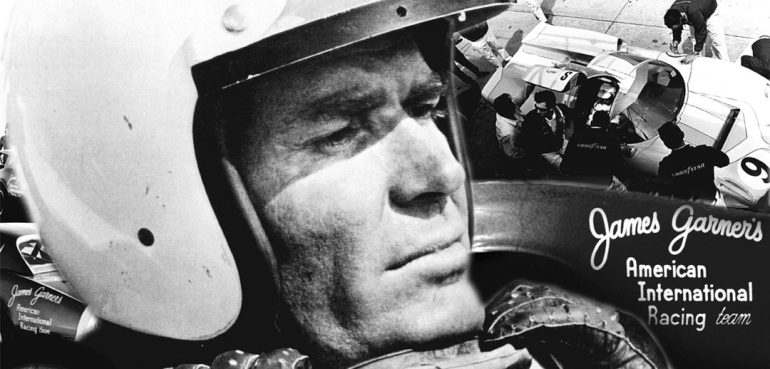
The late ’60s were a time where Hollywood seemed to rediscover auto racing. Movie stars and celebrities like Paul Newman, Steve McQueen, Dick Smothers and Peter Fonda were all bitten by the racing bug during this period. In 1966, actor James Garner (who is perhaps best known now for his starring role in the hit TV series, The Rockford Files) was cast to play the role of a down and out American racer in John Frankenheimer’s epic racing movie Grand Prix. Like many of his Hollywood brethren, Garner was hooked on racing – even to the point of doing most of his own driving and stunts in the movie until the studio’s insurance company put a stop to it!
During the filming of Grand Prix, Garner became good friends with a number of the professional racers hired to drive in the film. In particular, Garner formed a close bond with American road racers Bob Bondurant and Dick Guldstrand. According to Guldstrand, “The three of us had such a good time during the filming of Grand Prix, when it was over we looked at each other and said, ‘How can we keep this feeling going?’ The result was that we decided to create a professional race team that we called American International Racing.” AIR, the acronym for the team was incorporated in 1967 by the three friends, along with Irwin Sandin and Donald Rabbitt.
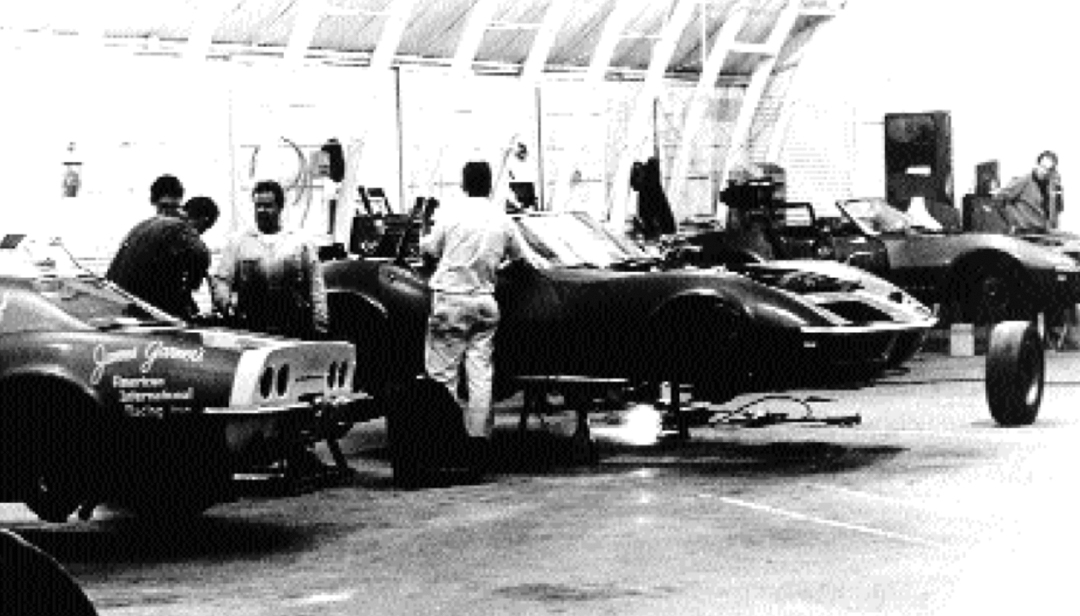
Three 1968 Corvette L-88s are prepared in AIRÕs Culver City shop for the 1968 24-Hours of Daytona. Photo: Jordan Collection
Guldstrand recalls that AIR’s original goal was to race the most exotic machinery available – cars like the new Howmet Turbine. However, the group really didn’t have the financial resources to buy such exotic equipment and Garner, interestingly, was counciled by his business advisors to limit his financial involvement. In the end Garner “seeded” the effort with $65,000. The first racing program AIR would embark on was called “Corvette 68.” The goal was to field a team of three precision- built Corvette L-88 coupes at the 24-Hours of Daytona, the 12-Hours of Sebring and the 24-Hours of Le Mans. The team had signed a contract with Goodyear, reportedly to add to the $65,000 Garner had put into the team’s startup fund; but Herb Caplan, a successful Sacramento businessman, had connections very high up at GM, combined with some of his own front money allowed AIR to acquire the three L-88 Corvettes needed for the program.
When the cars arrived back in AIR’s 6000 sq.ft. shop in Culver City, California, Bob McDonald, the chief mechanic, and his crew wasted no time in stripping two of the cars down to their bare frames for a NASCAR-style re-weld and prep. The third car was painted identical to the racecars and used as a promotional vehicle. The engines went a couple of doors down to Traco Engineering for the few modifications allowed.
Join 45,000+ Corvette Owners Who Read Our Newsletter
Our newsletter delivers all the Vette news, rumors, deals and events directly to you each week
Members only$35 / year
Keep going. This is where it gets good.
CorvSport Membership is for people who'd rather spend an hour inside one engine option than skim ten headlines. The rest of this story — and every other one like it — is a few seconds away.
Every members-only story
Deep history, market reports, buyer's guides, and the full archive back to 2010.
No ads. None.
The whole site reads like a magazine, on every device.
Every model year, 1953 to today
Production numbers, VINs, RPO codes, colors, options — one page per year.
30% off the shop
Every CorvSport shirt and piece of merch, all year.