Become a premium member for just $35/year and get ad-free access!

Shelby Cobra Killers: When GM Built One in Secret and Backed Another in the Shadows

During the golden era of the American automotive industry in the 1950s and 1960s, Ford and Chevrolet were locked in an arms race for sports car and racing supremacy. Chevrolet introduced the Corvette in 1953, and less than a decade later, a year before the launch of the C2 Corvette, there was a new kid on the block: the Ford-powered Shelby Cobra. Right off the bat, the Cobra was quicker than any Corvette on the road. Thanks to its huge power-to-weight advantage, short wheelbase, and massive torque, the Shelby Cobra was essentially a race car with license plates.

When the Cobra appeared in 1962, GM found itself in an awkward position. First, the C2 Corvette wasn’t ready yet, which meant Chevrolet was still racing an aging C1. As a result, the Cobra immediately began beating Corvettes in SCCA competition. However, due to GM’s self-imposed racing ban, the company could not openly fight the Cobra. Instead, it triggered a wave of covert, semi-official “Cobra Killer” programs, some inside GM and others adjacent to it, designed to beat the Shelby Cobra without violating GM’s corporate racing ban.

What happened next is one of the most fascinating wink-and-nod chapters in American motorsport history.

Why the Shelby Cobra Changed the Rules Overnight

Shelby Cobra 427 Prototype
Credit: Hagerty


By the early 1960s, the American sports car landscape was practically non-existent. The Corvette was pretty much the sole purpose-built sports car from the U.S., while Ford, Dodge, and Plymouth had no true production equivalents. Some cars offered performance, but they were mostly full-sized sedans or luxury-focused models like the Ford Thunderbird or drag racers and pony car concepts that had not yet reached the market. In that context, the arrival of the Shelby Cobra was disruptive in a way few cars ever have been because it ignored convention.

three-quarter front view of a black 1965 Shelby Cobra 427
Credit: Hagerty

By combining a lightweight British AC Ace chassis with Ford V8 power, first the 260 and 289 cubic-inch small blocks, and later the fearsome 427, Carroll Shelby created a car that weighed roughly 2,100 to 2,300 pounds, depending on configuration. Early Cobras produced around 260 horsepower, while later variants exceeded 400 hp. That power-to-weight ratio helped the Cobra eclipse anything Chevrolet was offering at the time. Of course, GM couldn’t ignore that, but there was one problem: they were unable to officially respond.

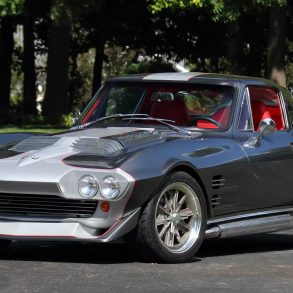
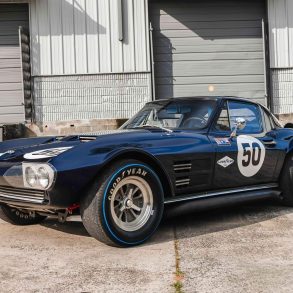
The Corvette Grand Sport and Zora Arkus-Duntov’s Secret Factory Weapon

1963 Corvette Grand Sport with the hood up
Credit: Motortrend

Inside Chevrolet Engineering, no one took the Cobra threat more seriously than Zora Arkus-Duntov.  Long before the Cobra appeared, Duntov had pushed for lighter, more race-focused Corvettes, so the Cobra was the perfect excuse to act. 

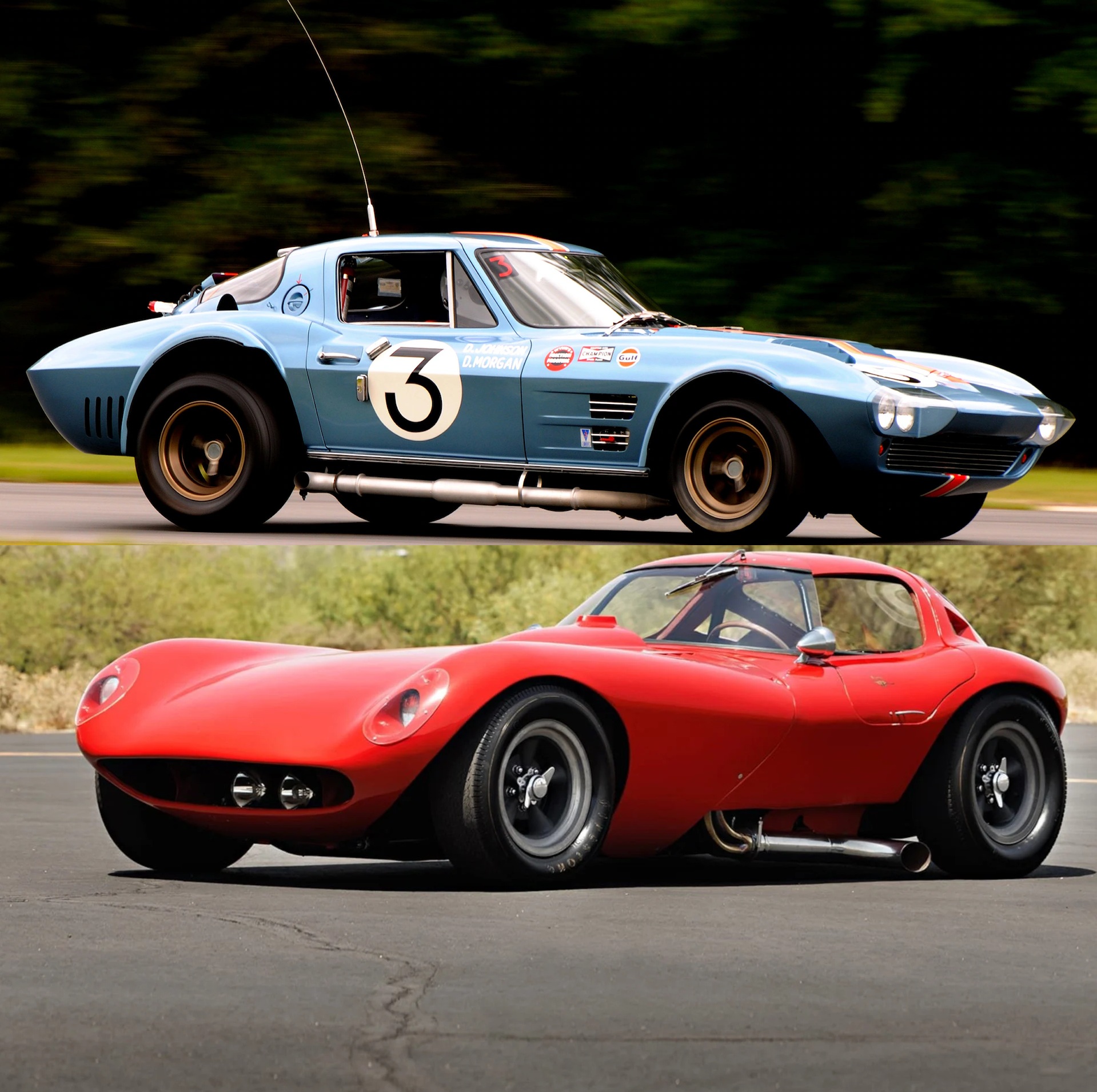
The Corvette Grand Sport was conceived as a purpose-built lightweight version of the upcoming C2 Corvette. It wasn’t meant to be a concept car or a styling exercise but rather a race car designed to exploit loopholes in GM’s racing ban by being framed as an engineering project rather than a factory racing program.

Under the skin, the Grand Sport featured extensive weight reduction, including thin-gauge aluminum body panels, a pared-down interior, and a reinforced but lighter chassis. Power was courtesy of a 377 cubic inch small block V8, essentially a racing-bred version of Chevrolet’s small block architecture, pumping out between 485 and 550 horsepower depending on tune. The target weight was around 1,900 pounds, hundreds of pounds lighter than a standard C2 Corvette.

Front view of a 1963 white Corvette Grand Sport
Credit: Motortrend

Chevrolet engineers revised the suspension geometry, upgraded the braking, and designed the car to run wide racing tires. In every meaningful way, the company had created a factory-built Cobra killer. Visibility, however, created a problem. And once GM executives realized the Grand Sport no longer functioned as a mere engineering exercise, they shut down the program after completing only five cars.

Fortunately, those cars didn’t disappear. They were quietly handed off to private teams and raced by entrants like John Mecom and Roger Penske, where they proved immediately competitive against Cobras and European GT cars alike. The Grand Sport had the balance, durability, and engineering depth the Cobra demanded. 

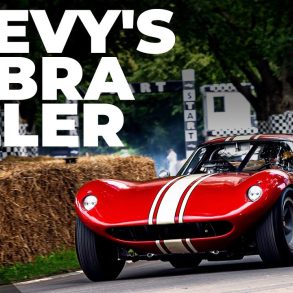
Bill Thomas’s Cheetah and the Privateer Path GM Could Not Take

Three-quarter side view of Bill Thomas Cheetah and Goodwood
Credit: Wikipedia

While Chevrolet was pulling the plug on the Grand Sport project, a very different solution emerged outside the company’s walls. Bill Thomas was a respected Corvette tuner and racer with close ties to Chevrolet hardware, but he operated independently. That independence mattered.

The Bill Thomas Cheetah wasn’t a Corvette, at least not officially. It used a tubular spaceframe chassis and a front-mid-mounted Chevrolet small block V8 pushed so far rearward that it nearly intruded into the cockpit. Wheelbase was extremely short, and bodywork was minimal. The goal was not refinement or endurance. The goal was maximum power-to-weight

Early Cheetahs employed 327 cubic inch small blocks producing around 400 horsepower, while later versions pushed closer to 500 horsepower. With a curb weight estimated around 1,800 pounds, the Cheetah offered explosive straight-line performance that could rival or exceed a Cobra. It was brutally fast, but it was also brutally difficult to drive.

Aerial view of a green Bill Thomas Cheetah GT-3
Credit: Silodrome

Heat management was a constant issue due to the engine’s placement. Handling was twitchy at speed, and development resources were limited. GM did not fund the project, but it tolerated it. Engines, parts, and quiet technical goodwill flowed through unofficial channels. That was as far as GM could go without leaving fingerprints. The result was a car that occasionally delivered on its promise but never had the time or support to mature. 

The Racing Ban That Shaped Two Very Different Cobra Killers


In 1963, six years after the infamous Automobile Manufacturers Association (AMA) ban recommended that all member companies, including GM, Ford, and Chrysler, cease factory-backed racing and stop advertising speed and horsepower, GM self-imposed a new racing ban. 

While Ford and Chrysler officially “walked away” from the AMA ban by 1962 to go racing openly, GM Chairman Frederic Donner double-downed on the policy in early 1963. He issued a strictly enforced internal edict that prohibited all GM divisions from participating in or supporting any form of motorsport. GM wanted to avoid a federal antitrust breakup, fearing that continued racing dominance would prove they held an illegal monopoly over the American auto market, since at the time, GM already controlled over 50% of the U.S. car market.

This decision killed off projects like the Chevrolet Grand Sport. However, that policy did not stop performance ambition but rather redirected it. While the company forbade official factory teams, it did not prohibit engineering, selling parts, or supporting customers. What GM couldn’t do was appear to be racing.

That distinction explains why GM ended up with two Cobra killers instead of one unified effort. The Grand Sport represented what Chevrolet Engineering believed the Corvette needed to be. The Cheetah represented what GM could tolerate from the outside. Both existed because neither alone was politically safe. 

Neither reached its full potential for the same reason. The Grand Sport was killed too early, while the Cheetah was left to fend for itself. Together, they form a snapshot of a company trying to win a war it was not allowed to fight openly.

Cobra Killer Comparison: Specs and Intent

Specification Shelby Cobra 289 Corvette Grand Sport Bill Thomas Cheetah
Years Active 1962 to 1965 1963 to 1964 1963 to 1966
Engine Ford V8 Chevy small block V8 Chevy small block V8
Displacement 289 cu in 377 cu in  327 to 377 cu in
Power Output ~271 hp 485 – 550 hp 400 – 500 hp
Curb Weight ~2,100 to 2,300 lbs ~1,900 lbs ~1,800 lbs
Wheelbase 90 inches 98 inches -90 inches
Intended Role Road and SCCA Racing GT endurance racing Sprint and drag racing

Two Cars, One Unfinished Answer

In hindsight, it’s hard not to see the Grand Sport and Cheetah as missed opportunities. But in reality, they were products of a system that prioritized caution over clarity. GM had the human and financial means to beat the Cobra, but it lacked the freedom to commit fully to a single solution.

The irony is that both cars achieved what they were meant to do. They beat the Cobra often enough to prove a point. They just were never allowed to live long enough to finish the argument.