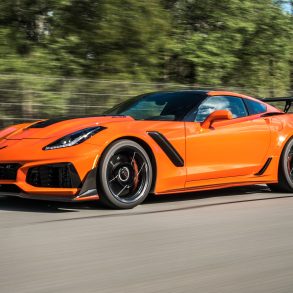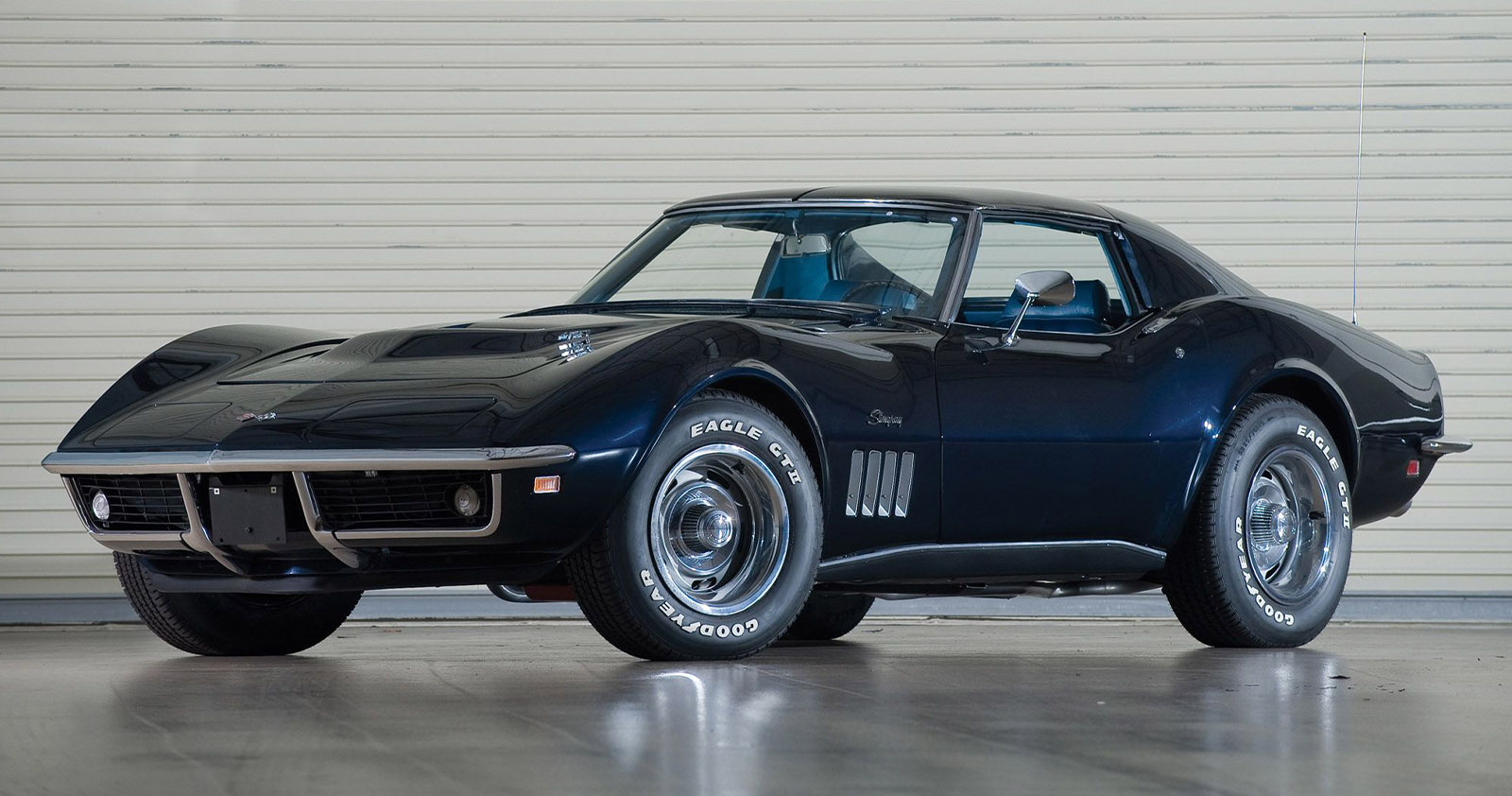
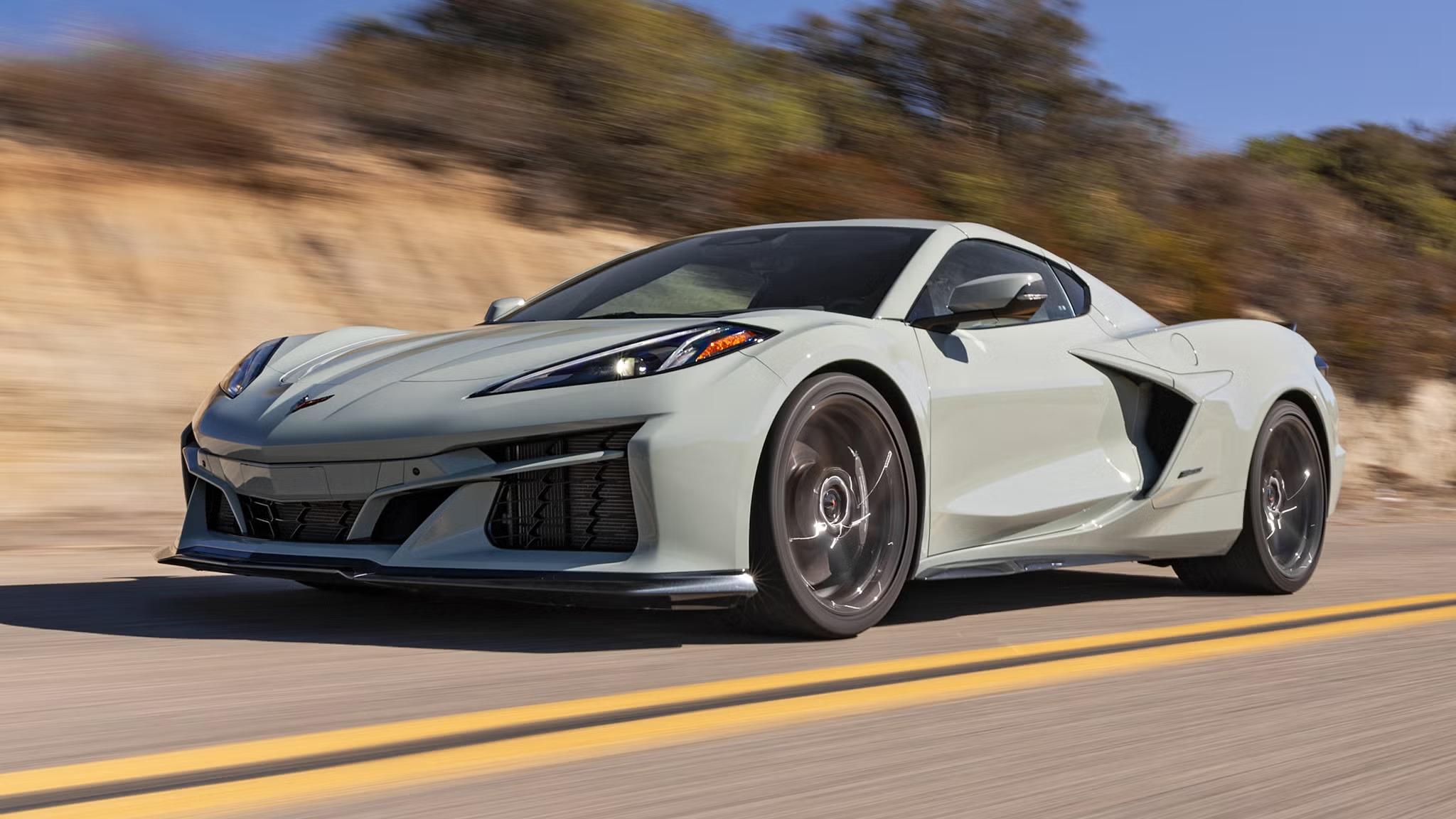
Chevrolet is done with the E-Ray. Production wraps up with the 2026 model year, and the hybrid all-wheel-drive slot in the lineup passes to the 2027 Grand Sport X, a car with a bigger engine and a name that traces back to Zora Arkus-Duntov’s aborted 1963 racing project. Four model years is a short run by Corvette standards.
Which makes this an odd car to evaluate. Nothing meaningful changed behind the rear glass. The 6.2-liter LT2, the front-axle electric motor and the 655-horsepower combined figure are exactly what they were when the car launched in January 2023, and so are the acceleration numbers. Everything the driver touches, though, is new. The E-Ray inherits the redesigned C8 cabin that Chevrolet rolled out across the entire lineup for 2026, and in the process it quietly fixed two or three things owners had been complaining about since day one.
So the last E-Ray is also the most polished one. Whether that reads as satisfying or frustrating probably depends on when you placed your order.
The LT2 + Electric Motor Powertrain
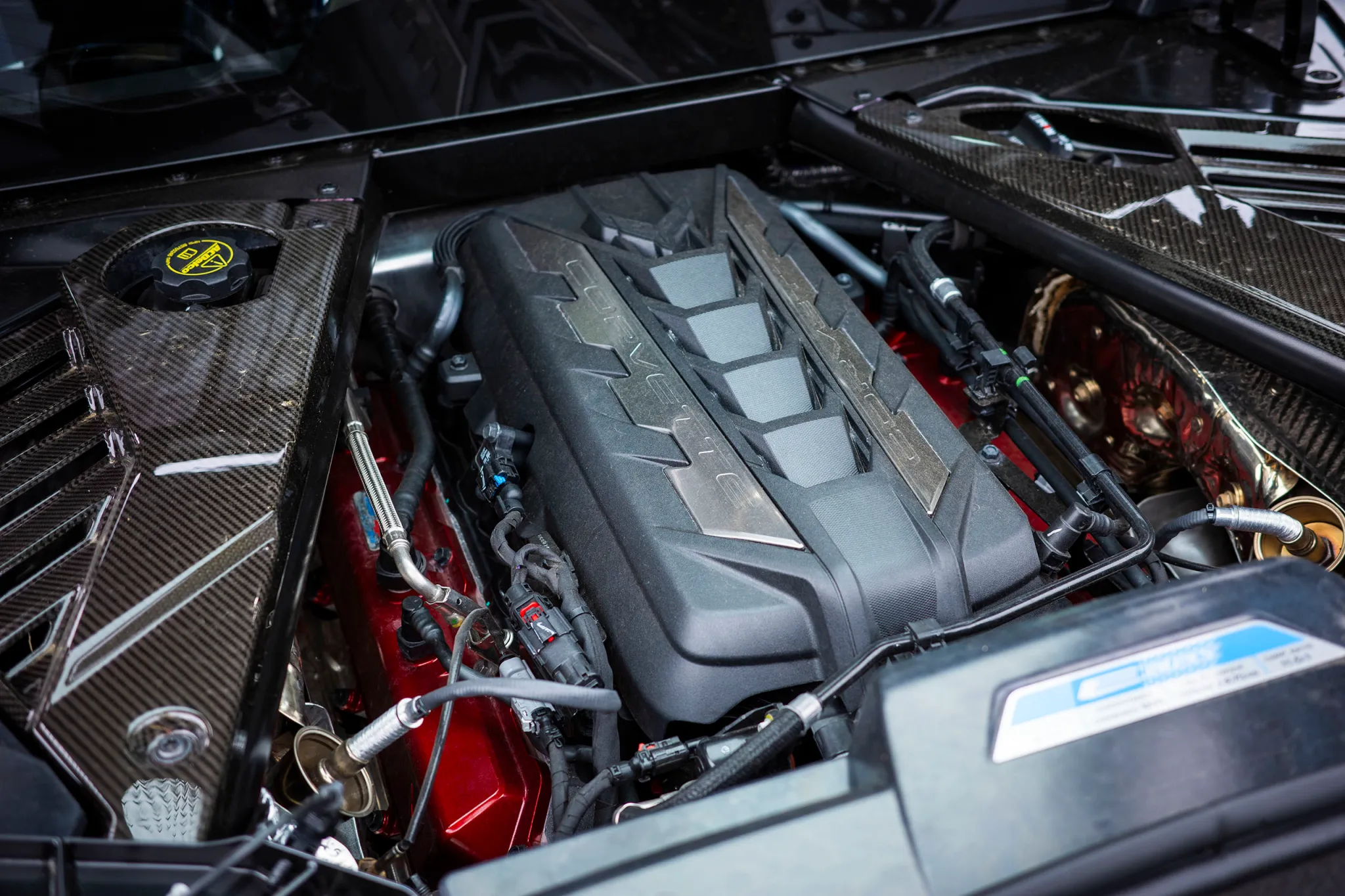
The layout has not changed since 2023, and there was never much reason for it to. Behind the seats sits the same naturally aspirated 6.2-liter LT2 that powers the Stingray, sending its output to the rear wheels through an eight-speed dual-clutch transmission. Up front, ahead of the driver’s feet, Chevrolet packaged a single electric motor, a gearset and a 1.9 kWh lithium-ion battery. There is no driveshaft connecting the two ends of the car. The V8 drives the rear axle, the motor drives the front axle and the road does the rest, which is why engineers call it a through-the-road hybrid. Combined output works out to 655 horsepower and 595 lb-ft.
The battery is small on purpose. It never gets plugged in, it recharges under braking and coasting and it exists to deliver bursts of front-axle torque rather than range. Stealth Mode will move the car on electric power alone up to 45 mph, which is enough to get out of a neighborhood at six in the morning without waking anyone.
What Chevrolet did change for 2026 is how you manage all of it. The Charge+ button, which either tops the battery up in a hurry or holds a charge for a track session, moved off the console and onto the steering wheel, sitting just below the Z Mode button. It is a small thing that matters a lot when you are reaching for it at speed. Chevrolet also added PTM Pro across the whole Corvette range for the first time since Performance Traction Management was introduced. It shuts off stability and traction control while leaving ABS and certain E-Ray front-axle controls running, which is about as close to unsupervised as a modern Corvette gets.
Performance Figures
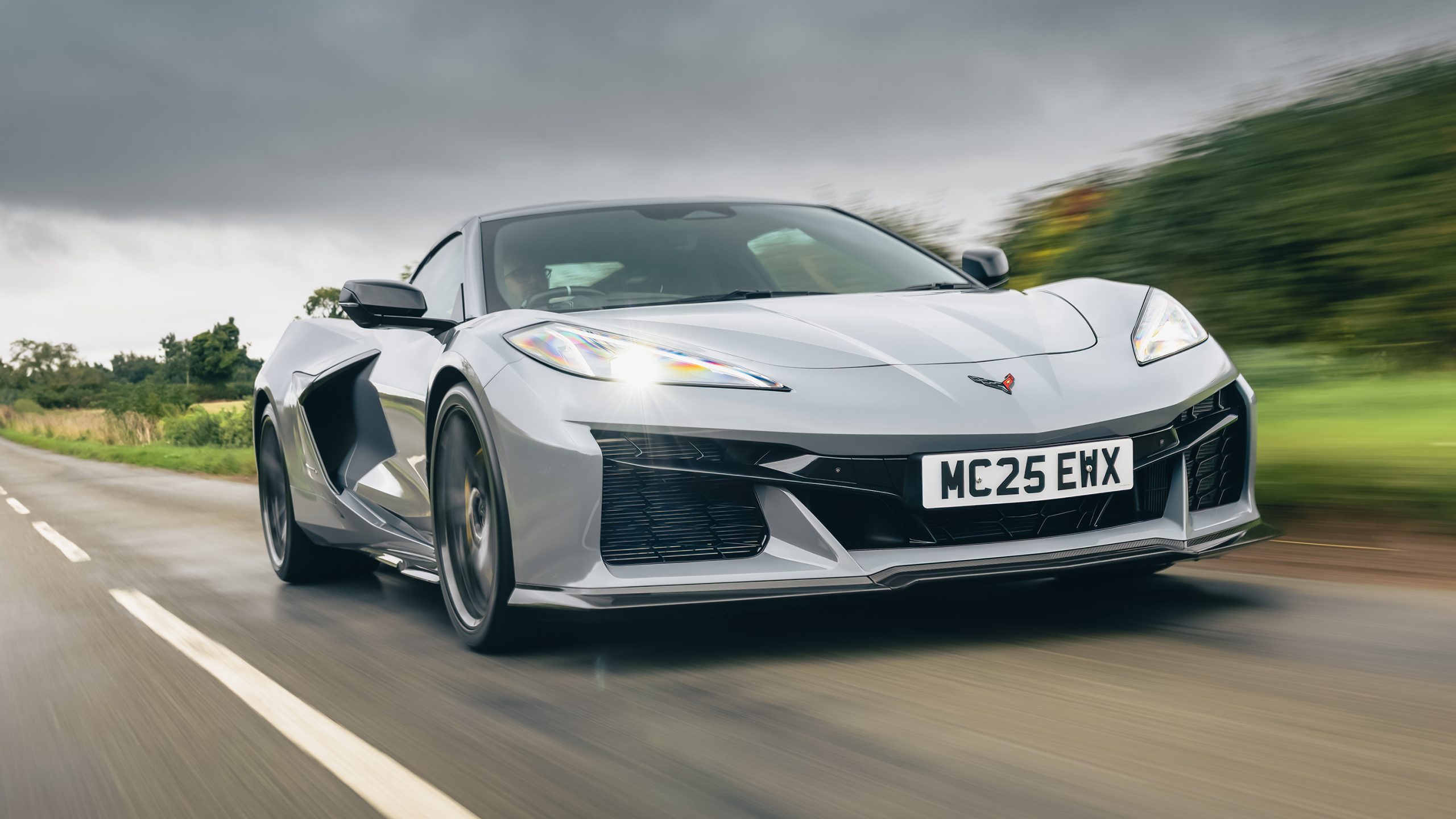
Nothing here moved, which is not a complaint at this price.
- 0 to 60 mph in 2.5 seconds
- 0 to 100 mph in roughly 6.0 seconds
- Quarter-mile in about 10.5 seconds at 126 mph
- Top speed of approximately 183 mph
The context around those numbers has shifted quite a bit, though. When the E-Ray arrived it was the quickest Corvette anyone had ever strapped test gear to. Then the 1,064-horsepower ZR1 landed. Then the ZR1X landed, took the E-Ray’s electric front axle, bolted it to a twin-turbo V8 and ran 1.8 seconds to 60 mph with an 8.9-second quarter-mile in independent testing. The E-Ray is now third in its own family.
It still beats the Z06 off the line, and it does so without asking anything of the driver beyond a firm right foot.
How It Stacks Against the Competition
| Vehicle | Power | 0-60 MPH | Base Price |
| Corvette E-Ray | 655 hp | 2.5 seconds | $108,600 |
| Porsche 911 GTS Hybrid | 532 hp | 2.9 seconds | $181,000 |
| McLaren Artura | 671 hp | 2.9 seconds | $255,400 |
| Ferrari 296 GTB | 819 hp | 2.9 seconds | $343,000 |
Everything in that group has gotten more expensive since 2023. The E-Ray has not, at least in MSRP terms, so a gap that already looked absurd has widened into something closer to a rounding error. Edmunds put it bluntly when it noted the Corvette delivers nearly identical speed to the Artura for roughly $150,000 less.
AWD Dynamics & Real-World Handling
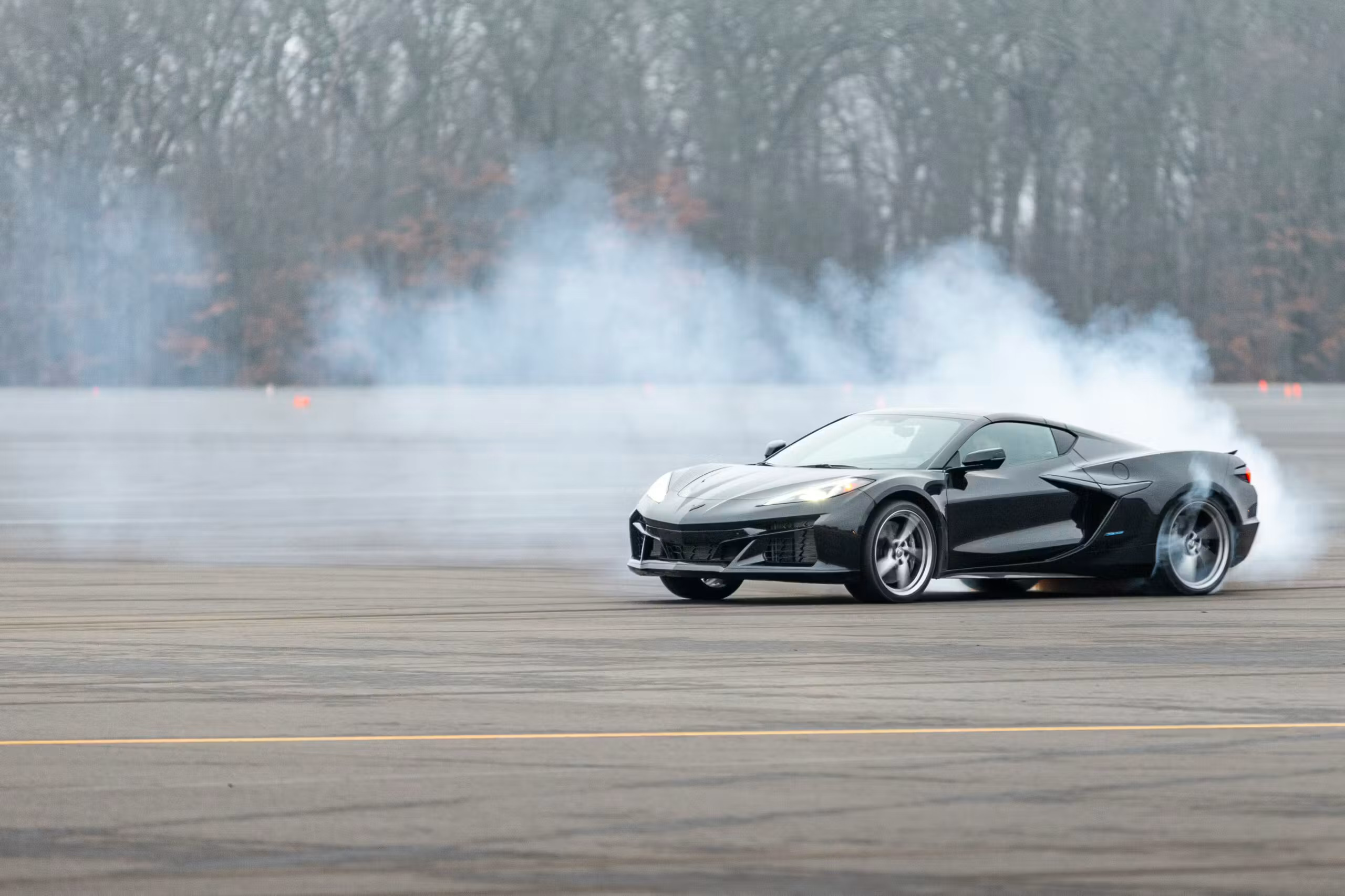
Traction is the whole argument. Sending power to the front wheels does more for a Corvette in February than another fifty horsepower ever would, and until the ZR1X showed up, no other C8 could do it.
The E-Ray is not a light car, and Chevrolet has never pretended otherwise. It weighs close to 4,000 pounds, more than any other eighth-generation Corvette, and reviewers still disagree about what that mass does to the experience. One camp misses the delicacy of the Z06 and says the E-Ray feels muted at the limit. The other camp points out that the car is easier to place, easier to trust and considerably less likely to spit you into a wall when the surface goes cold.
Both readings are defensible. Which one you land on depends almost entirely on where you drive. Standard rubber is the Michelin Pilot Sport All Season 4 ZP run-flat, which is the point of the car. The ZER Performance Package swaps in Pilot Sport 4S ZP summer tires and a sharper chassis tune for buyers who would rather have the grip and park the thing in December. Magnetic Ride Control 4.0 comes standard either way.
Exterior & Aero
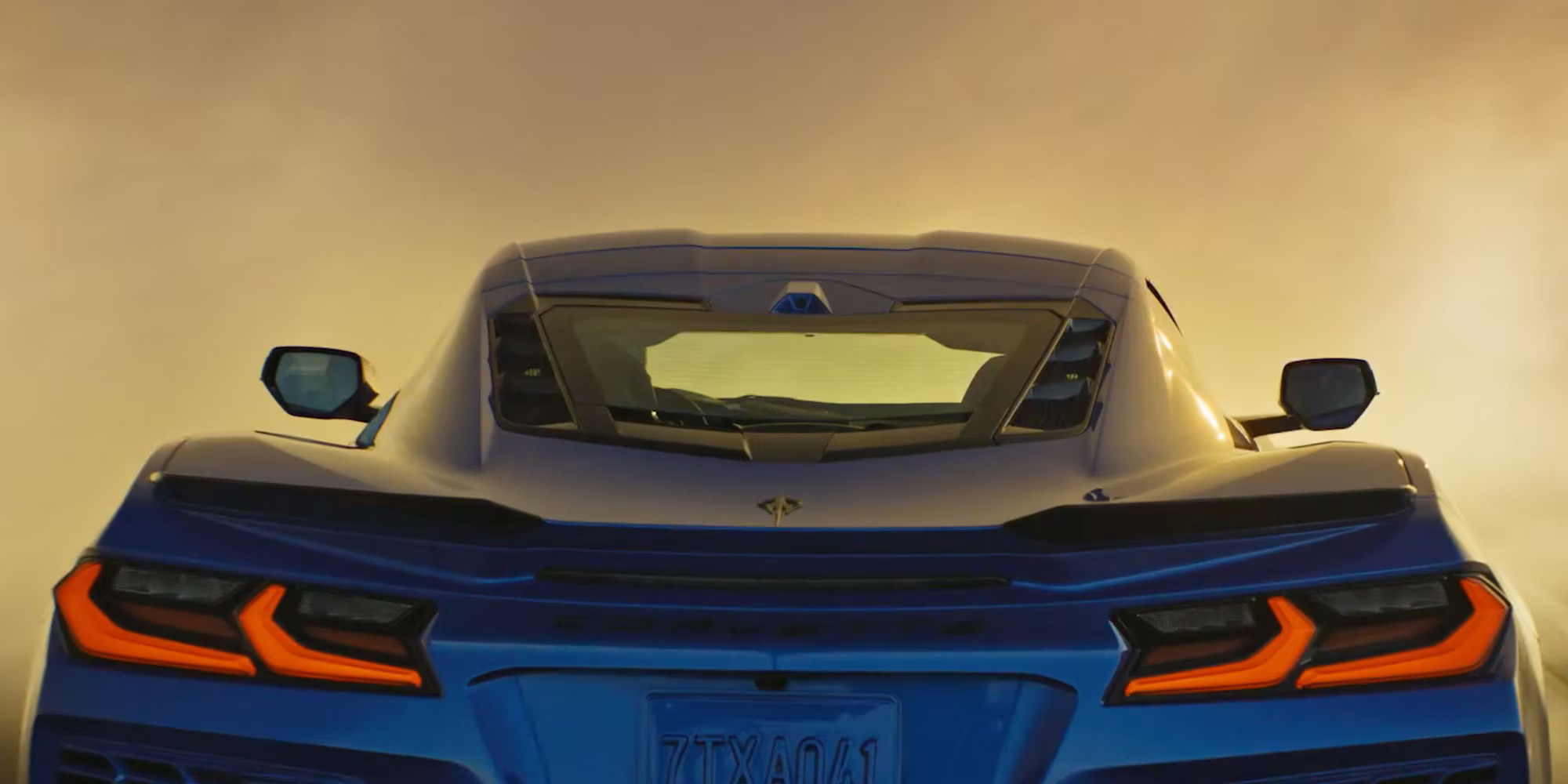
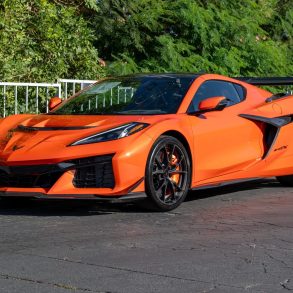
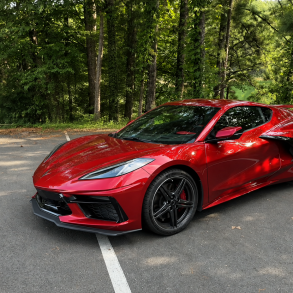
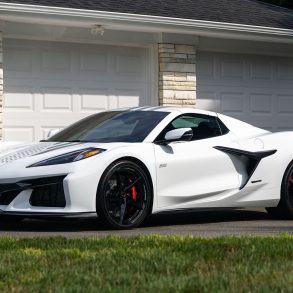
The Z06 body carries over untouched, so the changes for 2026 come down to equipment and paint. Body-color rocker panels are now standard on the E-Ray rather than an option, which cleans up the profile at no cost. Blue Brembo calipers, previously a ZR1 exclusive, made their way onto the E-Ray and Z06 order sheets. Chevrolet also added an asymmetrical center stripe in Edge Red and Carbon Flash, plus an electrochromic targa panel that switches the glass between full, medium and low tint at the press of a button for $3,000.
On the paint front, Roswell Green Metallic and Blade Silver Metallic joined the palette. To keep the count at ten, Chevrolet retired Rapid Blue and Sea Wolf Gray Tricoat after 2025. Rapid Blue had been on the books since the C8 launched in 2020 and had a real following, so expect that one to come up in every forum thread about the 2026 order guide.
Everything functional stays put: the wider track, the cooling vents feeding the battery and brakes, and the ZER package’s adjustable wicker spoiler.
Suspension, Tires & Brakes: Four-Square Control
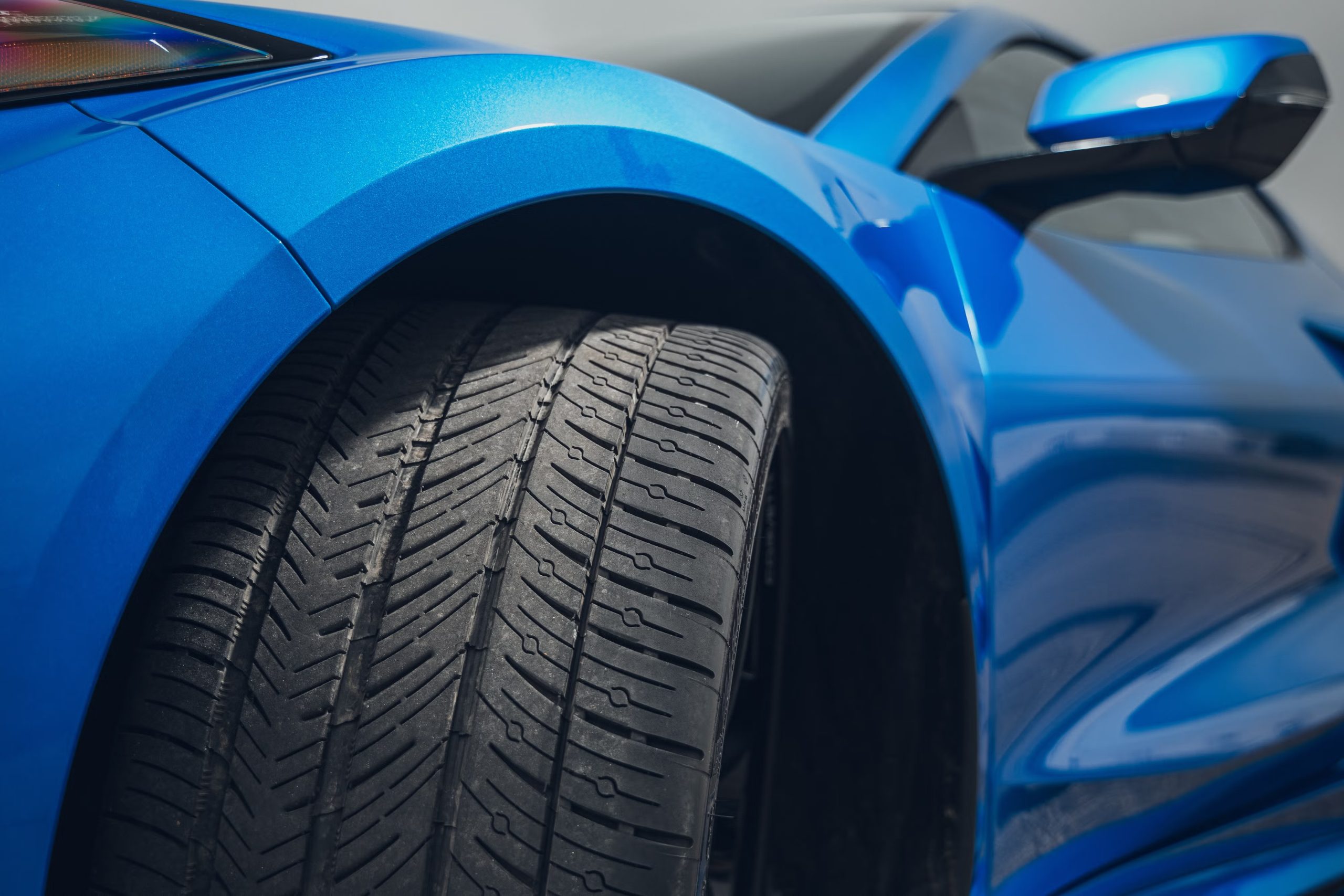
The hardware here is a carryover, and it was already the right hardware. Short/long arm double wishbones at all four corners, with forged aluminum uppers and cast aluminum L-shaped lowers. Magnetic Ride Control 4.0 reads the road and adjusts damping continuously. Wheels measure 20 inches up front and 21 inches at the rear, forged aluminum, wrapped in all-season rubber unless you tick the ZER box. Braking comes from carbon-ceramic Brembos as standard equipment, six-piston monobloc calipers in front and four-piston units at the rear.
What is new is the amount of information you get about all of it. The revised Performance App now feeds live tire pressures and temperatures, a reworked g-force gauge that shows the limits the car has reached over time rather than a needle bouncing around, and a propulsion vitals screen covering engine oil temperature and pressure, coolant temperature and transmission fluid temperature. Track-day drivers will find more use for that than most.
Interior & Tech
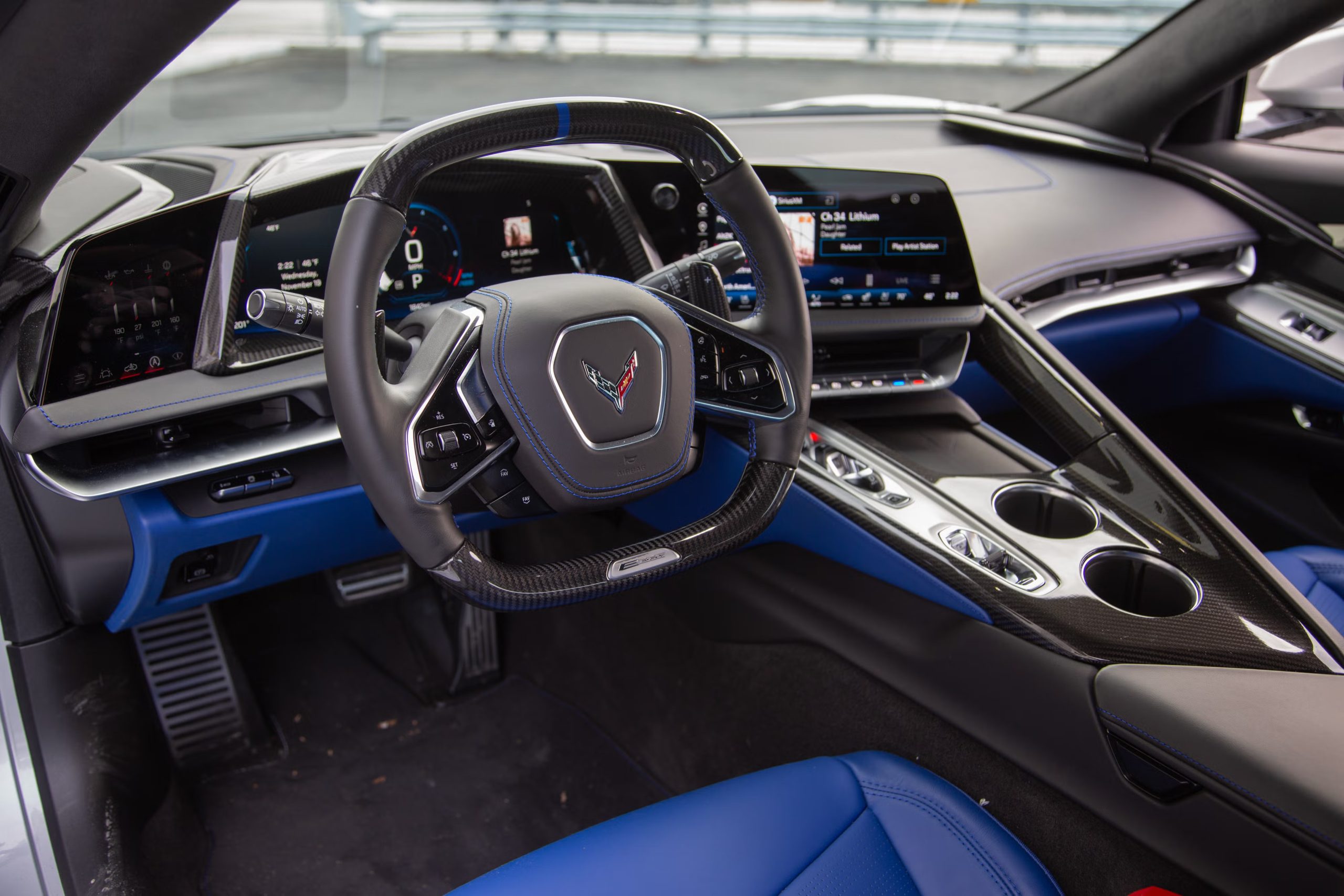
Here is the reason to care about the 2026 car. Since 2020, every C8 owner has had to reach across a vertical bank of climate switches running down the passenger side of the console. Enthusiasts called it the wall of buttons. Chevrolet’s own designers seemed to know it was a problem, and for 2026 they deleted it entirely.
The HVAC controls moved under the center display where you would expect to find them. The space they left behind became an integrated passenger grab handle with a USB-C port tucked below it, and the cabin feels noticeably more open as a result. The drive mode selector was redesigned and repositioned in line with the gear selector. Its old spot now holds a covered wireless charging pad, which is finally somewhere your arm can reach without a shoulder stretch. The volume knob grew and picked up a lit base. The cupholders lost their lid and gained hand-wrapped inserts, ambient lighting and crossed flags at the bottom, with real aluminum trim on 2LZ and 3LZ cars.
The screens are all new too. The old 8-inch touchscreen and 12-inch cluster are gone, replaced by a three-display setup: a 14-inch driver information center, a 12.7-inch center display angled toward the driver and a 6.6-inch auxiliary touchscreen sitting to the left of the steering wheel for drive settings and performance data. All of it runs on a custom infotainment system with Google built-in. Apple CarPlay and Android Auto are available.
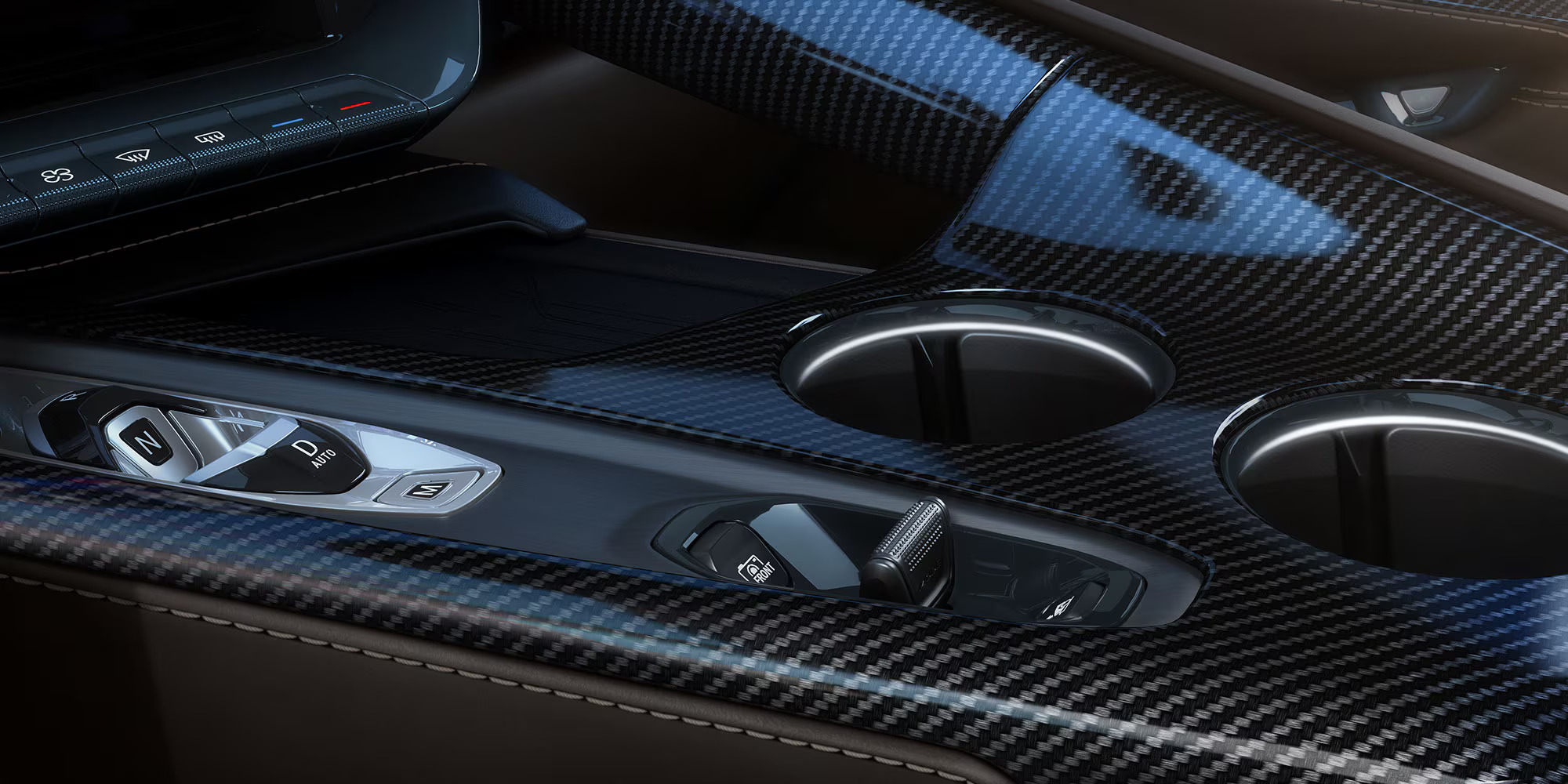
For the E-Ray specifically, the graphics package is worth a mention. New animations show energy moving between the V8, the front motor and the battery in real time, and the new eAWD gauge reports front axle output alongside battery state of charge. Performance driving product manager Dusty Smith described the approach as <cite index=”12-1″>”an intentional balance of physical and virtual controls,”</cite> and for the most part that holds up. The one casualty: heated and ventilated seat controls now live only in the touchscreen.
Chevrolet also went after the materials. The 2026 lineup introduced the first asymmetrical interior in Chevrolet history, a Jet Black and Adrenaline Red split that runs through the dash, console and seats. Santorini Blue, Very Dark Atmosphere and a Sky Cool scheme with Habanero accents joined the list, along with an Ultimate Suede package that covers nearly every surface in sueded microfiber. E-Ray buyers can also spec a carbon-fiber display hood over the driver information center. Cargo space holds at 12.5 cubic feet between the frunk and the rear compartment, still enough for two golf bags.
Safety, Warranty & Everyday Usability
The driver assistance list is modest for a six-figure car, which has been true of the C8 since the beginning. Standard equipment covers a rearview camera, forward collision alert, automatic emergency braking with pedestrian and cyclist detection, lane departure warning, lane keep assist and a following distance indicator.
Blind-spot monitoring, rear cross-traffic alert and the front-view camera stay on the options list. The E-Ray also runs an external pedestrian warning tone when it is moving on electric power at low speed, since the car is otherwise silent.
Warranty terms did not change. Three years or 36,000 miles limited, five years or 60,000 miles on the powertrain, first scheduled maintenance visit included.
Add up the all-wheel drive, the Stealth Mode and a cabin that no longer requires a learning curve, and this remains the C8 you could realistically drive every day without thinking about it much.
Pricing & Availability
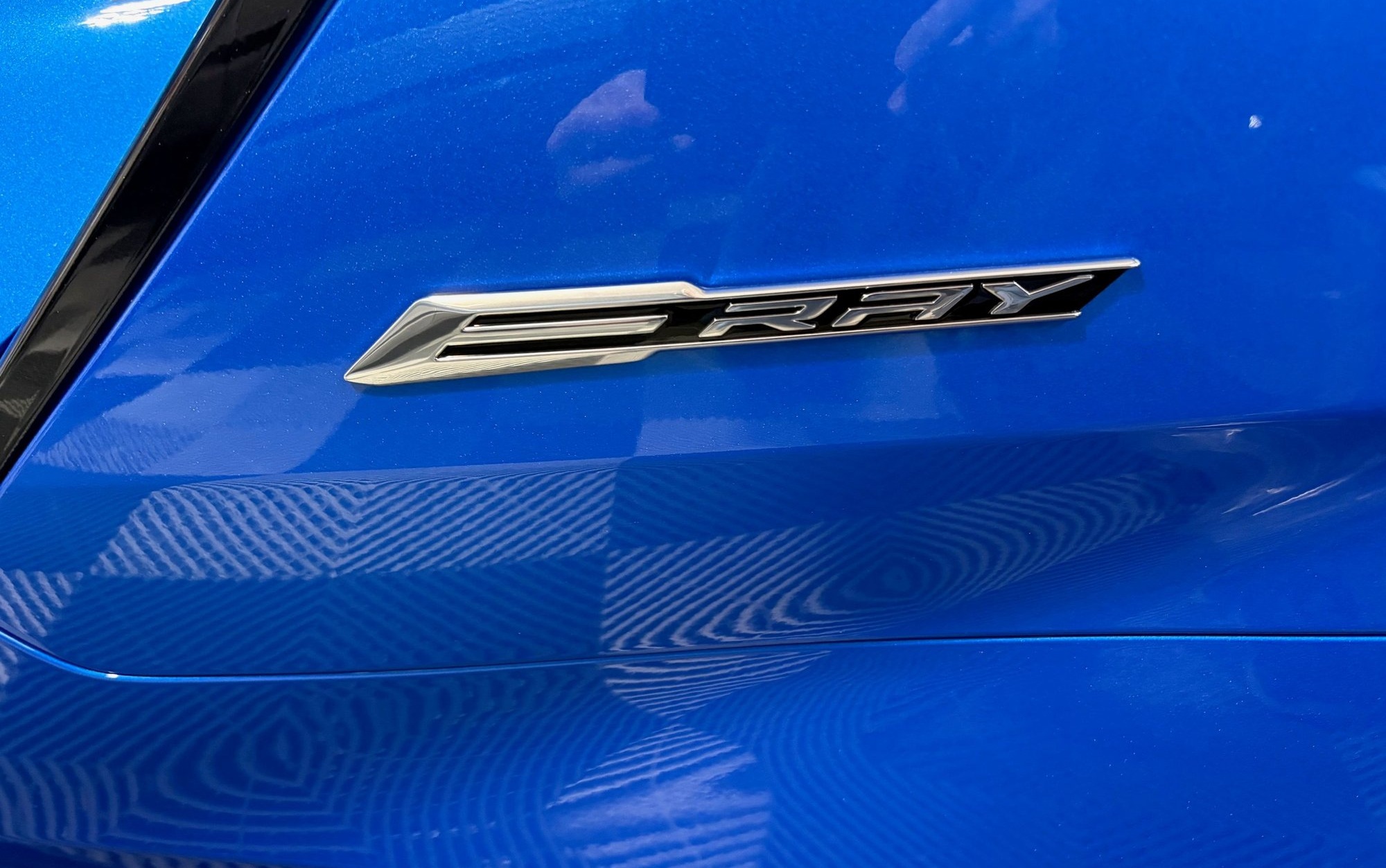
The E-Ray held its MSRP for 2026 while other Corvettes moved. Coupes list at $108,600 for the 1LZ, $114,100 for the 2LZ and $119,550 for the 3LZ. Convertibles come in at $115,600, $121,100 and $126,550 respectively. What did move is the destination charge, which Chevrolet raised from $1,995 to $2,495 in December 2025, pushing the real entry point just past $111,000.
The ZER Performance Package remains the meaningful mechanical option. Beyond that, the 2026 order guide adds the electrochromic roof, the blue calipers and the new paint and interior combinations.
Availability is where things get interesting. A spokesperson for GM’s Bowling Green Assembly Plant confirmed that E-Ray production ends after this model year, with the 2027 Grand Sport X taking over. That car pairs the new 6.7-liter LS6 V8 with the ZR1X’s 186-horsepower front motor for a combined 721 horsepower, and it will almost certainly cost more. If you want the badge instead of the successor, the window is closing.
E-Ray vs. Z06: Traction or Revs
| Feature | E-Ray | Z06 |
| Powertrain | 6.2L V8 plus front e-motor (655 hp) | 5.5L flat-plane-crank V8 (670 hp) |
| Drivetrain | AWD | RWD |
| Acceleration (0-60) | 2.5 seconds | 2.6 seconds |
| Top speed | 183 mph | 189 mph |
| Weight | About 4,000 lbs | 3,670 lbs |
| Focus | All-weather speed and daily use | Track precision and engagement |
| Starting price | $108,600 | $117,700 |
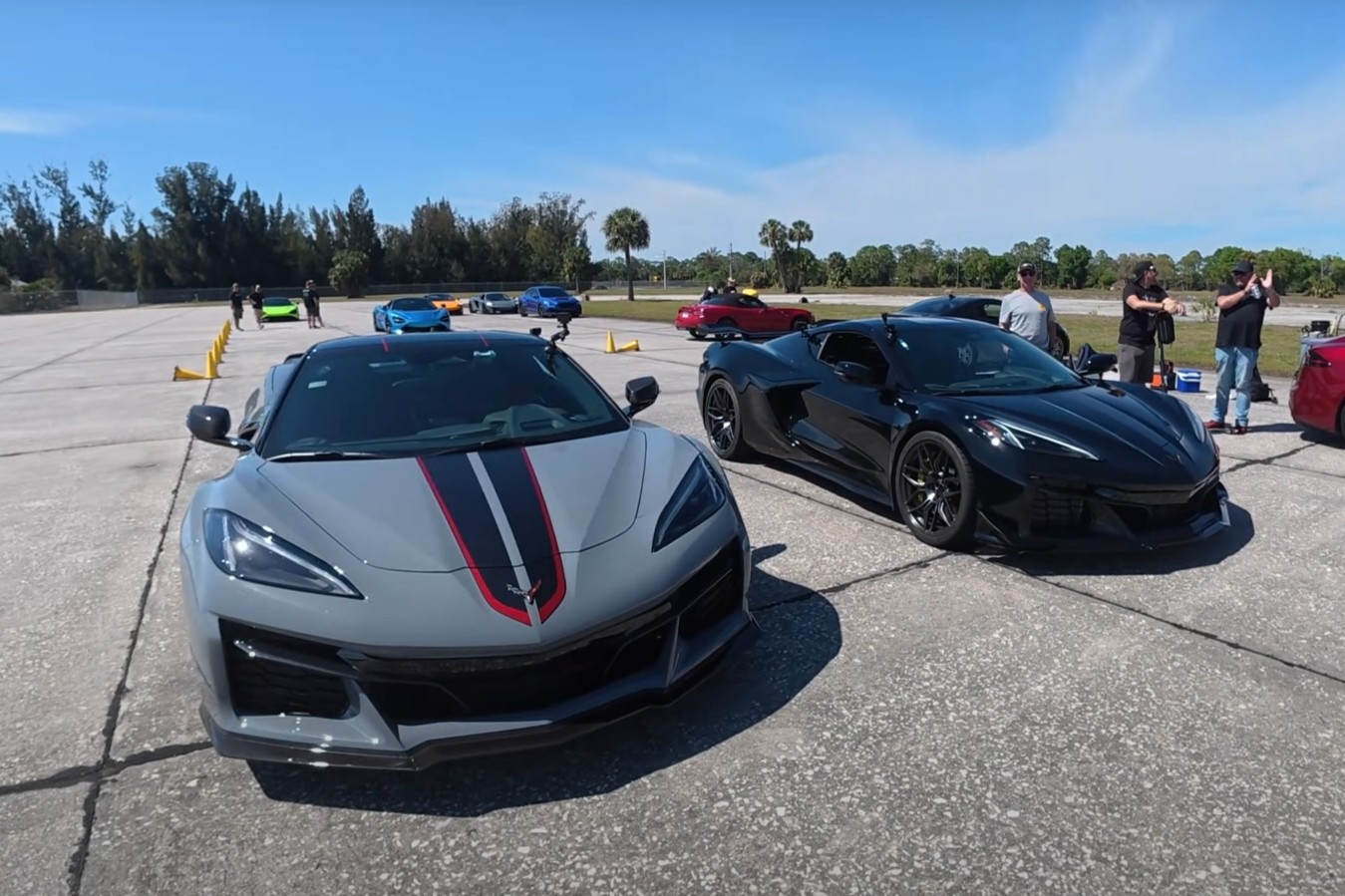
These two have never really competed with each other, whatever the spec sheet suggests. The Z06 is lighter, revs to 8,600 rpm and wants a driver who shows up prepared. The E-Ray gets to 60 mph a tenth quicker, asks for nothing and costs about $9,000 less to get into. Pick based on where you plan to spend your weekends.
Why the E-Ray Stands Out
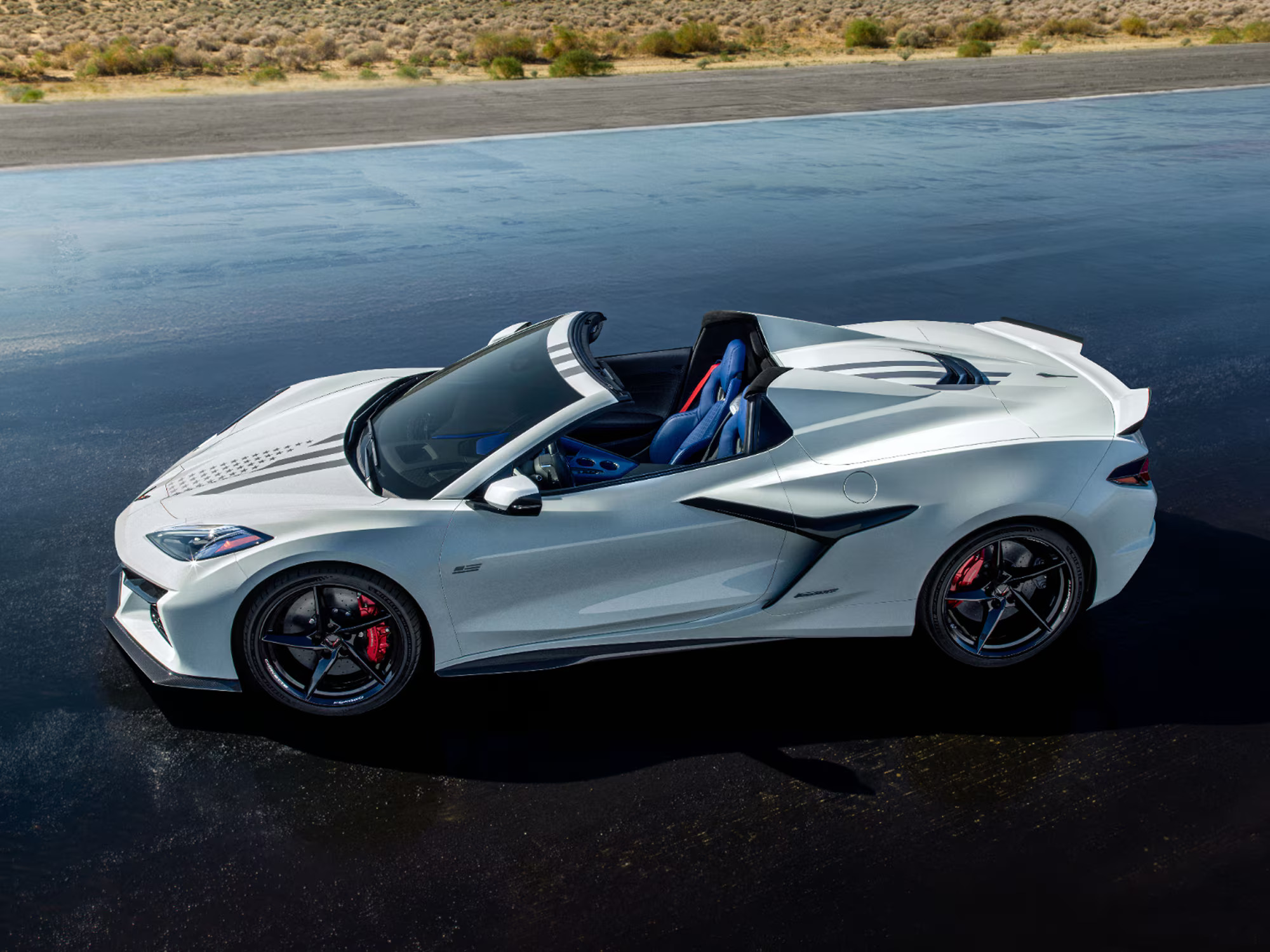
The E-Ray’s case was never about lap times. It was about range of use.
- Traction no other Corvette below the ZR1X can match
- Silent running at parking lot speeds
- Two luggage compartments and a ride that holds up over a long day
- Acceleration that still embarrasses cars costing twice as much
- A cabin, as of 2026, that finally matches the engineering behind it
That last point is the one that changed. For three years the E-Ray was a genuinely sophisticated piece of engineering wearing an interior that reviewers kept apologizing for. The 2026 car fixes it, and it does so in the same season Chevrolet announced the badge was going away.
The Grand Sport X will be quicker, more powerful and better connected to Corvette history. Fine. The E-Ray got there first, proved the concept worked and made electrification feel like a Corvette idea rather than a compliance exercise. This is the last one.
Chevrolet Corvette E-Ray Specifications
ENGINE
| Type: | LT2 6.2L V8 |
| Bore & stroke (in. / mm): | 4.06 x 3.62 / 103.25 x 92 |
| Block Material: | A319-T7 cast aluminum with cast-in iron cylinder liners and nodular main bearing caps |
| Oiling System: | Six-stage dry sump; includes oil-spray piston cooling |
| Oil Type: | Dexos 2 0W40 synthetic |
| Cylinder Head Material: | 319-T7 cast aluminum |
| Combustion Chamber Volume: | 59 cc |
| Compression Ratio: | 11.5:1 |
| Valvetrain: | Overhead valve, two valves per cylinder; dual-equal variable valve timing |
| Valve Size (in. / mm): | 2.13 / 54 hollow (intake) & 1.59 / 40.4 sodium filled (exhaust) |
| Fuel Delivery: | Direct injection with Active Fuel Management |
| Firing Order: | 1-8-7-2-6-5-4-3 (all cylinders); 1-7-6-4 (with deactivation) |
| Throttle Body: | 87mm single bore (electronic) |
| Electric Motor: | Single motor and gearset |
| Battery: | 1.9 kWh Lithium-Ion |
| ECU: | GM E99 (32-bit processing) |
| Combined Horsepower (hp / kW): | 655 / 488 |
| Combined Torque (lb.-ft. / Nm): | 595 / 806 |
TRANSMISSION & AXLE
| Type: | 8-speed dual-clutch transmission (DCT) |
CHASSIS & SUSPENSION
| Front Suspension: | FE5 Short/long arm (SLA) double wishbone, forged aluminum upper and cast aluminum L-shape lower control arms; monotube shock absorbers |
| Rear Suspension: | FE5 Short/long arm (SLA) double wishbone, forged aluminum upper and cast aluminum L-shape lower control arms; direct-acting stabilizer bar; monotube shock absorbers |
| Steering Type: | Variable-ratio rack-and-pinion with electric power assist; includes Active Steer Stops with available Magnetic Ride Control 4.0 |
| Steering ratio: | 15.7:1 |
| Turning Circle (ft. / m): | 36.4 / 11.1 |
| Brake Type: | Front and rear eBoost-assisted carbon ceramic discs with six-piston/monobloc front calipers and four-piston/monobloc rear calipers |
| Brake Rotor Size (in. / mm): | Front: 15.7 x 1.5 / 398 x 38 Rear: 15.4 x 1.3 / 391 x 34 |
| Wheel Size: | Front: 20-inch x 10-inch (w/5 x 120mm bolt pattern) Rear: 21-inch x 13-inch (w/5 x 120mm bolt pattern) |
| Tire Size: | Front: 275/30ZR20 Michelin Pilot Sport All Season 4+ Run Flat Rear: 345/25ZR21 Michelin Pilot Sport All Season 4+ Run Flat |
EXTERIOR DIMENSIONS
| Wheelbase (in. / mm): | 107 / 2722 |
| Overall Length (in. / mm): | 184.6 / 4699 |
| Overall Width without mirrors (in. / mm): | 79.7 / 2025 |
| Overall Height (in. / mm): | 48.6 / 1235 |
| Track (in. / mm): | Front: 66.3 / 1685 Rear: 66.1 / 1678 |
INTERIOR DIMENSIONS
| Headroom (in. / mm): | 37.9 / 962 |
| Legroom (in. / mm): | 42.8 / 1087 |
| Shoulder Room (in. / mm): | 54.4 / 1382 |
| Hip Room (in. / mm): | 52 / 1321 |
WEIGHTS & CAPACITIES
| Curb Weight (lb. / kg): | 3774 / 1712 (coupe) 3856 / 1749 (convertible) |
| Cargo Volume (cu. ft. / L)1: | 12.5/ 355 |
1Cargo and load capacity limited by weight and distribution.
FUEL TANK CAPACITY (approx.)
| 18.5 gal. / 70 liters |