Two firsts for 1978: a Silver Anniversary Edition and an Indy Pace Car replica that ballooned from 300 planned cars to 6,502, or 15 percent of the year's production.


C3 CORVETTE - 1978
A fastback glass roof for the Corvette’s 25th birthday, a Silver Anniversary paint scheme that one buyer in three ordered, and 6,502 black-and-silver Indy 500 Pace Car replicas that dealers sold above list. Horsepower edged up to 185 and 220, the tank grew to 24 gallons and the base price passed $9,000.
Quick Nav: Story · Specials · Pace Car · Anniversary · Price & Options · VIN · Specs · Technical · Pics & Videos · The Market · All · FAQs
Model & Gen: 1978 Corvette (C3)
Body Type: Fastback Sport Coupe (T-top) only; 25th-anniversary year
VIN: 1Z87L8S400001 – 1Z87L8S440274 (Corvette Coupe)
Original Price: $9,351.00 (Pace Car replica $13,653.21)
Colors: 10 plus two two-tones (Silver Anniversary silver over charcoal, Pace Car black over silver)
Engine: 350 ci V-8 only: 185 hp (L48; 175 hp in California and at high altitude) or 220 hp (L82)
Transmission: 4-speed wide-ratio standard (MM4); close-ratio M21 with the L82 only; 3-speed Turbo Hydra-Matic (MX1) at no charge, in 83 percent of cars
Units Produced: 46,776 (40,274 coupes + 6,502 Pace Car replicas)
The 1978 Corvette marked the car’s 25th year with the first real change to the Shark since 1968: the flying-buttress sail panels and the small vertical rear window were cut away for a large compound-curved glass fastback, which brought back the fastback profile of the 1963–67 coupes, let light into a cabin Car and Driver called ‘the most tightly coupled car known to man’, and nearly tripled the luggage space, now hidden under a roll-out cover. Dave McLellan considered a lift-up hatch and decided against the complication; it waited for the 1982 Collector Edition. Every 1978 wore 25th Anniversary emblems on the nose and fuel door, the glass roof panels promised for 1977 finally arrived as RPO CC1, the tank grew from 17 to 24 gallons with a space-saver spare to make room, and the dash was rebuilt around square instrument housings, a real glovebox, a one-piece padded panel and new door trim.
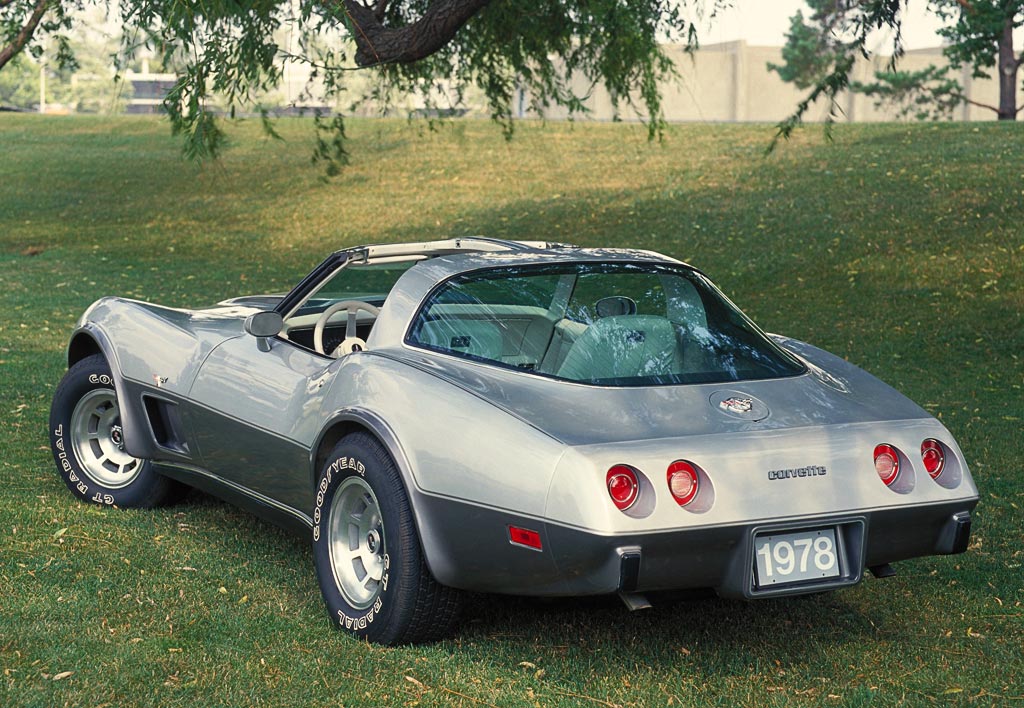
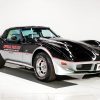
Two packages made the year. The Silver Anniversary paint (RPO B2Z, $399) put silver over Charcoal Silver with a pinstripe between, the first factory two-tone since 1961, and required the aluminum wheels and sport mirrors; 15,283 buyers, one in three, took it. The Indy 500 Pace Car replica (RPO Z78) was black over silver with a red stripe, front and rear spoilers, glass roof panels, silver leather or leather-and-cloth on new high-back seats, nearly every option on the list and a decal kit left in the car for the owner to apply. Chevrolet first planned 300, then 2,500, then one for each of its 6,200 dealers; 6,502 were built with their own 9xxxxx VIN sequence, listed at $13,653.21 and sold for more, and the first Corvette to pace the 500 did so on May 28, 1978.
Under the glass, the L48 rose to 185 hp (175 in California and at altitude) and the L82, with a dual-snorkel intake and a freer exhaust, to 220, with a close-ratio four-speed and 3.70 axle for the L82 only; Car and Driver’s L82 did 0–60 in 6.5 seconds and declared ‘the fast is back’. Production was 46,776, down on 1977 only because the Pace Car build consumed line time, and the base price passed $9,000 for the first time. In the market the 1978 is the C3 with the most low-mileage survivors, because thousands of Pace Cars were put away as investments and never were; the result is that a 500-mile Pace Car and a used one sit $30,000 apart, and the Silver Anniversary L82 four-speed has quietly become the collectors’ pick of the late C3s.
The arrival of the 1978 Chevy Corvette would happen just a few months after the 500,000th model rolled off the St. Louis assembly line (see the 1977 Corvette page for the full story). As significant as that milestone had been as a benchmark of Corvette success, the 1978 model would mark a second milestone – Corvette's Silver Anniversary.
Just as the Corvette had been America's only true production sports car in 1953, the 1978 Corvette continued to carry that mantle 25 years later, and with a similar distinction.
Despite being a dramatically different – and far more challenging – automotive market than the one that had existed when Harley Earl’s prototype first graced General Motors Motorama in New York City, the 25th Anniversary Corvette would still enable General Motors to commemorate the anniversary with class.
There were, of course, concessions that had been made by automotive manufacturers both in the United States and around the world. Sports cars as a whole had become a dwindling commodity. With each passing year, manufacturers had to deal with a broader (and ever growing) array of political, environmental, and financial challenges that made building expensive sports cars increasingly impractical.
The oil embargo of 1973 – 1974 had caused consumers to shun the gas-guzzler automobiles that had been popular just a decade earlier. Instead, the big sales winners were fuel efficient cars like those being built by the Japanese.
What made that even more desirable was that, in addition to being good on gas, they were far more dependable than most of the automobiles being built in the United States. In addition to fuel costs, higher insurance premiums, increased engineering requirements to further regulate engine emissions, and subsequently, higher car prices themselves made buying new cars less and less practical.
Still, General Motors had recognized that the Chevy Corvette was indispensable as a high-profit personal car that doubled as a showcar that got spectators into the automobile showrooms. They recognized that Corvette owner loyalty was fiercer than it had ever been. As such, they saw no need to revamp the current Corvette design, especially when the current car was still selling at or near its all-time-high volume.
Additionally, General Motors recognized that there were many other models in their automobile portfolio that needed to be reworked to survive the rising costs throughout the entire automobile industry. As such, a new, fourth-generation Corvette would not be seriously considered for several more years, though the idea of updating (or even replacing) the current model was not completely forgotten.
While work towards a new front-engine Corvette got underway during Corvette's 25th year, no timetable was attached to the completion of the new model.
Instead, to celebrate 25 years, executives within Chevrolet decided that something special had to be done to the current Corvette to commemorate the car's silver anniversary. The question that followed this decision was this: how could Chevrolet make a notable modification to the current model on a very limited budget? The answer was simple: trim away the old “flying buttress” sail panels and substitute a large, compound curved rear window. In so doing, Chevrolet engineers not only gave the aging third-generation Corvette a new look, but they also brought about the return of the Corvette fastback, which had been notably absent since 1967.
Did you know? While the 1978 Corvette Pace Car Replica is arguably one of the most popular examples of the C3 Corvette, its original design was very different from the car that everyone knows today. In the design phase, the original Pace Car design was to feature a two-tone silver paint with red striping, and was to feature special Goodyear tires with the word “CORVETTE” imprinted in raised, white, sidewall lettering. Additionally, only 300 of these collector Pace Cars were going to be produced in commemoration of the original 300 Corvettes built in 1953.
While a lot of discussions had centered around making the rear window a hinged, lift-up hatchback design, Dave McLellan, Chief Engineer of the Corvette, opted not to complicate the design for the 1978 model (though he would later introduce the option as part of the Collector Edition Hatchback model in 1982.)
Though not a hatchback, the addition of a curved window to the C3 not only improved the car’s overall appearance, it enhanced rearward visibility while also providing nearly three times the available luggage room of earlier models and greater ease of access. A retracting cover was also added to the rear compartment to offer added security and protection from the sun.
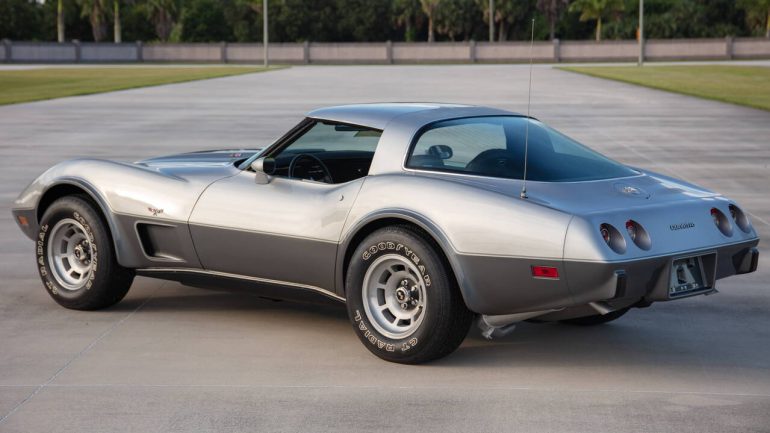
In addition to the new rear window, Chevrolet also felt that the 1978 model warranted a special “25th Anniversary” package to commemorate the car’s silver anniversary. Bill Mitchell had suggested a Silver Anniversary model in his favorite color – silver (which seemed appropriate) – and so it was decided that the 1978 “25th Anniversary Corvette” would indeed include a silver paint scheme.
Additionally, the car received a special striping package. Though inexpensive to manufacture, the striping package would be viewed by many consumers as a desirable package and, as such, GM would be able to mark up the package considerably. Ultimately, the “25th Anniversary” paint scheme ended up being two-tone; silver over a gray lower body with a separating pinstripe.
Listed as RPO B2Z, the special paint package cost an additional $399 over the base price of the car. It was also the first factory optioned two-tone Corvette offered since 1961. The anniversary car also received special “Silver Anniversary” badges, aluminum wheels, and dual “sport” outside mirrors as mandatory options, which added another $380 to the total cost of the car.
To further commemorate Corvette’s 25th anniversary, Chevrolet had negotiated with the Indianapolis Motor Speedway to allow a modified Corvette to serve as the pace car for the 1978 running of the Indianapolis 500.
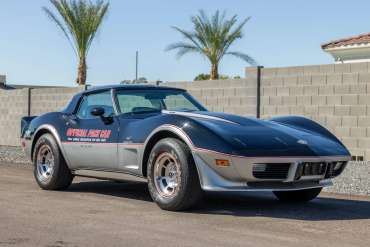
The car, much like the Silver Anniversary Edition, featured a special, two-tone paint scheme, although for this model, the color choice was black over silver metallic with a bright red pinstripe between the two tones of paint.
The Corvette Indy Pace Car also featured a front and rear spoiler, both of which added a more dramatic appearance to the car, though neither offered much in the way of additional downforce (or other functionality.) The front spoiler was similar to the one installed on the 1978 Pontiac Trans Am. It wrapped under and around the front of the car, blending into the wheel wells. The rear spoiler, on the other hand, curved down at its outboard ends to meet the bodysides of the Corvette.
The interior of the Corvette Pace Car was directly influenced by Bill Mitchell and featured either full silver leather or leather/gray cloth upholstery and gray carpeting. Chevrolet introduced a new, thin-shell seat design that featured more lumbar support. Although these seats were originally slated for the 1979 model, the development program was accelerated so that these new seats could be introduced as part of the 1978 Pace Car package.
Naturally, development of a special Corvette Pace Car meant an opportunity to market the design to consumers. Chevrolet initially decided that it would produce 2,500 Indy 500 Pace Car replicas or 100 cars for each year of Corvette’s production since 1953. Each of these cars would be sold on a “first come, first served” basis.
However, as Chevrolet already had 6,200 established dealerships at the time, it was quickly decided that a minimum order of 6,200 units should be built so that each showroom could have at least one. As such, the “Limited Edition Indy Pace Car Replica” Corvette accounted for nearly 14 percent of all the Corvettes manufactured that year.
Like the Silver Anniversary model, the Pace Car Replica was actually offered to consumers as an option package – RPO Z78. Like the actual pace car, it featured the same black over silver paint scheme, the same pin striping and spoiler kit, and the same interior.
Additionally, all the replicas included the new glass T-tops, alloy wheels, power windows, rear window defogger, air conditioning, sports mirrors, tilt/telescopic steering wheel, a heavy duty battery, an AM/FM stereo equipped with either an eight-track tape player or a CB radio, and power door locks. In addition to these features, each Indy Pace Car Corvette replica owner would receive a set of regalia decals that they could install at their discretion. The decal set included the famous “winged wheel” Indy Speedway logos for the rear fenders, as well as large door emblems that read “Official Pace Car, 62nd Annual Indianapolis 500 Mile Race, May 28, 1978.”
Of course, all of the 1978 Corvettes received other updates as well. While a lot of time and attention had been given to the two special edition cars, all Corvettes would undergo a series of cosmetic and functional updates that would make the newest entry unique, regardless of which package prospective consumers ultimately purchased.
All 1978 Corvettes received special “Silver Anniversary” badging on the exterior of the car. The interior received far more attention. The speedometer and tachometer were now encased in squared-up instrument panel housings, matching the previous year’s revamped console gauges. A genuine glovebox was added.
The interior door panels featured an all-new design with armrests that were screwed onto the door instead of being molded into the door as they had been since 1965. The doors now also featured integral door pulls. A single piece, fully padded dashboard with a front mounted cluster was developed for easier removal in such cases where service was required. Windshield and wiper controls were moved back to the instrument panel, but the dimmer switch remained on the steering column. The three-point seat belts were given a single inertia reel, and belt guides were eliminated.
All of the 1978 Corvettes also featured an updated anti-theft system. The new security system, which was standard on all Corvettes, was modified from previous years to include activation in the event that the T-tops were to be tampered with in any way. As the T-tops were a valuable item to car thieves, this additional security proved most valuable, as the 1978 Corvette was identified by law enforcement that year as one of the most frequently stolen cars.
Glass T-tops were offered for the first time in 1978, though GM had originally intended for them to be available on the 1977 model. Both the glass tops and the normal fiberglass T-top panels were modified to provide additional headroom to both the driver and passenger, and both included a key-lock assembly that helped further secure them to the vehicle by securing each T-top latch from being operable when locked.
Mechanically, the car remained very similar to the 1977 Corvette that had come before it. A few changes were made, including a larger fuel tank, which now held 24 gallons of gas (versus the 17 gallon tank used on the previous year.) The tank itself features an internal molded plastic liner cased inside of a steel shell. To accommodate the larger fuel tank, Corvette introduced a smaller, lighter weight spare tire. Wider 60-series tires were also introduced on the 1978 Corvette as an option, and the installation of these would require fender trimming at the Corvette assembly path to ensure proper fit. The tires, manufactured by Goodyear, were P255/60R15s. Aramid-belt construction in the tires contributed to a claimed improvement in ride smoothness.
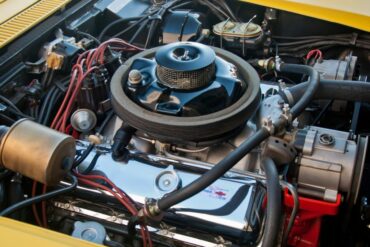
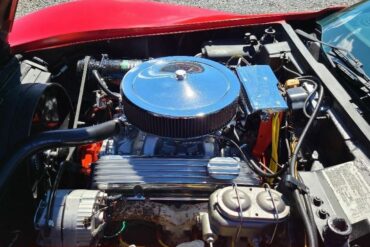
Power ratings diminished some as a result of stricter emission standards, and also as a result of the government’s new Corporate Average Fuel Economy (CAFE) mandates that took effect that year. As with the 1977 Corvette, the 1978 model featured two basic versions of the 350 CI small-block V-8 engine from which consumers could choose. The base L48 produced 185 brake horsepower in every state except California. For California and high-altitude areas, the engine generated 175 bhp. For consumers looking for a car with some additional power, the optional L82 engine could be purchased for an extra $525. The L82 featured an output of 220 brake horsepower via a dual-snorkel air intake system which allowed the delivery of a larger volume of cool air into the engine while a revamped exhaust system that featured larger exhaust and tailpipes along with lower restriction mufflers had been designed to reduce back pressure.
A close-ratio four-speed manual transmission returned as an exclusive option for the L82 engine, and a 3.70:1 rear axle made this combination the best performing setup available to consumers that year. The same gearset was also offered for the L82 with the wide-ratio four-speed transmission, while the L48 engine came with a 3.36:1 axle (which was also available on the L82 with the wide-ratio setup.) Additionally, the L82 was offered with a revised Turbo Hydra-Matic that featured a low-inertia, high-stall-speed (2,400rpm) torque converter. Corvettes equipped with the automatic transmission featured a 3.55:1 final drive, with the exception of the L48 at high altitudes, where the ratio was 3.08:1.
The FE7 Gymkhana Suspension package was again available for the 1978 Corvette, though its price had increased considerably from its original $7.00 price-tag in 1974. Now selling for an additional $41.00, the suspension package included heavy-duty shocks and higher-rate springs for all four wheels, plus a rear anti-roll bar and a thicker front stabilizer bar.
The arrival of the 1978 Corvette was met with a great deal of praise, especially for its more refined ride and appearance, both of which seemed to revitalize the car in the public eye.
The addition of the larger wrap around rear window earned the car praise, especially from reviewers like Car & Driver who stated “the large rear window freshened up the Corvette’s profile, and it also added space and light to help relieve the claustrophobia inside this, the most tightly coupled car known to man.”
Automobile critics praised the car’s performance aspects too – especially those Corvettes equipped with the L48 engine/automatic transmission combinations. When so equipped, the Corvette boasted 0–60 mph times of just 7.8 seconds and a top speed of 123 miles per hour.
At the same time, critics were also quick to point out that the Corvette’s cockpit continued to feel cramped and uncomfortable, and that the car’s front to rear axle weight distribution was uneven, causing the back end of the car to “step out” during sharp cornering maneuvers.
The Pace Car look was so popular that it actually tempted some owners of the standard 1978 Corvette coupes to create a “clone” that they could pass off as the Pace Car model.
While many of these “clones” were very convincing, there were (and still are for those consumers looking to buy one) some key indicators that helped spotters identify the real Pace Car replicas from the homemade knock-offs. For one, most counterfeiters would never replace the factory installed seats with the special edition seats used in the pace car. For another, the Pace Car edition Corvettes featured a special vehicle identification number (VIN).
The 1978 Corvette Pace Car VIN numbers had the number “9” as the eighth digit in the thirteen-digit sequence as opposed to the number “4” associated with all other 1978 models.
From a historical perspective, the 1978 Corvette Pace Car also set an important milestone when it paced the Indianapolis 500 that year. It represented the first time that an unmodified, truly stock machine paced the annual Memorial Day race. The Corvette that led the pack of drivers (which included Tom Sneva, Al Unser, Rick Mears, along with 30 other drivers on May 28, 1978) was almost identical to the Pace Car replica which was sold to consumers that year, save for the two openings made in the back of the car for the required flag poles mounted on the actual pace car.
In all, the 1978 Corvette saw the resurgence of a car brand that had begun to falter some throughout the previous decade. Between the Silver Anniversary and Pace Car Limited Edition Corvettes, and the overall look and feel of the 1978 model as a whole, there was no doubt that Corvette was moving in a better direction once more.
As stated in Car & Driver Magazine, “After a number of recent Corvette editions that prompted us to mourn the steady decline of both performance and quality in this once-proud marquee, we can happily report the twenty-fifth example of the Corvette is much improved across the board. Not only will it run faster now – the L82 version with four-speed is certainly the fastest American production car, while the base L48 automatic is no slouch – but the general drivability and road manners are of a high order as well.”
The 1978 Corvette sold quite well, moving 46,776 units in all. Of these, 6,502 were the limited edition Corvette Pace Car model, which retailed for more than $4,000 over the standard model. While the base coupe started at $9,351.00, the Pace Car had a sticker price of $13,653.21. Still, the Pace car had a unique “collector’s quality” about it which made it extremely desirable to consumers - so much so that every Pace Car in 1978 sold for more than list price.
 Ed Baumgarten
c. Mid America Motorworks
 The interior of the 1978 Corvette received a number of new updates including improved instrument panel housings and a genuine glovebox.
 Interior of the 1978 Indy Pace Car Corvette
 All 1978 Corvettes Pace Car Replicas included a set of optional "Offical Pace Car" decals that could be installed at their discretion.
 The October, 1977 Issue of Car & Driver Magazine showcased the 1978 Corvette, stating "At last, the fast is back!"
Chevrolet planned 300 Indy Pace Car replicas, one for each of the original 1953 Corvettes, then 2,500, then decided every one of its 6,200 dealers should have one and built 6,502. Dealers sold a $13,653.21 car for $20,000 and more, buyers parked them as investments, and so many never drove them that a 1978 Pace Car with under 1,000 miles still appears at auction several times a year.
DID YOU KNOW
The two anniversary packages, the Silver Anniversary paint on 15,283 cars and the 6,502 Indy 500 Pace Car replicas with their own VIN series, each have a section below. The ‘Corvette Summer’ movie car, Greenwood’s and Eckler’s widebody conversions and the Aerovette that GM cancelled this year are the rest of the 1978 specials.

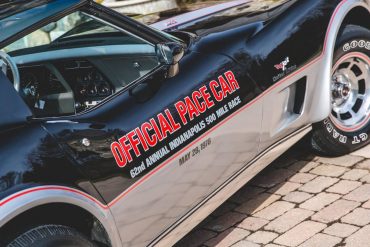
The first Corvette to pace the Indianapolis 500, on May 28, 1978, and the first limited edition sold to the public: RPO Z78, black over silver with a red stripe, front and rear spoilers, glass roof panels, red-accented aluminum wheels, silver leather or leather-and-cloth on new high-back seats, nearly every option on the list and a decal kit left for the owner to apply. Chevrolet planned 300, then 2,500, then one per dealer, and built 6,502 with their own 900001–906502 VIN series at $13,653.21; dealers sold them for more, buyers stored them, and low-mileage cars have sold for $34,750 to $44,000 in 2026 while driven examples bring $15,000 to $20,000.
MORE: ALL 1978 PACE CAR POSTS



Bill Mitchell’s choice for the 25th birthday: RPO B2Z, silver over Charcoal Silver with a pinstripe between, the first factory two-tone Corvette since 1961, at $399 plus the required aluminum wheels and sport mirrors. It was not a limited edition; 15,283 buyers, one in three, ordered it with any engine, gearbox and interior, so the cars range from L48 automatics to L82 close-ratio four-speeds with the Gymkhana suspension and P255/60R15 tires, which are the ones collectors now want. In 2026 Silver Anniversary cars sold for $9,373 to $36,300, with low-mileage L82 four-speeds at the top.

The Sport Coupe listed at $9,351.00, up $703 on 1977, with leather, power steering and brakes, the alarm, Positraction, a four-speed or Turbo Hydra-Matic and now the 24-gallon tank included.
The Pace Car replica listed at $13,653.21 and included almost everything: glass roof panels, aluminum wheels, power windows and locks, air, defogger, sport mirrors, tilt column, heavy-duty battery, the 8-track or CB stereo, power antenna, rear speakers, convenience group, P255/60R15 tires and the special seats; the L82 and a four-speed were extra-cost choices on it.
The Silver Anniversary paint (RPO B2Z, $399.00) required the aluminum wheels ($340.00) and sport mirrors ($40.00), so the package really cost $779, and 15,283 buyers paid it. The 220-hp L82 ($525.00) went into 12,739 cars, 27 percent, more than in any year since 1972; the close-ratio M21 into 3,385 of them, the standard wide-ratio MM4 into 4,773 cars and the Turbo Hydra-Matic (RPO MX1) into 38,614, 83 percent.
Aluminum wheels (RPO YJ8, $340.00) went on 28,008 cars, 60 percent, helped by the two packages; sport mirrors (RPO D35, $40.00) on 38,405; air conditioning (RPO C60, $605.00) into 37,638; the tilt-telescopic column (RPO N37, $175.00) into 37,858; the convenience group (RPO ZX2, $84.00, now with floor mats and intermittent wipers) into 37,222; power windows (RPO A31, $130.00) into 36,931; speed control (RPO K30, $99.00) into 31,608; the defogger (RPO C49, $95.00) into 30,912; the heavy-duty battery (RPO UA1, $18.00) into 28,243; the power antenna (RPO U75, $49.00) into 23,069; the Gymkhana suspension (RPO FE7, $41.00) under 12,590; power door locks (RPO AU3, $120.00) into 12,187 and rear speakers (RPO U81, $49.00) into 12,340. Radios: 20,899 8-track stereos (RPO UM2, $419.00), 10,189 stereos (U58, $286.00), 7,138 CB stereos (UP6, $638.00) and 2,057 AM/FM sets (U69, $199.00). The P255/60R15 tires (RPO QBS, $216.32) went on 18,296 cars and the P225/70R15 white-letters (QGR, $51.00) on 26,203; glass roof panels (RPO CC1, $349.00) on 972 non-Pace cars; the trailer package (ZN1, $89.00) on 972; California certification (YF5, $75.00) on 3,405 and high-altitude equipment (NA6, $33.00) on 260.
Most prices rose a few dollars during the year. A typical automatic L48 with air, power windows, tilt, speed control, defogger, stereo, aluminum wheels, mirrors and the convenience group came to about $11,200; a Silver Anniversary L82 four-speed with the 8-track, power antenna, speakers, wide tires and FE7 reached $12,500, and a Pace Car with the L82 passed $14,000.
MORE: PRICING, OPTIONS & COLORS / RPO CODES
| CODE | DESCRIPTION | QUANTITY | RETAIL PRICE |
|---|---|---|---|
| 1YZ87 | Base Corvette Sport Coupe | 40,274 | $9,351.00 |
| 1YZ87/Z78 | Limited Edition Indy 500 Pace Car replica (black/silver paint, spoilers, glass roof panels, aluminum wheels, A31, AU3, C49, C60, D35, N37, UA1, UM2 or UP6, U75, U81, ZX2, P255/60R15 tires, high-back seats, decal kit) | 6,502 | $13,653.21 |
| A31 | Power Windows | 36,931 | $130.00 ($135.00 late) |
| AU3 | Power Door Locks | 12,187 | $120.00 ($124.00 late) |
| B2Z | Silver Anniversary Paint (two-tone silver over charcoal silver, pinstripe, anniversary emblems; required YJ8 and D35) | 15,283 | $399.00 |
| C49 | Rear Window Defogger (electric) | 30,912 | $95.00 ($98.00 late) |
| C60 | Air Conditioning | 37,638 | $605.00 ($615.00 late) |
| CC1 | Removable Glass Roof Panels | 972 | $349.00 |
| D35 | Sport Mirrors (left remote) | 38,405 | $40.00 ($42.00 late) |
| FE7 | Gymkhana Suspension (heavy-duty springs and shocks, rear anti-roll bar, thicker front bar) | 12,590 | $41.00 ($46.00 late) |
| G95 | Optional Rear Axle Ratio (highway) | 382 | $15.00 |
| K30 | Speed Control (automatic only) | 31,608 | $99.00 ($104.00 late) |
| L82 | 350ci, 220HP Engine | 12,739 | $525.00 |
| M21 | 4-Speed Manual Transmission, Close Ratio (L82 only) | 3,385 | no charge |
| MM4 | 4-Speed Manual Transmission, Wide Ratio (standard) | 4,773 | no charge |
| MX1 | Turbo Hydra-Matic 3-Speed Automatic | 38,614 | no charge |
| N37 | Tilt-Telescopic Steering Column | 37,858 | $175.00 ($178.00 late) |
| NA6 | High-Altitude Emission Equipment (175 hp) | 260 | $33.00 |
| QBS | White Letter Steel-Belted Radial Tires, P255/60R15 (aramid-belted; fenders trimmed at the factory) | 18,296 | $216.32 |
| QGR | White Letter Steel-Belted Radial Tires, P225/70R15 | 26,203 | $51.00 |
| U58 | AM-FM Radio, Stereo | 10,189 | $286.00 |
| U69 | AM-FM Radio | 2,057 | $199.00 |
| U75 | Power Antenna | 23,069 | $49.00 |
| U81 | Dual Rear Speakers | 12,340 | $49.00 |
| UA1 | Heavy Duty Battery | 28,243 | $18.00 |
| UM2 | AM-FM Radio, Stereo with 8-Track Tape | 20,899 | $419.00 |
| UP6 | AM-FM Radio, Stereo with 40-Channel CB | 7,138 | $638.00 |
| YF5 | California Emission Certification (175 hp) | 3,405 | $75.00 |
| YJ8 | Cast Aluminum Wheels (set of 4, steel spare) | 28,008 | $340.00 ($345.00 late) |
| ZN1 | Trailer Package (FE7 springs and shocks, heavy-duty radiator, higher-output alternator) | 972 | $89.00 |
| ZX2 | Convenience Group (dome-light delay, headlight and low-fuel warnings, underhood and courtesy lights, floor mats, intermittent wipers, visor mirror) | 37,222 | $84.00 ($90.00 late) |
| CODE | EXTERIOR | TOTAL | INTERIOR |
|---|---|---|---|
| 13/07 | Silver Anniversary (silver over Charcoal Silver, RPO B2Z) | 15,283 | Black, Mahogany, Oyster, Red (leather or cloth); Silver |
| 19/47 | Pace Car replica (black over silver, red stripe) | 6,502 | Silver leather, or silver leather with gray cloth |
| 19 | Black | 4,573 | Black, Light Beige, Mahogany, Oyster, Red |
| 10 | Classic White | 4,150 | Black, Dark Blue, Dark Brown, Light Beige, Mahogany, Oyster, Red |
| 13 | Silver | 3,232 | Black, Dark Blue, Mahogany, Red |
| 82 | Corvette Mahogany | 2,121 | Black, Dark Brown, Light Beige, Mahogany, Oyster |
| 83 | Corvette Dark Blue | 2,084 | Dark Blue, Light Beige, Oyster |
| 72 | Corvette Red | 2,074 | Black, Light Beige, Oyster, Red |
| 89 | Corvette Dark Brown | 1,991 | Dark Brown, Light Beige, Oyster |
| 26 | Corvette Light Blue | 1,960 | Dark Blue |
| 59 | Corvette Light Beige | 1,686 | Black, Dark Blue, Dark Brown, Light Beige, Mahogany |
| 52 | Corvette Yellow | 1,243 | Black, Dark Brown, Oyster |
Both 350s moved up: the L48, now 8.2:1, to 185 hp net at 4,000 rpm and 280 lb-ft at 2,400 (175 hp with California or high-altitude equipment), and the L82, at 8.9:1 with its forged crank, four-bolt mains and performance cam, to 220 hp at 5,200 rpm and 260 lb-ft at 3,600, fed by a new dual-snorkel air cleaner and breathing out through 2.5-inch pipes and lower-restriction mufflers. Both ran a Quadrajet, HEI ignition, a single catalytic converter and unleaded fuel, with casting 3970010 and 462624 heads. The wide-ratio four-speed (RPO MM4) was standard, with a 2.85 first gear behind the L48 and 2.64 behind the L82; the close-ratio M21 came only with the L82 and a 3.70 axle, the quickest combination of the year, and the Turbo Hydra-Matic gained a low-inertia converter with a 2,400-rpm stall behind the L82.
Car and Driver’s L82 four-speed did 0–60 in 6.5 seconds and the quarter in 15.2 at 95 mph; an L48 automatic managed 7.8 seconds and 123 mph.
The chassis was the 1977 car’s with a 24-gallon tank in a steel shell with a plastic liner, the space-saver spare that made room for it, and the FE7 Gymkhana suspension (RPO FE7, $41.00) now adding a rear anti-roll bar and a thicker front bar to its stiffer springs and shocks on 12,590 cars. The big news was the tire: P255/60R15 aramid-belted Goodyears (RPO QBS, $216.32) on 18,296 cars, the first 60-series tire on a Corvette, which needed the fender lips trimmed on the line; P225/70R15 radials were standard.
The aluminum wheels (RPO YJ8, $340.00) were the Kelsey-Hayes castings of 1976–77, painted with red accents on the Pace Car, and went on 60 percent of cars. Four-wheel discs, power steering and the 98-inch wheelbase carried over; the glass roof and bigger tank pushed curb weight to about 3,560 lb.
MORE: FULL SPECIFICATIONS / ENGINE
| SPEC | 1978 CORVETTE |
|---|---|
| Engines | 350 ci (5.7 L) small-block V-8 in two versions, hydraulic lifters, catalytic converter, unleaded fuel, HEI ignition, SAE net ratings; new dual-snorkel air cleaner and larger 2.5-in exhaust with lower-restriction mufflers on the L82 |
| Base engine (L48) | 350/185 hp net @ 4,000 rpm, 280 lb-ft @ 2,400 rpm, 8.2:1, hydraulic lifters, Rochester Quadrajet; 175 hp with California (YF5) or high-altitude (NA6) equipment; 34,037 cars |
| RPO L82 | 350/220 hp net @ 5,200 rpm, 260 lb-ft @ 3,600 rpm, 8.9:1, hydraulic lifters, forged crank, four-bolt mains, high-performance camshaft, dual-snorkel intake, finned aluminum valve covers; 12,739 cars, $525.00 |
| RPO FE7 | Gymkhana suspension: higher-rate springs, firmer shocks, thicker front anti-roll bar and a 0.44-in rear bar; 12,590 cars, $41.00 (included in the 972 ZN1 trailer packages) |
| Transmission | 4-speed wide-ratio (RPO MM4, 2.85 first on the L48, 2.64 on the L82) standard on 4,773 cars; close-ratio M21 (2.43 first) with the L82 only, 3,385 cars; 3-speed Turbo Hydra-Matic (RPO MX1) at no charge in 38,614 cars, 83 percent, with a low-inertia 2,400-rpm-stall converter behind the L82 |
| Axle ratio | 3.36:1 with the L48 four-speed; 3.70:1 with the L82 four-speed; 3.55:1 with the automatic (3.08:1 high-altitude automatics); Positraction standard; highway ratio (RPO G95, $15.00) on 382 cars |
| Front suspension | Independent; short-long arm, coil springs, anti-roll bar; FE7 heavy-duty |
| Rear suspension | Independent; frame-mounted differential, half-shafts, trailing arms, transverse leaf spring; FE7 adds a rear anti-roll bar |
| Brakes | Four-wheel disc, 11.75-in rotors, four-piston calipers, dual-circuit master cylinder, power assist standard |
| Steering | Saginaw recirculating ball, power assist standard, 16.1:1; tilt-telescopic column (RPO N37, $175.00; 37,858 cars); wiper and washer controls moved back to the dash, dimmer stays on the column |
| Body | New fastback roof with a large compound-curved fixed rear window (1,425 sq in of glass against 293 before), giving nearly three times the luggage space, with a retracting security cover; 25th Anniversary nose and fuel-door emblems on every car; removable glass roof panels (RPO CC1, $349.00; 972 cars) offered at last; roof panels lockable and the alarm extended to them |
| Interior | Square speedometer and tachometer housings, a real glovebox, one-piece padded dash with front-mounted cluster and printed-circuit wiring, new door panels with screwed-on armrests and integral pulls, single-reel three-point belts; leather standard, cloth and leather at no cost; Pace Car high-back thin-shell seats (standard on all 1979s) |
| Wheels & tires | 15 x 8 in steel Rally wheels or 15 x 8 cast aluminum (RPO YJ8, $340.00; 28,008 cars, 60 percent); P225/70R15 steel-belted radials standard, raised-white-letter on 26,203 cars (RPO QGR); P255/60R15 aramid-belted white-letter tires (RPO QBS, $216.32; 18,296 cars) needed fender trimming at the plant; space-saver spare |
| Fuel tank | 24 gal (up from 17), steel shell with molded plastic liner; unleaded fuel only |
| Wheelbase | 98 in |
| Overall length / width / height | 185.2 in / 69.0 in / 48.0 in |
| Track, front / rear | 58.7 in / 59.5 in |
| Curb weight | approx. 3,560 lb |
| 0–60 mph | 6.5 sec (L82 four-speed, Car and Driver); 7.8 sec (L48 automatic) |
| Quarter mile | 15.2 sec @ 95 mph (L82 four-speed); approx. 16.3 sec (L48 automatic) |
| Top speed | 132 mph (L82); 123 mph (L48) |
| Production | 46,776: 40,274 standard coupes (15,283 of them Silver Anniversary) and 6,502 Pace Car replicas |
| Assembly | St. Louis, Missouri; engines from Flint |
The 1978 Corvette carries a thirteen-character VIN with two new codes: 1Z87L8S for the base coupe and 1Z8748S for the L82, followed by a sequence number from 400001 to 440274 for the 40,274 standard cars or from 900001 to 906502 for the 6,502 Pace Car replicas. The 1 is Chevrolet, Z the Corvette series, 87 the new fastback body (37 ended with 1977), the fifth character the engine (L for the 185-hp L48, 4 for the L82, which had been X through 1977), 8 the model year and S the St. Louis plant. The VIN plate is on the left front hinge pillar, with the trim tag on the same pillar carrying the body build date (A for September 1977 through L for August 1978), the trim code (152 silver leather on a Pace Car, for instance) and, on two-tone cars, both paint codes with U for the upper and M for the lower body: 19U/47M on a Pace Car, 13U/07M on a Silver Anniversary.
The engine pad on the right front of the block carries the Flint V prefix, the build date and a suffix: CHW for the L48 with four-speed, CLM and CUT with automatic, CLR California and CLS high-altitude (both 175 hp), CMR for the L82 with four-speed and CMS with automatic. Both engines are casting 3970010 with 462624 heads and run Quadrajets numbered 17058xxx. The VIN engine character, the pad suffix and the casting dates should agree, the distributor should be an HEI unit (1103291 on the L82), and on a Pace Car the 9 in the eighth position, the 19U/47M trim tag and the high-back seats are the three things no clone can fake at once.
MORE: VIN DECODER / PRODUCTION
| POSITION | MEANING |
|---|---|
| 1 (First Digit) | Manufacturer: 1 = Chevrolet |
| Z (Second Digit) | Series: Z = Corvette |
| 87 (Third & Fourth Digits) | Body: 87 = fastback Sport Coupe (new code for the glass-back body; 37 ended with 1977) |
| L / 4 (Fifth Digit) | Engine: L = 350/185 L48, 4 = 350/220 L82 (the L82 code changed from X to 4 this year) |
| 8 (Sixth Digit) | Model year: 8 = 1978 |
| S (Seventh Digit) | Assembly plant: S = St. Louis, Missouri |
| 400001–440274 or 900001–906502 (Eighth through Thirteenth Digits) | Production sequence: 4xxxxx for the 40,274 standard coupes, 9xxxxx for the 6,502 Pace Car replicas |
Two two-tones and ten solid colors: Silver Anniversary (15,283), Pace Car black over silver (6,502), Black (4,573), Classic White (4,150), Silver (3,232), Mahogany (2,121), Dark Blue (2,084), Red (2,074), Dark Brown (1,991), Light Blue (1,960), Light Beige (1,686) and Yellow (1,243); eight interior colors in standard leather or no-cost cloth and leather, with Oyster the most popular.
The 1978 is three markets in one. The Pace Car replica is the collectible, and because so many were stored new it is the C3 with the most sub-1,000-mile cars in circulation; mileage sets the price more than the engine, though an L82 and a four-speed help. The Silver Anniversary is the sleeper: a third of all 1978s wore it, so it is not rare, but an L82 four-speed Anniversary car with the Gymkhana suspension and wide tires is the best-driving late C3 and the one serious buyers now look for. The 40,000 standard coupes trail both, priced with the 1976 and 1977 cars, with original paint, the standard leather and a working stereo counting for more than anything else. Pace Car clones are common and a 9 in the eighth VIN position settles the question.
Results tracked by Classic.com from September through October 2026: Pace Car replicas sold for $44,000 (1,000 miles, Barrett-Jackson Las Vegas), $37,500 (L82, 11,000 miles, Bring a Trailer), $34,750 (483 miles, Bring a Trailer), $30,000 at Richmond Auctions, $20,350 and $18,700 at Mecum Nashville and Fort Worth for 29,000- and 37,000-mile cars, and $14,850 and $9,300 for high-mileage cars at Barrett-Jackson and Hagerty; a custom Pace Car made $26,400 at Mecum Fort Worth. Silver Anniversary cars sold for $36,300 (L82 four-speed, 4,000 miles) and $28,600 at Mecum Nashville, $30,750 (L82 four-speed, 10,000 miles) and $19,000 on Bring a Trailer, $22,000 at Richmond, $20,160 and $15,680 at Kruse, and $17,600 and $9,373 for high-mileage cars at Mecum and Hagerty. Standard coupes sold for $18,700 (modified) at Mecum Nashville and as little as $6,250 at Hagerty. In autumn 2026 dealers asked $24,000 to $57,000 for Pace Cars, $15,900 to $45,900 for Silver Anniversary cars and $16,500 to $30,000 for standard coupes. Check whether a result includes the buyer’s premium (Mecum and Barrett-Jackson results do, Bring a Trailer bids do not), and treat asking prices and unsold high bids separately from completed sales.
Verification starts with the VIN: a 4 in the fifth position is an L82, an L a base car, and a 9 in the eighth position a factory Pace Car, which should also have a 19U/47M trim tag, 152 or 15C silver trim, the high-back seats, glass roof panels and the rest of the package; the decals were owner-applied, so their presence or absence proves nothing. A Silver Anniversary car shows 13U/07M on the tag and must have aluminum wheels and sport mirrors. The engine pad should carry a V prefix and CMR or CMS on a 3970010 block with the partial VIN matching the car for an L82, CHW, CLM or CUT (CLR, CLS) for an L48. Original YJ8 wheels carry Kelsey-Hayes and Mexico markings; QBS cars should show the factory-trimmed fender lips. The rear glass is bonded and expensive to replace, so look for delamination and leaks at its edges, and check that the roll-out luggage cover is present.
The C3 body sits on the C2’s birdcage and rusts in the same places: the windshield frame, the door hinge pillars, the frame kickups over the rear wheels and around the trailing-arm mounts, the lower doors and the steel floor pan, which rusts where carpet holds water. The urethane covers at both ends crack and sag as the mounting hardware corrodes, the headlights still run on vacuum, which leaks at the actuators and check valves until nothing works, and the original catalytic converter is often long gone. The T-top seals leak, glass panels more than fiberglass ones, and the 1978 dash’s printed-circuit cluster and the 24-gallon tank’s plastic liner are year-specific items to check. Trailing-arm bushings, half-shaft U-joints and the four-piston calipers (weeping unless sleeved) are the usual mechanical work. A stored Pace Car with 500 miles needs every rubber part and fluid replaced before it is driven; budget for that as well as for the bumper covers, vacuum system, seals and brakes on any 1978 that has sat.
MORE: THE MARKET
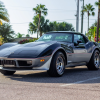
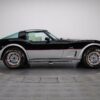

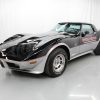
Chevrolet built 46,776 Corvettes for 1978 at St. Louis, Missouri, all fastback T-top coupes: 40,274 standard cars, 15,283 of them with the Silver Anniversary paint, and 6,502 Indy 500 Pace Car replicas with their own 9xxxxx VIN sequence. Of the total, 12,739 had the L82, 38,614 the Turbo Hydra-Matic, 28,008 aluminum wheels, 37,638 air conditioning and 12,590 the Gymkhana suspension. Production was down 2,437 on 1977 because the Pace Car build took line time.
In autumn 2026, 1978 Pace Car replicas sold for $9,300 to $44,000 at auction, the top figures for cars with under 1,000 miles, Silver Anniversary cars for $9,373 to $36,300, with L82 four-speeds at the top, and standard coupes for $6,250 to $18,700. Dealers asked $24,000 to $57,000 for Pace Cars, $15,900 to $45,900 for Silver Anniversary cars and $16,500 to $30,000 for standard coupes. Mileage matters more than anything else on a Pace Car, and the L82 four-speed Silver Anniversary is the collectors’ pick.
Two 350 small blocks, both hydraulic-lifter with a catalytic converter and unleaded fuel: the L48 at 185 hp, or 175 hp with California or high-altitude equipment, in 34,037 cars, and the L82 at 220 hp with a dual-snorkel intake and freer exhaust in 12,739. The wide-ratio four-speed was standard, the close-ratio M21 came only with the L82 and a 3.70 axle, and the Turbo Hydra-Matic, now with a high-stall converter behind the L82, went into 83 percent of cars. Car and Driver’s L82 four-speed did 0–60 in 6.5 seconds.
Ten solid colors and two two-tones. The Silver Anniversary paint (silver over Charcoal Silver) went on 15,283 cars and the Pace Car’s black over silver on 6,502; the solid colors were Black (4,573), Classic White (4,150), Silver (3,232), Mahogany (2,121), Dark Blue (2,084), Red (2,074), Dark Brown (1,991), Light Blue (1,960), Light Beige (1,686) and Yellow (1,243). Interiors came in oyster, silver, black, dark blue, light beige, dark brown, red and mahogany leather, or cloth with leather bolsters at no cost; Pace Cars were silver only.
The Sport Coupe was $9,351.00 and the Pace Car replica $13,653.21 with nearly every option included. The Silver Anniversary paint was $399.00 plus the required aluminum wheels ($340.00) and sport mirrors ($40.00); the L82 added $525.00, air conditioning $605.00, power windows $130.00, the tilt-telescopic column $175.00, the 8-track stereo $419.00, the CB stereo $638.00, the P255/60R15 tires $216.32 and glass roof panels $349.00. A typical automatic L48 with air, power windows, tilt, speed control, aluminum wheels and a stereo came to about $11,200, a well-optioned Silver Anniversary L82 to about $12,500, and dealers sold Pace Cars above list, some at $20,000 or more.
The roof: the vertical rear window and sail panels gave way to a large curved glass fastback, nearly tripling luggage space, with a roll-out security cover. Every car got 25th Anniversary emblems, a 24-gallon tank with a space-saver spare, a new dash with square instrument housings, a real glovebox and one-piece padded panel, new door trim, single-reel belts and an alarm that covered the roof panels, which could now be glass (RPO CC1). The L48 rose to 185 hp and the L82 to 220, P255/60R15 tires and a rear anti-roll bar (with FE7) were new, and the Silver Anniversary paint and Indy Pace Car replica were the year’s two packages.
The VIN: factory Pace Car replicas have a 9 as the eighth character (900001 to 906502) where every other 1978 has a 4. The trim tag should read 19U/47M for black over silver with silver trim (152 leather or 15C cloth), and the car should have the high-back thin-shell seats, glass roof panels, aluminum wheels, spoilers and the full option load, with the L82 and four-speed as the only variables. The Indy decals were supplied loose and applied by owners, so a car without them can be real and a car with them can be a clone. Pace Cars also appear in the 1978 Corvette VIN decoder and Chevrolet’s production total of 6,502.
1978 Corvette Advertisements / 1978 Corvette Colors / 1978 Corvette Engine / 1978 Corvette Factory Options / 1978 Corvette For Sale / 1978 Corvette Maintenance / 1978 Corvette Mods / 1978 Corvette Owners Manual / 1978 Corvette Pace Car / 1978 Corvette Performance / 1978 Corvette Posters / 1978 Corvette Pricing / 1978 Corvette Production / 1978 Corvette Recalls / 1978 Corvette Research / 1978 Corvette RPO Codes / 1978 Corvette Sales Brochures / 1978 Corvette Silver Anniversary Edition / 1978 Corvette Special Model Overview / 1978 Corvette Specifications / 1978 Corvette Technical Research / 1978 Corvette Service Bulletins / 1978 Corvette VIN Numbers