CORVETTE BUYER’S GUIDES
The Corvette Pace Car Buyer’s Guide: Every Indy 500 Replica
Buying a Corvette Indianapolis 500 Pace Car? Chevrolet sold six replicas, in 1978, 1986, 1995, 1998, 2007 and 2008, and they are bought on paperwork more than on paint. This guide compares them, gives what each costs in 2026 from the results the site tracks, how to tell a factory replica, and cars for sale.
Quick Nav: Overview · Why Buy · The Replicas · Car by Car · Real or Clone · Values · Price Ladder · What Moves the Price · The Guides · Driving · Costs to Own · Considerations · Problems · Inspection · Market Reports · For Sale · FAQs
The Basics
The Cars: The six Indianapolis 500 Pace Car replicas Chevrolet sold: 1978 (RPO Z78), 1986 (every convertible), 1995, 1998, 2007 and 2008 (RPO Z4Z); the 2002 and 2004 pace cars were sold as the 50th Anniversary and Commemorative Editions
Built: 6,502 (1978) · 7,315 (1986) · 527 (1995) · 1,163 (1998) · 500 (2007) · 500 (2008); about 16,500 replicas in all
What They Are: Production Corvettes with the track car’s paint, graphics, interior and option load; mechanically their base cars, so the generation guides carry the mechanical inspection
What One Costs Today: 1978 $9,300–$44,000 · 1986 $6,600–$26,400 · 1995 bids to $19,000, dealers to $49,983 · 1998 $18,000–$41,000 · 2007 mostly $30,000s–$40,000s · 2008 Hagerty #2 $42,400 (results tracked October 2025–October 2026; mileage decides everything)
The Pick: A documented low-mileage 1978 L82 four-speed for the collection; a 1998 six-speed for the best-driving replica with a real premium; a 2008 coupe for the modern one; a 1986 convertible only as a convertible, not as a pace car
Related: The Pace Cars page (every pace car, replica or not), the special editions, the anniversary cars, the year pages for 1978, 1986, 1995, 1998, 2007 and 2008, the generation buyer’s guides
The Overview
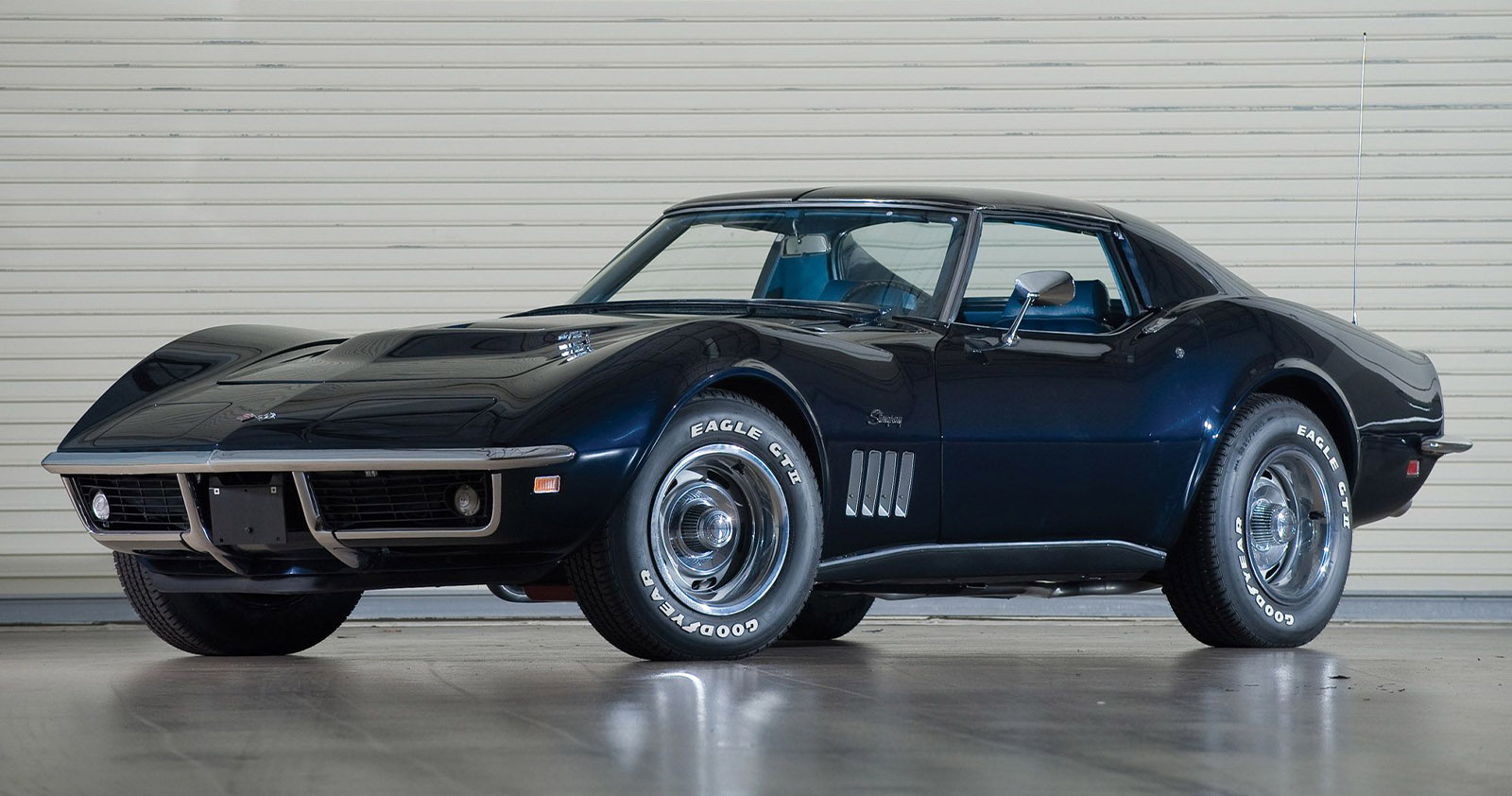
The Corvette has paced the Indianapolis 500 twenty-three times, more than any other car, and six times Chevrolet sold the public a replica: the black-over-silver 1978 that started the tradition and the speculation, the 1986 convertible (every one of them), the Dark Purple 1995, the Radar Blue 1998 with its yellow wheels, the Atomic Orange 2007 and the black-and-silver 2008 that marked the 1978 car’s 30th anniversary. The 2002 and 2004 pace cars were the 50th Anniversary and Commemorative Editions, sold as those; every pace year since 2008 has had track and festival cars only.
A pace car replica is a production Corvette with the track car’s paint, graphics and interior and most of the option list, so mechanically it is its base car, and the generation guides carry the mechanical inspection. What makes buying one different is everything else: the premium is for a package, so the package has to be proved (the VIN series on a 1978, RPO Z4Z on the console label from 1995, the VIN lists this site keeps for 1998, 2007 and 2008, and nothing at all on a 1986); the decals were owner-applied on the 1978 and 1986 and factory-applied later, so their presence proves nothing on the early cars; and more of these were stored new than driven, so mileage sets the price more than on any other Corvette of their years.
This guide compares the six, gives what each costs in 2026 from the results the site tracks, goes car by car through what the package was and what to verify, sets out the price ladder and what moves a car on it, and carries the known issues, the inspection and the questions readers ask. The Pace Cars page has every pace car, replica or not, and each replica has its own guide.
Why Buy a Corvette Pace Car
The Indianapolis connection
A pace car is the one Corvette that comes with a date and a race attached. The 1978 led the 62nd Indianapolis 500 with Jim Rathmann driving on May 28, 1978, the Corvette’s first time and Chevrolet’s way of marking the car’s 25th year; Chuck Yeager drove the 1986 convertible, Jim Perkins the 1995, Parnelli Jones the 1998, Patrick Dempsey the 2007 and Emerson Fittipaldi the 2008 (in a one-off E85 Z06, while the black-and-silver replicas marked the 1978 car’s 30th anniversary). Hagerty’s 2024 look at the pace-car market concluded they are proven collectibles for exactly that reason: not rare, not faster than the base car, often loud, and wanted anyway for the race.
Replicas, clones and decal kits
The market has three kinds of pace car and the price gap between them is the whole point of this guide. A factory replica was built with the package: the 1978’s Z78 with its own 900001–906502 VIN series, the 1995, 1998, 2007 and 2008 cars’ Z4Z on the build sheet and console label, and the VIN lists this site keeps. A clone is a standard car painted and decaled afterwards; the 1978 has been cloned more than any Corvette of its era because the paint scheme is simple and the premium was large, and repainted purple 1998 convertibles exist. And the 1986 is neither: Chevrolet declared every 1986 convertible a pace car and gave dealers the door decals, so a “1986 Pace Car” is a convertible, worth no more for the stickers.
Why 1978 is its own market
Chevrolet planned 300 replicas, then 2,500, then one per dealer, and built 6,502 at $13,653.21; dealers sold them for twice that in the spring of 1978, buyers stored them, and within a year the premium was gone. The result, nearly fifty years on, is the C3 with the most sub-1,000-mile cars in circulation and a price ladder that runs from $9,300 for a high-mileage car to $44,000 for a 1,000-mile one in the same autumn. The 1978 is bought on mileage, originality and the VIN, with the L82 and the four-speed the only mechanical variables; the Silver Anniversary car of the same year, a third of production, is the one serious C3 buyers drive.
What they are to drive and to own
A pace car drives like its base car: a 1978 like a late C3 (the fastback glass, the L48 or L82, T-tops that leak), a 1986 like an early C4 convertible, a 1995 like an LT1 C4, a 1998 like a C5 with Active Handling, a 2007 or 2008 like a Z51 C6 convertible or LS3 coupe. The replica adds paint that fades unevenly (the purple-over-white 1995 most of all), graphics that crack and are reproduced, two-tone leather that is hard to match, and a decal set that may or may not be on the car. The generation guides carry the mechanical lists; this guide carries the rest.
MORE: EVERY CORVETTE PACE CAR / THE SPECIAL EDITIONS / THE 1978 PACE CAR GUIDE

The Six Pace Car Replicas Compared
Six replicas over thirty years, and the table puts them side by side: what Chevrolet sold, how many, what made it a replica rather than a decal kit, what one costs in 2026 and the verdict. The 2002 (50th Anniversary) and 2004 (Commemorative Edition) pace years are bought as those editions and sit in the special-editions guide; the 2005, 2006 and every year since 2008 had track and festival cars only, which trade privately and at the headline auctions.
The rule across all six: the premium is for the package, so the package is what you pay for and what you verify. Mileage comes next and matters more than on any other Corvette of these years, because so many replicas were stored; the transmission (a four-speed 1978, a six-speed 1998) and originality of the paint and graphics follow.
MORE: THE 1978 REPLICA GUIDE / THE 1986 REPLICA GUIDE / THE 1995 REPLICA GUIDE / THE 1998 REPLICA GUIDE / THE 2007 REPLICA GUIDE / THE 2008 REPLICA GUIDE / EVERY PACE CAR
| YEAR | THE CAR | BUILT | WHAT MADE IT A REPLICA | WHAT ONE COSTS IN 2026 | THE VERDICT |
|---|---|---|---|---|---|
| 1978 | 1978 Corvette coupe, L48 or L82, RPO Z78, $13,653.21 | 6,502 | Black over silver with the red stripe, front and rear spoilers, glass T-tops, aluminum wheels, silver leather or leather-and-cloth on the new high-back seats, nearly every option; its own 900001–906502 VIN series (a 9 in the eighth position); decals supplied loose for the owner to apply | Auction $9,300 (high mileage) to $44,000 (1,000 miles); $34,750–$37,500 for sub-11,000-mile cars; dealers asked $24,000–$57,000 in autumn 2026. Hagerty’s condition-#2 value for an L82 car: $41,300, over 60% above a base 1978 | The collectible and the clone magnet: bought on the VIN, the trim tag and the mileage, with the L82 four-speed the one to want. A 500-mile car needs every rubber part and fluid before it is driven. |
| 1986 | 1986 Corvette convertible, any color, $32,032 | 7,315 | Nothing: Chevrolet declared every 1986 convertible a pace car replica and supplied door decals for dealers or owners to apply; the actual pace cars were yellow (732 yellow convertibles sold). Convertibles carry their own 900001–907315 VIN series | Auction $6,600 to $26,400 (a 919-mile car), most $7,700–$15,000; dealers asked $10,995–$21,500, with a 40-mile car at $49,900. Hagerty: no premium over a 1986 convertible, which is the car | Buy it as the first C4 convertible, on mileage, the yellow color and the 4+3 manual; pay nothing for the decals. The least valuable replica and the honest one. |
| 1995 | 1995 Corvette convertible, LT1, RPO Z4Z $2,816 ($46,481) | 527 | Dark Purple Metallic over Arctic White with the red stripe and flag graphics and Indianapolis 500 door decals, white top, black-and-purple leather with embroidered headrests, five-spoke wheels, automatic, performance axle and Bose CD included; paint 05/10 and trim 194 on the tag; 87 did Speedway duty, 20 went for export | Bid to $15,500 (3,000 miles) and $19,000 (28,000 miles) without selling in 2026; dealers asked $24,990 for a 13,000-mile car and $36,900–$49,983 for 89–295-mile cars. Hagerty: #2 $27,800, within a few hundred dollars of a base car; #3 $14,500, 26% above | The rarest replica and the one with the softest market: asking prices far above completed sales. Buy a documented car on its mileage and original paint, and expect the purple to have faded against the white. |
| 1998 | 1998 Corvette convertible, LS1, RPO Z4Z $5,039 / $5,804 with the six-speed ($49,464 / $50,229) | 1,163 | Pace Car Purple (code 21; “Radar Blue” in the press release), factory-applied yellow checkered-flag graphics, yellow five-spoke wheels, black top, yellow-and-black leather with embroidered headrests, Active Handling and nearly every option; 616 automatics, 547 six-speeds; a 3 in the sixth VIN position and Z4Z on the console label | Auction $18,000 (50,000 miles) to $41,000 (a 22-mile six-speed), most documented sub-30,000-mile cars $23,000–$33,000 against a Classic.com benchmark near $30,000; dealers asked $26,900–$39,990. Hagerty: #2 $32,800, 6.5% above a base convertible | The best replica to drive and the one with the surest premium: nearly identical to the track car, unmistakable, and the site’s VIN post lists every one. A six-speed with under 20,000 miles is the buy. |
| 2007 | 2007 Corvette convertible, LS2, Z51, 3LT content, RPO Z4Z, $66,995 ($68,245 automatic) | 500 | Atomic Orange with gold ribbon graphics from the fender vents, Indianapolis 500 door shields and fender badges, the Z06 spoiler, Sterling Silver split-spoke wheels, embroidered Ebony seats, Atomic Orange trim plates, console pods, engine covers and door handles; a 3 in the sixth VIN position, Z4Z/83U/P4A on the label; the site’s VIN post lists all 500 | Mostly dealer-listed in the $30,000s and $40,000s in 2026, the only 2007 on which the automatic costs nothing in value. Hagerty: #2 $37,300, 11% above a base 2007 convertible | The collectible C6 convertible, underpriced against the Ron Fellows Z06 of the same year. Bought on the label and the VIN list; the orange door handles are the detail tributes miss. |
| 2008 | 2008 Corvette coupe or convertible, LS3, Z51, 3LT content, RPO Z4Z, $59,090 / $68,160 | 500 (234 coupes, 266 convertibles) | Black over silver with the red stripe for the 1978 car’s 30th anniversary, Indianapolis 500 graphics and badges, each signed by Emerson Fittipaldi at Bowling Green; Z4Z on the label with Z51 and 3LT content; the site’s VIN post lists all 500 | Hagerty: #2 coupe $42,400, 13% above a base 2008 coupe; the site’s 2008 market puts the replica with the Ron Fellows and 427 cars in the special-edition world rather than with ordinary 2008s | The modern one and the last replica: the LS3 car with the best C6 interior and a signature. The coupe (234) is the rarer body; bought on the label, the VIN list and the mileage. |
The Replicas Car by Car: What the Package Was and What to Verify
What each replica was when new, how many were built, the code that proves it and the thing most often faked, from the replica guides and the year pages. Each year’s page carries the full RPO list, the VIN breakdown, the production split and the current market for the whole model year.
1978 Corvette Indy 500 Pace Car Replica (RPO Z78)
Chevrolet marked the Corvette’s 25th year by pacing the 62nd Indianapolis 500 on May 28, 1978, with 1960 winner Jim Rathmann driving a black-over-silver L82 with a red stripe and the new fastback glass. The replica was RPO Z78 at $13,653.21 against a $9,351 base coupe, and it included almost everything: glass roof panels, aluminum wheels with red accents, power windows and locks, air conditioning, the rear defogger, sport mirrors, the tilt-telescopic column, the heavy-duty battery, an AM/FM stereo with 8-track or CB, power antenna, rear speakers, the convenience group, P255/60R15 tires, front and rear spoilers and the new thin-shell high-back seats in silver leather or leather-and-cloth, pulled forward from the 1979 program. The L82 ($525) and the four-speed were the only extra-cost choices. The Indy decals, the winged-wheel fender logos and the “Official Pace Car, 62nd Annual Indianapolis 500 Mile Race, May 28, 1978” door panels, came loose in the car for the owner to apply or not.
The plan was 300 cars, then 2,500, then one per dealer; 6,502 were built with their own VIN sequence, 900001 to 906502, which is the single fact that settles a 1978: a factory Pace Car has a 9 as the eighth VIN character where every other 1978 has a 4. The trim tag should read 19U/47M (black over silver, silver trim) with 152 leather or 15C cloth, and the car should have the high-back seats, glass panels, aluminum wheels, spoilers and the full option load. Dealers sold them for $20,000 to $25,000 that spring; by 1979 the premium had gone and many sat in storage for decades, which is why sub-1,000-mile cars are common and why a stored car needs every rubber part, every fluid and often its brakes before it is driven. Clones are common and a 9 in the VIN settles the question.
1986 Corvette Convertible, the Pace Car that was every convertible
The 1986 brought the first Corvette convertible since 1975, stiffened with a large X-brace and priced $5,005 above the coupe at $32,032, and a stock yellow one paced the 70th Indianapolis 500 on May 31, 1986 with Chuck Yeager driving. Still smarting from the 1978 frenzy, Chevrolet declared every 1986 convertible an official pace car replica regardless of color and supplied door decals for dealers or owners to apply; 7,315 were built, 21 percent of production, in twelve colors and no special package, with 732 in the pace car’s yellow (code 35). Most never had their decals applied.
Nothing on the VIN or the trim tag distinguishes a decaled car from an undecaled one, so a “1986 Pace Car Edition” in a listing is any of the 7,315 convertibles, and reproduction decals are sold. Verify it as a 1986 convertible: 67 in the sixth and seventh VIN positions with a 900001-series sequence, aluminum 14101128 heads on every convertible, the ABS self-test and the VATS key. Pay for mileage, originality, the yellow color and the 4+3 manual, not for the stickers; the premium belongs to low-mileage unused cars, which have started to bring real money (a 919-mile car made $26,400 at Mecum Kissimmee in January 2026).
1995 Corvette Indy 500 Pace Car Replica (RPO Z4Z)
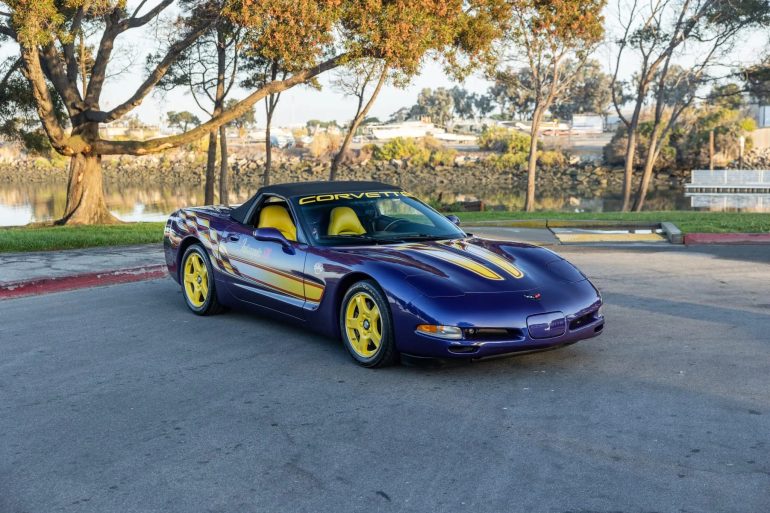
A near-stock LT1 convertible paced the 79th Indianapolis 500 on May 28, 1995, the Corvette’s third time, with Chevrolet general manager Jim Perkins driving the six-speed one of the three pace cars built (the other two were automatics). RPO Z4Z, $2,816 on a $43,665 convertible, put Dark Purple Metallic over Arctic White with a broad red stripe across the nose that became stylized flags down the sides, Indianapolis 500 door decals, a white top, black-and-purple leather sport seats with the race emblem embroidered in the headrests, ZR-1-style five-spoke wheels on P275/40ZR17s, and the automatic, performance axle, electronic air conditioning and Bose CD into 527 convertibles, 87 of them for Speedway duty and 20 for export.
Verification: Z4Z on the build sheet or window sticker, paint 05/10 and trim 194 on the door-pillar tag, the two-tone leather and embroidered headrests, the white top, the five-spokes and the automatic. The graphics are reproduced, so check for original adhesion and paint beneath them; many cars were delivered with the decals uninstalled in the trunk, so a documented car without them is not a fake and one with them is not automatically real. The purple fades unevenly against the white, the graphics crack and the two-tone leather is hard to match, and the car is otherwise a 1995 LT1 with the vented Optispark, the bigger brakes and the C4 electrical items.
1998 Corvette Indy 500 Pace Car Replica (RPO Z4Z)
The new C5 convertible paced the 82nd Indianapolis 500 on May 24, 1998 with 1963 winner Parnelli Jones driving, and the replica was nearly identical to the track car, which had only a freer intake and exhaust (345 to 370 hp), a lowered stance, roll bars, a fire extinguisher and strobes in the tonneau fairings. RPO Z4Z was $5,039 on an automatic or $5,804 with the six-speed, so a Pace Car listed at $49,464 or $50,229: Pace Car Purple paint (code 21, “Radar Blue” in GM’s press material), factory-applied yellow graphics with the checkered-flag motif over the tail, yellow five-spoke wheels, a black top, yellow-and-black leather with embroidered headrests, the Active Handling system, the Delco CD and Bose, memory power seats and almost every option. 1,163 were built: 616 automatics and 547 six-speeds; 1,111 for the United States, 37 export and 15 for Canada, including five pilot cars.
Verification: a 3 in the sixth VIN position (convertible), Z4Z on the build sheet, window sticker and the console service-parts label with paint code 21, the yellow-and-black interior, the black top, the factory graphics, the yellow wheels and the Active Handling button; this site’s 1998 Pace Car VIN post lists every replica’s sequence number and build date, so a claimed car can be matched. Graphics have been reproduced and repainted purple convertibles exist, so a car without its label and sheet is a tribute until proven otherwise. Mechanically it is a 1998 C5: the column lock, EBCM, fuel senders and headlamp motors of the generation guide.
2002 and 2004: the pace years with no replica
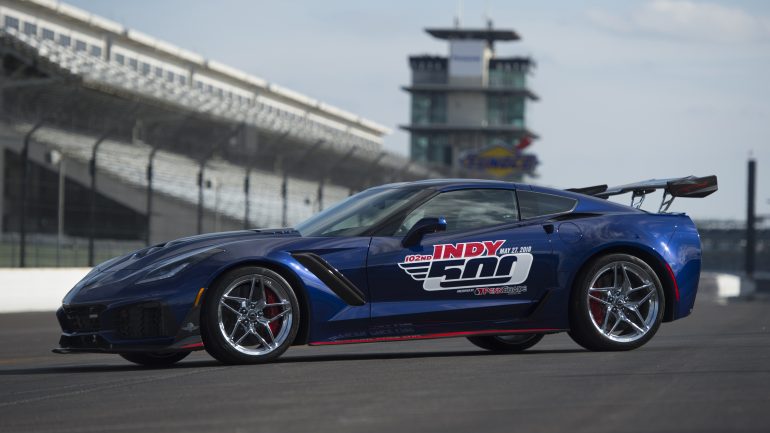
A 50th Anniversary coupe paced the 86th race on May 26, 2002 with Jim Caviezel driving, and a Commemorative Edition convertible the 88th on May 30, 2004 with Morgan Freeman. Chevrolet sold no replica of either; the 50th Anniversary and Commemorative Editions are bought as those editions, and the Anniversary-look pace-car graphics seen on some 2002 convertibles are the $465 licensed decal kit (Phoenix Graphix also reproduces it), not a factory package. The 2005 convertible (Colin Powell) and 2006 Z06 (Lance Armstrong) pace years had track and festival cars only.
2007 Corvette Indy 500 Pace Car Replica (RPO Z4Z)
Patrick Dempsey started the 91st race on May 27, 2007 in an Atomic Orange convertible with gold ribbon graphics, and for the first time since 1998 Chevrolet sold a replica: 500 convertibles at $66,995 ($68,245 with the paddle-shift automatic), every one a 3LT Z51 car with the LS2, navigation and Bose, in Atomic Orange including the door handles, with the gold ribbons flowing back from the fender vents, Indianapolis 500 door logos and fender badges, the color-keyed Z06 spoiler, new Sterling Silver split-spoke wheels, Ebony seats with embroidered Indianapolis 500 logos, and Atomic Orange trim plates, console pods and engine covers.
Verification: Z4Z on the console label with 83U, P4A, Z51 and 3LT content, a 3 in the sixth VIN position, the embroidered headrests and the orange trim plates, pods and engine covers; this site’s 2007 Z4Z VIN post lists all 500. The Atomic Orange door handles are the detail tribute cars miss. It is the only 2007 on which the automatic costs nothing in value, and mechanically it is a Z51 C6 convertible: the column lock, the power top’s trunk switch and hydraulics, the 6L80’s updates and the chrome wheels that pit.
2008 Corvette Indy 500 Pace Car Replica (RPO Z4Z)
Two very different Corvettes shared the 92nd race on May 25, 2008: a one-off Z06 E85 concept in Gold Rush Green that Emerson Fittipaldi drove to start the race, and black-and-silver commemorative coupes and convertibles marking thirty years since the 1978 car. Chevrolet built 500 replicas of the latter, 234 coupes at $59,090 and 266 convertibles at $68,160, each an LS3 Z51 car with 3LT content and each signed by Fittipaldi at the Bowling Green plant. It was the Corvette’s tenth Indianapolis pace car and the last replica Chevrolet has sold.
Verification: Z4Z on the console label with Z51 and 3LT content and the black-and-silver paint, a W in the eighth VIN position (the LS3) and a 2 or 3 in the sixth, the signature, and the site’s 2008 Z4Z VIN post, which lists all 500. It sits with the Ron Fellows and 427 cars in the special-edition world rather than with ordinary 2008s, and mechanically it is a 2008 LS3 car: the best of the early C6s, with the dual-mode exhaust actuators, the roof-panel bond on coupes and the power top on convertibles to check.
MORE: THE 1998 VIN LIST / THE 2007 VIN LIST / THE 2008 VIN LIST / RPO CODES
Replica or Clone? The Markers, Year by Year
The premium on a pace car is the premium on a package, and every package here has been imitated with paint and a decal kit. This table is the short version to take to the viewing: what proves the car, what proves nothing, and what is reproduced. The year pages carry the full VIN breakdowns and label codes.
Two general rules. First, the decals prove nothing on a 1978 or a 1986 (owner-applied) and only a little on the later cars (factory-applied but reproduced); the code on the label or the VIN series does. Second, a car without its build sheet, window sticker or console label is a tribute until proven otherwise, and the site’s VIN lists for 1998, 2007 and 2008 settle a claim in a minute.
MORE: 1998 VIN LIST / 2007 VIN LIST / 2008 VIN LIST / THE VIN DECODER / RPO CODES
| YEAR | WHAT PROVES IT | WHAT IS FAKED OR PROVES NOTHING | THE TELL |
|---|---|---|---|
| 1978 | A 9 as the eighth VIN character (900001–906502); trim tag 19U/47M with 152 leather or 15C cloth; the high-back thin-shell seats, glass roof panels, aluminum wheels, spoilers and full option load; a V-prefix pad with CMR/CMS (L82) or CHW/CLM/CUT (L48) on a 3970010 block | The decals (owner-applied, so a car without them can be real and a car with them can be a clone); the spoilers and paint (any 1978 can be painted black over silver); the Silver Anniversary car (13U/07M, silver over gray) mistaken for one | The VIN. Every other 1978 has a 4 in the eighth position. |
| 1986 | Nothing beyond being a 1986 convertible: 67 in the sixth and seventh VIN positions with a 900001–907315 sequence; aluminum 14101128 heads; the trim tag’s paint code | The door decals (dealer or owner applied, reproduced); any claim of a “pace car package” or special equipment; the yellow paint (732 yellow convertibles, no premium beyond the color) | There is no tell because there was no package; price it as a convertible. |
| 1995 | Z4Z on the build sheet or window sticker; paint 05/10 and trim 194 on the door-pillar tag; Dark Purple over Arctic White with the white top, black-and-purple leather, embroidered headrests, five-spoke wheels and the automatic | The stripe-and-flag graphics and door decals (reproduced; many were delivered uninstalled); a repainted two-tone standard convertible | The tag codes and the two-tone interior; look for original adhesion and paint under the graphics. |
| 1998 | A 3 in the sixth VIN position; Z4Z and paint code 21 on the console service-parts label, build sheet and window sticker; yellow-and-black leather, black top, yellow wheels, factory graphics, the Active Handling button; the site’s 1998 Pace Car VIN list | The graphics (reproduced) and repainted purple convertibles; yellow-painted standard wheels | The VIN list and the console label; a car without both is a tribute. |
| 2007 | Z4Z, 83U, P4A, Z51 and 3LT content on the console label; a 3 in the sixth VIN position; embroidered Indianapolis 500 headrests, Atomic Orange trim plates, console pods, engine covers and door handles; the site’s 2007 Z4Z VIN list | The gold ribbon graphics, badges and the Z06 spoiler (all obtainable); an Atomic Orange 3LT convertible dressed up | The orange door handles and the label; the VIN list settles it. |
| 2008 | Z4Z with Z51 and 3LT content on the console label; a W in the eighth VIN position (LS3) with a 2 or 3 in the sixth; the black-and-silver paint with the red stripe, the graphics and Fittipaldi’s signature; the site’s 2008 Z4Z VIN list | The paint and graphics (a black 2008 repainted two-tone), the signature (check it is factory, not added) | The label and the VIN list; 234 coupes and 266 convertibles, no more. |
What a Corvette Pace Car Is Worth in 2026
Pace car replicas are bought on mileage above everything, because so many were stored new; then on the package being proved; then on the transmission and the originality of the paint and graphics. The figures below are the results the site tracked on Classic.com between October 2025 and October 2026 for each replica year, with Hagerty’s May 2024 condition-#2 values as a second reference; the year pages carry the full results and are updated as new sales come in.
1978. Replicas sold for $44,000 (1,000 miles, Barrett-Jackson Las Vegas), $37,500 (L82, 11,000 miles) and $34,750 (483 miles) on Bring a Trailer, $30,000 at Richmond, $20,350 and $18,700 for 29,000- and 37,000-mile cars at Mecum, and $14,850 and $9,300 for high-mileage cars; a custom Pace Car made $26,400. Dealers asked $24,000 to $57,000. Hagerty puts a condition-#2 L82 Pace Car at $41,300, more than 60 percent above a base 1978, and Sports Car Market’s profile of the car recorded the same shape a generation ago: $8,000 for high-mileage cars to $30,000 for a low-mileage L82 four-speed around 2000.
1986. Convertibles (every one a replica) sold for $6,600 to $26,400, the top figure a 919-mile car at Mecum Kissimmee, most between $7,700 and $15,000; dealers asked $10,995 to $21,500 and $49,900 for a 40-mile car. Hagerty gives the 1986 convertible no pace-car premium, about 10 percent over a 1987 convertible for being the first.
1995. The thinnest market of the six: replicas were bid to $15,500 (3,000 miles) and $19,000 (28,000 miles) in 2026 without selling, a 145-mile car was listed at $38,900 and a 28,000-mile car at $27,997, and dealers asked $24,990 for a 13,000-mile car and $36,900 to $49,983 for 89- to 295-mile cars. Hagerty’s #2 value, $27,800, is within a few hundred dollars of a base 1995 convertible; its #3 value, $14,500, is 26 percent above. Asking prices and sales are far apart on this car.
1998. The surest premium: replicas sold for $18,000 (50,000 miles, automatic) to $41,000 (a 22-mile six-speed on Bring a Trailer), with most documented sub-30,000-mile cars between $23,000 and $33,000 (six-speeds $23,000–$29,700 at 6,000–26,000 miles, a 551-mile automatic $37,400) against a Classic.com benchmark near $30,000; dealers asked $26,900 to $39,990. Hagerty: #2 $32,800, 6.5 percent above a base convertible. The six-speeds (547) bring more than the automatics.
2007 and 2008. The 2007 replica is mostly dealer-listed in the $30,000s and $40,000s, the collectible C6 convertible and the only 2007 on which the automatic costs nothing in value; Hagerty’s #2 is $37,300, 11 percent above a base convertible. The 2008 sits with the Ron Fellows and 427 Z06s in the special-edition world; Hagerty’s #2 for the coupe is $42,400, 13 percent above a base 2008 coupe. Hagerty’s broader point stands for both: actual track and festival cars are a different market, from $38,500 for a 2004 track car to $242,000 for a 2006 pace car at auction, and two collections of them averaged $76,000 and $100,000 a car.
Two cautions. Check whether an auction result includes the buyer’s premium (Mecum and Barrett-Jackson results do, Bring a Trailer bids do not), and treat asking prices and unsold high bids separately from completed sales: a 1995 bid to $19,000 without selling is not a $19,000 car, and a $49,983 ask is not a $49,983 sale. The ladder below puts the six in five tiers.
MORE: 1978 MARKET / 1986 MARKET / 1995 MARKET / 1998 MARKET / 2007 MARKET / 2008 MARKET / AUCTION COVERAGE
The Pace Car Price Ladder: Five Tiers
What the money buys across the six replicas, from the 2026 results. The tiers overlap: a delivery-mileage 1986 costs what a driven 1998 costs, and the choice within a tier is between the better example of the cheaper car and the ordinary example of the dearer one.
Drivers and Decal Cars
$6,000 – $15,000
High-mileage 1978s with faded paint or questionable VINs, most 1986 convertibles, and the clones. Recent sales: 1978s at $9,300 and $14,850 for high-mileage cars, 1986s at $6,600 to $15,000. Buy a 1978 here only with a 9 in the VIN and a plan for the brakes, rubber and vacuum system; buy a 1986 as a convertible and ignore the stickers.
Driven Replicas
$15,000 – $25,000
Documented 1978s with 25,000 to 40,000 miles, 1995s and 1998 automatics with real mileage, the best 1986s. Recent sales: 1978s at $18,700 and $20,350, a 50,000-mile 1998 at $18,000, 1998 six-speeds at $23,000 to $24,750, a 919-mile 1986 at $26,400. The usable end: a real package at a used-car price, and the tier to drive from, provided the VIN or the label checks out.
Documented Low-Mileage
$25,000 – $35,000
Sub-20,000-mile 1998 six-speeds, 1978s around 10,000 miles, 2007 convertibles, the better 1995s. Recent sales: 1998s at $28,750 to $33,333, a 1978 at $30,000 at Richmond, 2007s mostly listed in the $30,000s. The tier where most serious buyers end up, where the VIN lists and labels earn their keep, and where original paint and graphics separate the two ends of the range.
Time Capsules
$35,000 – $50,000
Sub-1,000-mile 1978s, delivery-mileage 1998s and 1995s, 2008 coupes and the best 2007s. Recent sales: 1978s at $34,750 (483 miles), $37,500 and $44,000 (1,000 miles); a 22-mile 1998 six-speed at $41,000; a 551-mile 1998 automatic at $37,400; 1995s asked at $36,900 to $49,983; a 40-mile 1986 asked at $49,900. Hagerty’s #2 values for an L82 1978 ($41,300) and a 2008 coupe ($42,400) sit here.
Track and Festival Cars
$38,000 – $250,000
The actual pace, track and festival cars, a few dozen for each race and none of them replicas: a 2004 track car at $38,500, a 2006 pace car at $242,000, and collections averaging $76,000 to $100,000 a car (Hagerty). Bought on provenance from the Speedway and Chevrolet, not on a label; the Pace Cars page has the story of each.
What Moves the Price of a Pace Car
Mileage. More than on any Corvette of these years, because the replicas were bought as keepsakes and stored. A 1978 with 500 miles brings four times what one with 60,000 miles brings; a 22-mile 1998 brought twice a 50,000-mile one in the same year.
Proof of the package. The 9 in a 1978’s VIN, Z4Z on a 1995–2008 label and the site’s VIN lists for 1998, 2007 and 2008 are the premium. A car that cannot prove its package is a tribute, and a tribute is worth the base car less the cost of undoing the paint.
Transmission. The four-speed on a 1978 and the six-speed on a 1998 (547 of 1,163) bring more; the 1995 came only as an automatic, and the 2007 is the one C6 on which the automatic costs nothing.
Paint, graphics and interior originality. Original paint with factory graphics and the two-tone or embroidered interior intact leads; a repaint to the correct scheme with reproduction graphics is a tier down; the 1995’s purple and the 1998’s yellow leather are the ones that show their age.
The decals, oddly. On a 1978 or 1986 an unapplied original decal set in the box is worth having and proves nothing; applied reproductions prove less. On the later cars the factory graphics are part of the package.
The base car’s condition. A pace car is its base car underneath, and a 1978 with a tired birdcage or a 1995 with a dead Optispark is priced as such; the generation guides carry the lists.
MORE: THE C3 GUIDE / THE C4 GUIDE / THE C5 GUIDE / THE C6 GUIDE
The Investment Case, With Realistic Expectations
Pace cars have lagged the other special editions and that is the case for them. The 1978 replica was the first lesson in special-edition economics (bought at double sticker, worth sticker a year later) and took forty years to grow into Hagerty’s $41,300 for a condition-#2 L82 car; the 1986 never carried a premium; the 1995 trades well under what its 527-car run implies; the 1998 has the surest premium but a modest one; the 2007 and 2008 sit a little above their base cars. Hagerty’s conclusion in 2024 was that they are proven collectibles anyway, wanted for the Indianapolis connection more than for rarity or speed.
The realistic expectation is steady appreciation for documented delivery-mileage cars (the 1978 time capsules most of all, because the supply of unrestored originals shrinks every year), stability for driven replicas, and nothing for clones and decal cars. The strongest cases are a sub-1,000-mile 1978 L82 four-speed with its VIN and trim tag, a sub-10,000-mile 1998 six-speed on the VIN list, and a 2008 coupe (234 built) with its signature; the 1995 is the contrarian pick, the rarest replica with the softest market. The weakest is a 1986 bought as a pace car.
Buy the one you will enjoy and treat the race as the bonus it is; the Indianapolis connection is what keeps these cars wanted, and it does not wear out.
MORE: AUCTION RESULTS / THE ANNIVERSARY CARS / EVERY SPECIAL EDITION
The Pace Car Guides on CorvSport
Every pace car Chevrolet built has a guide on the site; these are the replicas and the pace years a buyer meets, with the VIN lists for the three later replicas.
Corvette Pace Cars: every Indy 500 pace car and replica — the master list, 1978–2026
The 1978 Indy Pace Car — 6,502 replicas, RPO Z78
The 1986 Indy Pace Car — every convertible, 7,315
The 1995 Pace Car Replica — 527, RPO Z4Z
The 1998 Pace Car Replica — 1,163, RPO Z4Z
1998 Pace Car VIN and sequence numbers — every replica listed
The 2002 Pace Car — the 50th Anniversary coupe; no replica
The 2004 Pace Car — the Commemorative Edition convertible; no replica
The 2005 Pace Car — track and festival cars only
The 2006 Z06 Pace Car — track and festival cars only
The 2007 Pace Car Replica — 500 Atomic Orange convertibles
2007 Z4Z VIN numbers — all 500
The 2008 Pace Car Replica — 500 coupes and convertibles, 30th anniversary
2008 Z4Z VIN numbers — all 500
The special-editions guide — where the replicas sit with the other editions
Driving a Pace Car: It Drives Like Its Base Car
None of the six replicas changed anything mechanical, so a pace car drives exactly like the Corvette under the paint, and the generation guides describe each in full. In short:
1978. A late C3 with the new fastback glass and the full option load: a 185-hp L48 or 220-hp L82, mostly automatics (the four-speed is the one to want), power everything, air, the Gymkhana suspension on some, the first 60-series tires, and a cabin that is the best of the C3 years. Slow by any modern standard, comfortable, and a car whose T-tops, vacuum headlights and urethane bumpers need looking after; a stored one needs everything rubber before it is driven.
1986. The first C4 convertible: 235 hp from the aluminum-head L98, the 4+3 or the 700-R4, the digital dash, anti-lock brakes for the first time, and a body with some cowl shake despite the X-brace. Sharp handling for its day, a harsh ride on Z51 cars, and the C4 electrical items.
1995. An LT1 C4 convertible at its most developed: 300 hp, the automatic only on the replica, the 13-inch brakes and ABS/ASR 5, de Carbon shocks and the softer springs of 1995. Quick, comfortable, and the Optispark and C4 electronics to live with.
1998. A C5 convertible with Active Handling, 345 hp and the choice of automatic or six-speed: the best replica to drive by a distance, a modern car in every way that matters, with the C5’s column lock, EBCM and fuel senders as the known items.
2007 and 2008. Z51 C6s with 3LT interiors: the 400-hp LS2 convertible of 2007 and the 430-hp LS3 coupe or convertible of 2008, with the dual-mode exhaust on the LS3 cars, Magnetic Ride on none of them, and the C6 list of column lock, roof bond, top hydraulics and dash panels. The 2008 is the best of the early C6s and the best pace car to drive every day.
Drive the base car first in your head: if a 1978 C3 is what you want, the Pace Car is the best-equipped 1978 there is; if you want a modern car, the 1998 and 2008 are the ones.
MORE: THE C3 BUYER’S GUIDE / THE C4 BUYER’S GUIDE / THE C5 BUYER’S GUIDE / THE C6 BUYER’S GUIDE / PERFORMANCE FIGURES BY YEAR
What a Pace Car Costs to Own
A pace car costs what its base car costs to run, plus the replica’s own items, plus the cost of mileage that was never put on it. In order of generation:
1978. A late C3 is cheap to run and expensive to wake up: parts are reproduced down to the last clip and any shop can service an L48 or L82, but a car that has sat for decades needs tires by date, every hose and seal, brake calipers (sleeved), the vacuum system for the headlights, fuel-system work and fluids before it is safe to drive, and the T-top and fastback-glass seals leak when old. Budget a first-year refresh of a few thousand dollars on any stored 1978, and more if the birdcage or frame has been wet. Insure on an agreed value.
1986 and 1995. Cheap: C4 parts are plentiful, the L98 and LT1 are simple, and the known items (digital dash, hub bearings, Optispark on the 1995, weatherstrips, headlamp motors) are inexpensive once sorted. The replica adds nothing mechanical; the 1995’s two-tone paint and graphics are the costly cosmetics if they need redoing.
1998. A C5 is the cheapest modern Corvette to own: LS1 service anywhere, shared parts, 25 mpg. The replica’s yellow-and-black leather and factory graphics are the costly items to restore; the column lock, EBCM and fuel senders are the generation’s.
2007 and 2008. Ordinary C6 running costs, with the 3LT interior’s wrapped leather and the chrome wheels that pit as the cosmetic items, and the orange or two-tone paint expensive to match after a scrape. A standard policy covers a driven car; a delivery-mileage car wants an agreed value.
Across all six, the real cost is storage done badly: a replica that sat outside or in a damp garage has lost its paint, its interior and (on a 1978) its structure, and a replica that sat perfectly still needs its rubber, fluids and fuel system renewed. Pay for the car that was stored well and driven a little.
MORE: OWNER’S MANUALS / MAINTENANCE SCHEDULES / THE MODS HUB
Other Key Buying Considerations
Making sure it is a pace car, and the right one for you
Beyond price, mileage and condition, a pace car purchase turns on a handful of judgments: what the car is for, whether the package is real, what the paperwork and the decals do and do not prove, how the base car stands mechanically, and where the replica sits in a market that has sorted the six very differently.
Use and purpose
A time capsule to keep wants the lowest-mileage documented 1978 or 1998 you can afford and a dry garage; a car to drive wants a 1998 six-speed, a 2008 or a 2007 with real miles and a sensible price; a first C3 wants a driven 1978 bought as a well-equipped 1978, not as an investment; a convertible wants a 1986 priced as one. Most regrets come from the mismatch: the 500-mile 1978 bought to drive (and the refresh it needs), the clone bought as a collectible, the 1986 bought for its stickers.
The 1978 clone problem
More 1978 Pace Cars have been faked than any Corvette of the era, because the scheme is simple, the premium was large and the parts (spoilers, wheels, seats) are available. The VIN settles it: a factory replica has a 9 as the eighth character and a sequence from 900001 to 906502; every other 1978 has a 4. Then the trim tag (19U/47M, 152 or 15C), the high-back seats and the glass panels. A clone is a 1978 coupe worth a 1978 coupe’s money, and a seller who will not show the VIN plate has answered the question.
Documentation and the VIN lists
From 1995 the package is RPO Z4Z on the build sheet, window sticker and (from 1998) the console service-parts label, and this site keeps the VIN and sequence lists for every 1998, 2007 and 2008 replica, so a claimed car is checked in a minute. The 1995’s proof is the door-pillar tag (paint 05/10, trim 194) and the sheet. A car with its original window sticker, build sheet, Protect-O-Plate or dealer paperwork, and for a stored car the storage history, is worth more than the same car without, and on a pace car the paperwork is a larger share of the value than on any standard Corvette.
Decals, graphics and paint originality
The 1978’s and 1986’s decals were supplied loose and applied by owners or dealers, so a car without them can be real, a car with them can be a clone, and an unapplied original set in the box is a bonus rather than proof. From 1995 the graphics were factory-applied but are reproduced; check for original adhesion and for paint beneath them, and on a 1995 or 1998 for a repaint to the two-tone or purple scheme. The 1995’s purple fades unevenly against the white, the 1978’s black shows its age on the fiberglass, and matching Atomic Orange or the 2008 two-tone after a scrape is expensive.
The base car underneath
A pace car is a 1978 C3, a 1986 or 1995 C4, a 1998 C5 or a 2007–08 C6 with paint, and it has that car’s problems: birdcage and frame rust, vacuum headlights, T-top seals and urethane bumpers on the 1978; the digital dash, hub bearings and weatherstrips on the 1986, plus the Optispark on the 1995; the column lock, EBCM and fuel senders on the 1998; the column lock, roof bond, top hydraulics and dash panels on the C6s. The generation guides carry the full lists and inspections, and a stored car needs the first-year refresh described above.
Market position and future value
The six have sorted themselves: the 1978 is the collectible with the widest spread, the 1998 the surest premium, the 2007 and 2008 a little above their base cars, the 1995 rare and soft, the 1986 no premium at all. Hagerty’s conclusion is that pace cars are proven collectibles for the Indianapolis connection, and the site’s tracked results agree at the documented low-mileage end. Price against completed sales and the year pages, not against the asking prices (which on the 1995 are far above the sales), and remember that an unsold high bid is a ceiling the market declined to pay.
Common Pace Car Problems: The Replica’s Own, Then the Base Car’s
The replicas add paint, graphics and interior to a production car, so their own problems are cosmetic and their mechanical problems are the base car’s. The table carries the replica items first, then the base-car items for each replica year from the generation guides, with the fix and the cost. None should stop a purchase; all belong on the checklist, and a car with the paperwork for them is the one to buy.
The generation guides carry the full lists (the C3’s fifteen items, the C4’s seventeen, the C5’s eighteen, the C6’s seventeen); this is the subset that applies to the replica years.
MORE: THE C3 GUIDE / THE C4 GUIDE / THE C5 GUIDE / THE C6 GUIDE
| GEN | PROBLEM | YEARS | WHAT HAPPENS | THE FIX AND THE COST |
|---|---|---|---|---|
| All | Clones and decal cars | 1978, 1986, 1995–2008 | Standard cars painted and decaled as replicas; 1986s sold as “pace car editions”; repainted purple 1998s; tributes of the 2007 and 2008. | The VIN (a 9 in the eighth position on a 1978), Z4Z on the label from 1995, and the site’s VIN lists for 1998, 2007 and 2008; a 1986 is a convertible and nothing more. |
| All | Graphics and decals | 1978–2008 | Owner-applied decals missing or peeling on 1978s and 1986s; factory graphics cracking and lifting on 1995–2008 cars; reproductions applied over repaints. | Reproduction sets exist for every year (Phoenix Graphix and others); originality is the question, not availability. Look for adhesion and paint beneath. |
| All | Two-tone and special paint | 1978, 1995, 2008 | The 1978’s black over silver shows every flaw of the fiberglass; the 1995’s Dark Purple fades unevenly against the Arctic White; the 2008’s two-tone and the 2007’s Atomic Orange tintcoat are expensive to match. | Paint depth readings at the color break; a correct repaint is a tier down from original paint and a wrong one two. |
| All | Replica interiors | 1978, 1995, 1998, 2007 | Silver leather (1978), black-and-purple (1995) and yellow-and-black (1998) two-tone leather wear and are hard to match; embroidered headrests are reproduced but not well. | Correct replacement leather is costly; a car with its original interior intact is worth paying for. |
| All | Storage damage | 1978–2008 | Delivery-mileage replicas that sat for decades: perished rubber, dried seals, varnished fuel systems, seized calipers, flat-spotted or date-expired tires, dead batteries that leaked (1997–99 C5s). | A first-year refresh before the car is driven: tires, hoses, seals, brakes, fluids, fuel system; a few thousand dollars on a C3, less on the later cars. Price it in. |
| C3 | Birdcage rust | 1968–82 | The steel structure the body is bonded to rusts from inside at the windshield frame (water from the cowl), the door hinge pillars, the T-top channels and, on 1968–72 coupes, the rear window frame; the signs are bubbling at the pillars, water in the footwells, doors that sag or will not latch, and T-tops that no longer seal. | Cut-and-weld repair with the glass out; the most expensive C3 repair, well into five figures. Inspect with a light, a mirror and a magnet under the windshield trim and inside the door posts, and look at the T-top center bar. |
| C3 | Frame rust | 1968–82 | The ladder frame rusts at the kickups over the rear wheels, around the trailing-arm mounts and shim stacks and in the boxed side rails under and behind the doors; cars from the salt states worst. The trailing arms themselves collect debris and rot. | A body-off repair or a replacement frame; replacement trailing arms are reproduced. Look from below with the car on a lift, and photograph everything. |
| C3 | Vacuum headlights and wiper door | 1968–82 | The headlight doors (and, 1968–72, the wiper door) run on engine vacuum through rubber hoses, check valves, relays and actuators that harden, crack and leak until the lights stall half-open or nothing works. Early cars add the fiber-optic lamp monitors that go dark. | Hoses are cheap, the diagnosis is not; a full system rebuild is a few hundred dollars in parts and a weekend. The lights should open together without hesitation. Fiber optics are a hobby of their own and often left dark. |
| C3 | T-tops and seals | 1968–82 | Neglected panels whistle, rattle and leak at the weatherstrips and latches; glass panels (1978-on) leak more than fiberglass ones and crack, and the 1968–72 removable rear window leaks at its seals. | New weatherstrips and adjusted latches, a few hundred dollars; cracked glass panels are expensive. Remove each panel and check its seals, glass and latch; the headliner tells you about past leaks. |
| C3 | Urethane bumper covers | 1973–82 | The early urethane cracks, fades and sags where the mounting hardware corrodes; the 1974 two-piece tail opens at its seam; 1973 noses have mostly been repainted or replaced. | Reproduction covers are available and cheap to buy, costly to fit, bond and paint to match. A 1974 with a one-piece 1975-style tail has been repaired, which is common and should be priced in. |
| C3 | Brakes | 1968–82 | The C2’s four-piston calipers weep fluid past the pistons once the bores pit and the pedal sinks; contaminated fluid shows as a swollen reservoir bladder; corroded lines fail. | Sleeve the calipers in stainless (most driven cars have been done) with new pistons and seals, a few hundred a corner. Check for a firm pedal, fluid on the inside of the wheels and the bladder under the master-cylinder cover. |
| C3 | Bonded rear glass and dash electronics | 1978–82 | The fastback glass delaminates and leaks at its edges and is expensive to replace; the printed-circuit instrument cluster fails in ways that need a specialist; the 1980–82 Computer Command Control needs its ECM, oxygen sensor and E4ME carburetor understood and parts are scarce for the LG4. | Glass is a specialist job; cluster repair is a known trade; CCC is simple when someone knows it. Check the hatch struts and lower-corner seals on a Collector Edition. |
| C4 | Digital dash | 1984–89 | The electroluminescent LCD cluster fades, loses segments and goes dark, and the dimmer and the printed-circuit connectors behind it corrode; the 1990–96 hybrid dash is better but its digital speedometer section and the instrument lighting still dim or fail. | Rebuilt clusters are available and good used ones are scarce; a rebuild costs more than the price gap between a good and a fair car. Toggle every function at the viewing. |
| C4 | Optispark distributor | 1992–96 | The LT1’s optical distributor sits behind the water pump, where a weeping pump seal, a split hose or a wet road soaks it; the unvented 1992–94 units also trap condensation and build ozone, and the result is a misfire, a stall or a no-start. | A replacement (vented, or an aftermarket unit) with the water pump off; ask first whether it has been done. The vented 1995–96 unit is far better. A pump and distributor together are a four-figure job. |
| C4 | Fuel-pump relay | 1984–96 | The relay fails and the car will not start, more often on pre-1990 cars; many owners carry a spare. | A cheap part and the first thing to check on a no-start that is not the Optispark. |
| C4 | Hub bearings | 1984–96 | The sealed hub assemblies wear prematurely, growl and, left alone, can seize a wheel. | Replace before they fail; a known, moderate job. Ask when they were last done. |
| C4 | 4+3 overdrive | 1984–88 | The Doug Nash overdrive unit leaks, slips and loses its solenoid, and the clutch is heavy. | Specialist rebuild or, as on many cars, bypass; a car with the overdrive still working is worth more to an enthusiast. |
| C4 | VATS and ABS/ASR | 1986–96 | The resistor key wears and the decoder fails, leaving a car that will not start for minutes at a time; ABS pumps, wheel-speed sensors and the ASR system are expensive when they fail; airbag (INFL REST) and seat-belt lights point to a failed sensor or module. | VATS bypass modules are common; ABS and SIR parts are the costly ones. Check every warning light clears after start-up. |
| C4 | Weatherstrips, roof and hatch seals | 1984–96 | The targa-panel and hatch seals and the door weatherstrips dry out, crack and pull loose, letting water into the carpet and onto the electronics; targa panels crack at the mounting hardware. | A full set of seals is a few hundred dollars and a day; wet carpet is a warning about everything under it. |
| C5 | Electronic column lock | 1997–2004 | The theft-deterrent lock on the steering column misreads the key if it is inserted even slightly wrong, fails to release so the car will not start, shows “Pull Key, Wait 10 Seconds”, and in the worst cases has locked the column with the car moving. Recall 04V060 (2004) covered it. | Verify the recall work or the bypass before buying any C5. Dealers disabled or relayed the lock under the recall and most cars now carry a dealer or aftermarket bypass, which is cheap; a new column is not. Ask which the car has and look for the relay. |
| C5 | EBCM, wheel-speed and steering-position sensors | 1997–2004 (EBCM mostly 1997–2000) | ABS, traction and Active Handling lights from a failing Electronic Brake Control Module, a dirty or failed wheel-speed sensor or the steering-wheel position sensor; the early EBCM is a known weak point. | A rebuilt EBCM is a few hundred dollars and the site has a DIY; the sensors are inexpensive. Have any warning light diagnosed by a neutral third-party mechanic rather than taking the seller’s word. |
| C5 | Fuel-level senders and fuel pump | 1997–2004 | The sulfur in modern fuel kills the sending units, so the gauge reads empty or wrong and the light stays on; the main pump behind the driver’s seat hums. | Replacement senders, a tank-out job most cars have had; the quieter later pump is a known fix. Check the gauge against a fill. |
| C5 | Headlight motors | 1997–2004 | The pop-up headlight gears strip and one lamp stays down or lags the other, so the car appears to be winking at you. | Brass gear kits and an afternoon, or rebuilt motors; a readily identifiable and inexpensive fix. Cycle the lights several times and make sure both open and close together. |
| C5 | Battery and PCM | 1997–1999 | The original Delco battery cracked at the posts and leaked acid onto the PCM and harness beneath it. | Check the battery tray and the computer’s connectors for corrosion; a damaged harness is a bigger job than it looks. |
| C6 | Electronic column lock | 2005–07 most, all years some | The column lock and the transmission position switch carried over from the C5 trigger “service column lock” and no-start conditions; a recall covered early cars. | The update or a bypass; confirm it is done. Cheap once diagnosed, stranding if not. |
| C6 | Roof-panel bond (coupes) | 2005–13 | The removable roof panel’s bond to its frame separates and the panel lifts or delaminates; the subject of a recall on 2005–07 coupes. Panel squeaks in cold weather are normal body flex, not the bond. | Check the panel for play and the bond for separation; a replacement panel is expensive, the recall work is free if not done. |
| C6 | 6L80 automatic | 2006–13 | Shift-quality complaints and torque-converter shudder, answered by software updates and fluid changes. | Drive it at low speed under light throttle; confirm the updates. The 2005 four-speed is its own, duller, story. |
| C6 | Dash and door panels | 2005–13 | The foam-in-place dash and door panels bubble and lift at the edges on the base interiors; the 4LT and Centennial leather-wrapped interiors far less. | Cosmetic and expensive to fix properly; the 4LT is the cure. |
| C6 | Convertible top | 2005–13 | The power top’s trunk position switch goes out of alignment and stops the top mid-cycle; the hydraulics leak with age. | Adjustment or a pump; cycle the top twice at the viewing. |
| C6 | NPP exhaust actuators | 2008–13 | The dual-mode exhaust valves stick or rattle; vacuum lines perish. | Listen at idle; inexpensive. |
| C6 | Wheels and tires | 2005–13 | The original run-flats wear out in 15,000–20,000 miles and ride hard; chrome wheels pit and peel from the inside; the 12-inch rears on Z06, Grand Sport and ZR1 get curbed and the early ten-spokes crack; PS2 and Cup tires age out before they wear out. | Budget a set of tires on any car that needs them and use it in the negotiation; inspect every wheel inside and out; check date codes. |
The Pace Car Inspection, Step by Step
A pace car inspection is the base car’s inspection (the generation guide has it) with a documentation layer on top, and the documentation comes first because it decides whether the premium exists at all.
1. The VIN, before you travel. Ask for the full VIN. On a 1978 the eighth character must be a 9 and the sequence between 900001 and 906502; on a 1986 convertible the sixth and seventh are 67 with a 900001-series sequence; on a 1998 the sixth is a 3; on a 2008 the eighth is W. Then run it against this site’s VIN lists for 1998, 2007 and 2008, and against a history report for title brands, mileage history and the storage story the seller tells.
2. The paperwork. The build sheet or window sticker (Z78 on a 1978, Z4Z from 1995), the console service-parts label on a 1998–2008 (Z4Z, the paint code, Z51 and 3LT content on the C6s), the door-pillar tag on a 1995 (05/10, 194), the Protect-O-Plate and dealer paperwork where they survive, the service file, and on a stored car the storage history and the first-year refresh receipts. On a 1986 there is no package paperwork, so stop looking for it.
3. The trim tag and the labels on the car. A 1978 should read 19U/47M with 152 or 15C; the paint code on a 1986 should match the car; the C5 and C6 labels should list the codes above. A missing or replaced label is a question, not a disqualification, but it moves the burden to the seller.
4. The package on the car. 1978: high-back thin-shell seats, glass roof panels, aluminum wheels with red accents, both spoilers, the full option load, the red stripe at the color break. 1995: white top, two-tone seats with embroidered headrests, five-spokes, automatic. 1998: yellow wheels, black top, yellow-and-black leather, the Active Handling button, factory graphics. 2007: orange door handles, trim plates, pods and engine covers, Z06 spoiler, Sterling Silver wheels, embroidered seats. 2008: the two-tone, the graphics, Fittipaldi’s signature. Anything missing is either a clone or a car that has been undone.
5. Paint and graphics. Paint depth at the color break and on every panel; original adhesion of the graphics and paint beneath them; fade on the 1995’s purple and the 1978’s black; overspray in the jambs and under the spoilers. An original-paint car with tired graphics is worth more than a fresh repaint with new ones.
6. Interior. The two-tone or silver leather for wear, dye transfer and mismatched panels; the embroidered headrests for originality; the carpet and console; the 1978’s dash for cracks and its printed-circuit cluster; the C4’s digital dash; the C6’s dash and door panels for bubbling. Lift the carpet on a 1978 for the floor and the birdcage.
7. The base car’s structure and systems. Follow the generation guide: the 1978’s birdcage, frame, vacuum headlights, T-top seals, urethane bumpers and brakes; the C4’s hub bearings, weatherstrips, Optispark (1995) and electronics; the C5’s column lock, EBCM and fuel senders; the C6’s column lock, roof bond, top hydraulics and exhaust actuators. On a lift, every time.
8. Storage damage. On a delivery-mileage car read the tire date codes, look at every hose and seal, check the brake fluid and the calipers, smell the fuel, look for a leaked battery on a C5 and for mice. A time capsule that has never been refreshed is a project with a low odometer, and the refresh is part of the price.
9. The drive. Short on a stored car (it needs its refresh first), proper on a driven one: brakes, steering, the automatic’s shifts or the manual’s clutch, the top on a convertible, every electrical item, and the generation’s known noises. A pace car should drive like a good example of its base car and nothing else.
10. Price it against the market, then decide. The year pages carry the tracked results and this page the ladder; price the car against completed sales, deduct what the inspection found (the refresh, the brakes, the graphics), and walk away from any car whose package cannot be proved. There is always another 1978 Pace Car, 6,502 of them, and the right one has a 9 in its VIN and a folder in its trunk.
MORE: THE VIN DECODER / RPO CODES / 1998 VIN LIST / 2007 VIN LIST / 2008 VIN LIST
The Site’s Pace Car Market Pieces and Sales
What CorvSport has written about pace cars changing hands: the bargain hunts, the time capsules, the wholesale lanes and the collections at auction, newest first. The year pages carry each replica year’s results.
Wholesale Market Report: An E-Ray, High-Mileage C7, & C5 Pace Car, To Name A Few — 2025
Garage Queens: Two Corvette Z06s And A Rare 50th Anniversary Pace Car — 2024
Bargain Hunter: Here's Your Chance At The Coveted 1978 Pace Car For A Deal — 2024
[Time Capsule 4-Sale] How Much To Own This '78 Pace Car With Only 16 Miles? — 2023
[Time Capsule Survivor Sold] How Much Did This Rare 1978 L82 Indy Pace Car Fetch? — 2023
Barn Find Rescue: '78 Pace Car Goes From Tired To Great... Part 1 — 2023
Pace Car Years: Recalls, Service Bulletins and Maintenance Schedules
The site’s recall, service-bulletin and maintenance-schedule posts for the replica years’ generations.


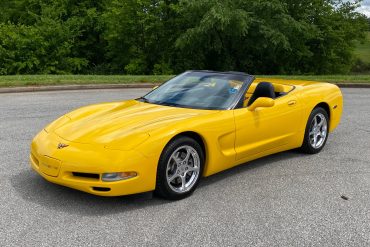
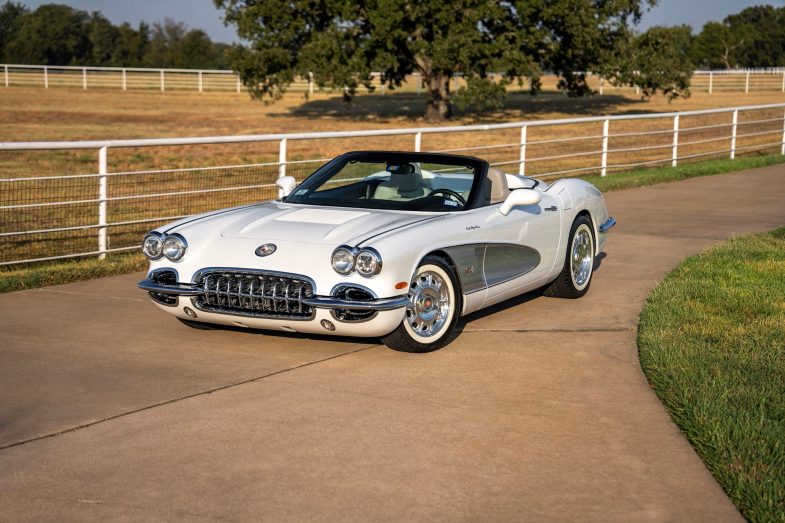
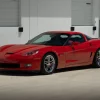
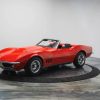
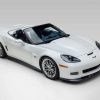
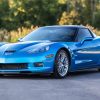
Corvette Pace Cars For Sale
The C3 through C6 Corvettes the site has listed for sale, newest first; the pace cars are among them, and the 1978s appear most often. The for-sale page has every Corvette the site is following and the auctions tag the results.
FAQs
Which Corvette pace cars were sold as replicas?
Six: the 1978 (6,502, RPO Z78, black over silver), the 1986 (every convertible, 7,315, with decals supplied), the 1995 (527, RPO Z4Z, Dark Purple over Arctic White), the 1998 (1,163, RPO Z4Z, Pace Car Purple with yellow wheels), the 2007 (500 Atomic Orange convertibles, RPO Z4Z) and the 2008 (500 black-and-silver coupes and convertibles, RPO Z4Z). The 2002 and 2004 pace cars were the 50th Anniversary and Commemorative Editions, sold as those, and every pace year since 2008 has had track and festival cars only.
The Pace Cars page lists all twenty-three Indianapolis 500 Corvettes with their drivers and replicas; the special-editions guide places the six among the other editions.
How do I tell a real 1978 Pace Car from a clone?
The VIN: factory replicas have a 9 as the eighth character and a sequence number from 900001 to 906502, where every other 1978 has a 4. Then the trim tag, which should read 19U/47M (black over silver, silver trim) with 152 leather or 15C cloth, and the car itself: the high-back thin-shell seats, glass roof panels, aluminum wheels, both spoilers and the full option load, with the L82 and the four-speed the only variables.
The Indy decals were supplied loose and applied by owners, so a car without them can be real and a car with them can be a clone; they prove nothing either way. The engine pad should carry a V prefix with CMR/CMS (L82) or CHW/CLM/CUT (L48) on a 3970010 block with the partial VIN matching the car.
How much is a 1978 Corvette Pace Car worth?
In the results the site tracked from September to October 2026, 1978 replicas sold at auction from $9,300 for high-mileage cars to $44,000 for a 1,000-mile car, with sub-11,000-mile cars at $34,750 to $37,500 and 29,000–37,000-mile cars at $18,700 to $20,350; dealers asked $24,000 to $57,000. Hagerty’s condition-#2 value for an L82 Pace Car is $41,300, more than 60 percent above a base 1978.
Mileage sets the price more than anything else, because so many were stored new; the L82 and the four-speed help; originality of the paint and interior and the VIN settle the rest. The 1978 year page carries the current results.
Is a 1986 Corvette convertible really a pace car?
Yes, every one of them: a yellow 1986 convertible paced the 70th Indianapolis 500 with Chuck Yeager driving, and Chevrolet declared all 7,315 convertibles official pace car replicas regardless of color, supplying door decals for dealers or owners to apply. There was no package, no price and no special equipment, and most never had the decals applied.
So a “1986 Pace Car Edition” is a 1986 convertible, worth no more for the stickers; the premium goes to low mileage, originality, the yellow (code 35) color of the actual pace cars and the 4+3 manual. Hagerty gives it no pace-car premium at all, about 10 percent over a 1987 convertible for being the first C4 convertible.
Which pace car replica is the best buy?
The 1998 for a car to drive and a sure premium: 1,163 built, nearly identical to the track car, Active Handling, the six-speed available (547), and a market of $23,000 to $33,000 for documented sub-30,000-mile cars with the site’s VIN list to verify every one. The 2008 for the modern car: the LS3, the best early-C6 interior, 234 coupes, a signature, and prices a little above a base 2008. The 1978 for the collection, bought on its VIN and its mileage.
The 1995 is the contrarian pick, the rarest replica with the softest market (bids to $19,000 against asks to $49,983), and the 1986 is a convertible to be bought as one.
Do the decals matter?
On a 1978 or a 1986, no: they came loose in the car for the owner to apply, so their presence proves nothing and their absence costs nothing, and an unapplied original set in the box is a pleasant bonus. From 1995 the graphics were factory-applied and are part of the package, but they are reproduced, so what matters is original adhesion and paint beneath them rather than the graphics themselves.
What proves a pace car is the VIN series (1978), RPO Z4Z on the build sheet and console label (1995–2008) and the site’s VIN lists for 1998, 2007 and 2008. The 1986 has no proof because it had no package.
Are Corvette pace cars a good investment?
They have lagged the other special editions, which is both the warning and the opportunity. The 1978 took forty years to grow into Hagerty’s $41,300 for a condition-#2 L82 car after selling for double sticker new; the 1986 never carried a premium; the 1995 trades under what 527 cars implies; the 1998, 2007 and 2008 carry modest premiums of 6 to 13 percent over their base cars. Hagerty concluded in 2024 that they are proven collectibles anyway, for the Indianapolis connection.
Realistic expectations: steady appreciation for documented delivery-mileage cars (the 1978 time capsules most of all), stability for driven replicas, nothing for clones and decal cars. Buy the one you will enjoy and treat the race as the bonus.
What should I check mechanically on a pace car?
Whatever the generation guide says for the base car, because the replica changed nothing underneath: on a 1978 the birdcage and frame, vacuum headlights, T-top and fastback-glass seals, urethane bumpers and the four-piston brakes; on a 1986 or 1995 the digital dash, hub bearings, weatherstrips, cooling fans and (1995) the Optispark; on a 1998 the column lock, EBCM, fuel senders and headlamp motors; on a 2007 or 2008 the column lock, roof-panel bond, power-top hydraulics, exhaust actuators and dash panels.
Then the replica’s own items: the paint at the color break, the graphics’ adhesion, the two-tone leather and embroidered headrests, and on a stored car the tires by date, every hose and seal, the brakes, the fuel system and the battery. A time capsule that has never been refreshed is a project with a low odometer.
What are the actual pace cars and festival cars worth?
A different market from the replicas: a few dozen track, parade and festival cars were prepared for each race, with strobes, roll bars and the Speedway’s graphics, and they trade on provenance from Chevrolet and the Speedway rather than on a label. Hagerty’s survey recorded auction results from $38,500 for a 2004 track car to $242,000 for a 2006 pace car, and two collections of them that averaged about $76,000 and $100,000 a car.
They surface at Mecum and Barrett-Jackson more than anywhere else, often in groups; the Pace Cars page has the story of each year’s cars, and the first 2019 ZR1 pace car (crashed by GM’s president on a parade lap in 2018) is the one everyone asks about.
Where can I find Corvette pace cars for sale and check prices?
The for-sale section above and the site’s for-sale page gather the C3–C6 Corvettes we are following from owners, dealers and the auctions, newest first; the 1978 Pace Car appears more often than any other replica, and the bargain-hunting and time-capsule pieces linked above follow the notable ones. The year pages for 1978, 1986, 1995, 1998, 2007 and 2008 carry the tracked results, and Bring a Trailer, Mecum, Barrett-Jackson, Hagerty and the Corvette Forum classifieds are where the cars change hands.
Use the results, not the asking prices: dealers were asking $57,000 for 1978s that were selling for $44,000 at best, and $49,983 for 1995s that could not find a buyer at $19,000.