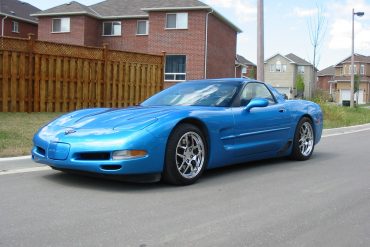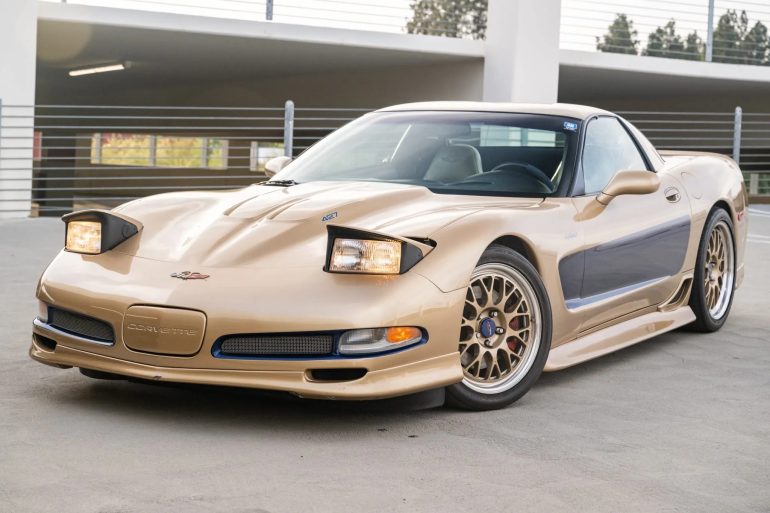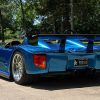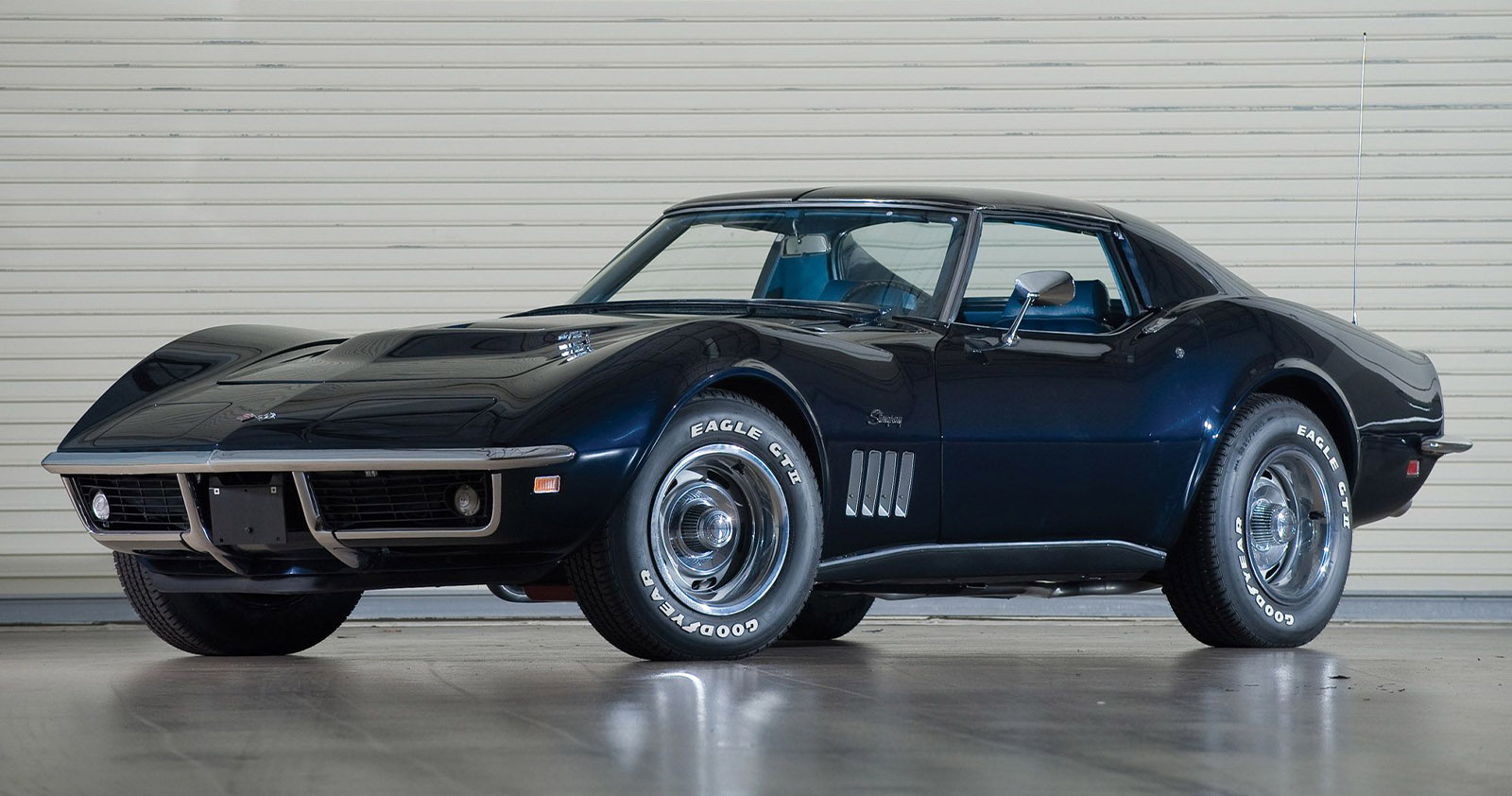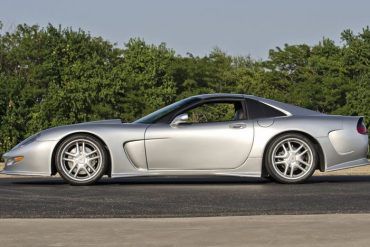
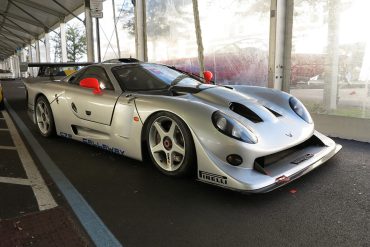
Built with Germany's IVM to homologate a Le Mans GT2 racer, the C12 kept only the C5's door cuts and glass. Twenty were made at about $200,000 each, and the C12.R took pole at Le Mans in 2001.


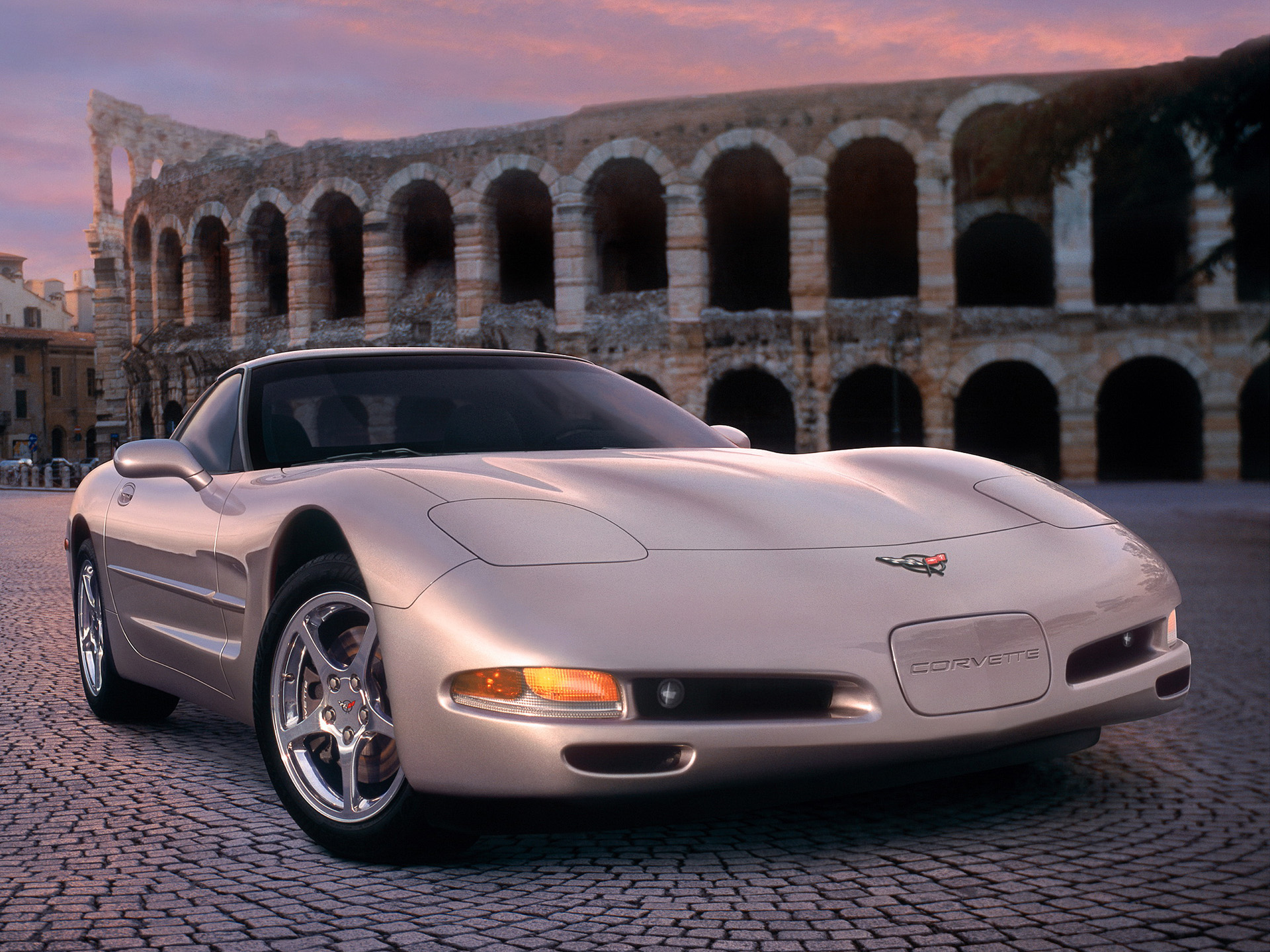
C5 CORVETTE - 1997
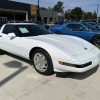
The first all-new Corvette in thirteen years: hydroformed frame rails, a balsa-cored floor, a rear transaxle, the 345-hp all-aluminum LS1 and run-flat tires. Unveiled in Detroit on January 6, 1997 at $37,495. Coupe only, and a short model year: 9,752 built, every one a target coupe, before the convertible and the awards arrived for 1998.
Quick Nav: Story · Specials · Callaway C12 · Price & Options · VIN · Specs · Technical · Pics & Videos · The Market · All · FAQs
Model & Gen: 1997 Corvette (C5)
Body Type: Two-door hatchback coupe with lift-off roof panel, the only body offered; the convertible followed for 1998 and the fixed-roof hardtop for 1999
VIN: 1G1YY22G?V5100001 – 1G1YY22G?V5109707
Original Price: $37,495.00 ($38,060 with the $565 destination charge, $270 more than a 1996 coupe)
Colors: 7 (Torch Red, Black, Sebring Silver, Arctic White, Light Carmine Red, Nassau Blue, Fairway Green); interiors in Black, Light Gray and Firethorn Red leather
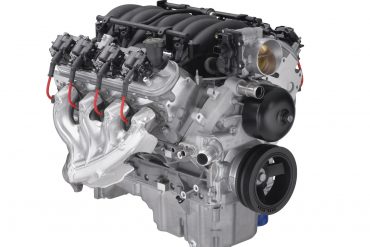
Engine: 346 ci (5.7 L) LS1 all-aluminum small-block V-8, 345 hp and 350 lb-ft, the first of the Gen III engines
Transmission: 4L60-E four-speed automatic standard (M30, 6,943 cars); Borg-Warner T56 six-speed manual $815 (MN6, 2,809 cars); both mounted at the rear axle as a transaxle
Units Produced: 9,752 (all coupes)
The C5 was the first Corvette designed from a clean sheet since 1963 and the first with its own, all-new engine since 1955. Nothing of consequence carried over. Dave McLellan’s team had started in 1989 with the structure: Lotus Engineering advised that a car stiff enough to be built as a convertible needed a torsionally rigid backbone, which meant moving the transmission to the rear axle, and body staff engineer Jerry Fenderson proposed forming each side rail from a single 15-foot steel tube inflated in a die at 10,000 psi. The hydroformed rail replaced fourteen welded pieces, the first use of the process on a major structural member of a mass-produced car. GM cancelled the program in 1992, the year Dave Hill succeeded McLellan as chief engineer, and it survived only because Chevrolet general manager Jim Perkins and manufacturing chief Joe Spielman quietly diverted $2.5 million from their own budgets to build the CERV IV-A, a 1992 convertible body on the new backbone, and drove GM’s North American Strategy Board in it until the money was restored.
The production car was 1.2 inches longer than the C4 on a wheelbase 8.3 inches longer, 2.9 inches wider and 1.4 inches taller, with the wheels pushed to the corners, a 0.29 drag coefficient, John Cafaro’s sheet-molded-composite body on the aluminum-caged, balsa-floored frame, twin composite fuel tanks ahead of the rear axle and a cargo hold of 25 cubic feet, double the C4’s. The LS1, built in Romulus, Michigan, kept the small-block’s 4.40-inch bore spacing and pushrod valvetrain but was new in every other respect: a deep-skirt aluminum block with cast-in liners and six-bolt mains, aluminum heads, a composite intake, coil-near-plug ignition, electronic throttle control and a 3.90 x 3.62-inch bore and stroke for 346 cubic inches, 345 hp at 5,600 rpm and 350 lb-ft at 4,400, 44 pounds lighter than the LT4 it replaced. It drove a rear-mounted 4L60-E automatic or $815 Borg-Warner T56 six-speed through an aluminum torque tube, for a 51.4/48.6 weight split, and sat on double-wishbone suspension at both ends with transverse composite springs, Goodyear Eagle F1 GS Extended Mobility run-flats on 17 x 8.5 and 18 x 9.5-inch wheels, and no spare.
Chevrolet unveiled the car at the Detroit show on January 6, 1997 and in 402 dealerships the same day, at $37,495 plus $565 destination, $270 more than a 1996 coupe for more than $1,200 of new standard equipment: leather seats, a power driver’s seat, a Bose-speaker Delco cassette system, passive keyless entry, speed-sensitive steering, tire-pressure monitoring and the run-flat tires. GM quoted 0–60 in 4.72 seconds with the six-speed, the quarter in 13.36 at 109.4 mph, 172 mph, 0.93 g and 125 feet from 60 mph; Motor Trend matched the 0.93 g and ran 4.8 and 13.2 at 109.6, and Car and Driver saw 175 mph in August. The late start and the coupe-only line held production to 9,752, the lowest since 1959, and AutoWeek’s Best in Show at Detroit was followed a year later by the 1998 North American Car of the Year and Motor Trend’s Car of the Year. Today a 1997 is the cheapest way into a C5: good automatics change hands between about $14,000 and $19,000, six-speeds and sub-20,000-mile cars $23,000 to $30,000.
For Corvette enthusiasts the world over, March 7, 1997, was a date that would be long remembered. After the 13-year production run of the C4, Chevrolet had declared this date as the day that the first all-new Corvette would be made available for sale to the public. Given the massive amount of fanfare that surrounded the arrival of the C5 Corvette, it was little wonder that there was such an overwhelming clamor for this amazing new variant of the legendary sports car.
The arrival of the C5 had been announced some time earlier and there had certainly been plenty of information made available to consumers and enthusiasts alike long before its actual arrival. The new Corvette was celebrated as “bringing a new level of sophistication to the franchise.” Further, it was abundantly clear that this new Corvette was truly going to be unlike anything that had ever come before it. While these types of catch-phrases were synonymous with the introduction of any new car – especially a sports car – there was a great deal of truth behind them, as would soon be discovered the world over.
To begin with, the C5 Corvette had a completely new look that was at once elegant, seductive, and a testament to the long lineage of sports cars that preceded it. As interior designer Jon Albert put it, “You won’t find a car in the Corvette’s price range that provides the same level of quality, power, ride, handling, and refinement.” As Albert explained further, “We designed the C5 with a synchronous mindset. We focused on individual goals, such as improved performance, reduced mass, and increased reliability, with the overall framework of the whole car. We evaluated and balanced each charge so as to optimize the entire car.”
The honors came quickly: AutoWeek named the new Corvette “Best in Show” at the 1997 North American International Auto Show, MotorWeek gave it its Drivers’ Choice Award for best high-performance car, American Woman Motorscene voted it “Most Likely to be Immortalized,” and a year later a jury of 48 journalists named it the 1998 North American Car of the Year.
The C5 was longer and wider than its predecessor, but the relocation of the wheels to the corners of the car also aided in giving the C5 Corvette a very modern appearance. The wheelbase had been increased from 96.2 inches to 104.5 inches, the overall length increased from 178.5 inches to 179.6 inches, the width increased from 70.7 inches to 73.6 inches, the height increased from 46.3 inches to 47.8 inches, and the track width had been extended 4.4 inches in the front and 2.9 inches at the rear. These increases produced the aforementioned end result of placing the car’s wheels close to the corner of the Corvette’s chassis, which not only aided in the car’s contemporary appearance, but also produced enhanced stability and gave the car a roomier interior.
The body of the car had been completely re-designed to be more aerodynamic than any of its older counterparts. Even so, while the body styling was more swept back and the front hood and cowl were lowered to provide an additional 18 feet of forward visibility, the car was still unmistakably Corvette. Exemplifying the Corvette tradition started by Harley Earl 44 years earlier, the new Corvette’s entire body was still formed from a fiberglass-type material (specifically a flexible, sheet-molded composite compound) that, while more technically advanced than the materials used to craft the exterior of its C1 predecessor, still gave recognition to Corvette’s earliest days. Also paying homage to the C1 Corvette was the appearance of the signature fender “gills” that were located just behind the front wheel well to draw off engine heat. These gills are offset by a cove that runs along the length of the door, which was a feature first introduced on the 1956 Chevy Corvette.
Did you know? Of all the innovations made during the development of the C5 Corvette, none was more significant than the development of the rear mounted transaxle. This design was considered after GM engineers observed the continued successes experienced by the Ferrari Daytona and the Porsche 944 (both of which use the same configuration). The primary goal of this design change was improved balance between the front and rear of the car. By moving the transaxle to the rear of the Corvette, GM engineers were able to achieve a 51% to 49% weight distribution, which is just about ideal for vehicle drivability and balance.
The windshield was designed to produce a steeper angle than any that came before it, adding to the swept back allure of the new Corvette’s signature design. As with all previous generations (except the C1), the headlights were hidden away, giving the front end a smooth, airfoil-like appearance. The front fascia featured a recessed grill on either side of the front license plate mounting area, and oval vents below the corner parking lights served as air ducts to help cool the front brakes. The front hood also received a re-design and, while less intriguing than the C4 clamshell, the C5’s hood still opened from the front of the car, and because of reduced size and weight, was also much easier to open than its earlier counterpart.
The rear end, while shorter than its C4 predecessor, was actually designed to sit higher which helped in the reduction of drag while simultaneously opening up more internal cargo space – doubling the available space from the earlier generation to a total of 25 cubic feet. Moreover, the effect of the redesign resulted in a coefficient of drag which was a reduction over previous generations. With a coefficient of 0.29, it was improved even over the 1996 C4 Corvette, which had a coefficient of 0.33.
Other aspects of the new rear end also carried Corvette trademarks: the modestly convex rear fascia was finished with a distinctive horizontal crease beneath which four oval taillights were mounted.
The rounded taillights, another throwback to the earliest Corvettes, gave the car an entirely familiar appearance while still being a completely new design. Subtle additions to the rear fascia also included horizontal slots below the brake lights which aided in venting muffler heat. The exhaust system itself was wrapped to exit at the central point of the car’s rear end where two pairs of twin exhaust tips emerge, framed on three sides by the fascia.
Like the exterior, the C5’s interior was an almost complete departure from all earlier-generation Corvettes. The cockpit was bigger, roomier, and more thoughtfully designed. The four-inch-tall doorsills of the C4 were eliminated, thanks to a newly designed frame. The end result of the elimination of these side rails meant that C5 owners would find ingress and egress to be no problem whatsoever.
Another improvement was the increased head and body room inside the cockpit of the C5. An extra 1.5 inches of head and shoulder room and an extra 3.4 inches of additional hip room aided in producing a “user-friendly” interior – a significant improvement to the C5 that had never been considered before.
Also like the exterior, the interior did include elements that were throwbacks to earlier generation Corvettes. The dashboard took its inspiration from the C2 Corvette, complete with the “dual coves” introduced on the 1963–1967 cars.
Taking it a step further, the new dashboard design included a passenger’s grab handle. The often-troublesome digital gauges that were synonymous with the C4 Corvette were converted back to conventional analog gauges. These circular gauges were marked with ultra-violet-lit “day glo” backlight paint and were set on different planes providing drivers with an almost three-dimensional effect. At night, when drivers flipped on the headlights, the “day-glo” paint was illuminated with black lights that would give the dashboard an almost “other worldly” glow that was both high tech in appearance and easy to read.
Other, more subtle changes/upgrades were included in the interior re-design. As was part of the C5’s design initiative from the beginning, the interior received treatments that would give the new car’s interior a more sophisticated, more exclusive appearance. Soft-touch pads replaced cheap plastic switchgear throughout the cockpit. The parking brake was now activated by a proper center console control arm instead of an inconvenient lever placed to the left of the driver’s seat (as had been the case on the C4). While the C4 Corvette was routinely criticized for its ever-present squeaks, rattles, vibrations, and its complete lack of sophistication, the C5’s new design was praised for its newfound rigidity, overall feeling of precision, and its major improvement to quality.
Beyond the new design, the car came packed with an entire array of standard features – some of which were reminiscent of the C4, while others were completely new and unique to the C5. As with before, the C5 included a removable body color (painted) roof panel (although a blue-tinted glass panel could be substituted for an extra $650.00, or both could be ordered collectively for an additional $950.00). Another significant feature to return for the C5 was the Bose audio system with an AM/FM/cassette head unit manufactured by Delco. Leather seats were standard, as was a proximity-based passive keyless-entry system (a feature which, though common today, was still something of a big deal in 1997).
Other optional upgrades were made available to consumers who wanted to increase the “creature-comfort” level of their new Corvettes. Some of these included dual-zone electronic air conditioning (a $365.00 upgrade), a remote 12-disc CD changer ($600.00), and a Memory package that remembered the driver’s preferred settings for the outside mirrors, the climate-control system, the power seats, and the radio settings. When fully loaded, this new Corvette had more features available to consumers than any other generation had offered before it.
But there was more to the Corvette than just the comforts of the cockpit or its ultra-sleek exterior. It was built to perform with automobile contenders from around the world. To start, the new Corvette was fitted with a newly designed, yet historically traditional pushrod, 16-valve small-block V8. Designated as the LS1, this new engine delivered 345 bhp at 5,600 rpm and 350 lb-ft of torque at 4,400 rpm. While the engine displacement was the same as the C4’s LT1, this 5.7 liter engine was constructed of aluminum instead of iron and was a more aggressive, more durable design than its predecessor.
Also a carry over from its predecessor, the LS1 kept the small-block’s time-honored 4.40-inch bore spacing (4.40 inches from bore center to bore center) and the familiar 5.7-liter displacement label. Specified to run on premium fuel and filled with synthetic oil from the factory, the new LS1 had to be carefully fitted into the body of the Corvette. In fact, the engine clearances were so minimal, the new oil pan that was mated to the LS1 engine was scarcely 5 inches deep, yet offered increased capacity and the ability to supply lubricant during even the most extreme cornering maneuvers.
Even more impressive was the fact that this new 5.7-liter engine weighed 44 pounds less than the LT4 engine that it replaced, while still producing enough power to make it a serious contender against the former ZR1’s power plant. Mated to the new LS1 engine was a standard, four-speed automatic transmission gearbox. As with the C4 before it, a Borg-Warner T56 six-speed manual transmission was offered for an additional $815.00 (a revised version of the previous generation’s ZF-era gearbox, now mounted at the rear axle).
As before, the six-speed included the first-to-fourth Computer-Aided Gear Selection (CAGS) skip shift. While the linkages were more complex than before, the six speed transmission’s shift effort and feel were very reminiscent of the C4.
In an effort to increase the equal distribution of weight, the C5’s transmission was relocated to the rear of the car. Located just in front of the rear axle, the transmission was mated to the LS1 engine via an aluminum tube which ran through an enclosed tunnel that formed a chassis backbone strong enough to reduce structural loads on the outboard frame rails. Relocating the transmission to the rear axle produced the desired balancing result with a 51/49 percent weight distribution. This equal distribution of weight would result in an automobile that was better-balanced and better equipped to handle the rigors of even the most aggressive drivers.
Further, this new layout was the direct result of a car that hadn’t solely been the brain-child of a single designer, but rather the response by GM to understand the considerable number of customer (and enthusiast) inputs that had driven the development of this car – including a call for friendly handling, roominess in the cockpit, and a solid, silent automobile. Another added benefit of relocating the transmission to the rear of the Corvette was the elimination of the former toe-pinching tunnels of the C4.
Instead of featuring a frame composed of 28 individual, welded pieces like the C4, the new model’s frame rails were composed of seamless, one-piece steel tubes that were “inflated” into shape by hydraulic pressure.
This produced a new perimeter-frame chassis that was considerably stronger than any previous generation Corvette. Tying the frame rails together was a chassis floor of composite plastic plates that sandwiched sheets of Ecuadorian balsa wood. The balsa was selected because it was lighter than synthetic fillers and was better at absorbing noise and vibration.
Placement of the fuel tank was also considered in the development of the frame, and it was decided that the fuel tank would be mounted ahead of the rear axle instead of behind it as this placement would also enhance the car’s weight balance and available cargo room.
The rear suspension was now a true short/long-arm double-wishbone design with bushings and geometry developed for optimal ride and handling. The transverse plastic leaf springs were carried over from the C4, but, thanks to the stiffer structure, they had lower spring rates which resulted in a smoother, softer ride. There were two suspension options available for the 1997 Corvette: the first was the autocross-ready (but exceedingly jarring) Z51 suspension package. The second was the high-tech F45 Selective Real Time Damping system that allowed drivers the option to select three varying suspension modes: Tour, Sport and Performance.
Braking on the 1997 C5 featured new, vented rotors mated with aluminum calipers. While these were, at least in principle, a carryover from the C4, this new configuration was an upgrade over the previous braking system in that it featured thicker rotors. Additionally, as the ABS was now integrated with the traction control system, the brake pedal no longer needed to be pushed to signal activation of the antilock braking system.
In an on-going effort to move away from the necessity of carrying a spare tire with jacking system, the 1997 Corvette was fitted with Eagle F1 GS Extended Mobility Tires. These tires were designed to run airless for 200 miles. Their introduction to the extended mobility tires convinced Chevrolet to eliminate the spare tire and jack altogether, which further helped the engineers reduce weight while increasing cargo space. The inflation level of the tires was monitored constantly and could be called up on an instrument-panel display (thanks to the tire-pressure monitoring system that has since become standard on almost every GM vehicle). The wheels were 17 x 8.5 inches in front and, for the first time, 18 x 9.5 inches at the rear, on P245/45ZR17 and P275/40ZR18 tires that were slightly narrower than the 1996 model’s base 255/45 and 285/40 package. This proved to be an advantage as the somewhat narrower tires actually aided in improving the directional stability to levels unsurpassed by General Motors.
Perhaps one of the 1997 Corvette’s most significant achievements is that the C5 was immediately recognized as one of the fastest Corvettes of all time and was one of the fastest cars in the world that year. When equipped with the six-speed manual transmission, it could accelerate from 0-60 mph in just 4.7 seconds, which was a half-second less than the 1996’s LT4 engine equipped C4, and just as quick as the 405 bhp equipped 1995 ZR-1 Corvette. Its top speed was documented at 172 miles per hour, which made it faster than any of the C4 coupes/convertibles and only seven miles shy of matching the ZR-1’s top-speed. Equally impressive was the skidpad numbers of 0.93 g, which was the best number ever achieved by a production Corvette, while braking from 60-0 miles-per-hour was a supercar-short 125 feet.
Needless to say, the C5 was a success from the moment the first models hit the showroom floor. The automotive press was, for the most part, very enthusiastic about the new car, favorably comparing it to such exotic counterparts as Porsche and Ferrari – and at less than half the price of its European counterparts, there were few who could criticize the Corvette for being anything less than the perfect blend of “emotion and intelligence.”
As was stated by Car and Driver’s Csaba Csere, “If, as they say, God is in the details, then this is the first holy Corvette.” It was also considered the most-civilized Corvette produced to date. The new Corvette also earned high marks for providing better handling and improved ride quality, much improved instrumentation, vastly improved interior ergonomics and improved outward visibility. While there were critics amongst those that praised the arrival of the Corvette, their voices were few. Even the most cynical reviewers could find little truly wrong with the 1997 Corvette.
Surprisingly, given the demand for pre-sales of these cars, only 9,752 C5 Corvettes were built in the 1997 model year. This was not a critical concern to anybody within General Motors though because future orders were increasing exponentially. Besides, the production-constrained 1997 Corvette had another variable working against it – namely that the model year had started late for the C5 Corvette. Still, the Corvette was selling briskly for the first time in more than a decade.

 The 1997 C5 Corvette was an almost entirely new design. Critics praised it as the most sophisticated and well thought-out Corvette to date.
 The 1997 Corvette Rear Fascia. Note the horizontal slots below the brake lights which aid in venting the exhaust system
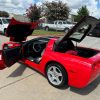
 The re-designed 1997 C5 Corvette Interior.
 "Exploded" view of the 1997 C5 Corvette's LS1 Small Block V-8 Engine. (Image courtesy of GM Media.)
 The 1997 Corvette Side Rails were created of seamless one-piece steel that was hydro-formed into shape, making it considerably stronger than a frame constructed of individually welded pieces. (Image courtesy of GM Media.)
Three option counts on the 1997 production chart add up to 9,752 (automatics plus six-speeds, base plus Z51 suspension, manual plus dual-zone air), but the roof panels add up to 9,707: 2,078 body-color panels, 7,213 blue-tinted glass panels and 416 dual-roof packages, exactly the length of the VIN sequence, 100001 to 109707. The 45 missing cars are the pilot and prototype builds Chevrolet counted in the production total but never gave production sequence numbers. Nine buyers took delivery of their new C5 at the National Corvette Museum under RPO R8C.
DID YOU KNOW
The Callaway C12 has its own section below. Also here: the Callaway C7R GT1 that led its class at the 1997 Daytona 24 Hours, and the C5-based concepts and specials of the first year.
Reeves Callaway answered the C5 within months. The C12, shown at Geneva in 1997 and designed by Paul Deutschman with IVM Automotive in Germany, rebuilt the C5 as a 1,998-mm-wide GT2 homologation car: carbon-fiber and Kevlar bodywork sharing only the door cuts and glass with the Corvette, a track five inches wider on fabricated stainless arms, 14-inch metal-matrix rotors, 295/30ZR19 Pirellis and a 440-hp SuperNatural LS1 (482 hp from the later 6.2-liter LS6 cars). About twenty were built through 2001 at roughly $200,000 apiece, in coupe, hardtop and cabriolet form in Europe, and a C12.R took pole at Le Mans in 2001. The same year Callaway’s C7R GT1, a 640-hp monocoque racer, led its class at the Daytona 24 Hours before rule changes sidelined it.
MORE: THE CALLAWAY C12 STORY
The 1997 Corvette listed at $37,495.00, or $38,060 with the $565 destination charge, $270 more than the 1996 coupe’s $37,790 delivered; Chevrolet made the point at the launch that the new car carried more than $1,200 of equipment that had been optional or unavailable the year before, including the power driver seat, the Bose-speaker Delco cassette system, speed-sensitive steering, the tire-pressure monitor and the run-flat Extended Mobility tires.
Only the hatchback coupe was offered, 9,752 of them, so there is no convertible premium to reckon with. The big-ticket options were Selective Real Time Damping (RPO F45, $1,695.00), taken on 3,094 cars, the $950.00 dual-roof package (C2L, 416 cars) and the $815.00 Borg-Warner six-speed (MN6), chosen by 2,809 buyers against 6,943 who kept the 4L60-E automatic; 2,739 of the automatics took the $100.00 3.15:1 performance axle (G92) and 1,077 cars the $350.00 Z51 Performance Handling Package, which could not be combined with F45.
The blue-tinted glass roof (CC3, $650.00) went on 7,213 cars, three in four, leaving 2,078 with the standard body-color panel.
Inside, the leather sport seats (AQ9, $625.00) went into 6,711 cars and the power passenger seat (AG2, $305.00) into 8,951; dual-zone electronic air conditioning (CJ2, $365.00) replaced the standard manual air on 7,999 cars, and the Memory Package that required it (AAB, $150.00) went into 6,186.
The Delco CD player (UN0, $100.00) was fitted to 6,282 cars and the remote 12-disc changer (U1S, $600.00) to 4,496; 8,829 cars had fog lamps (T96, $69.00), 8,315 the luggage shade and net (D42, $50.00), 9,371 floor mats (B34, $25.00), 4,366 body-side moldings (B84, $75.00) and 2,258 the front plate frame (V49, $15.00). Emissions packages were $170.00 for California (YF5, 885 cars) or Massachusetts and New York (NG1, 677). A fully loaded automatic with F45 and the glass roof came to about $42,300 before destination; a six-speed Z51 with the glass roof and sport seats to about $40,200.
Nine owners took delivery at the National Corvette Museum (R8C), and some 800 cars carried export codes: 426 EXP, 325 for Canada (Z49) and 46 for Mexico (CV3).
MORE: PRICING, OPTIONS & COLORS / RPO CODES
| CODE | DESCRIPTION | QUANTITY | RETAIL PRICE |
|---|---|---|---|
| 1YY07 | Base Corvette Hatchback Coupe (345-hp LS1, 4L60-E automatic, body-color lift-off roof panel, leather seats, six-way power driver seat, Delco AM/FM cassette with Bose speakers, air conditioning, passive keyless entry, dual airbags, ABS and traction control, speed-sensitive steering, tire-pressure monitor, Goodyear EMT run-flat tires on 17/18-inch wheels) | 9,752 | $37,495.00 |
| FE1 | Base Suspension (standard) | 8,675 | no charge |
| AAB | Memory Package (mirrors, radio, climate control and driver seat; requires CJ2) | 6,186 | $150.00 |
| AG2 | Six-Way Power Passenger Seat | 8,951 | $305.00 |
| AQ9 | Sport Seats, leather, with power bolsters and lumbar (requires AG2) | 6,711 | $625.00 |
| B34 | Front Floor Mats | 9,371 | $25.00 |
| B84 | Body Side Moldings | 4,366 | $75.00 |
| C2L | Dual Removable Roof Panels, body color and blue-tinted glass | 416 | $950.00 |
| C60 | Manual Air Conditioning (standard) | 1,753 | no charge |
| CC3 | Removable Roof Panel, blue-tinted glass (in place of the body-color panel) | 7,213 | $650.00 |
| CF7 | Removable Roof Panel, body color (standard) | 2,078 | no charge |
| CJ2 | Electronic Dual-Zone Air Conditioning (in place of the standard C60 manual air) | 7,999 | $365.00 |
| CV3 | Mexico Export | 46 | – |
| D42 | Luggage Shade and Parcel Net | 8,315 | $50.00 |
| EXP | Export (all markets) | 426 | – |
| F45 | Selective Real Time Damping (not with Z51) | 3,094 | $1,695.00 |
| G92 | Performance Axle Ratio, 3.15:1 (automatic only; required with Z51 automatic) | 2,739 | $100.00 |
| M30 | Four-Speed Automatic Transmission, 4L60-E (standard) | 6,943 | no charge |
| MN6 | Six-Speed Manual Transmission, Borg-Warner T56 | 2,809 | $815.00 |
| NG1 | Massachusetts/New York Emissions | 677 | $170.00 |
| R8C | Customer Delivery at the National Corvette Museum | 9 | – |
| T96 | Fog Lamps | 8,829 | $69.00 |
| U1S | Remote Compact 12-Disc CD Changer | 4,496 | $600.00 |
| UN0 | Delco AM/FM Stereo with CD and Bose speakers (in place of cassette) | 6,282 | $100.00 |
| V49 | Front License Plate Frame | 2,258 | $15.00 |
| YF5 | California Emissions | 885 | $170.00 |
| Z49 | Canadian Export Equipment | 325 | – |
| Z51 | Performance Handling Package (FE3 sport suspension: stiffer springs, bars and shocks; not with F45) | 1,077 | $350.00 |
| CODE | EXTERIOR | TOTAL | INTERIOR |
|---|---|---|---|
| 70 | Torch Red | 3,026 | Black, Light Gray, Firethorn Red |
| 41 | Black | 2,393 | Black, Light Gray, Firethorn Red |
| 13 | Sebring Silver Metallic | 2,164 | Black, Light Gray, Firethorn Red |
| 10 | Arctic White | 1,341 | Black, Light Gray, Firethorn Red |
| 53 | Light Carmine Red Metallic | 381 | Black, Light Gray |
| 23 | Nassau Blue Metallic | 292 | Black, Light Gray, Firethorn Red |
| 87 | Fairway Green Metallic | 155 | Black, Light Gray, Firethorn Red |
One engine, the all-new LS1 (RPO LS1, VIN code G): 346 cubic inches, 5.7 liters, from a 3.90-inch bore and 3.62-inch stroke in a deep-skirt cast-aluminum block (casting 12550592) with cast-in iron liners, six-bolt powdered-metal main caps and a structural cast-aluminum oil pan, under aluminum heads (10215339, late 12558806) with two valves per cylinder, hydraulic roller lifters and roller rockers, a composite intake manifold, sequential injection, coil-near-plug ignition and GM’s first electronic throttle.
Compression was 10.1:1 on premium fuel, output 345 hp at 5,600 rpm and 350 lb-ft at 4,400 with a 6,000-rpm redline, the firing order changed to 1-8-7-2-6-5-4-3 and the whole engine 44 pounds lighter than the 1996 LT4. Engine codes were ZYC with the manual and ZYD with the automatic, and every LS1 was built at GM’s Romulus, Michigan plant.
The transmission moved to the rear axle in a Getrag limited-slip transaxle fed by an aluminum torque tube: the standard 4L60-E automatic (3.06, 1.63, 1.00, 0.70) with a 2.73:1 axle or the optional 3.15:1, or the $815 Borg-Warner T56 six-speed (2.66, 1.78, 1.30, 1.00, 0.74, 0.50) with a 3.42:1 axle and the first-to-fourth CAGS skip shift. EPA figures were 17/25 mpg automatic and 18/28 manual.
The structure was a perimeter frame of two hydroformed steel side rails tied by cast-aluminum front and rear cross members, a sheet-steel backbone tunnel, a welded cage of aluminum castings and extrusions around the cockpit, a magnesium steering-column support and a composite floor sandwiching balsa wood, 4.5 times stiffer than the C4 with 1,500 fewer parts and 68 pounds lighter than a 1996 coupe.
Suspension was short-long-arm double wishbones at both ends, forged and cast aluminum arms on transverse composite leaf springs with 19-mm bars and 36-mm monotube shocks (FE1), Z51’s 21.7-mm bars and 45-mm shocks, or F45’s continuously variable Real Time Damping; brakes were 12.8-inch vented front and 12.0-inch rear rotors with Bosch ABS and ASR traction control; steering was speed-sensitive magnetic variable-effort rack and pinion at 16.1:1, 2.66 turns lock to lock. Goodyear Eagle F1 GS Extended Mobility tires, P245/45ZR17 front and P275/40ZR18 rear on 17 x 8.5 and 18 x 9.5-inch wheels, ran 200 miles flat at 55 mph and let Chevrolet drop the spare.
GM’s own numbers were 4.72 seconds to 60 mph (5.05 automatic), 13.36 at 109.4 mph, 172 mph, 0.93 g and 125 feet from 60; Car and Driver (February 1997) ran 4.9 and 13.4 at 108, Road & Track 4.8 and 13.3 at 108 with 116 feet from 60, Motor Trend (April) 4.8, 13.2 at 109.6, 114 feet and 0.93 g, and Car and Driver’s August test reached 175 mph.
MORE: FULL SPECIFICATIONS / ENGINE
| SPEC | 1997 CORVETTE |
|---|---|
| Engine, LS1 (RPO LS1, standard) | 346 ci (5.7 L, 5,665 cc) Generation III small-block V-8, VIN G: 3.90 x 3.62 in, deep-skirt cast-aluminum block 12550592 with cast-in iron liners and six-bolt powdered-metal main caps, aluminum heads 10215339 (late 12558806), 2 valves per cylinder, hydraulic roller lifters, roller rockers, hollow steel camshaft, powdered-metal rods, composite intake, coil-near-plug ignition, sequential injection, electronic throttle control, 10.1:1, premium fuel; 345 hp @ 5,600 rpm, 350 lb-ft @ 4,400 rpm, 6,000-rpm redline; firing order 1-8-7-2-6-5-4-3; suffix ZYC (manual) / ZYD (automatic); built in Romulus, Michigan |
| Transmission | Rear-mounted transaxle via aluminum torque tube, Getrag limited-slip differential: 4L60-E four-speed electronic automatic standard (RPO M30, 6,943 cars), ratios 3.06, 1.63, 1.00, 0.70, reverse 2.29; Borg-Warner T56 six-speed manual (RPO MN6, $815.00, 2,809 cars) with CAGS first-to-fourth skip shift, ratios 2.66, 1.78, 1.30, 1.00, 0.74, 0.50, reverse 2.90 |
| Axle ratio | 2.73:1 automatic (GU2), 3.15:1 with RPO G92 ($100.00, 2,739 cars); 3.42:1 manual (GU6) |
| Structure | Perimeter frame of two hydroformed one-piece steel side rails (from 15-ft, 6-in tubes at 10,000 psi), cast-aluminum front and rear cross members, sheet-steel backbone tunnel, welded aluminum cockpit cage, magnesium steering-column support, composite floor with balsa core, twin composite fuel tanks ahead of the rear axle; 4.5 times the C4’s torsional stiffness, about 1,500 fewer parts |
| Suspension | Front and rear: short-long-arm double wishbones, forged aluminum upper and cast aluminum lower arms, transverse composite leaf springs, monotube shocks, ride-height adjusters; FE1 base (19-mm bars, 36-mm shocks; 8,675 cars), Z51/FE3 Performance Handling ($350.00; 21.7-mm bars, 45-mm shocks; 1,077 cars), F45 Selective Real Time Damping ($1,695.00; 28-mm electronic shocks, Tour/Sport/Performance; 3,094 cars) |
| Brakes & traction control | Four-wheel vented discs, 325 x 32 mm front and 305 x 26 mm rear, aluminum calipers, Bosch ABS with ASR traction control standard |
| Steering | Rack and pinion, speed-sensitive magnetic variable-effort power assist, 16.1:1, 2.66 turns lock to lock, 38.5-ft turning circle |
| Body | Sheet-molded-composite panels on the steel frame, hatchback coupe with lift-off roof panel (body color CF7, blue-tinted glass CC3 $650.00, both C2L $950.00), hidden headlamps, four oval taillamps, center-exit quad exhaust; drag coefficient 0.29 |
| Interior | Twin-cove cockpit, analog gauges with UV-lit markings, Driver Information Center (12 readouts, four languages), leather seats standard (sport seats AQ9 $625.00), six-way power driver seat, Delco AM/FM cassette with Bose speakers (CD UN0 $100.00, 12-disc changer U1S $600.00), passive keyless entry, manual air conditioning (dual-zone CJ2 $365.00), dual airbags; 25.0 cu ft cargo |
| Wheels & tires | Cast aluminum five-spoke 17 x 8.5 in front, 18 x 9.5 in rear; Goodyear Eagle F1 GS Extended Mobility run-flat P245/45ZR17 front, P275/40ZR18 rear; tire-pressure monitor standard, no spare |
| Fuel tank | 19.1 gal, twin composite tanks with transfer pump |
| Wheelbase | 104.5 in (+8.3 over the C4) |
| Overall length / width / height | 179.7 / 73.6 / 47.7 in |
| Track, front / rear | 62.0 / 62.1 in |
| Curb weight | 3,229 lb automatic, 3,218 lb manual; 51.4/48.6 front/rear |
| 0–60 mph | 4.72 sec manual, 5.05 automatic (GM); 4.8 (Road & Track, Motor Trend, Car and Driver Aug 1997), 4.9 (Car and Driver Feb 1997) |
| Quarter mile | 13.36 sec @ 109.4 mph (GM); 13.2 @ 109.6 (Motor Trend), 13.3 @ 108 (Road & Track), 13.4 @ 108 (Car and Driver) |
| Top speed | 172 mph (GM); 175 mph (Car and Driver, Aug 1997) |
| Braking / lateral acceleration | 125 ft from 60 mph, 0.93 g (GM); 114 ft and 0.93 g (Motor Trend), 116 ft (Road & Track), 0.89–0.90 g (Road & Track, Car and Driver) |
| Fuel economy (EPA) | 17 / 25 mpg automatic; 18 / 28 mpg manual |
| Production | 9,752 coupes (VIN sequence 100001–109707) |
| Assembly | Bowling Green, Kentucky; engines from Romulus, Michigan |
Every 1997 Corvette carries a VIN of the form 1G1YY22G?V51xxxxx: 1 for the United States, G for General Motors, 1 for Chevrolet, Y for the Corvette car line and Y for the Corvette series, 2 for the two-door hatchback coupe (the only body this year; convertibles would take a 3 from 1998 and hardtops a 1 from 1999), 2 for active manual belts with driver and passenger airbags, G for the 5.7-liter LS1, a check digit in the ninth position that varies car by car, V for the 1997 model year and 5 for Bowling Green, Kentucky. The sequence numbers run from 100001 to 109707, 9,707 cars, against an official production total of 9,752: the total counts the pilot and prototype cars built at the start of the C5 program, which did not take production sequence numbers, and the roof-panel option counts on the production chart (2,078 + 7,213 + 416) agree with the 9,707.
The engine pad on the front of the block carries the Romulus plant code, the build date and the suffix ZYC (six-speed) or ZYD (automatic) on a 12550592 aluminum block with 10215339 or late-production 12558806 heads; the earlier casting is generally treated as a 1997-only head, the 1998 LS1 using the 806 casting throughout. The VIN is on a plate on the inner vertical surface of the left windshield pillar, visible through the glass, and is repeated on the certification label on the driver’s door and on the service parts identification label in the console, which lists the car’s RPO codes, paint code (10, 13, 23, 41, 53, 70 or 87) and interior trim (193 black, 923 light gray, 943 Firethorn Red). Paint code and trim also appear on the build sheet; a 1997 with a Light Gray or Firethorn interior under Light Carmine Red paint is not a factory combination, since the red interior was not offered with it.
MORE: VIN DECODER / PRODUCTION
| POSITION | MEANING |
|---|---|
| 1G1 (First through Third) | Country, maker, make: 1 = built in the USA, G = General Motors, 1 = Chevrolet |
| Y (Fourth) | Car line: Y = Corvette |
| Y (Fifth) | Series: Y = Corvette |
| 2 (Sixth) | Body: 2 = two-door hatchback coupe, the only 1997 body (3 = convertible from 1998; 1 = hardtop from 1999) |
| 2 (Seventh) | Restraint system: 2 = active manual belts with driver’s and passenger’s airbags |
| G (Eighth) | Engine: G = 346 ci (5.7 L) LS1, 345 hp; suffix ZYC manual, ZYD automatic |
| x (Ninth) | Check digit, calculated from the other sixteen characters |
| V (Tenth) | Model year: V = 1997 |
| 5 (Eleventh) | Assembly plant: 5 = Bowling Green, Kentucky |
| 100001–109707 (Twelfth through Seventeenth) | Production sequence number: 9,707 numbers for an official total of 9,752 cars; the difference is the pilot and prototype cars counted in the total |
Seven colors: Torch Red (3,026), Black (2,393), Sebring Silver Metallic (2,164), Arctic White (1,341), Light Carmine Red Metallic (381), Nassau Blue Metallic (292) and Fairway Green Metallic (155); interiors in Black (6,481), Light Gray (2,543) and Firethorn Red (728) leather, the red not offered with Light Carmine Red paint. Coupes only, with a body-color or blue-tinted glass roof panel.
The 1997 is the entry ticket to the C5 and is priced like one. It has the LS1, the hydroformed chassis and the look of every later car, but no convertible, no hardtop, 345 rather than 350 hp, a few first-year parts of its own (the early cylinder heads, a one-year-only PCM and some interior trim) and the thinnest option list of the generation, so collectors have passed it over for the 1998 Pace Car, the 1999 hardtop and the Z06. That keeps a well-kept 1997 cheaper than the equivalent 1998–2000 by a few thousand dollars and makes the six-speed cars, 2,809 of them, the ones worth seeking: they bring the same premium over automatics as any other C5 and the 1997-only features count for little either way. Color matters more than year here: Torch Red and Black are two-thirds of production, so a Nassau Blue or Fairway Green car (447 between them) stands out at a show without costing more.
Classic.com results for the twelve months to October 2026 show the range. The top of the market is a 1,000-mile six-speed sold by GAA in July 2026 for $30,500 (and consigned again for GAA’s November sale), followed by a 4,000-mile six-speed on Bring a Trailer in June at $23,500 and a 24,000-mile six-speed from Top End Motors in March at $23,000. Clean automatics with 13,000 to 39,000 miles sold between $17,500 and $18,900 (Bring a Trailer in June, Hagerty in June, GAA in February), while a 25,000-mile car brought $16,555 on Bring a Trailer in July and 49,000- and 57,000-mile cars $14,300 apiece (Bring a Trailer in June, Mecum Glendale in March). A 67,000-mile six-speed changed hands twice on Cars & Bids, for $16,000 in May and $18,250 in June. High-mileage drivers set the floor: $10,250 for 76,000 miles and $8,100 for 141,000 on Bring a Trailer, $9,300 for 86,000 miles at Hagerty. An 11,000-mile automatic was bid to $21,000 at Mecum in January without selling; dealers asked $18,990 to $28,599 for 58,000- to 13,000-mile cars, and $24,250 to $26,390 for 6,000–14,000-mile examples. Auction prices quoted are hammer prices; add the buyer’s premium (typically 5 to 10 percent) when comparing with dealer asking prices.
Verification is simple on a 1997 because there were no editions: a V in the tenth VIN position, a G in the eighth, sequence 100001–109707, and the service parts label in the console listing the RPOs the seller claims (MN6 for a six-speed, F45 or Z51 for the suspension, AQ9 for sport seats, C2L for both roofs). Check that both roof panels are present on a C2L car, since the body-color panel is often lost, and that the tire-pressure sensors read on the Driver Information Center. Original window stickers and build sheets survive on many low-mileage cars and are worth asking for; so is a stack of service receipts, because the 1997’s weak points are documented and a car with them already addressed is worth more than one without.
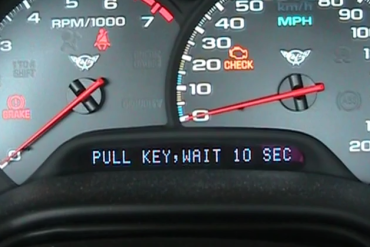
The 1997’s inspection list is the C5’s plus a first-year layer. The electronic column lock (recall 04V060, 2004) can lock the steering with the key out and leave a “Pull Key, Wait 10 Seconds” message; dealers disabled it under the recall and most cars now carry a bypass, so confirm which. The original AC Delco battery cracked at the posts and leaked acid onto the PCM and harness below it, so check the battery tray and the computer’s connectors for corrosion; the lap-belt retractors were recalled (00V111) for twisting webbing. Rocker-arm needle bearings fail and announce themselves as valvetrain noise and metal on the drain plug; harmonic balancers walk forward on early LS1s; front rotors warp and the brake-wear and ABS/traction lights point to wheel-speed sensors or the EBCM. Fuel-level senders read empty on high-sulfur fuel, the main fuel pump behind the driver’s seat hums (a quieter pump is a known fix), window regulators and the headlight bezel plugs fail, the roof panel creaks until its seals are greased, the seat bolsters split and the seats rock a quarter inch under braking. None of it is expensive by sports-car standards, and the LS1 itself, properly oiled, goes well past 150,000 miles; a sorted 1997 six-speed is the best-value C5 there is.
MORE: THE MARKET
Get all the latest news stories, upcoming auctions, prices, videos and more about the 1997 Chevrolet Corvette! The latest headlines here.
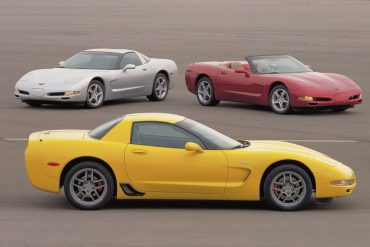







Chevrolet built 9,752 Corvettes for 1997 at Bowling Green, Kentucky, all hatchback coupes, the lowest total since 1959, because the all-new C5 went on sale late in the model year and the convertible did not arrive until 1998. The VIN sequence runs only to 109707 (9,707 numbers); the official total includes the pilot and prototype cars. 6,943 had the automatic and 2,809 the six-speed; 7,213 took the blue-tinted glass roof, 416 both roofs, 3,094 Selective Real Time Damping, 1,077 the Z51 package, 6,711 sport seats, 6,282 the CD player and 4,496 the 12-disc changer. 797 were built for export, nine were delivered at the National Corvette Museum.
In the twelve months to October 2026, Classic.com tracked 1997 Corvettes selling from $8,100 (141,000 miles) to $30,500 (a 1,000-mile six-speed at GAA), with most clean automatics between $14,300 and $18,900 and low-mileage six-speeds at $23,000 to $23,500. Dealers asked $19,000 to $28,600, and up to $26,390 for a 6,000-mile car. The six-speed, mileage and documentation set the price; the 1997-only details do not add to it, which makes a sorted 1997 the cheapest way into a C5.
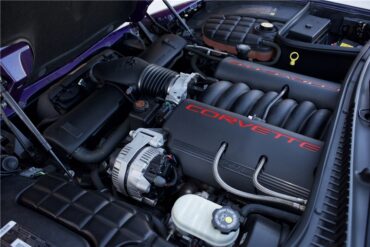
The all-new LS1, the first of GM’s Generation III small-blocks: 346 cubic inches (5.7 liters) from a 3.90 x 3.62-inch bore and stroke, a deep-skirt all-aluminum block with cast-in liners and six-bolt mains, aluminum heads, a composite intake, coil-near-plug ignition, sequential injection and electronic throttle control, at 10.1:1 compression on premium fuel. It made 345 hp at 5,600 rpm and 350 lb-ft at 4,400 with a 6,000-rpm redline, weighed 44 pounds less than the LT4 it replaced and was built in Romulus, Michigan. It drove a rear-mounted 4L60-E automatic or Borg-Warner T56 six-speed through an aluminum torque tube.
Seven: Torch Red (3,026 cars, 31 percent), Black (2,393), Sebring Silver Metallic (2,164), Arctic White (1,341), Light Carmine Red Metallic (381), Nassau Blue Metallic (292) and Fairway Green Metallic (155). Interiors were leather in Black (6,481), Light Gray (2,543) or Firethorn Red (728); the red interior was not offered with Light Carmine Red paint. Roof panels were body color or, on 7,213 cars, blue-tinted glass.
$37,495 for the coupe, $38,060 delivered with the $565 destination charge, $270 more than a 1996 coupe with more than $1,200 of newly standard equipment. Real Time Damping added $1,695, the six-speed $815, the dual-roof package $950, the glass roof $650, sport seats $625, the CD changer $600, dual-zone air $365, the Z51 package $350, the power passenger seat $305 and the Memory Package $150; emissions packages were $170. A loaded automatic came to about $42,300 before destination.
Everything. The C5 was the first clean-sheet Corvette since 1963: a perimeter frame of hydroformed one-piece steel side rails with a central backbone tunnel, an aluminum cockpit cage and a balsa-cored composite floor, 4.5 times stiffer than the C4; a rear-mounted transaxle fed by a torque tube for a 51/49 weight split; the all-aluminum 345-hp LS1 with electronic throttle control; double-wishbone suspension at both ends on composite transverse springs; 17- and 18-inch wheels on Goodyear Eagle F1 GS run-flat tires with no spare; a wheelbase 8.3 inches longer and a cargo hold of 25 cubic feet; sheet-molded-composite bodywork at 0.29 Cd; and a twin-cove cockpit with analog gauges, a Driver Information Center and 3.7 inches less step-in height. It was unveiled at Detroit on January 6, 1997 and named 1998 North American Car of the Year.
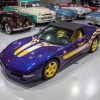
No. The 1997 Corvette was sold only as the hatchback coupe with a lift-off roof panel. The convertible returned for 1998 (with the Indianapolis 500 Pace Car edition), the fixed-roof hardtop arrived for 1999, and the Z06 built on the hardtop came for 2001. The only 1997 cars outside the coupe were conversions: Callaway’s C12, shown at Geneva in 1997 and built on C5 chassis through 2001, and the C7R GT1 racer.
1997 Corvette Advertisements / 1997 Corvette Colors / 1997 Corvette Common Issues / 1997 Corvette Engine / 1997 Corvette Factory Options / 1997 Corvette Maintenance / 1997 Corvette Mods / 1997 Corvette Owners Manual / 1997 Corvette Performance / 1997 Corvette Posters / 1997 Corvette Pricing / 1997 Corvette Recalls / 1997 Corvette Research / 1997 Corvette RPO Codes / 1997 Corvette Sales Brochures / 1997 Corvette Special Model Overview / 1997 Corvette Specifications / 1997 Corvette Technical Research / 1997 Corvette Service Bulletins / 1997 Corvette VIN Numbers