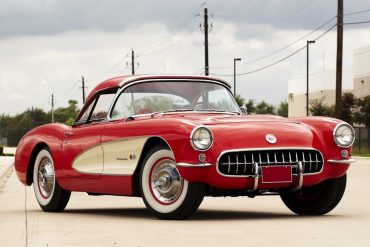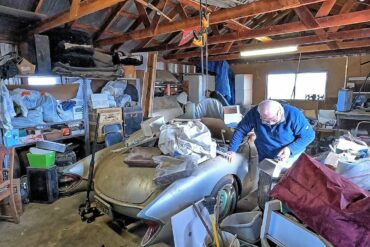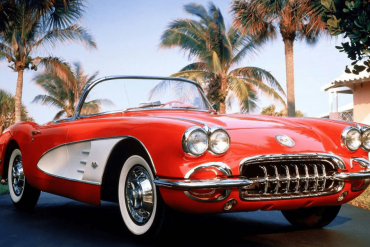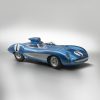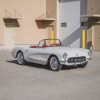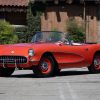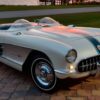

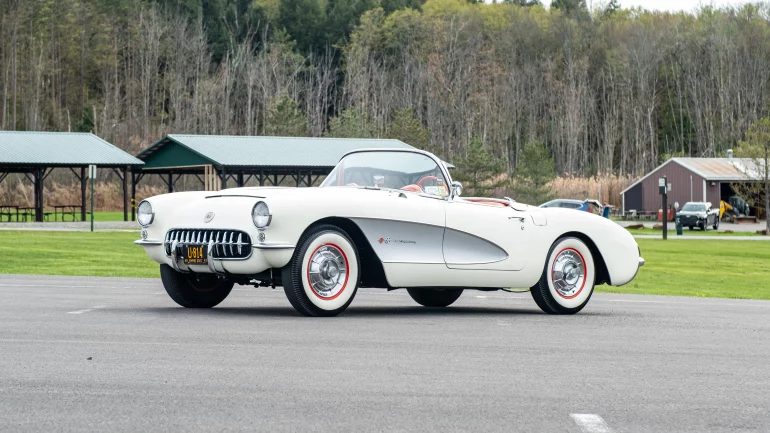

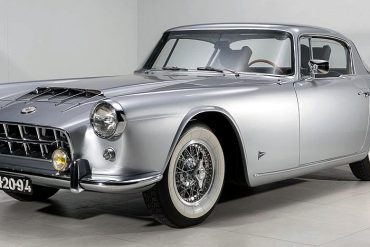
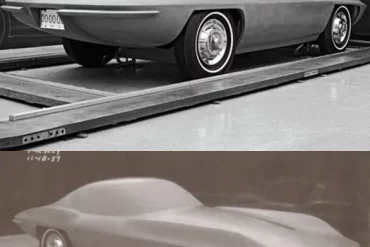
A Corvette rebodied in aluminum by a Swiss coachbuilder for Geneva 1957, then lost for decades. Found in Portugal with just 3,800 km, the Michelotti coupe carries Borrani wires and a wood-rimmed wheel.


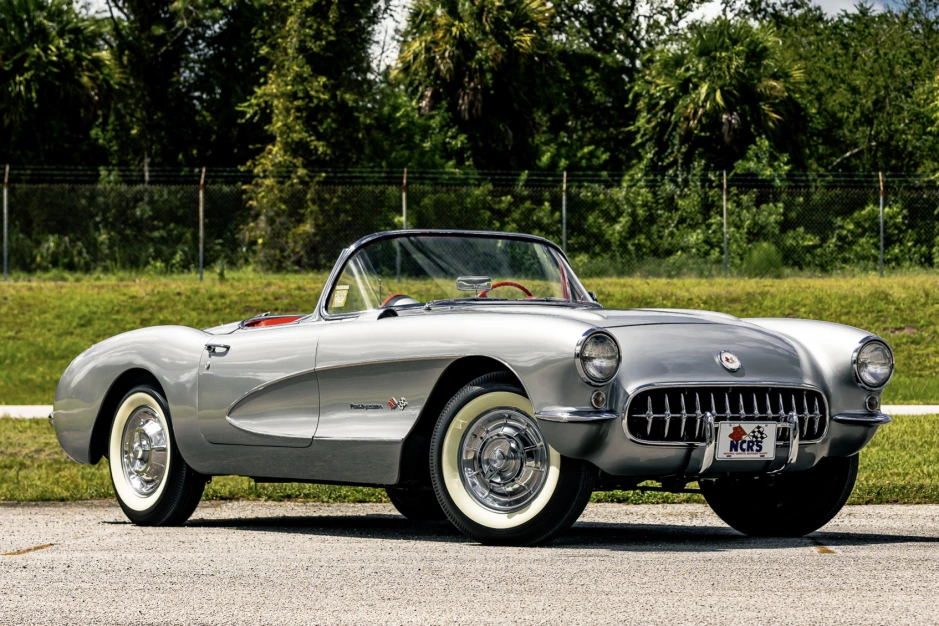
C1 CORVETTE - 1957
One horsepower per cubic inch: the 283 V-8, Ramjet fuel injection, the first four-speed, Positraction and a racing suspension package, in a year that doubled production to 6,339 and settled the Corvette’s future for good.
Quick Nav: The Story · Specials · Price & Options · VIN · Specs · Technical · Pics & Videos · The Market · All Content · FAQs
Model & Gen: 1957 Corvette (C1)
Body Type: 2 Door Convertible (removable hardtop optional)
VIN: E57S100001 – E57S106339
Original Price: $3,176.32 base
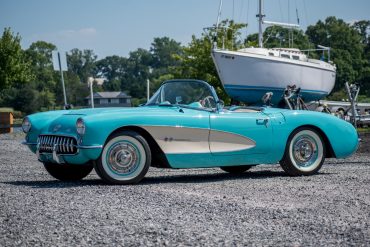
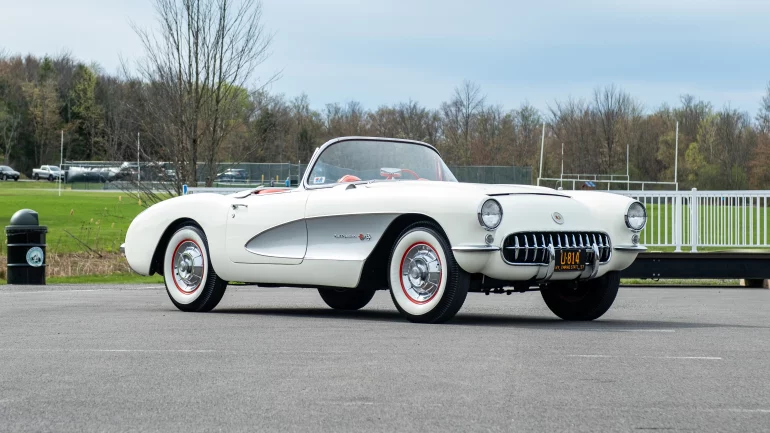
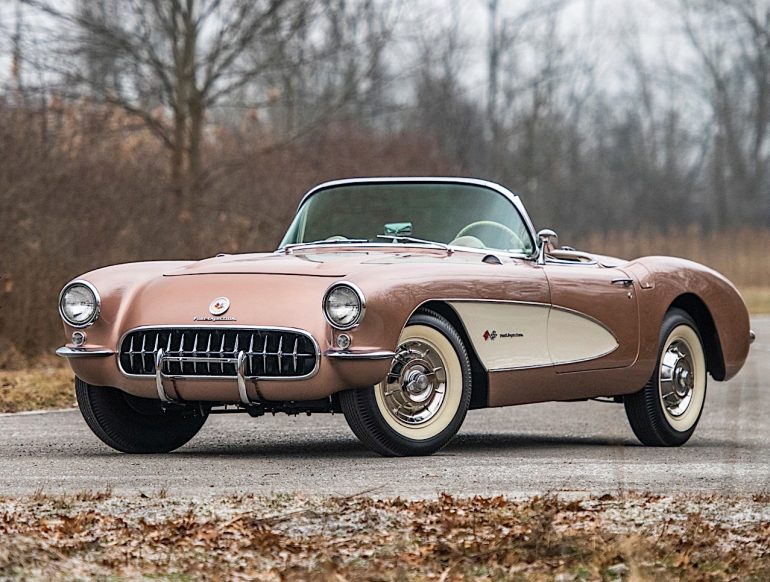
Colors: 7 (Onyx Black, Polo White, Venetian Red, Cascade Green, Arctic Blue, Aztec Copper, Inca Silver)
Engine: 283 ci V-8, 220 to 283 hp (fuel injection optional)
Transmission: 3-speed manual standard; 4-speed manual and 2-speed Powerglide optional
Units Produced: 6,339
The 1957 Corvette looks exactly like the 1956 and is a different car underneath. The small-block grew from 265 to 283 cubic inches, and on top of the carbureted 220, 245 and 270-horsepower versions Chevrolet offered Rochester Ramjet fuel injection, which in its hottest form made 283 horsepower from 283 cubic inches: “one horsepower per cubic inch,” as the advertising said. Only 1,040 buyers paid the $484.20 for it, but the fuelie became the Corvette’s calling card.
Just as important was what went behind the engine. A Borg-Warner four-speed manual arrived in April 1957 as RPO 685 and went into 664 cars, Positraction limited-slip axles came in three ratios, and RPO 684, the $780.10 heavy-duty racing suspension, turned a street car into something that could run at Sebring. The 43 “airbox” cars, with a cold-air induction box and a column-mounted tachometer, were built for exactly that; two production 1957s finished 12th and 15th overall at Sebring, first in the GT class.
Production nearly doubled to 6,339 cars, Ford dropped the two-seat Thunderbird, and in June the industry’s AMA agreement banned factory racing, which Chevrolet got around quietly. From here on, the question was never whether the Corvette would survive, only how fast it would get.
In the period of just two short years, Corvette had evolved from a car that was facing the very serious threat of extinction to one that showed real promise for a long and healthy life.
While General Motors still recorded only modest sales of the Chevrolet Corvette in 1956, it was apparent to everyone that it was also beginning to be taken seriously as a sports car. Even after the immense structural, physical, and mechanical facelift it received in 1956, Corvette saw some major improvements in 1957.
A new, larger 283-cid engine was placed under the hood. Mechanically, it was really still the existing 265-cid engine, though it had been bored out 1/8-inch (to 3.875 inches). This modified engine delivered an impressive 220 horsepower when coupled with a four-barrel carburetor. Dual four-barrels took it to 245 horsepower (and 270 bhp with the high-lift camshaft). Better still, consumers could now also purchase GM 's newly developed “Ramjet” fuel injection system which yielded 250 horsepower (or 283 bhp).
Chevy ads carried the news that the Corvette now produced “one horsepower per cubic inch”
While fuel injection is almost universal today, the very idea of it in 1957 was completely foreign to automotive manufacturers. While some European manufacturers had already begun experimenting with fuel injection in their production cars, Chevrolet turned to this new technology to bring added performance to its two-year-old V8 engine.
GM had considered using supercharging (as an alternative method to boost performance) but decided against it because of reliability issues. Fuel injection provided more precise fuel metering than a carburetor allowed, so GM assembled a development team to develop its own fuel injection delivery system. The team was comprised of Ed Cole, who had been promoted to Chevrolet's chief in 1955 ; Harry Barr, who designed the 1949 Cadillac V-8 and went on to become Cole's successor as Chevy's Chief Engineer; John Dolza, head of fuel injection development for the GM engineering staff; and Zora Arkus-Duntov.
Duntov had been developing his own fuel injection system since early 1956 (after an accident while driving a prototype Corvette hardtop with experimental disc brakes at the GM Proving Grounds in April left him with a broken vertebrae in his back). Standing erect in a body cast, and often seen wearing a skirt (as he was unable to dress himself due to the cast he was wearing), Duntov spent the next six months working on the fuel injection system while his body healed.
The team of engineers solved the problems keeping them from developing a successful fuel injection system in a reasonably short period of time, and the fuel injection system was mated with the V-8 engine and dyno testing began.
Despite the relatively inexpensive manufacturing process and the promise of successful performance improvement, the initial dyno-testing showed the fuel injection system was no more powerful than a standard dual-carburetor V-8. Despite this, Cole wanted to make fuel injection available to the entire 1957 Chevrolet production line.
Cole believed that offering fuel injection in the new line of cars would provide a technological advancement that prospective Chevrolet customers could appreciate. As the Chevy line of vehicles had received nothing more than an automotive “facelift” for 1957, Cole realized that fuel injection would help boost the stock-car racing image. It was believed that the fuel-injected engines - and moreover, the horsepower that these fuel injected engines produced - would boost the performance of these racers, giving the Chevrolet models an edge over the competition.
In time, Chevrolet and GM's Rochester carburetor division came up with a workable system that both increased top-end engine output and increased power throughout the entire RPM range.
The inlet manifold was formed in aluminum and fuel was carefully metered via a high pressure pump that was driven direct from the distributor. However, as with many new technologies, there were many reliability issues that began creating issues almost immediately. The most notable was that dirt would often get into the fuel lines (probably dirt that was suspended in the fuel itself), and cause uneven running due to the injectors getting overheated.
That, combined with the fact that the new fuel injection option cost an additional $484.20 (which was approximately 15% of the total sales price of a 1957 Corvette), resulted in very few '57 Corvettes being sold with fuel injection. In total, 1,040 of the 6,339 Corvettes produced in 1957 came with fuel injection.
“Ramjet Fuel Injection”, as it was known in 1957, was dropped from all of Chevy’s passenger car models, although Corvette continued to offer it as an option until 1965. Ironically (especially in regard to all the hype surrounding “1 horsepower per cubic inch”), the top fuel injected (“fuelie” as they were referred to at that time) engine actually delivered closer to 290 bhp, which was more than the advertised 283. This “over-performance” was attained on 10.5:1 compression - the same compression shared with the dual-carb 270 bhp engine. The milder 250 bhp fuel injected engine ran at a lower compression - 9.5:1, which was the same as the 245 bhp twin carbureted engine.
These numbers are speculated by some historians to be inaccurate. Although an uncommon practice, it is speculated that Chevrolet actually underrated the carbureted engine's real horsepower in favor of demonstrating that the Ramjet was the better performer.
Interestingly, it was not engine performance but the four-speed manual gearbox that had the greatest impact on the performance aspect of the Chevrolet Corvette. Available as early as April 9, 1957 and priced at only $188.30, Regular Production Option (RPO) 685 was essentially the existing three-speed Borg-Warner transmission with the reverse gear moved into the tailshaft housing to make room for a fourth forward speed.
Gear ratios were closely spaced at 2.20:1 (1st), 1.66 (2nd), 1.31 (3rd), and 1.00 (4th). Of all the Corvettes produced that year, 667 of them included this option.
“Positraction” (referred to today simply as “Posi” amongst car enthusiasts), was another, separate option that was available with several different final-drive rear axle ratios which included 3.70:1, 4.11:1 and 4.56:1. Chevy's new limited slip differential was intended to help get the most performance out of the new engines and transmissions regardless of the car's intended purpose - be it racing or street driving.
Did you know? In 1957, anyone seeking to purchase a Corvette could actually purchase a genuine racing version. When placing the order, consumers had the option of selecting the EN build code which would allow them to build a true Corvette race car. Chevy warned that the EN version was not for the street and actually refused to include heaters on cars equipped with the racing package.
To provide greater handling and stability, Chevrolet also issued RPO 684 - a heavy duty racing suspension package. This option, priced at $780.10, included heavy duty springs, a thicker front anti-sway bar, the aforementioned Positraction rear end, larger piston shock absorbers, a tighter steering ratio that reduced turns lock-to-lock from 3.7 turns to only 2.9, and ceramic/metal brake linings with finned ventilated drums. When mated to the 283 small-block Chevy, you truly had a race car you could purchase directly from the showroom floor. However, with the cost of this option being even more than that of the fuel injected engines combined with it's focus really being serious racers, only 51 Corvettes were equipped with it in 1957.
In almost any form, the 1957 Corvette delivered uncompromising, and largely unmatched, performance. The Corvette had effectively become a street-legal sports car. As taken from an excerpt in the book CORVETTE: Sports Car Superstar: “the '57 Corvette delivered certifiably staggering performance. Motor Trend clocked a 250-bhp fuelie at just 7.2 seconds in the 0-60 mph sprint. The 283-bhp version was even more formidable, with Road & Track running the same test in a four-speed with the short 4.11:1 final drive in just 5.7 seconds; it breezed through the quarter-mile in 14.3 seconds at better than 90 mph and sailed on to a maximum 132 mph.”
To demonstrate just how fast the 1957 Corvette really was, a pair of production models were the first GT Class cars to finish at Sebring that year, taking 12th and 15th places. The 12th place car finished no less than 20 laps ahead of the top qualifying Mercedes Benz 300SL, which had been, up to that point “regarded as the world's fastest road car.”
The Sebring victory was a huge turning point in the life of the Corvette. It had earned the respect of the most critical of judges and had proven that it could perform, even amongst the toughest competition.
Finally, after several years of struggles ranging from meager sales to lackluster performance to poor customer acceptance, the Corvette's future was no longer in question. The car had made incredible progress, both mechanically and socially, and the sales numbers proved it doubling from 1956 to 1957.
Better still, Ford had decided to withdraw the Thunderbird from the two-seater market, which Chevrolet was both aware of and believed would help escalate sales of the upcoming 1958 models to numbers in excess of 10,000 units. In what some might consider a cruel twist of fate - during an era when Corvette was proving itself on the racetrack - the Automobile Manufacturers Association (AMA) adopted a two-point resolution that required members (including General Motors) to: 1.) Cease performance-oriented advertising and, 2.) cease competition sponsorship, including technical assistance.
This was due to pressure from the National Safety Council, which claimed that using recognizable road cars on the track, and referring to their race-bred qualities in advertising material had “a detrimental effect on the behavior of purchasers of such cars on the public highway.”
As no manufacturer wanted to be seen as promoting reckless driving, GM President Harlow Curtice was among those who voted in favor of this measure, which effectively banned all factory-sponsored racing activities, which included any future competition in which Corvette might be a part.
Despite this new ban, industry insiders quickly developed ways to work around it. Engineers continued to further support automakers' racing development, supplying drivers and owners with assorted high performance, under-the-counter contraband equipment. Duntov himself made certain that anyone who wanted a racing model Corvette could obtain one by simply choosing the correct options. In addition, whether fueled by the ban or simply out of his own passion for speed, Duntov began developing even higher performance gear that he would implement later on into future iterations of Corvette.
He also continued to be spotted at many racing events, as did other GM executives. Still, even in the wake of the new racing ban, the Corvette had finally established itself as a real two-seat sports car and was widely embraced by both sports car enthusiasts and critics alike.
The 1957 model year ensured the future of the Corvette and now, with the successes the car was showing on a regular, repeating basis, Chevrolet added it indefinitely to its production car line. Still, with a car that still had room to grow, the Corvette development team had to find ways to improve on a machine that had become, for many, the idealic American Sports Car.
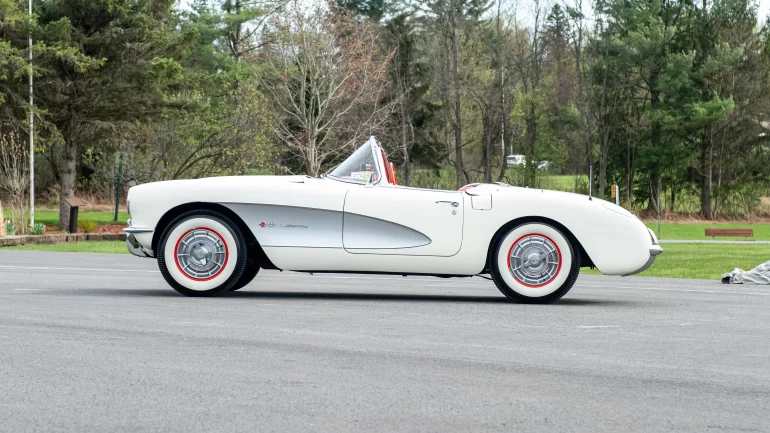
The 1957 and 1956 bodies are identical. The quickest tell without opening the hood is the inside mirror: 1957’s adjusts with a locknut that needs a wrench, 1956’s with a thumbscrew. Fuel-injected cars also wear “Fuel Injection” script on the fenders and trunk lid.
DID YOU KNOW
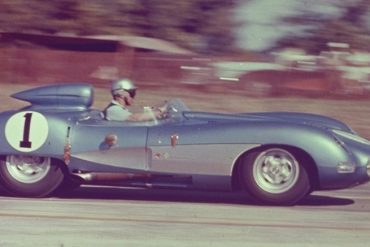
1957 is the Corvette SS year: the magnesium-bodied XP-64 racer, the airbox cars built for Sebring, and the Italian-bodied one-offs that followed.


The base price edged up to $3,176.32, and for the first time the engine list ran to seven choices. The 220-hp single-carburetor 283 was standard; 2,045 buyers paid $150.65 for the 245-hp dual-quad (RPO 469A) and 1,621 paid $182.95 for the 270-hp dual-quad with the Duntov camshaft (RPO 469C). Fuel injection cost $484.20, about 15 percent of the car, in 250-hp (579A/579C, 284 cars) and 283-hp (579B, 713 cars) forms, and $726.30 bought the 283-hp airbox racing version (579E, 43 cars). The three-speed manual was standard on 4,282 cars; the new four-speed (RPO 685, $188.30) went into 664 cars from April, and 1,393 buyers still took the Powerglide. Positraction was $48.45 in 3.70, 4.11 or 4.56:1, and the heavy-duty racing suspension (RPO 684) was $780.10 on 51 cars.
The comfort options carried over: the removable hardtop ($215.20) on 4,055 cars, the power top ($139.90) on 1,336, power windows ($59.20) on 379, the signal-seeking radio ($199.10) on 3,635, the heater ($118.40) on 5,373 and whitewalls ($31.60) on 5,019. Seven exterior colors were offered, with Inca Silver new for the year, and 2,794 cars had the $19.40 two-tone treatment that painted the coves silver or beige: 909 Onyx Black/Silver, 716 Venetian Red/Beige, 319 Polo White/Silver, 319 Cascade Green/Beige, 263 Aztec Copper/Beige, 258 Arctic Blue/Silver and 10 Inca Silver/Ivory. The cove color on both 1956 and 1957 cars was Metallic Silver, not Inca Silver. The color totals in the factory records add up to 6,336, three short of production, and the colors post is missing the Onyx Black and Aztec Copper rows, which are supplied here from the factory figures.
MORE: PRICING, OPTIONS & COLORS / RPO CODES
| CODE | DESCRIPTION | QUANTITY | RETAIL PRICE |
|---|---|---|---|
| 2934 | Base Corvette Convertible | 6,339 | $3,176.32 |
| 101 | Heater | 5,373 | $118.40 |
| 102 | AM Radio, Signal Seeking | 3,635 | $199.10 |
| 107 | Parking Brake Alarm | 1,873 | $5.40 |
| 108 | Courtesy Lights | 2,489 | $8.65 |
| 109 | Windshield Washers | 2,555 | $11.85 |
| 276 | Wheels, 15 x 5.5 (5) | 51 | $15.10 |
| 290 | Whitewall Tires, 6.70 x 15 | 5,019 | $31.60 |
| 303 | 3-Speed Manual Transmission, close ratio | 4,282 | $0.00 |
| 313 | Powerglide Automatic Transmission | 1,393 | $188.30 |
| 419 | Auxillary Hardtop | 4,055 | $215.20 |
| 426 | Power Windows | 379 | $59.20 |
| 440 | Two-Tone Paint Combination | 2,794 | $19.40 |
| 469A | 283ci, 245HP Engine (2x4 Carburetors) | 2,045 | $150.65 |
| 469C | 283ci, 270HP Engine (2x4 Carburetors) | 1,621 | $182.95 |
| 473 | Power Operated Folding Top | 1,336 | $139.90 |
| 579A | 283ci, 250HP Engine (Fuel Injection) | 182 | $484.20 |
| 579B | 283ci, 283HP Engine (Fuel Injection) | 713 | $484.20 |
| 579C | 283ci, 250HP Engine (Fuel Injection) | 102 | $484.20 |
| 579E | 283ci, 283HP Engine (Fuel Injection) | 43 | $726.30 |
| 677 | Positraction Rear Axle, 3.70:1 | 327 | $48.45 |
| 678 | Positraction Rear Axle, 4.11:1 | 1,772 | $48.45 |
| 679 | Positraction Rear Axle, 4.56:1 | – | $48.45 |
| 684 | Heavy Duty Racing Suspension | 51 | $780.10 |
| 685 | 4-Speed Manual Transmission (from April 9, 1957) | 664 | $188.30 |
| EXTERIOR | TOTAL | CONVERTIBLE TOP | WHEELS | INTERIOR |
|---|---|---|---|---|
| Onyx Black | 2,189 | Beige/Black/White | — | Beige/Red |
| Venetian Red | 1,320 | Beige/Black/White | Red | Beige/Red |
| Polo White | 1,273 | Beige/Black/White | Red/Silver | Beige/Red |
| Cascade Green | 550 | Beige/Black/White | Green | Beige |
| Arctic Blue | 487 | Beige/Black/White | Blue | Beige/Red |
| Aztec Copper | 452 | Beige/Black/White | — | Beige |
| Inca Silver | 65 | Black/White | Silver | Beige/Red |
Boring the 265 to 3.875 inches produced the 283, and Chevrolet offered it seven ways. The base single four-barrel made 220 horsepower at 4,800 rpm; dual four-barrels gave 245, or 270 with the Duntov high-lift camshaft. The Rochester Ramjet fuel injection, developed by a team under Ed Cole and Zora Arkus-Duntov with Rochester’s John Dolza, metered fuel from a high-pressure pump driven off the distributor into an aluminum plenum. In 9.5:1 form it made 250 horsepower; with the Duntov cam and 10.5:1 compression it made 283, the first production engine from Detroit to claim one horsepower per cubic inch. Early units suffered from dirt in the metering system and hot-start problems, and many were swapped for carburetors by dealers, which is why genuine fuelies are rarer today than the 1,040 built.
The four-speed, a Borg-Warner T-10 with ratios of 2.20, 1.66, 1.31 and 1.00:1, arrived on April 9, 1957 and did more for the car’s performance than any engine; with the 283-hp fuelie and a 4.11:1 Positraction axle, period tests recorded 0–60 in 5.7 seconds, the quarter mile in 14.3 seconds and 132 mph. RPO 684 added heavy-duty springs and shocks, a thicker front anti-roll bar, a quicker steering adapter, Positraction and ceramic-metallic brake linings in finned drums with air scoops, the first serious answer to the C1’s brake fade. Everything else, from the 102-inch chassis to the 11-inch drums and the dashboard, carried over from 1956.
MORE: FULL SPECIFICATIONS / ENGINE
| SPEC | 1957 CORVETTE |
|---|---|
| Engine | 283 ci (4.6 L) OHV small-block V-8, the 265 bored 1/8 in to 3.875 in; cast iron block & heads, 9.5:1 (10.5:1 on the 283-hp fuel-injected engine) |
| Base engine | 220 hp @ 4,800 rpm, 300 lb-ft @ 3,000 rpm, single Carter WCFB four-barrel; 1,633 cars |
| RPO 469A | 245 hp @ 5,000 rpm, 300 lb-ft @ 3,800 rpm, dual four-barrels; 2,045 cars, $150.65 |
| RPO 469C | 270 hp @ 6,000 rpm, 285 lb-ft @ 4,500 rpm, dual four-barrels with the Duntov camshaft; 1,621 cars, $182.95 |
| RPO 579A / 579C | 250 hp @ 5,000 rpm, 305 lb-ft @ 3,800 rpm, Rochester Ramjet fuel injection; 182 + 102 cars, $484.20 |
| RPO 579B | 283 hp @ 6,200 rpm, 290 lb-ft @ 4,400 rpm, Ramjet fuel injection with the Duntov camshaft and 10.5:1; 713 cars, $484.20 |
| RPO 579E (“Airbox”) | 283-hp fuel-injected engine with cold-air induction box and tachometer on the steering column, for racing; 43 cars, $726.30 |
| Transmission | 3-speed manual standard (4,282 cars); Borg-Warner T-10 4-speed from April 9, 1957 (RPO 685, 664 cars, $188.30); 2-speed Powerglide automatic (RPO 313, 1,393 cars, $188.30) |
| Axle ratio | 3.70:1 standard; Positraction limited-slip in 3.70, 4.11 or 4.56:1 (RPO 677/678/679, $48.45; 2,099+ cars) |
| Suspension | Independent front with coil springs and anti-roll bar; live axle on semi-elliptic leaf springs. RPO 684 heavy-duty racing suspension ($780.10, 51 cars): stiffer springs and shocks, thicker front bar, quick steering adapter, ceramic-metallic brake linings with finned drums and cooling scoops |
| Brakes | 11-in drums front and rear |
| Tires | 6.70 x 15 in, tubeless; 15 x 5.5 in wheels on RPO 276 (51 cars) |
| Wheelbase | 102 in |
| Overall length | 168 in |
| Curb weight | 2,985 lb / 1,354 kg |
| 0–60 mph | 5.7 sec (283-hp fuel injection, 4-speed, 4.11:1) |
| Quarter mile | 14.3 sec |
| Top speed | 132 mph |
| Production | 6,339, all convertibles; 4,055 with the removable hardtop; 1,040 fuel-injected |
| Assembly | St. Louis, Missouri |
The 1957 VIN moves to a six-digit sequence: the last six digits begin at 100001 and run through 106339, accounting for each of the 6,339 Corvettes built. The VIN plate is on the driver-side door post and the number is also stamped in several places on the frame. Every 1957 begins E57S, with no engine code in the VIN, so the engine pad suffix is the only factory stamping that identifies the engine.
The suffix codes are EF (220 hp, manual), FH (220 hp, Powerglide), EH (245 hp, manual), FG (245 hp, Powerglide), EG (270 hp, manual), EM (250-hp fuel injection, manual), FK (250-hp fuel injection, Powerglide), EL (283-hp fuel injection, manual) and EN (283-hp fuel injection, airbox). The 283-hp fuel-injected engines use block casting 3731539; all the others share 3740997. Only one body style, the convertible, was built.
MORE: VIN DECODER / PRODUCTION
| POSITION | MEANING |
|---|---|
| E (First Digit) | General Motors Identification Code for Chevy Corvette. |
| 57 (Second & Third Digits) | Model Year |
| S (Fourth Digit) | Location of the Assembly Plant. S - St. Louis, Missouri. |
| 1XXXXX (Fifth thru Tenth Digits) | Production Sequence Numbers |
Seven colors on the second-year body, with 2,794 two-tone cars: Onyx Black (2,189), Venetian Red (1,320), Polo White (1,273), Cascade Green (550), Arctic Blue (487), Aztec Copper (452) and, new for 1957, Inca Silver (65).
The 1957 is the most valuable of the 1956–57 pair and the most varied: a 220-hp Powerglide driver and a documented 283-hp fuelie four-speed are the same body with a price gap of several multiples. The engine is everything. Fuel-injected cars sit at the top, with the 43 airbox cars and the 51 RPO 684 cars in their own collector tier above that; genuine 270-hp dual-quad four-speed cars are next; 245-hp dual-quads are the volume collector car; 220-hp and Powerglide cars are the entry point. Because dealers removed many injection units when new and the parts have all been reproduced, “fuelie” is a claim to be proven, not a description to be accepted.
Results tracked by Classic.com through September 2026 put original or well-restored 283 dual-quad cars between about $64,500 and $83,000: $64,500, $70,000 and $75,057 on Bring a Trailer in August and September, $78,100 at Barrett-Jackson Columbus in June, and $80,000 for a 61,000-mile original car in June, with a $83,000 high bid on a 72,000-mile dual-quad going unsold. Modified and restomod cars ranged from $42,000 to $83,500, and a modified hardtop car was bid to $180,000 at Saratoga in September without selling. Dealer asking prices ran $80,000 to $125,000. [ADD A VERIFIED FUEL-INJECTED SALE: no confirmed 2026 fuelie auction result was available when this was written; well-documented 283-hp cars trade well above the dual-quad range.] Check whether a result includes the buyer’s premium, and treat asking prices and unsold high bids separately from completed sales.
Verification on a 1957 starts with the engine pad. The suffix code (EF, EH, EG, EM, EL, EN, FH, FG or FK) must match the equipment, the block casting must be 3731539 on a 283-hp fuelie and 3740997 on everything else, and the block date must precede the car’s build. A fuel-injection unit should carry a Rochester serial number consistent with 1957, and an airbox car needs documentation, since the box and column tachometer are straightforward to add. Four-speed cars built before April 1957 did not exist, so a four-speed in an early VIN is a conversion. NCRS judging sheets, old photographs, ownership records and restoration invoices all help, and ask to see dates and scores rather than just the award.
The body is the 1956 design in its second year, and it cracks in the same places: around the headlight bezels, the door hinge pillars, the cove edges where the trim mounts, and the cowl. Door fit and the gap at the hardtop are the quickest guide to a restoration. Underneath, the boxed frame rails rust from the inside, so an inspection on a lift is essential. On the road, a fuel-injected engine should start hot and cold without drama and idle evenly; one that does not is a system in need of a specialist, and that is expensive. Expect the standard drum brakes to be adequate rather than good. Most of these cars see few miles, so budget for tires, brakes and fuel-system work on anything that has sat.
MORE: THE MARKET
Get all the latest news stories, upcoming auctions, prices, videos and more about the 1957 Chevrolet Corvette! The latest headlines here.
Chevrolet built 6,339 Corvettes for 1957, all convertibles, at St. Louis, Missouri, nearly double the 3,467 of 1956. Of those, 1,040 had Ramjet fuel injection, 664 had the new four-speed manual, 4,055 had the removable hardtop and 51 had the RPO 684 racing suspension. Only 43 were airbox cars.
In 2026, original or well-restored 283 dual-quad 1957 Corvettes have mostly sold for $64,000 to $83,000 at auction, with 220-hp and modified cars from about $42,000. Genuine fuel-injected cars sell for considerably more, and documented airbox or RPO 684 cars are in a collector tier of their own. The engine and its paperwork decide the price.
The new 283-cubic-inch small-block V-8 in seven versions: 220 hp with a single four-barrel, 245 or 270 hp with dual four-barrels, and 250 or 283 hp with Rochester Ramjet fuel injection, plus the 283-hp airbox racing engine. A three-speed manual was standard, the two-speed Powerglide was optional, and a Borg-Warner four-speed became available on April 9, 1957.
Seven: Onyx Black (2,189 cars), Venetian Red (1,320), Polo White (1,273), Cascade Green (550), Arctic Blue (487), Aztec Copper (452) and Inca Silver (65), new for the year. For $19.40, 2,794 buyers had the side coves painted silver or beige.
The base price was $3,176.32 with the 220-hp engine and three-speed manual. The dual-quad engines added $150.65 or $182.95, fuel injection $484.20, the four-speed $188.30, the hardtop $215.20 and Positraction $48.45. A fully optioned fuel-injected four-speed car with the racing suspension cost well over $5,000.
A 1957 Corvette with the optional Rochester Ramjet mechanical fuel injection, RPO 579, which replaced the carburetors with a high-pressure pump and an aluminum plenum. It made 250 hp, or 283 hp with the Duntov camshaft and 10.5:1 compression, the famous one horsepower per cubic inch. It cost $484.20, went into 1,040 cars, and was the only fuel-injected American production car of its day.
RPO 579E, the $726.30 racing version of the 283-hp fuel-injected engine. It added a cold-air induction box feeding the injection unit from the left front fender and moved the tachometer to the steering column, where a racing driver could see it. Only 43 were built, usually with the RPO 684 heavy-duty suspension, and they are among the most valuable C1 Corvettes.
1957 Corvette Advertisements / 1957 Corvette Colors / 1957 Corvette Engine / 1957 Corvette Factory Options / 1957 Corvette For Sale / 1957 Corvette Ghia-Aigle Coupe / 1957 Corvette Maintenance / 1957 Corvette Owners Manual / 1957 Corvette Performance / 1957 Corvette Posters / 1957 Corvette Pricing / 1957 Corvette Production / 1957 Corvette Recalls / 1957 Corvette Research / 1957 Corvette RPO Codes / 1957 Corvette Sales Brochures / 1957 Corvette Special Model Overview / 1957 Corvette Specifications / 1957 Corvette SS XP-64 / 1957 Corvette Super Sport / 1957 Corvette Technical Research / 1957 Corvette Service Bulletins / 1957 Corvette VIN Numbers