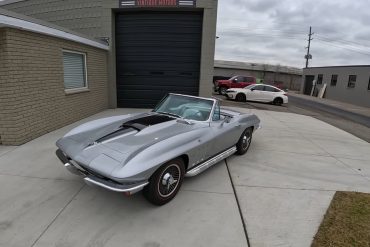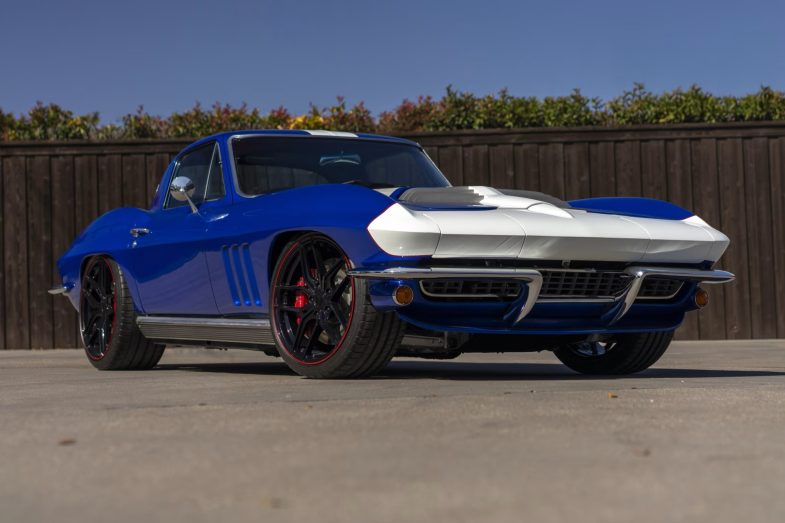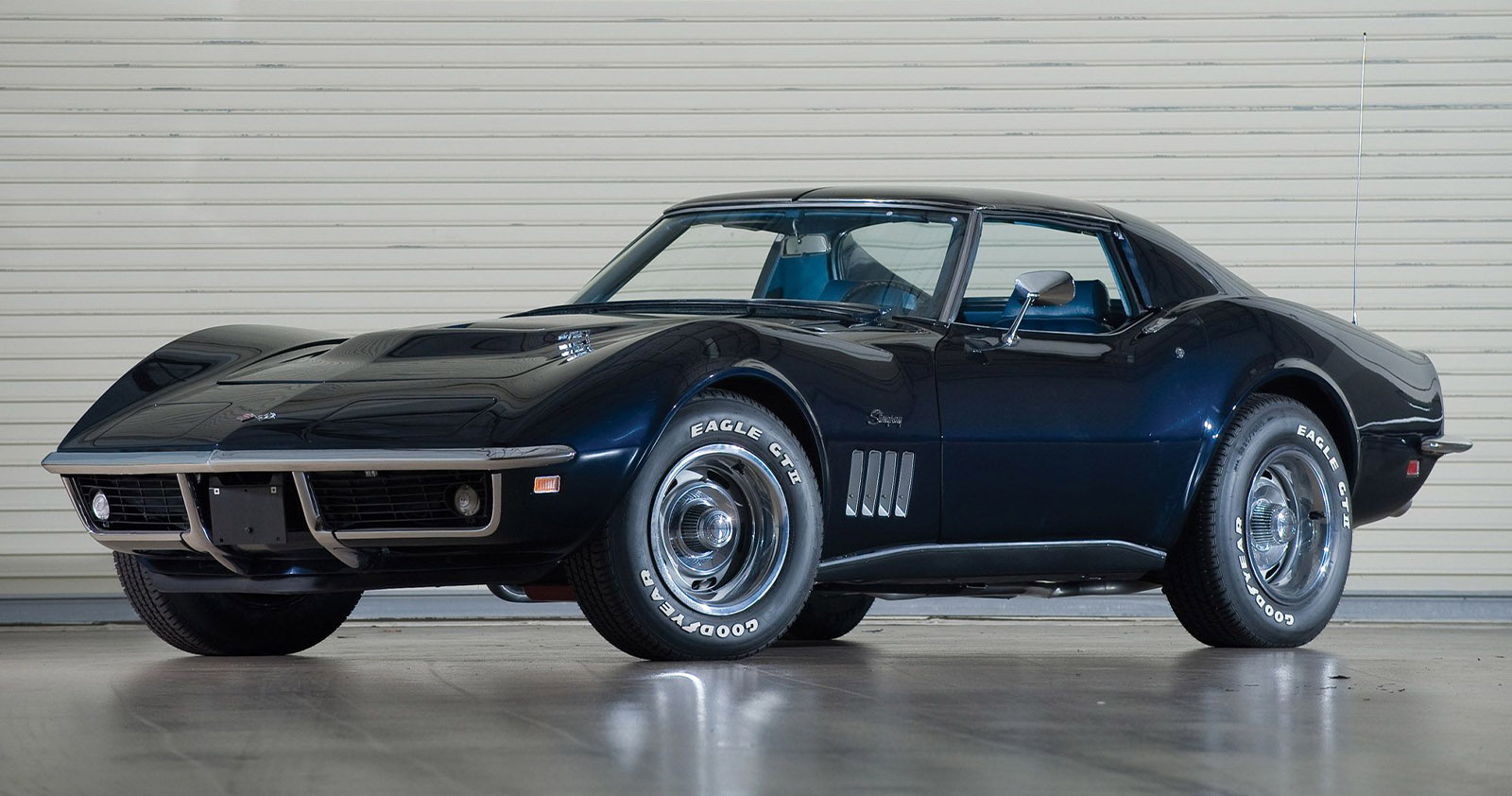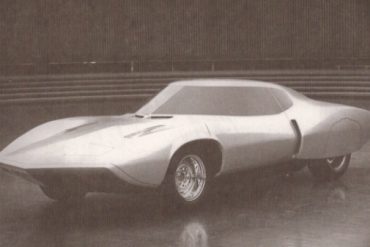
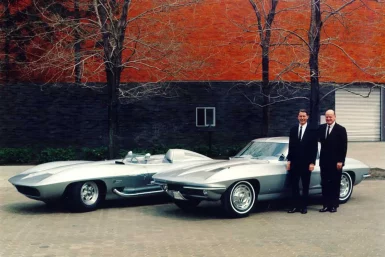
Far more radical than what Zora Arkus-Duntov had in mind, this Styling Staff proposal gave the mid-engine chassis gullwing doors, rear air intakes and a periscope for rear vision.


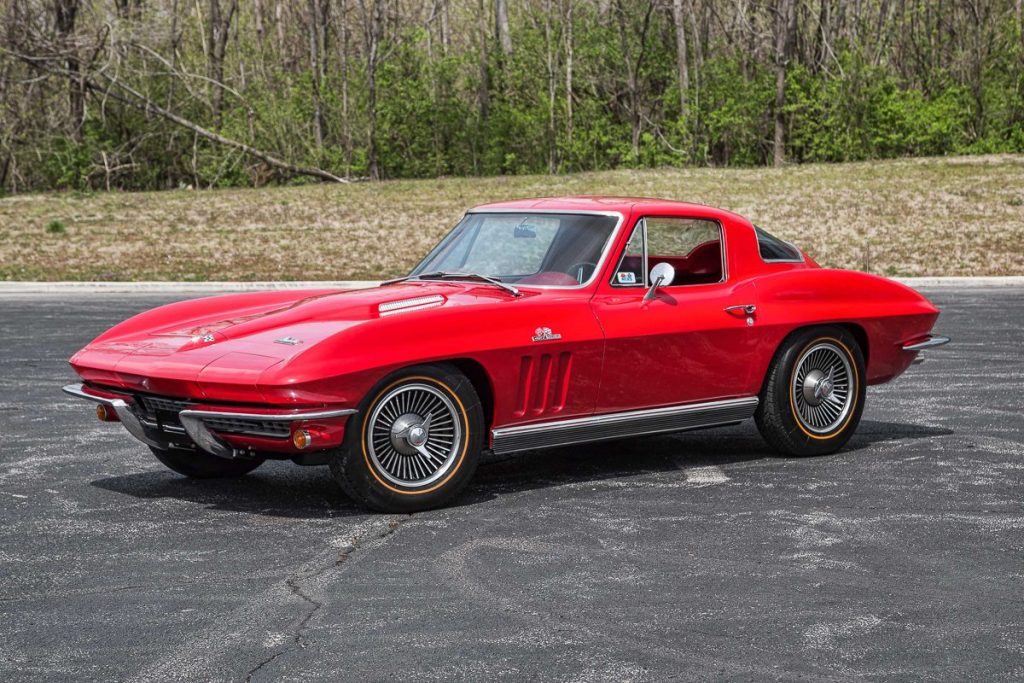
C2 CORVETTE - 1966
The 427 arrives in two strengths, the small-block list shrinks to two, the grille goes egg-crate and the coupe loses its roof vents: a record 27,720 built, more than a third of them big blocks.
Quick Nav: Story · Specials · Price & Options · VIN · Specs · Technical · Pics & Videos · The Market · All · FAQs
Model & Gen: 1966 Corvette (C2)
Body Type: Sport Coupe or Convertible
VIN: 194376S100001 – 194376S127720
Original Price: $4,295 coupe / $4,084 convertible
Colors: 10 (Nassau Blue, Milano Maroon, Rally Red, Silver Pearl, Sunfire Yellow, Mosport Green, Ermine White, Laguna Blue, Trophy Blue, Tuxedo Black)
Engine: 327 ci V-8, 300 or 350 hp; 427 ci big block, 390 hp (L36) or 425 hp (L72)
Transmission: 3-speed manual standard; Muncie 4-speed (M20/M21/M22) and 2-speed Powerglide optional
Units Produced: 27,720
The 1966 Corvette is the first 427. Chevrolet bored the Mark IV big block from 396 to 427 cubic inches and offered it two ways: the hydraulic-lifter L36 with 390 horsepower and the solid-lifter L72 with 425 and 460 lb-ft of torque, the latter briefly badged 450 before Chevrolet quietly lowered the number on paper. Together they went into 10,374 cars, more than a third of production, and the small-block list shrank from five engines to two, the 300-hp L75 and the 350-hp L79. Fuel injection was gone.
The rest of the car was left mostly alone, which is why the 1966 is sometimes called the 1965 with the engine the chassis deserved. An egg-crate grille replaced the horizontal bars, the coupe lost its roof-mounted extractor vents and the interior blower that fed them, the wheel covers and rocker moldings were restyled, backup lights became standard, and the seats got extra pleats, a vinyl headliner and optional headrests. The four-speed went into 24,755 cars, Positraction into 24,056 and the AM/FM radio into 26,363, so a plain 1966 is a rare thing.
Production rose for the fourth straight year to a record 27,720, up 4,158 on 1965, with convertibles outselling coupes 17,762 to 9,958. On the track Roger Penske’s L72 coupe won the GT class at Daytona and Sebring, previewing the L88 that would appear the following year, while in Detroit the Mako Shark II was being turned into the C3. The 1967 everyone expected turned out to be one more year of the Sting Ray.
With the 1966 Corvette arriving after General Motors' recent, overwhelming success with the 427 Sting Ray, there was no question that the newest Corvette model would continue to feature big-block engines.
This turnabout in events was rather interesting, especially given GM management’s earlier decree that no car line smaller than a full-size model would carry an engine larger than 400 cubic inches. Perhaps fortunately for Corvette, it was Carroll Shelby’s two-seat Cobra, which featured its own 427 cubic inch V8 engine that prompted the change of opinion.
Chevrolet now felt it would also need a 427 cubic inch engine, and it materialized for the 1966 model year.
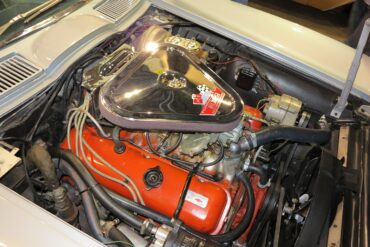
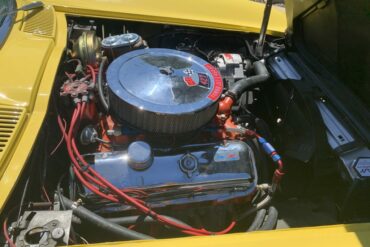
Although it was effectively a 396 cubic inch engine with a larger 4.25-inch bore, the new 427 big-block engine came in two forms: the relatively mild L36, which featured a hydraulic-cam and produced 390 horsepower on 10.25:1 compression, and the truly awesome L72, a 425 horsepower engine with 11:1 compression, larger intake valves, a bigger Holley four-barrel carburetor on an aluminum manifold, mechanical lifters, and four-hole (instead of two-hole) main bearing caps.
Though it had no more horsepower than the previously developed 396 cubic inch engine, the 427 did pack quite a bit more torque: 460 lb-ft instead of 415.
Given the fact that, especially in the Sixties, engine outputs were sometimes deliberately understated, it is not unreasonable to assume that the output of these two engines was closer to 420 and 450 horsepower respectively.
There were limitations to ordering the big block 427 cubic inch engine. First, it had to be ordered in combination with Positraction and the close-ratio Muncie four-speed transmission. It also required that the Corvette was equipped with an upgraded suspension, similar to the setup on the 396 package. Lastly, it required stouter, shot-peened half shafts and U-joints, as well as a higher-capacity radiator and sump.
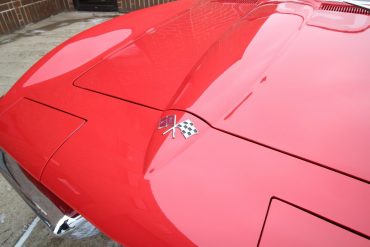
Did you know? The 427 cubic-inch engines were introduced in the 1966 model. Corvettes equipped with this type of engine received a special bubble hood first seen on the 1965 Corvettes equipped with the 396 cubic inch engine. Although initially listed as a 450hp engine, the solid lifter 427ci engine's rating was later reduced to 425hp shortly after its introduction for reasons unknown. Similarly, the 390 horsepower engine was initially rated at 400 horsepower. When the official ratings were reduced, the decision to make this change was purely administrative and was not the result of any changes made to the engines.
The introduction of the big-block V-8 engine captured the imagination of Corvette consumers the world over, and in no time at all, the demand for big-blocks far surpassed those of the conventional 327 small block Chevy engine.
As a result, the small-block engine options were reduced from five to two for the 1966 model year, with only the 300-horsepower (L75) and 350-horsepower (L79) versions remaining available to prospective consumers. Even amongst the earlier small-block options that had been available on earlier Corvettes, these two engines were arguably the best all-around engines.
Additionally, both could be paired with the Powerglide automatic, the standard three-speed manual, or either of the optional four-speed manual transmissions.
With the exception of the dramatic new lineup of engine choices, there was little else that was deemed “new” for the 1966 model year.
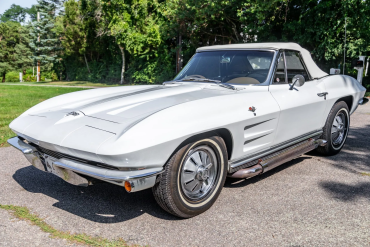
There were minor modifications made to the Corvette’s appearance. For one, the Sting Ray’s front end was mildly altered with the introduction of an “egg-crate” grille insert which replaced the previously installed horizontal bars.
Restyled wheel covers were introduced along with an all-new rocker trim. Also, the coupe lost its roof-mounted extractor vents, which had proven to be inefficient in earlier model years.
Lastly, less notable upgrades like the addition of “Corvette Sting Ray” scripts to the hood and the introduction of standard backup lights were introduced.
Likewise, the interior went largely unaltered from 1965. The interior electric ventilation system was dropped (in conjunction with the aforementioned exterior vents), extra pleats were added to the Sting Ray’s bucket seats, chrome door pull handles were introduced, headrests were made optional, and a vinyl-covered foam headliner replaced the previously used fiberboard.
Given that these were among the only notable changes from 1965 to 1966, there was a good deal of reasonable speculation that an all-new Corvette was slated for 1967.
Consumers found that the new Corvette, especially one equipped with the 427 big-block, had all the refinement it needed. The 427 Sting Ray was an astonishingly fast car, with 0-60 times of just 4.8 seconds, 0-100 mph times of 11.2 seconds, and a top speed of 140 miles per hour (when equipped with the short 4.11:1 gearing) Even in cars equipped with the somewhat less sensational 3.36:1 ratio, the Corvette was still able to run 0-60 times of 5.4 seconds with a standing quarter of 12.8 seconds at 112 miles per hour (source Car and Driver).
Impressive as those numbers were, the intent of the 427 cubic inch engine had been to meet the Shelby Cobra head-on and give it some staunch competition. However, even despite the staggering horsepower and the impressive performance numbers, the fact remained that the Corvette was half a ton heavier than the Shelby Cobra, so even with the same horsepower rating, it was considered less than a threat. Still, the Corvette did not go home empty-handed. The Corvette still took a number of victories in endurance racing including Penske’s team’s GT-class win and 12th overall at the 1966 Daytona 24 Hours.
The lack of changes for the 1966 model year did not hurt Corvette’s popularity with consumers. In fact, 1966 would prove to be another record-breaking year in Corvette sales, with volume rising to 27,720 units sold – an increase of more than 4,200 units over 1965’s sales of 23,562 units. See the total 1965 production volume breakdown.


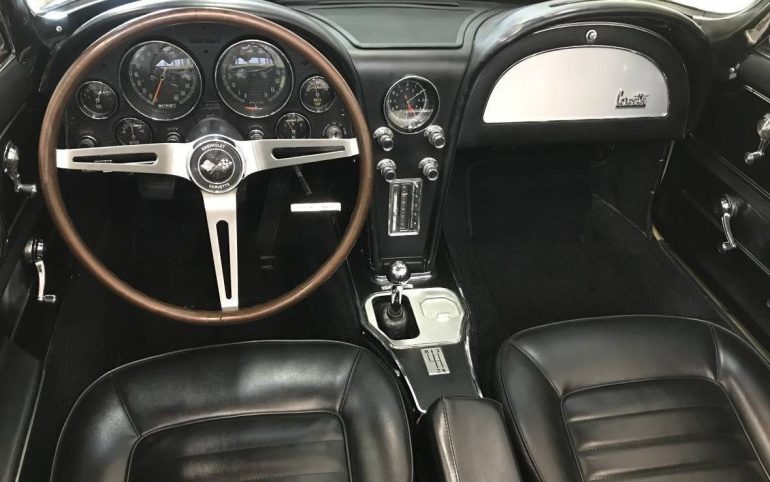

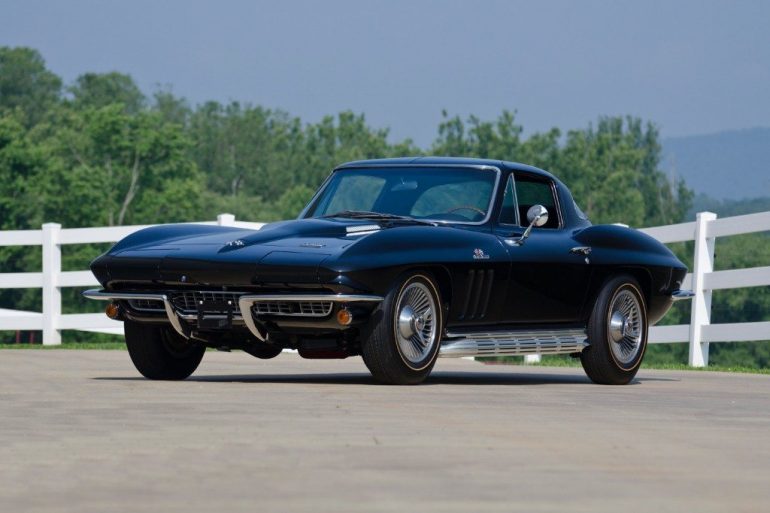
 FOR SALE: A 1966 Corvette Convertible with new, black vinyl top.
The 1966 big blocks were sold with two sets of numbers. Early cars and literature said 450 hp for the L72 and 400 for the L36; mid-year Chevrolet dropped the ratings to 425 and 390 without touching the engines, so a “427/450” 1966 is the same car as a “427/425”. Car and Driver still got one to 60 mph in 4.8 seconds.
DID YOU KNOW
1966’s specials are the big-block cars: the 427/450-badged early L72s, the 36-gallon N03 tank coupes and Roger Penske’s class-winning Daytona and Sebring racer, alongside the mid-engine styling proposals that pointed at the C3.
Prices went down. The Sport Coupe listed at $4,295 and the convertible at $4,084, each $26 or so less than 1965, with the 300-hp 327 and the three-speed. The engine list was shorter but the money went up the list: the 350-hp L79 at $105.35 went into 7,591 cars, the 427/390 L36 at $181.20 into 5,116 and the 427/425 L72 at $312.85 into 5,258, leaving about 9,755 cars with the base engine.
The four-speed cost $184.35 in either wide-ratio M20 (10,837 cars) or close-ratio M21 (13,903) form, the heavy-duty M22 $237.00 on 15 cars, and the Powerglide (RPO M35, $194.85) went into 2,401; only about 564 cars kept the three-speed. Positraction (RPO G81, $42.15) was on 24,056 cars and the F41 suspension ($36.90) on 2,705, both mandatory with the 427.
New to the list were headrests (RPO A82, $42.15, 1,033 cars), shoulder belts (RPO A85, $26.35, 37 cars), the hazard warning flasher (RPO V74, $11.60, 5,764 cars), the California-only air injection reactor (RPO K19, $44.75, 2,380 cars) and the J56 heavy-duty brake package ($342.30, 382 cars). Side exhaust (RPO N14, $131.65) jumped to 3,617 cars, the teakwood wheel (RPO N32, $47.40) to 3,941, goldwall tires (RPO T01, $46.55) to 5,557 and knock-off wheels (RPO P48, $316.00) to 1,194.
Air conditioning (RPO C60, $412.90) went into 3,520 cars, power steering (RPO N40, $94.80) into 5,611, power brakes (RPO J50, $42.15) into 5,464, power windows (RPO A31, $57.95) into 4,562, leather seats ($79.00) into 2,002 and the AM/FM radio (RPO U69, $199.10) into 26,363; 54 buyers deleted the heater for a $97.85 credit. The hardtop (RPO C07, $231.75) went onto 8,463 of the 17,762 convertibles.
Ten colors were offered with black, white or beige tops; the color totals add up to 27,709, eleven short of production.
MORE: PRICING, OPTIONS & COLORS / RPO CODES
| CODE | DESCRIPTION | QUANTITY | RETAIL PRICE |
|---|---|---|---|
| 19437 | Base Corvette Sport Coupe | 9,958 | $4,295.00 |
| 19467 | Base Corvette Convertible | 17,762 | $4,084.00 |
| 402–451 | Genuine Leather Seats (black, red, bright blue, dark blue, saddle, silver, green, white/blue) | 2,002 | $79.00 |
| A01 | Soft Ray Tinted Glass, All Windows | 11,859 | $15.60 |
| A02 | Soft Ray Tinted Glass, Windshield | 9,270 | $10.55 |
| A31 | Power Windows | 4,562 | $57.95 |
| A82 | Headrests | 1,033 | $42.15 |
| A85 | Shoulder Belts | 37 | $26.35 |
| C07 | Auxiliary Hardtop (convertible) | 8,463 | $231.75 |
| C48 | Heater and Defroster Deletion (credit) | 54 | −$97.85 |
| C60 | Air Conditioning | 3,520 | $412.90 |
| F41 | Special Front and Rear Suspension | 2,705 | $36.90 |
| G81 | Positraction Rear Axle, all ratios | 24,056 | $42.15 |
| J50 | Power Brakes | 5,464 | $42.15 |
| J56 | Special Heavy Duty Brakes | 382 | $342.30 |
| K19 | Air Injection Reactor (California) | 2,380 | $44.75 |
| K66 | Transistor Ignition System | 7,146 | $73.75 |
| L36 | 427ci, 390HP Engine | 5,116 | $181.20 |
| L72 | 427ci, 425HP Engine | 5,258 | $312.85 |
| L79 | 327ci, 350HP Engine | 7,591 | $105.35 |
| M20 | 4-Speed Manual Transmission, Wide Ratio | 10,837 | $184.35 |
| M21 | 4-Speed Manual Transmission, Close Ratio | 13,903 | $184.35 |
| M22 | 4-Speed Manual, Close Ratio, Heavy Duty | 15 | $237.00 |
| M35 | Powerglide Automatic Transmission | 2,401 | $194.85 |
| N03 | 36 Gallon Fuel Tank (coupe) | 66 | $198.05 |
| N11 | Off-Road Exhaust System | 2,795 | $36.90 |
| N14 | Side-Mount Exhaust System | 3,617 | $131.65 |
| N32 | Teakwood Steering Wheel | 3,941 | $47.40 |
| N36 | Telescopic Steering Column | 3,670 | $42.15 |
| N40 | Power Steering | 5,611 | $94.80 |
| P48 | Cast Aluminum Knock-Off Wheels (set of 5) | 1,194 | $316.00 |
| P92 | Whitewall Tires, 7.75x15 (rayon cord) | 17,969 | $31.30 |
| T01 | Goldwall Tires, 7.75x15 (nylon cord) | 5,557 | $46.55 |
| U69 | AM-FM Radio | 26,363 | $199.10 |
| V74 | Traffic Hazard Warning Switch | 5,764 | $11.60 |
| CODE | EXTERIOR | TOTAL | SOFT TOP |
|---|---|---|---|
| 976 | Nassau Blue | 6,100 | Black, White, Beige |
| 988 | Milano Maroon | 3,799 | Black, White, Beige |
| 974 | Rally Red | 3,366 | Black, White, Beige |
| 986 | Silver Pearl | 2,967 | Black, White, Beige |
| 984 | Sunfire Yellow | 2,339 | Black, White, Beige |
| 982 | Mosport Green | 2,311 | Black, White, Beige |
| 972 | Ermine White | 2,120 | Black, White, Beige |
| 978 | Laguna Blue | 2,054 | Black, White, Beige |
| 980 | Trophy Blue | 1,463 | Black, White, Beige |
| 900 | Tuxedo Black | 1,190 | Black, White, Beige |
The 427 is the 396 with a 4.25-inch bore, and it came in two characters. The L36 used hydraulic lifters, 10.25:1 compression, a cast-iron intake and two-bolt mains for 390 horsepower and the same 460 lb-ft as its brother; it is the torquey, docile one and 5,116 buyers took it.
The L72 had 11.0:1 compression, solid lifters, larger intake valves, a 780-cfm Holley on an aluminum manifold and four-bolt main caps for 425 horsepower at 5,600 rpm; 5,258 were built. Both were rated higher at introduction, 400 and 450, and the lower numbers that replaced them changed nothing under the hood. Ordering either meant Positraction, the four-speed, the F41 suspension, shot-peened half-shafts and U-joints, a bigger radiator and the bulged hood with 427 emblems. The small blocks were the hydraulic-lifter 300-hp L75 and 350-hp L79, the last with the big Holley and 11.0:1 compression; the solid-lifter 365 and the fuel-injected 375 were gone.
The chassis carried over from 1965 with its four-wheel disc brakes, now joined by the J56 heavy-duty package with dual-pin calipers and metallic linings for the 382 cars headed for racing. Car and Driver’s 427/425 test car, on a 4.11 axle, ran 0–60 in 4.8 seconds, 0–100 in 11.2 and the quarter in 12.8 at 112 mph, numbers that have been argued over ever since; on the standard 3.36 gearing a 427 was good for about 5.4 seconds to 60 and 140 mph. The 350-hp L79 remained the balanced choice, quicker than any 1963–64 small block and lighter over the nose than a 427.
MORE: FULL SPECIFICATIONS / ENGINE
| SPEC | 1966 CORVETTE |
|---|---|
| Engines | 327 ci (5.4 L) small-block V-8 in two versions; 427 ci (7.0 L) Mark IV big-block V-8 in two versions |
| Base engine (L75) | 327/300 hp @ 5,000 rpm, 360 lb-ft @ 3,200 rpm, 10.5:1, hydraulic lifters, Carter four-barrel; about 9,755 cars |
| RPO L79 | 327/350 hp @ 5,800 rpm, 360 lb-ft @ 3,600 rpm, 11.0:1, hydraulic lifters, Holley four-barrel; 7,591 cars, $105.35 |
| RPO L36 | 427/390 hp @ 5,200 rpm, 460 lb-ft @ 3,600 rpm, 10.25:1, hydraulic lifters, Holley four-barrel on cast-iron intake, two-bolt mains; 5,116 cars, $181.20 (badged 400 hp early in the year) |
| RPO L72 | 427/425 hp @ 5,600 rpm, 460 lb-ft @ 4,000 rpm, 11.0:1, solid lifters, 780-cfm Holley on aluminum intake, larger intake valves, four-bolt mains; 5,258 cars, $312.85 (badged 450 hp early in the year) |
| Big-block requirements | Positraction, four-speed and F41 suspension mandatory with the 427; shot-peened half-shafts and U-joints, heavy-duty radiator and sump; bulged hood with 427 emblems |
| Transmission | 3-speed manual standard (about 564 cars); Muncie 4-speed wide-ratio M20 (10,837 cars) or close-ratio M21 (13,903), $184.35; heavy-duty M22 (15 cars, $237.00); 2-speed Powerglide (RPO M35, $194.85; 2,401 cars, small block only) |
| Axle ratio | 3.36:1 standard; 3.08, 3.55, 3.70, 4.11 and 4.56:1 available; Positraction (RPO G81, $42.15) on 24,056 cars |
| Front suspension | Independent; short-long arm, coil springs, anti-roll bar; F41 heavy-duty springs and bar (2,705 cars) |
| Rear suspension | Independent; frame-mounted differential, half-shafts, trailing arms, nine-leaf transverse spring |
| Brakes | Four-wheel disc, 11.75-in rotors, four-piston calipers; power assist (RPO J50, $42.15; 5,464 cars); J56 heavy-duty brakes with dual-pin calipers and metallic pads (382 cars, $342.30) |
| Steering | Recirculating ball; telescopic column (RPO N36; 3,670 cars); power steering (RPO N40, $94.80; 5,611 cars) |
| Exhaust | Side-mount exhaust (RPO N14, $131.65) on 3,617 cars; off-road exhaust (RPO N11) on 2,795 |
| Wheels & tires | 15 x 5.5 in steel wheels with new covers; 7.75 x 15 tires; cast aluminum knock-offs (RPO P48, $316.00; 1,194 cars); goldwall tires (RPO T01) on 5,557 cars |
| Fuel tank | 20 gal; 36-gallon tank (RPO N03, $198.05) on 66 coupes |
| Wheelbase | 98 in |
| Overall length / width / height | 175.1 in / 69.6 in / 49.8 in (coupe) |
| Curb weight | approx. 3,150 lb small block; big-block cars roughly 100 lb heavier |
| 0–60 mph | 5.4 sec (427/425, 3.36 axle) and 4.8 sec with 4.11 gearing, per Car and Driver; approx. 6.0 sec (327/350) |
| Quarter mile | 12.8 sec @ 112 mph (427/425, Car and Driver); 13.4 sec @ 105 mph in other period tests |
| Top speed | approx. 140 mph (427/425) |
| Production | 27,720: 9,958 coupes and 17,762 convertibles; 10,374 big blocks |
| Assembly | St. Louis, Missouri; small blocks from Flint, big blocks from Tonawanda |
The 1966 Corvette carries a thirteen-character VIN: 194376S for the Sport Coupe and 194676S for the convertible, followed by a sequence number from 100001 to 127720 shared by both bodies and accounting for all 27,720 cars. The 1 is Chevrolet, 9 the Corvette series, 4 the V-8, 37 or 67 the body, 6 the model year and S the St. Louis plant. The VIN plate is on the instrument panel brace under the glove box, with the trim tag beside it; the number is also stamped on the frame.
The engine pad suffix sorts the big blocks from the small: HE and HO for the 300-hp 327 with manual and Powerglide, HT for the 350-hp L79, IH and IK for the 427/390 with manual and Powerglide, and IL for the 427/425, with further codes (HR, HD, KH, IM, IQ, IP) for California cars with K19 air injection. Small blocks carry Flint’s F prefix and big blocks Tonawanda’s T.
MORE: VIN DECODER / PRODUCTION
| POSITION | MEANING |
|---|---|
| 1 (First Digit) | Manufacturer: 1 = Chevrolet |
| 9 (Second Digit) | Series: 9 = Corvette |
| 4 (Third Digit) | Engine: 4 = V-8 |
| 37 / 67 (Fourth & Fifth Digits) | Body: 37 = Sport Coupe, 67 = Convertible |
| 6 (Sixth Digit) | Model year: 6 = 1966 |
| S (Seventh Digit) | Assembly plant: S = St. Louis, Missouri |
| 100001–127720 (Eighth through Thirteenth Digits) | Production sequence number, shared by coupes and convertibles |
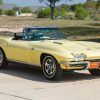
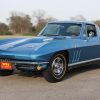
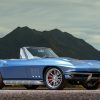
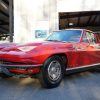
Ten colors, with three new blues and Nassau Blue again the favorite: Nassau Blue (6,100), Milano Maroon (3,799), Rally Red (3,366), Silver Pearl (2,967), Sunfire Yellow (2,339), Mosport Green (2,311), Ermine White (2,120), Laguna Blue (2,054), Trophy Blue (1,463) and Tuxedo Black (1,190).
The 1966 market is a big-block market. The 427s are the cars collectors want, with the solid-lifter L72 on top and a documented early “450-hp” car or a 36-gallon tank coupe above that; the hydraulic L36 is the same look for less; then the 350-hp L79, the best small block of the C2 years; then the 300-hp cars most of the 27,720 are. Coupes carry a premium over convertibles at each level, and the modified and restomod cars that make up much of the supply trade on their build rather than their engine code.
Results tracked by Classic.com for September and October 2026 show the spread: a 76-mile L72 coupe sold for $121,000 at Mecum Fort Worth and an L72 convertible with hardtop for $202,720 at Kruse; an L36 convertible with hardtop brought $125,000 on Bring a Trailer and an 88,000-mile L36 coupe $76,000; an L79 convertible sold for $100,000 and 300-hp convertibles for $64,960 and $70,000. An L36 convertible was bid to $80,000 at Hemmings without selling, and a modified L72 coupe to $81,000. Modified and custom cars sold between $60,500 and $104,500 at Barrett-Jackson Las Vegas, and a project L36 convertible went for $24,500. Dealer asking prices ran $175,000 to $250,000 for L72s, $100,000 to $172,000 for L36s and $69,000 to $108,000 for small blocks. Check whether a result includes the buyer’s premium, and treat asking prices and unsold high bids separately from completed sales.
Verification starts at the engine pad: a 427 should carry a Tonawanda T prefix, an IH/IK or IL suffix and a block date before the car’s build date, and an L72 needs the four-bolt block, aluminum intake and 780 Holley, since L36 and L72 share a bore and a hood. Positraction, the four-speed and F41 were mandatory with the 427, so a big-block car without them is wrong somewhere. The 450-hp badging is easy to reproduce and does not by itself make an early car. NCRS judging sheets, Protect-O-Plates, old photographs, ownership records and restoration invoices all help, and ask to see dates and scores rather than just the award.
The C2 body is bonded to a steel birdcage, and that is where the expensive problems hide: the windshield frame, the door hinge pillars and, on coupes, the rear window frame rust from inside and are costly to repair. The ladder frame rusts at the kickups over the rear wheels and around the trailing-arm mounts, trailing-arm bushings and half-shaft U-joints wear, and the four-piston calipers weep brake fluid unless they have been sleeved in stainless. A 427 should start easily, idle lumpily on the solid-lifter cam, pull hard from 3,000 rpm and hold its temperature in traffic; a big block that runs hot usually has a radiator or shroud problem. Most of these cars see few miles, so budget for tires, brakes and fuel-system work on anything that has sat.
MORE: THE MARKET
Get all the latest news stories, upcoming auctions, prices, videos and more about the 1966 Chevrolet Corvette! The latest headlines here.




Chevrolet built 27,720 Corvettes for 1966 at St. Louis, Missouri, a record at the time: 9,958 Sport Coupes and 17,762 convertibles. Of those, 10,374 had the 427 big block (5,116 L36 and 5,258 L72), 7,591 had the 350-hp L79, 24,755 had a four-speed, 3,617 had side-mount exhaust, 1,194 had knock-off wheels and 66 coupes had the 36-gallon tank.
In late 2026, 427/425 L72 cars sold for $121,000 to over $200,000 at auction, 427/390 L36 cars for about $76,000 to $125,000, L79 cars for around $100,000 and 300-hp cars for $65,000 to $70,000, with coupes above convertibles at each level. Modified and restomod cars ran $60,000 to $105,000. Dealers ask considerably more for big blocks. The engine, its documentation and the body style decide the price.
Four: the 327 small block in 300-hp (L75) and 350-hp (L79) form, and the new 427 big block as the 390-hp L36 or the 425-hp L72. The 365-hp and fuel-injected 375-hp 327s were dropped. A three-speed manual was standard, the Muncie four-speed went into 89 percent of cars, and the Powerglide automatic was available only with the small blocks.
Ten: Nassau Blue (6,100 cars), Milano Maroon (3,799), Rally Red (3,366), Silver Pearl (2,967), Sunfire Yellow (2,339), Mosport Green (2,311), Ermine White (2,120), Laguna Blue (2,054), Trophy Blue (1,463) and Tuxedo Black (1,190), with black, white or beige soft tops. Laguna Blue, Trophy Blue, Mosport Green and Sunfire Yellow were new for 1966.
The Sport Coupe was $4,295 and the convertible $4,084 with the 300-hp engine and three-speed manual, slightly less than 1965. The 427/390 added $181.20, the 427/425 $312.85, the L79 $105.35, the four-speed $184.35, Positraction $42.15, side exhaust $131.65, knock-off wheels $316.00 and air conditioning $412.90. A 427/425 coupe with the four-speed, Positraction, F41, side exhaust and knock-offs came to about $5,300.
The 427 replaced the 396 and the small-block list shrank to two engines, with fuel injection gone. Outside, an egg-crate grille replaced the horizontal bars, the coupe lost its roof vents, and the wheel covers and rocker moldings were restyled; backup lights became standard. Inside, extra seat pleats, chrome door pulls, a vinyl headliner and optional headrests and shoulder belts. The hazard flasher, the J56 heavy-duty brakes and California air injection were new options.
Same 427 block and bore, different internals. The L36 has hydraulic lifters, 10.25:1 compression, a cast-iron intake and two-bolt main caps for 390 hp; the L72 has solid lifters, 11.0:1 compression, larger intake valves, an aluminum intake with a 780-cfm Holley and four-bolt mains for 425 hp. Both make 460 lb-ft and both wear the bulged hood. Early cars were badged 400 and 450 hp; the lower ratings were a paperwork change, not an engine change.
1966 Corvette Advertisements / 1966 Corvette Colors / 1966 Corvette Common Issues / 1966 Corvette Engine / 1966 Corvette Factory Options / 1966 Corvette For Sale / 1966 Corvette Maintenance / 1966 Corvette Mods / 1966 Corvette Owners Manual / 1966 Corvette Performance / 1966 Corvette Posters / 1966 Corvette Pricing / 1966 Corvette Production / 1966 Corvette Recalls / 1966 Corvette Research / 1966 Corvette RPO Codes / 1966 Corvette Sales Brochures / 1966 Corvette Special Model Overview / 1966 Corvette Specifications / 1966 Corvette Technical Research / 1966 Corvette Service Bulletins / 1966 Corvette VIN Numbers