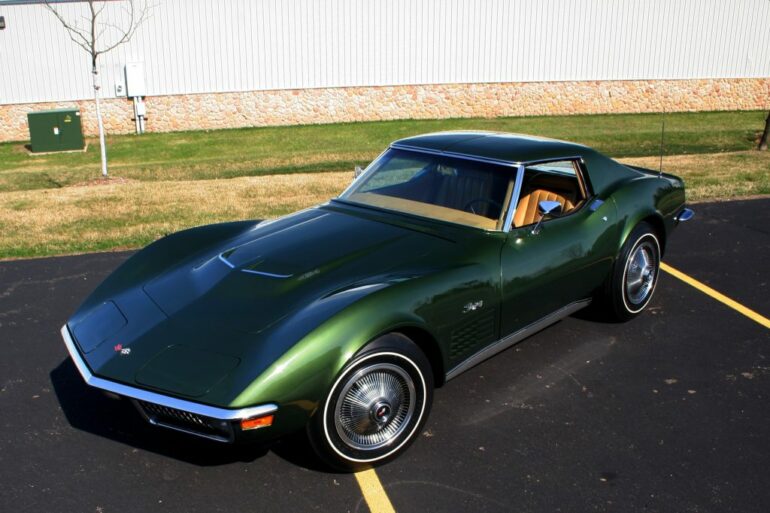
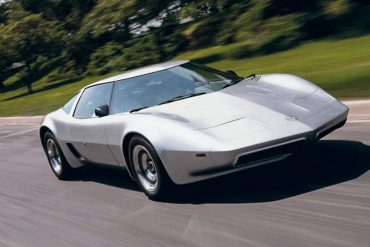
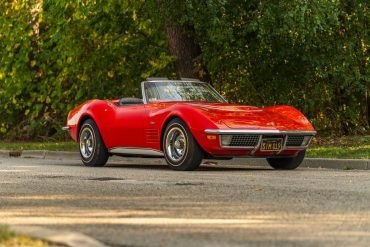
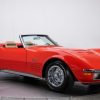
Only Bill Mitchell could get away with this. Bill always managed to have a hot daily ride. Engineering prototypes that weren't street-legal stayed behind the fence, but many of the show car Corvettes managed to go home with Bill. His usual statement on his "design study" cars was, "This thing runs like a bear!" For the Mulsanne Bill added, "This is the best Stingray ever."
Quick Nav: Story · Specials · ZR1 · Price & Options · VIN · Specs · Technical · Pics & Videos · The Market · All · FAQs
The Basics
Model & Gen: 1970 Corvette (C3)
Body Type: Sport Coupe (T-top) or Convertible
VIN: 194370S400001 – 194370S417316
Original Price: $5,192.00 coupe / $4,849.00 convertible
Colors: 11 (Classic White, Monza Red, Marlboro Maroon, Mulsanne Blue, Bridgehampton Blue, Donnybrooke Green, Daytona Yellow, Cortez Silver, Ontario Orange, Laguna Gray, Corvette Bronze)
Engine: 350 ci V-8, 300 or 350 hp, or 370 hp solid-lifter LT-1; 454 ci big block, 390 hp (LS5); the 460-hp LS7 was listed but never sold
Transmission: Muncie 4-speed standard (M20 wide or M21 close ratio at no charge); M22 heavy-duty $95; 3-speed Turbo Hydra-Matic (M40) at no charge
Units Produced: 17,316
The Overview
The 1970 Corvette was late. The UAW strike and John DeLorean’s decision to run the record 1969 model year into December meant the 1970 did not reach showrooms until February, and when it arrived it carried the changes previewed on Bill Mitchell’s Aero Coupe show car: an egg-crate grille with matching fender louvers in place of the four gills, square parking lamps in the grille corners, wheel openings flared to stop stone chips on the tuck-under, rectangular exhaust tips recessed into the tail and bigger side markers. Inside, the seats were reshaped for an inch more headroom with the headrests built in, the shoulder-belt reels moved into the rear quarters, and a $158 custom interior added leather, cut-pile carpet and wood-grain trim. Tinted glass, Positraction and the four-speed (or the Turbo Hydra-Matic) became standard, and the price went up $411 to cover it: $5,192 for the coupe, $4,849 for the convertible.
The engines were the news. The 427 was stroked to 454 and offered only as the 390-hp LS5 with 500 lb-ft of torque; the 460-hp aluminum-head LS7 was printed in the order guide, driven across the country by Sports Car Graphic and then cancelled before a customer got one. Zora Arkus-Duntov’s answer to the big block was the LT-1, a solid-lifter 350 with 11.0:1 compression, an 850-cfm Holley and a 6,500-rpm redline, rated at 370 hp and sold with a striped hood for $447.60; 1,287 buyers took it. For racers the ZR1 package wrapped the LT-1 in the M22 gearbox, heavy-duty brakes and suspension and an aluminum radiator and forbade the radio and air conditioning. Twenty-five were built, the first cars to wear a badge Chevrolet would bring back in 1990, 2009 and 2019.
With the year starting in February, production was 17,316, 10,668 coupes and 6,648 convertibles, the lowest since 1962 and a number that makes every 1970 scarcer than its neighbors. It was also the last year of high compression: Ed Cole’s order that every GM engine run on 91-octane fuel took effect for 1971, so the 1970 LT-1 and LS5 are the strongest of their kind, and the 1970 is the year C3 buyers pay for when they want the Shark at its best.
The 1970 Corvette Story
The arrival of the 1970 Corvette happened somewhat later than was typical in the automotive manufacturing industry, due in part to the incredible sales backlog that had occurred during the 1969 model year and also due in part to the UAW (United Auto Workers) strike, which delayed the new Corvette from reaching showrooms until February.
The decision to prolong the ’69’s production had been made by then Chevrolet President, John Z. DeLorean, who had taken the helm of the company on February 1, 1969. Along with the Camaro and the Pontiac Firebird, DeLorean believed that prolonging production of the earlier models into the winter of 1969-70 would help Chevrolet make up ground on an order backlog that had occurred in part because of the two-month automotive workers strike at GM plants early in 1969.
It was because of this extension that the 1969 Corvette had set record sales numbers for the model year.
On November 7, 1969, Chevrolet manufactured its 250,000th Corvette since production of the sports car had begun on June 30, 1953. Although technically the model should have been a 1970 Corvette, it was still recognized as a 1969 because of the aforementioned production extension. The car, which rolled off the production line at 10:32 a.m., was a convertible painted in Riverside Gold. The car was originally purchased by George Dyer of Montebello, California.
Interestingly, the 1970 Corvette’s arrival would come at a time when, despite the Corvette’s incredible popularity, it was simultaneously falling under increasing scrutiny for its general lack of overall production value and build quality.
In 1970, Road & Track Magazine surveyed 177 Corvette owners and found most agreed that “the worst thing about Corvettes, according to the owners, is the workmanship – or the lack of it.
Whereas 18% of the owners of 1963–67 models considered workmanship the worst feature of the car, an astounding 40% had that comment to make about the 1968–69 models! Seventeen percent of the owners of both series listed squeaks and rattles as the worst feature.”
While this did little to diminish demand for the Corvette, Chevrolet recognized that this issue presented a genuine challenge for them. In order to keep up with demand, GM had been forced to add a third shift in their St. Louis plant to keep production on schedule.
Despite the realization that production quality was being compromised, the result of such high volume (for both the 1968 and 1969 model years, as well as the preparatory work for the 1970) was that quality control was barely able to hold its own, let alone have any chance of improving. It was during this time period that production quality had reached an all-time low.
The 1970 Corvette actually made its formal debut in late February and introduced the world to a number of small, but improved design styling touches. These design changes, which had been introduced on a show car known simply as the Aero Coupe, had included many elements which suggested that the designers were looking to move away from Corvette’s current role as a pure sports car (the ZL-1 notwithstanding) and more towards the blended role of becoming a luxury sports car.
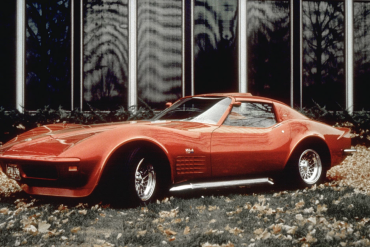
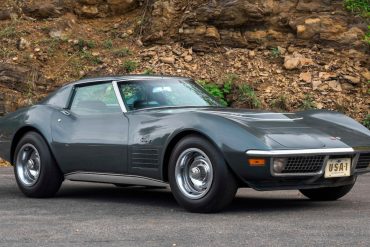
The Aero Coupe had featured an egg-crate patterned grille, matching louvers along the fenders (which replaced the four gills of the 1968 and 1969 model years), and more deeply flared wheel houses, introduced to reduce the severity of the bodyside tuck-under, which had been discovered as being susceptible to stone damage.
The exterior of the 1970 Corvette also featured a number of other design cues that were new for the model year. Amongst these, the parking lights were now squared off and set into the corners of the grille. Mandatory side marker lights at the front and rear of the car were larger and better integrated into the design than those of earlier model years. In the back of the car, new rectangular exhaust pipe tips were recessed into the underside of the tail in a manner inspired by the Mako Shark II. A number of detail refinements were also made to the taillights and the stainless steel rocker moldings.
Additionally, the headrests were integrated into the seat design and a more accessible release button was introduced for the seat back hinge. The inertia reels for the shoulder harnesses were tucked away more neatly in the rear quarters, thereby opening up more space in the trunk area. The seatbelts themselves were now being fed through slots in the seat backs that made them feel built into the design.
The interior of the 1970 Corvette was improved upon in a number of areas. The seats, which had been re-designed in 1969, underwent another design change that added an inch of urgently needed headroom as well as better lateral support.
A new option was introduced for the 1970 Corvette that could be ordered at a small, added cost to the customer. The “custom interior” option, though it had no separate RPO code associated with it, sold for an additional $158.00 on top of the base coupe or convertible price. The custom interior gave the Corvette a “dressed-up” look, a subtle touch of plushness that offset the minimalist character of the usual Corvette interior. Leather-trimmed seats, cut-pile, door-to-door carpeting, a leather boot (for manual transmission shift levers), and wood-grain trim on the console and doors were all introduced to provide an additional layer of warmth to the interior of the 1970 Corvette.
The previously optional Soft-Ray Tinted Glass option (RPO A01) was made standard equipment for the 1970 model year. As a result, all 1970 Corvettes received evenly tinted glass on all windows.
In addition to the window tint, a number of other options were made standard for the 1970 model year including Positraction differentials (formerly RPO G81) and the four-speed manual transmission (formerly RPO M20/M21), of which consumers could choose to install wide-ratio, close-ratio, or have it swapped all together for the Turbo Hydra-Matic at no additional cost.
Mechanically, there were many carryovers from the previous model year. The small-block engine lineup remained the same at the two lower power ratings (300 horsepower and 350 horsepower respectively). However, GM did introduce a new solid-lifter, small block engine that they designated the LT-1.
Corvettes equipped with this engine received a special hood dome surrounded by striping and “LT-1” lettering. While these markings were certainly a differentiator between which engine a particular Corvette was built with, it was also readily obvious to anyone who heard the unique rumble from the exhaust pipes and the tapping of its mechanical lifters that they were in the presence of an LT-1 engine.
Corvettes equipped with the LT-1 engine also came standard with a larger bore – two-and-a-half inch – exhaust system, and a larger carburetor – an 850 CFM Holley four-barrel with vacuum controlled secondary throttles. Although only a small-block, the Holley four-barrel was actually the same carburetor that GM had specified for Corvette’s big-block engine setups. In conjunction with the massive fuel delivery system, Corvette engineers also included a transistorized Delco ignition system, which helped produce reliable high-speed operation (with a redline of 6,500 rpm) in the LT-1 engine. The numbers that the LT-1 engine produced were impressive, and certainly consistent with the performance expectations that individuals like Zora Arkus-Duntov had for the Corvette.
The LT-1 equipped Corvettes could manage a quarter mile run in just 14.2 seconds at 102 miles per hour, indicating that GM’s published ratings of 370 bhp at 6,000 rpm and 380 lb-ft of torque at 4,000 rpm were both on the conservative side.
In point of fact, the LT-1 engine was actually specified for use in the SCCA’s Class B Production car series. For racers wishing to purchase a Corvette so equipped, they would need look no further than the factory options order sheet, which included the LT-1 engine as well as a cold-air hood and all of the relevant brake and chassis racing equipment.
Of course, many racers looking to utilize the performance and handling aspects of the Corvette were not going to invest their money into a small-block, despite the performance numbers it was capable of producing.
Serious racers knew that, if they were able to sort through the options presented to them, they should have been able to assemble a race car that would rival anything on the track. While earlier Corvettes were capable of being equipped with such options as the ZL-1 (the all-aluminum version of the 427 cubic inch L88 engine), the 1970 offerings were a little harder to come by.
For the 1970 model year, Chevrolet introduced a big block 427 that was stroked out to a full 4.00 inches and 454 cubic inches. It was the first time that the stroke had been increased since the engine had been introduced in its more conservative iteration – a 396 cubic-inch big block – in 1965. While the arrival of the 454 was considered by some to be in response to the Corvette’s increasing presence on the racetrack, the truth is actually more intriguing. The added cubic inches in the Corvette were actually the byproduct of Chevy’s need to expand the engine’s size to counterbalance the loss of performance in its regular passenger cars due to the mandatory reductions in exhaust emissions as required by state and federal laws.
Still, there was the question of how racers could build a serious track car by using the right combination of production codes. The aforementioned L88 and ZL1 options were no longer offered for 1970 (though Chevy continued to sell Can-Am engines to bona fide race teams). Instead, GM announced that it would be offering two big-block options: RPO LS5 and LS7. The LS5 would come equipped with hydraulic lifters, 10.25:1 compression, a single, four-barrel carburetor, and was rated at 390 bhp (at 4,800 rpm) with a massive 500 lb-ft of torque.
Did you know? In 1970, big block engines increased from 427 to 454 cubic inches and the powerful 370 HP LT1 small block engine made its debut. Also, the first ZR1 performance package appeared in 1970 (not 1990, as some might believe) and included the 370 HP LT1 engine and a host of other performance items.
The LS7, on the other hand, became known merely as a “legendary engine”. GM did publish specs on the LS7 engine, and articles about the engine were published in many automobile magazines, but the engine itself was never made available for purchase.
That’s not to say that the engine never came into being. Quite to the contrary, GM did produce an LS7 equipped Corvette in December 1969 that was driven from Los Angeles to Detroit by Paul Van Valkenburgh, a writer from the magazine Sports Car Graphic. He stated that, “with a full tank, two aboard and a full load of luggage the car would still turn the standing quarter mile in 13.8 seconds with a top speed of 108 miles per hour.” He further went on to write that “never have we tested a car that had such a secure speed potential. This car gives the impression that it could do anything you demanded.” Depending on the source of information, the LS7 engine’s output was rated at either 460 or 465 horsepower.
Unfortunately for Corvette owners, the LS7 engine program was cancelled by GM’s own internal discouragement of producing cars with excessively high horsepower (which is ironic because at the time the decision was made, Ed Cole (one of the engineers behind the very first Corvette) was president of General Motors and would have been capable of overruling that decision). In addition, Chevrolet had begun a campaign to “weed out” costly options that would clog up their assembly lines. This campaign became known as the “de-proliferation” program. The LS7 fell prey to the “de-pro” program, and ceased its existence almost before it had begun.
The 1970 Corvette was one of the first cars during John DeLorean’s tenure as general manager of Chevrolet to fall prey to a new pricing plan that took advantage of the car’s unprecedented popularity. DeLorean contested that since each year’s production quota was usually spoken for, and secured by concrete dealer and buyer orders (usually in as early as March or April), that it seemed reasonable that General Motors should actually increase the price of the Corvette more substantially than it had in previous years – and that is exactly what happened.
Corvette prices jumped dramatically from the mid-$4,000 price range in 1969 (depending on coupe or convertible (see 1969 Specifications Page for more information)), to over $5,000 in 1970. The base coupe (without extra options) now retailed for $5,192.00.
The convertible on the other hand, while still somewhat less expensive, sold for $4,849.00. While the sudden price increase doubtless had some impact on some customers’ willingness to purchase a new Corvette, it was really the late production start as the result of the UAW strike which most adversely impacted the total sales numbers on the 1970 Corvette. The coupe sold just 10,668 units, whereas the convertible sold an abysmal 6,648. In all, 1970 saw the sale of only 17,316 Corvettes, which was the lowest sales number for Corvette since 1962.
Road & Track Magazine tested an LS5 equipped Corvette with an automatic transmission and was able to manage a 0-60 time of 7.0 seconds, a quarter-mile time of 15.0 seconds at 93 miles per hour, and a top speed of 144 miles per hour. While these performance numbers were impressive, the testers criticized the suspension, complaining that it “suffered from both excessive harshness over irregular surfaces and a certain flatness at speed.”
Production Volumes
While these criticisms were certainly noteworthy, they also turned out to be irrelevant. The 1970 model year would mark the end for the big-block, high-power Corvettes as they had been known up to this point. A number of factors played into this decision, including skyrocketing insurance rates and a large decline in the sale of sports cars, but the largest contributing factor was GM President Ed Cole’s desire to eliminate low-volume options. Further, he dictated that all engines would be required to be able to run on 91-octane fuel, a decision that was made because of the anticipation of the ever tightening emission regulations that would govern future automotive production.

The 1970 Corvette Aero Coupe started as a stock 1968 Corvette and was modified by Bill Mitchell to preview the 1970 1/2 styling changes. (Image courtesy of GM Media.)
The fender louvers changed on the 1970 Corvette, featuring an egg-crate patterned grille.
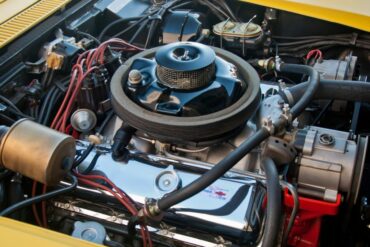
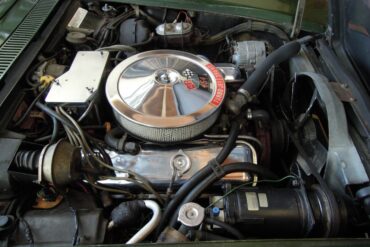
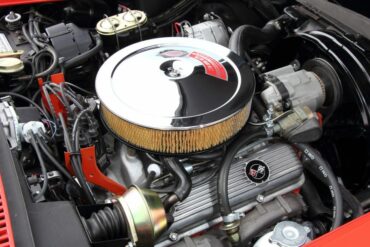
The 1970 LT-1 Engine.
The 1970 Corvette ZR-1The first ZR1 could not be ordered with a radio, air conditioning, power steering, power windows, a rear defroster, wheel covers or the alarm; Chevrolet called it the Special Purpose Engine Package and sold 25 at $968.95. A 1970 ZR1 convertible brought $962,500 at Mecum Indianapolis in 2022, about 185 times what the whole car cost new.
DID YOU KNOW
1970 Corvette ZR1
The first ZR1 was RPO ZR1, the Special Purpose Engine Package, at $968.95: the 370-hp LT-1 with the M22 Rock Crusher four-speed, J56 heavy-duty brakes, F41 springs and shocks, K66 transistor ignition and an aluminum radiator with a metal shroud, built for SCCA B-Production. Radio, air conditioning, power steering, power windows, rear defroster, wheel covers and alarm could not be ordered. Twenty-five were built in 1970, 53 over three years, and a 1970 convertible sold for $962,500 at Mecum Indianapolis in 2022.
MORE: ALL 1970 ZR1 POSTS
Price & Options
Core Features & Factory Options
The Sport Coupe listed at $5,192.00 and the convertible at $4,849.00, up $411 on 1969, but the price now included tinted glass, Positraction and a choice of the wide-ratio or close-ratio Muncie four-speed or the Turbo Hydra-Matic at no charge; only the heavy-duty M22 ($95.00, 25 cars, all ZR1s) cost extra, and the automatic went into 5,102 cars, the M21 into 4,383 and the standard M20 into about 7,806.
The engine list was all new above the base 300-hp 350: the 350-hp L46 at $158.00 went into 4,910 cars, the 454/390 LS5 at $289.65 into 4,473 and the LT-1 at $447.60 into 1,287, 25 of them as the $968.95 ZR1 package. That left about 6,646 cars with the base engine. An optional axle ratio (RPO G81, now $12.65) went into 2,862 cars.
Power steering (RPO N40, $105.35) reached 11,907 cars, 69 percent, power brakes (RPO J50, $47.40) 8,984, air conditioning (RPO C60, $447.65) 6,659, the tilt-telescopic column (RPO N37, $84.30) 5,803, power windows (RPO A31, $63.20) 4,813 and the alarm (RPO UA6, $31.60) 6,727. The AM/FM radio (RPO U69, $172.75) went into 14,529 cars and the stereo (RPO U79, $278.10) into 2,462. The raised-white-letter tires (RPO PU9, $33.15) outsold the white-stripes (RPO PT7, $31.30) for the first time, 7,985 to 6,589, and the deluxe wheel covers (RPO P02, $57.95) went on 3,467 cars.
The custom interior ($158.00) with leather seats, cut-pile carpet and wood-grain trim went into 3,191 cars, the hardtop (RPO C07, $273.85) onto 2,556 of the convertibles with 832 vinyl-covered (RPO C08, $63.20), the rear defroster (RPO C50, $36.90) into 1,281, California emissions equipment (RPO NA9, $36.90) into 1,758 and the heavy-duty battery (RPO T60, $15.80) into 165 small-block cars.
Eleven colors were offered with black, white or sandalwood tops; Chevrolet did not record production by color.
MORE: PRICING, OPTIONS & COLORS / RPO CODES
| CODE | DESCRIPTION | QUANTITY | RETAIL PRICE |
|---|---|---|---|
| 19437 | Base Corvette Sport Coupe | 10,668 | $5,192.00 |
| 19467 | Base Corvette Convertible | 6,648 | $4,849.00 |
| 403–424 | Custom Interior Trim (leather seats, cut-pile carpet, wood-grain trim) | 3,191 | $158.00 |
| A31 | Power Windows | 4,813 | $63.20 |
| A85 | Custom Shoulder Belts (standard on coupes; convertibles) | 475 | $42.15 |
| C07 | Auxiliary Hardtop (convertible) | 2,556 | $273.85 |
| C08 | Vinyl Covering for Auxiliary Hardtop | 832 | $63.20 |
| C50 | Rear Window Defroster | 1,281 | $36.90 |
| C60 | Air Conditioning (not with LT-1) | 6,659 | $447.65 |
| G81 | Optional Rear Axle Ratio (Positraction now standard) | 2,862 | $12.65 |
| J50 | Power Brakes | 8,984 | $47.40 |
| L46 | 350ci, 350HP Engine | 4,910 | $158.00 |
| LS5 | 454ci, 390HP Engine | 4,473 | $289.65 |
| LT1 | 350ci, 370HP Engine (solid lifters) | 1,287 | $447.60 |
| M21 | 4-Speed Manual Transmission, Close Ratio | 4,383 | no charge |
| M22 | 4-Speed Manual, Close Ratio, Heavy Duty | 25 | $95.00 |
| M40 | Turbo Hydra-Matic 3-Speed Automatic | 5,102 | no charge |
| N37 | Tilt-Telescopic Steering Column | 5,803 | $84.30 |
| N40 | Power Steering | 11,907 | $105.35 |
| NA9 | California Emissions Equipment | 1,758 | $36.90 |
| P02 | Deluxe Wheel Covers | 3,467 | $57.95 |
| PT7 | White Stripe Tires, F70x15, nylon | 6,589 | $31.30 |
| PU9 | White Letter Tires, F70x15, nylon | 7,985 | $33.15 |
| T60 | Heavy Duty Battery (standard with LS5) | 165 | $15.80 |
| U69 | AM-FM Radio | 14,529 | $172.75 |
| U79 | AM-FM Radio, Stereo | 2,462 | $278.10 |
| UA6 | Alarm System | 6,727 | $31.60 |
| ZR1 | Special Purpose Engine Package (LT-1, M22, J56, F41, K66, aluminum radiator) | 25 | $968.95 |
| CODE | EXTERIOR | SOFT TOP | INTERIOR |
|---|---|---|---|
| 972 | Classic White | Black, White, Sandalwood | Black, Blue, Brown, Green, Red, Saddle |
| 974 | Monza Red | Black, White, Sandalwood | Black, Brown, Red, Saddle |
| 975 | Marlboro Maroon | Black, White, Sandalwood | Black, Brown, Saddle |
| 976 | Mulsanne Blue | Black, White, Sandalwood | Black, Blue |
| 979 | Bridgehampton Blue | Black, White, Sandalwood | Black, Blue |
| 982 | Donnybrooke Green | Black, White, Sandalwood | Black, Brown, Green, Saddle |
| 984 | Daytona Yellow | Black, White, Sandalwood | Black, Green |
| 986 | Cortez Silver | Black, White, Sandalwood | Black, Blue, Brown, Green, Red, Saddle |
| 991 | Ontario Orange | Black, White, Sandalwood | Black, Saddle |
| 992 | Laguna Gray | Black, White, Sandalwood | Saddle |
| 993 | Corvette Bronze | Black, White, Sandalwood | Black, Saddle |
Specifications & Performance
Engine & Transmission
Two new engines bracketed the carryover 300- and 350-hp 350s. The LT-1 was Duntov’s small block built like a big block: 11.0:1 compression, a forged crank, a solid-lifter camshaft, the 850-cfm Holley four-barrel from the L88 on an aluminum intake, 2.5-inch exhaust and transistor ignition, rated at 370 hp at 6,000 rpm and 380 lb-ft at 4,000 with a 6,500-rpm redline.
It came only with the four-speed and without air conditioning, and it ran the quarter in 14.2 seconds at 102 mph, which made the published numbers look modest. The LS5 took the Mark IV to 454 cubic inches with a 4.00-inch stroke, kept hydraulic lifters, a single Quadrajet and 10.25:1 compression, and made 390 hp at 4,800 rpm and 500 lb-ft at 3,400; Road & Track’s automatic LS5 did 0–60 in 7.0 seconds, the quarter in 15.0 at 93 and 144 mph flat out, and complained about the ride.
The LS7 was the one that got away: a 454 with aluminum heads, 11.25:1 compression, solid lifters and the 850 Holley, rated at 460 hp (465 in some documents), listed in the order guide at about $3,000 and driven from Los Angeles to Detroit by Sports Car Graphic, which ran 13.8 at 108 with two aboard and luggage. GM’s campaign against low-volume options and Ed Cole’s 91-octane rule killed it before any were sold.
The ZR1 package put the LT-1 in a car built for SCCA B-Production: M22 Rock Crusher, J56 heavy-duty brakes with the proportioning valve, F41 springs and shocks, K66 ignition and an aluminum radiator, with the comfort options locked out. The chassis was otherwise 1969’s on 15 x 8 wheels, and the Turbo Hydra-Matic was now available with every engine but the LT-1.
MORE: FULL SPECIFICATIONS / ENGINE
| SPEC | 1970 CORVETTE |
|---|---|
| Engines | 350 ci (5.7 L) small-block V-8 in three versions, including the new solid-lifter LT-1; 454 ci (7.4 L) Mark IV big-block V-8 as the LS5; the 460-hp LS7 was listed and never built for sale |
| Base engine | 350/300 hp @ 4,800 rpm, 380 lb-ft @ 3,200 rpm, 10.25:1, hydraulic lifters, Rochester Quadrajet; about 6,646 cars |
| RPO L46 | 350/350 hp @ 5,600 rpm, 380 lb-ft @ 3,600 rpm, 11.0:1, hydraulic lifters, Quadrajet; 4,910 cars, $158.00 |
| RPO LT-1 | 350/370 hp @ 6,000 rpm, 380 lb-ft @ 4,000 rpm, 11.0:1, solid lifters, forged crank, 850-cfm Holley four-barrel on aluminum intake, 2.5-in exhaust, transistor ignition, 6,500-rpm redline, LT-1 striped hood; 1,287 cars, $447.60; four-speed only, no air conditioning |
| RPO LS5 | 454/390 hp @ 4,800 rpm, 500 lb-ft @ 3,400 rpm, 10.25:1, hydraulic lifters, Quadrajet, 4.251 x 4.00 in bore and stroke; 4,473 cars, $289.65; heavy-duty battery standard |
| RPO LS7 (not sold) | 454/460 hp @ 5,600 rpm, 490 lb-ft, 11.25:1, aluminum heads, solid lifters, 850-cfm Holley; published in the order guide and dropped before any were built for customers |
| RPO ZR1 | LT-1 engine with the M22 heavy-duty four-speed, J56 heavy-duty brakes, F41 suspension, K66 transistor ignition and an aluminum radiator with metal shroud; radio, air conditioning, power steering, power windows, rear defroster, wheel covers and alarm not available; 25 cars, $968.95 |
| Transmission | Muncie 4-speed standard: wide-ratio M20 (about 7,806 cars) or close-ratio M21 (4,383) at no charge; heavy-duty M22 (25 cars, $95.00); 3-speed Turbo Hydra-Matic (RPO M40) at no charge (5,102 cars), not with LT-1 |
| Axle ratio | 3.36:1 standard with manuals, 3.08:1 with Turbo Hydra-Matic; Positraction standard; optional ratios (RPO G81, $12.65) 2.73, 3.55, 3.70, 4.11 and 4.56:1 on 2,862 cars |
| Front suspension | Independent; short-long arm, coil springs, anti-roll bar; F41 heavy-duty springs and shocks included with ZR1 |
| Rear suspension | Independent; frame-mounted differential, half-shafts, trailing arms, nine-leaf transverse spring |
| Brakes | Four-wheel disc, 11.75-in rotors, four-piston calipers, dual-circuit master cylinder; power assist (RPO J50, $47.40; 8,984 cars); J56 heavy-duty brakes included with ZR1 |
| Steering | Saginaw recirculating ball, 16.0:1; 15-in wheel; tilt-telescopic column (RPO N37, $84.30; 5,803 cars); power steering (RPO N40, $105.35; 11,907 cars) |
| Exhaust | Dual, with new rectangular tips recessed into the lower rear panel; side-mount exhaust dropped after 1969 |
| Wheels & tires | 15 x 8 in slotted steel Rally wheels with trim rings and caps; F70 x 15 bias-ply tires, with white-stripe (RPO PT7, 6,589 cars) or raised-white-letter (RPO PU9, 7,985); deluxe wheel covers (RPO P02, $57.95; 3,467 cars) |
| Fuel tank | 20 gal |
| Wheelbase | 98 in |
| Overall length / width / height | 182.5 in / 69.0 in / 47.8 in (coupe) |
| Track, front / rear | 58.7 in / 59.4 in |
| Curb weight | approx. 3,300 lb small block; 454 cars roughly 150 lb heavier |
| 0–60 mph | approx. 5.7 sec (LT-1); 7.0 sec (454/390 with automatic, Road & Track) |
| Quarter mile | 14.2 sec @ 102 mph (LT-1); 15.0 sec @ 93 mph (454/390 automatic, Road & Track); 13.8 sec @ 108 mph (LS7 prototype, Sports Car Graphic) |
| Top speed | approx. 125 mph (LT-1); 144 mph (454/390, Road & Track) |
| Production | 17,316: 10,668 coupes and 6,648 convertibles; 4,473 big blocks; built January to July 1970 after the strike-extended 1969 run |
| Assembly | St. Louis, Missouri; small blocks from Flint, big blocks from Tonawanda |
Vehicle Identification Numbers (VIN)
17,316 Cars, 194370S400001 TO 194370S417316
The 1970 Corvette carries a thirteen-character VIN: 194370S for the Sport Coupe and 194670S for the convertible, followed by a sequence number from 400001 to 417316 shared by both bodies and accounting for all 17,316 cars. The 1 is Chevrolet, 9 the Corvette series, 4 the V-8, 37 or 67 the body, 0 the model year and S the St. Louis plant. The VIN plate is on the left front hinge pillar, with the trim tag on the same pillar carrying the body build date (A for January 1970 through G for July, the whole short model year), the trim code and the paint code; the number is stamped on the frame and as a partial VIN on the engine and transmission.
The engine pad on the right front of the block carries the plant prefix (V for Flint small blocks, T for Tonawanda big blocks), the build date and a suffix: CTD and CTG for the 300-hp 350 with manual and automatic (CTL and CTM later in the year), CTH for the L46 (CTJ with air conditioning, CTN, CTO, CTP and CTQ variants), CTK, CTR and CTU for the LT-1, CTV for the LT-1 in a ZR1, and CGW, CRI, CRJ and CZU for the LS5 by transmission and ignition. The 350 block is casting 3970010 and the 454 is 3963512; LT-1 heads are 3973414 (or 3927186), the L46’s 3927187 and the LS5’s 3964290. The LT-1’s Holley carries list number R4489A or R4555A, the rest run Quadrajets numbered 70402xx and 70405xx. Axle codes begin with C (CAK 3.36, CAL 3.08, CAZ 3.55 heavy-duty, CFB 4.11 heavy-duty), and the transmission, axle and distributor should all be dated before the build date.
MORE: VIN DECODER / PRODUCTION
| POSITION | MEANING |
|---|---|
| 1 (First Digit) | Manufacturer: 1 = Chevrolet |
| 9 (Second Digit) | Series: 9 = Corvette |
| 4 (Third Digit) | Engine: 4 = V-8 |
| 37 / 67 (Fourth & Fifth Digits) | Body: 37 = Sport Coupe, 67 = Convertible |
| 0 (Sixth Digit) | Model year: 0 = 1970 |
| S (Seventh Digit) | Assembly plant: S = St. Louis, Missouri |
| 400001–417316 (Eighth through Thirteenth Digits) | Production sequence number, shared by coupes and convertibles |
Pictures, Videos, Wallpapers & Galleries
Eleven colors, most of them new: Classic White, Monza Red, Marlboro Maroon, Mulsanne Blue, Bridgehampton Blue, Donnybrooke Green, Daytona Yellow, Cortez Silver, Ontario Orange, Laguna Gray and Corvette Bronze, with black, white or sandalwood soft tops and six interior colors. Chevrolet did not record production by color.
Market & Buying Guide
For Sale & What They Bring
The 1970 is the C3 the market has decided is the best of the chrome-bumper cars: the last high-compression year, the first LT-1, the only 390-hp 454, the facelift, and the smallest production run of the decade. The order is the ZR1s (25 built) well ahead of everything else, then the LT-1, the LS5, the L46 and the 300-hp cars, with the convertible carrying a premium over the coupe at each level and documented original engines mattering more than in 1968 or 1969 because the LT-1 is the most faked small block Chevrolet built. A correct LT-1 hood, the right Holley and the CTK/CTR/CTU suffix are what buyers pay for.
Results tracked by Classic.com and the auction houses through October 2026: ZR1s sit at a Classic.com benchmark of about $209,000, with a Monza Red coupe at $217,500 on Bring a Trailer in November 2024, a Corvette Bronze convertible at $170,500 at Mecum Indianapolis in 2024 and $148,500 at Kissimmee in 2025 before returning to Bring a Trailer in August 2025, and the record a convertible at $962,500 at Mecum Indianapolis in 2022. LT-1s ran from $35,200 at Mecum Nashville to $81,400 at Barrett-Jackson Las Vegas in September 2026, with a convertible with hardtop bid to $42,000 at Hemmings and another to $75,000 at Mecum Fort Worth without selling; dealers were asking $49,900 and $59,900, and the 1970–72 LT-1 benchmark is about $54,000. An original LS5 sold for $65,500 on Bring a Trailer in December 2025 and an automatic for $36,300 at Mecum Kansas City, with dealers asking $55,900 to $74,000; an L46 convertible brought $39,000 on Bring a Trailer, original small-block cars $26,000 to $30,500, and a modified car $55,000. Original automatic coupes were offered at $23,900 to $27,000, L46 convertibles with hardtops at $40,000 to $61,900. Check whether a result includes the buyer’s premium (Mecum and Barrett-Jackson results do, Bring a Trailer bids do not), and treat asking prices and unsold high bids separately from completed sales.
Verification on a 1970 starts with the engine pad: a V prefix and a CTK, CTR or CTU suffix (CTV for a ZR1) on a 3970010 block with 3973414 heads, a Holley R4489A or R4555A, the aluminum intake and the 2.5-inch exhaust make an LT-1, and the partial VIN stamped beside the suffix must match the car. The LT-1 hood, stripes and console plaque are all reproduced and prove nothing on their own. A ZR1 needs the LT-1 plus the M22, the J56 calipers and proportioning valve, the F41 springs, the K66 distributor and the aluminum radiator with its metal shroud, and no factory radio or air conditioning; the Protect-O-Plate, tank sticker and build sheet are the documents that matter, and the registries know most of the 25. An LS5 should carry a T-prefix 3963512 block with CGW, CRI, CRJ or CZU and 3964290 heads. NCRS and Bloomington Gold judging sheets and old photographs help with all of them.
The C3 body sits on the C2’s birdcage and rusts in the same places: the windshield frame, the door hinge pillars and the frame kickups over the rear wheels and around the trailing-arm mounts. The 1970 adds nothing new to the list but keeps the vacuum system for the headlights and wiper door, which leaks at the actuators and check valves until nothing works, the fiber-optic lamp monitors that go dark, and T-top and rear-window seals that leak. An LT-1 wants its solid lifters adjusted and its Holley set up properly or it will not idle, and a 454 that runs hot has a radiator, shroud or timing problem; both are hard on the four-piston calipers, which weep unless sleeved. Trailing-arm bushings and half-shaft U-joints are the usual mechanical work. Budget for the vacuum system, seals and brakes on any 1970 that has sat, and for a correct LT-1 carburetor if the car has lost its original.
MORE: THE MARKET
FAQs
How many 1970 Corvettes were built?
Chevrolet built 17,316 Corvettes for 1970 at St. Louis, Missouri, 10,668 T-top Sport Coupes and 6,648 convertibles, the lowest total since 1962 because the UAW strike and the extended 1969 run pushed the start of the model year to January 1970 and the cars into showrooms in February. Of those, 4,473 had the 454 LS5, 4,910 the 350-hp L46 and 1,287 the LT-1, 25 of them as ZR1s; 5,102 had the Turbo Hydra-Matic.
How much is a 1970 Corvette worth today?
In 2026, 1970 LT-1s sold for $35,200 to $81,400 at auction with dealers asking $49,900 to $59,900; LS5 454s sold for $36,300 to $65,500 with dealers asking $55,900 to $74,000; L46 and 300-hp cars sold for $26,000 to $39,000, and original automatic coupes were offered from $23,900. ZR1s are valued around $209,000 by Classic.com, with recent sales of $148,500 to $217,500 and a 2022 record of $962,500 for a convertible.
What engines did the 1970 Corvette have?
Four that shipped: the 350 small block at 300 hp (base), 350 hp (L46) or 370 hp as the solid-lifter LT-1, and the new 454 big block at 390 hp (LS5). The 460-hp aluminum-head LS7 454 was listed and cancelled before any were sold. The four-speed was standard in wide or close ratio, the Turbo Hydra-Matic was a no-cost option on everything but the LT-1, and the ZR1 package added the M22 heavy-duty gearbox to the LT-1.
What colors did the 1970 Corvette come in?
Eleven: Classic White, Monza Red, Marlboro Maroon, Mulsanne Blue, Bridgehampton Blue, Donnybrooke Green, Daytona Yellow, Cortez Silver, Ontario Orange, Laguna Gray and Corvette Bronze, with black, white or sandalwood soft tops. Only Monza Red, Daytona Yellow and Cortez Silver carried over from 1969. Interiors came in black, blue, brown, green, red and saddle vinyl, with black or saddle leather in the custom interior. Chevrolet did not record production by color.
How much did the 1970 Corvette cost when new?
The Sport Coupe was $5,192.00 and the convertible $4,849.00, with tinted glass, Positraction and the four-speed or Turbo Hydra-Matic included. The L46 added $158.00, the LS5 454 $289.65, the LT-1 $447.60 and the ZR1 package $968.95; power steering was $105.35, power brakes $47.40, air conditioning $447.65, the custom interior $158.00 and the AM/FM radio $172.75. An LT-1 coupe with power brakes and steering came to about $5,790, and a ZR1 coupe to $6,160.95 before tires and tint.
What changed on the 1970 Corvette?
An egg-crate grille and matching fender louvers replaced the four gills, the wheel openings were flared, the parking lamps went square, the exhaust tips became rectangular and recessed, and the side markers grew. Inside, redesigned seats with built-in headrests, shoulder-belt reels moved to the rear quarters and a custom interior option. Tinted glass, Positraction and the four-speed or automatic became standard. The 427 became the 454, the LT-1 and the ZR1 package arrived, side exhaust was dropped, and the price rose $411.
What is the 1970 Corvette LT-1?
RPO LT-1 was a 350 cubic inch small block built to race: 11.0:1 compression, a forged crank, solid lifters, an 850-cfm Holley four-barrel on an aluminum intake, 2.5-inch exhaust and transistor ignition, rated at 370 hp at 6,000 rpm and 380 lb-ft, with a 6,500-rpm redline and a striped hood with LT-1 lettering. It cost $447.60, came only with a four-speed and could not be ordered with air conditioning. Chevrolet built 1,287 in 1970, the highest rating the LT-1 would carry before compression dropped in 1971, and 25 of them went out as ZR1s.
All The Research
1970 Corvette Advertisements / 1970 Corvette Colors / 1970 Corvette Common Issues / 1970 Corvette Engine / 1970 Corvette Factory Options / 1970 Corvette For Sale / 1970 Corvette Maintenance / 1970 Corvette Mods / 1970 Corvette Owners Manual / 1970 Corvette Performance / 1970 Corvette Posters / 1970 Corvette Pricing / 1970 Corvette Production / 1970 Corvette Recalls / 1970 Corvette Research / 1970 Corvette RPO Codes / 1970 Corvette Sales Brochures / 1970 Corvette Special Model Overview / 1970 Corvette Specifications / 1970 Corvette Technical Research / 1970 Corvette Service Bulletins / 1970 Corvette VIN Numbers / 1970 Corvette XP-881 / 1970 Corvette ZR1