


C3 CORVETTE - 1979
The 1979 Corvette
The record year: 53,807 Corvettes, more than Chevrolet has built in any year since. The 25th-anniversary badges came off, the Pace Car’s high-back seats and spoilers went on the order form, a radio became standard and so, from May, did air conditioning, power windows and the tilt column, which pushed the base price past $10,000.
Quick Nav: Story · Price & Options · VIN · Specs · Technical · Pics & Videos · The Market · All · FAQs
The Basics
Model & Gen: 1979 Corvette (C3)
Body Type: Fastback Sport Coupe (T-top) only
VIN: 1Z8789S400001 – 1Z8789S453807 (Corvette Coupe)
Original Price: $10,220.23
Colors: 10 (Classic White, Silver, Black, Frost Blue, Yellow, Dark Green, Frost Beige, Red, Dark Brown, Dark Blue)
Engine: 350 ci V-8 only: 195 hp (L48) or 225 hp (L82), both up 5 hp on new open-flow mufflers
Transmission: 4-speed wide-ratio standard (MM4); close-ratio M21 with the L82 only; 3-speed Turbo Hydra-Matic (MX1) at no charge, in 77 percent of cars
Units Produced: 53,807 (the all-time Corvette record)
The Overview
The 1979 Corvette is the 1978 fastback with the birthday decorations taken down and the Pace Car’s best ideas made available to everyone. Crossed flags replaced the 25th Anniversary emblems on the nose and fuel door, the chrome around the rear glass and roof panels went black, halogen high beams were phased in, and the Pace Car’s high-back seats, twelve pounds lighter apiece with inertia-locking folding backs, became standard in every car. Its front and rear spoilers went on the option list as RPO D80 for $265, where 6,853 buyers found them; they cut drag by about 15 percent and were worth half a mile per gallon. Glass roof panels, in their first full year, went on 14,480 cars. An AM-FM radio became standard equipment for the first time, with the stereo, 8-track, the new cassette deck and the CB sold as upgrades.
Both engines gained five horsepower from new open-flow mufflers, and the L48 also got the L82’s dual-snorkel air cleaner, for 195 and 225 hp; the L82 went into 14,516 cars, more than in any other year, and Road & Track’s four-speed L82 ran 0–60 in 6.6 seconds and the quarter in 15.3 at 95 mph, the quickest Corvette numbers since the big-block years. Shock rates were made the same for manual and automatic cars, the fuel filler was reshaped to keep leaded-fuel nozzles out, and the ignition lock gained a shield. On May 7, 1979, air conditioning, power windows and the tilt-telescopic column, which 80 percent of buyers were ordering anyway, became standard, and the base price went to $10,220.23, the first Corvette past $10,000. Late cars got the 85-mph speedometer a year ahead of the federal rule.
Chevrolet built 53,807 of them, on two nine-hour shifts and Saturday overtime at St. Louis, a record that the 1984 C4 approached and no year since has matched. Critics measured it against the $6,395 Mazda RX-7, the Datsun 280ZX and the Porsche 924 and called the Shark long in the tooth, and buyers lined up anyway. Today the 1979 is the most plentiful Corvette there is, which keeps prices low, and the best version, an L82 four-speed with FE7, spoilers, glass tops and the 60-series tires, is the quickest and most comfortable C3 of the decade for about the price of a used economy car.
The 1979 Corvette Story
By the late 1970s, Corvette production was moving at a pace that had never been seen in the history of the car. As Chevrolet General Manager, Robert Lund, had stated in March 1977, “The St. Louis Plant is operating two nine-hour shifts daily and working overtime two Saturdays a month just to meet sales demand. Current demand is running more than 29 percent ahead of last year.”
Little did anyone realize that, after the popularity of the 1978 Pace Car and Silver Anniversary Editions in 1978, Corvette was about to set another production record – manufacturing more than 50,000 Corvettes in one year – with the 1979 model year. At the same time, Corvette was about to surpass another record – a base price of more than $10,000 – for the first time in the car’s history.
The price increase in the 1979 model year was well justified, especially given that the Corvette had been fast approaching that cost threshold for the past couple of years.
As before, Chevrolet engineers had continued adding more of the previously optional features available to consumers to the standard base package.
While in 1978, tilt-telescopic steering columns, air conditioning, and power windows had all been optional, nearly 80 percent of all the cars sold that year included all three of these options – which, when added up, cost consumers an additional $910.00 over the base price of $9,351. In early 1979, while these items remained optional for a time (now at a combined cost of $966.00), it was decided that this trio of optional equipment would become a standard part of the car.
On May 7, 1979, they officially became part of the standard equipment group, and Corvette’s base price climbed to $10,220.23. By the end of the production year, the base price would soar even higher as additional options – along with a strong inflationary spiral on the cost of some of the standard equipment – pushed the car’s price higher still.
While the fastback Corvette design introduced in 1978 carried over into the 1979 model year, there were a few, mostly subtle, refinements made to the car’s overall appearance. For one, the “25th Anniversary” emblems were replaced by the more traditional “crossed flags” which had been a key identifier of the Chevy Corvette for more than a quarter century.
Additionally, the chrome trim that wrapped the 1978 rear window and the roof panels was replaced with black trim moldings. Tungsten-halogen headlights were phased into 1979 production early in the model year for increased visibility. The tungsten-halogen headlight beams replaced only the high-beam units. Lastly, a couple of items from the 1978 Pace Car package became options for the 1979 model year.
Tinted roof panels (RPO CC1) became available to consumers, as did the front and rear spoilers (RPO D80). The spoilers were functional, decreasing drag by about 15% and increasing fuel economy by about a half-mile per gallon.
Despite this, sales of Corvettes with this option in 1979 accounted for just under 13% of total sales that year.
Moving inward, the interior received slightly more refinement than the exterior. The biggest, most notable change centered around the introduction of the new “high back” seat style previously introduced on the 1978 Pace Car Replicas. These same seats were now standard equipment for the 1979 model year. The seats used an extensive amount of plastic in their frame structure which resulted in an overall weight reduction of about twelve pounds per seat.
Did you know? The 1979 Corvette was the first model year to offer an AM/FM Radio as standard equipment. Prior to 1979, if a Corvette owner wanted to include a radio, they ordered it at an additional cost to the base price.
At the same time, the new seats offered improved side bolster support to its occupants. They also featured seat backs that folded at a higher point (than most conventional seats) to permit easier rear storage area access.
Inertia locks were introduced that restrained the seat backs during sudden deceleration, which negated the need for manual locks on these new, folding seats. Despite all this, the new seats did not offer reclining seatbacks, which were becoming increasingly available in most vehicles – even the cheapest Japanese cars being built that year.
While the seats received a great deal of attention, the rest of the interior was subject to a number of other small changes as well. The driver and passenger seat tracks were redesigned to provide an additional inch of forward travel.
The ignition cylinder lock received additional shielding to reinforce it, making it more difficult to access in the event of an attempted car theft. The previously optional AM-FM radio became standard equipment, while an illuminated visor-mirror combination for the passenger sunvisor became an available option on the 1979 Corvette. An 85 miles-per-hour (max.) speedometer, which would be officially introduced as standard equipment in the 1980 Corvette, was installed on some late-production 1979 models. This was the result of a federal mandate that was slated to begin in September, 1979 and would remain in effect until March, 1982.
Mechanically, both the base L48 and optional L82 engines received a 5 horsepower increase due to a new “open flow” muffler design. Additionally, the low restriction, dual snorkel air intake that had been introduced on the L82 engine was added to the L48 engine, which gave the base engine an additional 5 horsepower boost, resulting in an overall output of 195hp for the L48 and 225hp for the optional L82 engines, respectively.
Elsewhere on the car, shock absorber rates were standardized so that they were the same, regardless of the type of transmission (manual or automatic) installed. Automatic cars used a 3.55:1 final drive, with 3.36:1 behind the L48 four-speed and 3.70:1 behind the L82 four-speed. The fuel filler pipe was redesigned to make it more difficult for consumers to modify for leaded-fuel access.
Automotive reviewers and critics remained skeptical of the car’s value given its steadily rising prices and the availability of comparatively priced sports cars like the Mazda RX-7 (with base pricing starting at just $6,395), the Datsun 280ZX ($9,899.00), and even the 1979 Porsche 924 ($12,025.00).
Still, none could argue that the Corvette was not an impressive straight-line contender in this field of European and Asian imports. Road & Track Magazine test drove a 1979 Corvette equipped with an L82 engine and recorded a 0-60 time of just 6.6 seconds, a standing quarter-mile time of 15.3 seconds at 95 mph, and a top speed of 127 mph.
Still, most critics agreed that the C3 was again getting long in the tooth and, while the prestige of owning a Corvette continued to flourish amongst consumers, serious automobile enthusiasts were beginning to question how much longer it would be before Chevrolet introduced the next generation of the beloved sports car.
With more than a half decade to go before the actual arrival of the C4, the speculation would continue, though the engineers behind Corvette still had a few tricks up their sleeves, as would be seen in the coming years as the production of the third-generation Shark started to draw to a close.
Production Volumes
In total, Chevrolet manufactured 53,807 Corvettes in 1979, which set the record for the most Corvettes built in a single year of the car’s 26-year history – a record that still stands.
It was the height of the Corvette’s acceptance, which was ironic given that General Motors had once been convinced that the C3 model would never sell half as well. Instead, the car’s popularity was stronger than ever, despite an increasing number of competitors vying for consumer attention. It had proven to be indispensable as both a high-profit personal car as well as a showroom sweetheart.
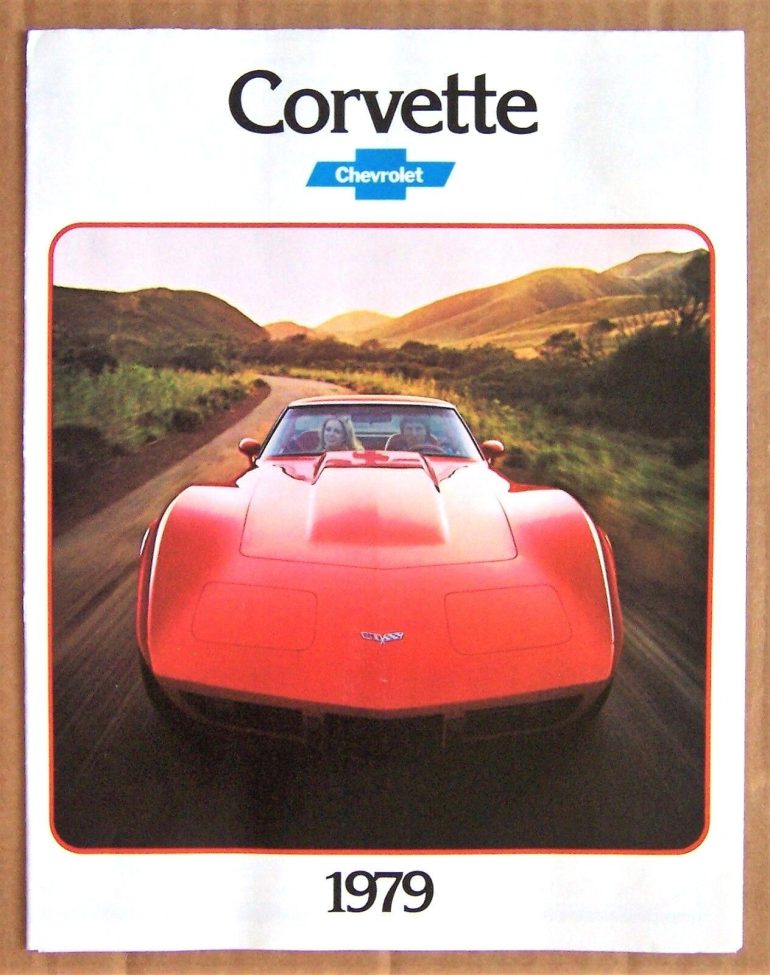


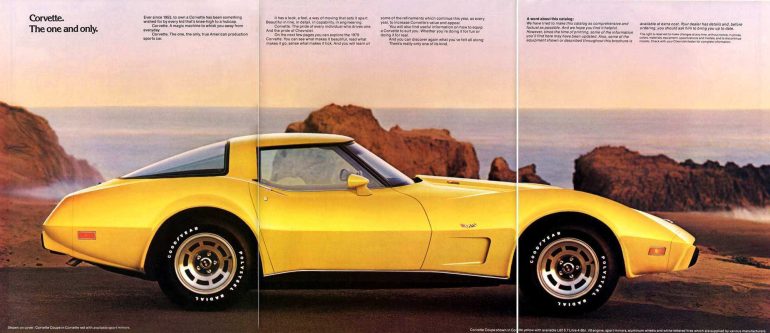
 1979 Corvette Ad - "The One and Only" (Image courtesy of GM Media.)
The 53,807 Corvettes built for 1979 are still the most Chevrolet has made in a single model year. The 1984 C4 came closest at 51,547; no year since has passed 40,000. It happened in a year when critics were comparing the ten-year-old Shark unfavorably with a $6,395 Mazda RX-7.
DID YOU KNOW
Price & Options
Core Features & Factory Options
The Sport Coupe listed at $10,220.23 after May 7, 1979, when air conditioning ($635.00), the tilt-telescopic column ($190.00) and power windows ($141.00) became standard; before that the three were options that 80 percent of buyers ordered, and they still appear in the option counts (47,136, 47,463 and 20,631 plus 28,465 with the power-lock package).
Leather, an AM-FM radio, power steering and brakes, the alarm, Positraction and a four-speed or Turbo Hydra-Matic were all included. The 225-hp L82 ($565.00) went into 14,516 cars, 27 percent; the close-ratio M21 into 4,062, the wide-ratio MM4 into 8,291 and the Turbo Hydra-Matic (RPO MX1) into 41,454, 77 percent.
The Gymkhana suspension (RPO FE7, $49.00) went under 12,321 cars, heavy-duty shocks alone (RPO F51, $33.00) under 2,164, the trailer package (RPO ZN1, $98.00) on 1,001, the highway axle (RPO G95, $19.00) on 428, California certification (RPO YF5, $83.00) on 3,798 and high-altitude equipment (RPO NA6, $35.00) on just 56.
Sport mirrors (RPO D35, $45.00) went on 48,211 cars; the convenience group (RPO ZX2, $94.00) into 41,530; the defogger (RPO C49, $102.00) into 41,587; speed control (RPO K30, $113.00) into 34,445; aluminum wheels, renumbered RPO N90 ($380.00), onto 33,741, 63 percent; the power windows-and-locks package (RPO ZQ2, $272.00) into 28,465 and power locks alone (RPO AU3, $131.00) into 9,054. With a radio standard, the audio options were upgrades: 21,435 8-track stereos (RPO UM2, $228.00), 12,110 of the new cassette stereos (UN3, $234.00), 9,256 plain stereos (U58, $90.00) and 4,483 CB stereos (UP6, $439.00), with the power antenna (U75, $52.00) on 35,730 cars and rear speakers (U81, $52.00) on 37,754.
Glass roof panels (RPO CC1, $365.00) went on 14,480 cars, the spoilers (RPO D80, $265.00) on 6,853, the P255/60R15 tires (RPO QBS, $226.20) on 17,920 and the P225/70R15 white-letters (QGR, $54.00) on 29,603; the heavy-duty battery (UA1, $21.00) on 3,405. A typical automatic L48 with glass tops, defogger, mirrors, speed control, aluminum wheels, white-letter tires, stereo, antenna, speakers, convenience group and power locks came to about $11,700, and an L82 four-speed with FE7, spoilers, wide tires and the cassette deck to about $12,900.
Ten colors were offered; the totals add up to 53,792, fifteen short of production.
MORE: PRICING, OPTIONS & COLORS / RPO CODES
| CODE | DESCRIPTION | QUANTITY | RETAIL PRICE |
|---|---|---|---|
| 1YZ87 | Base Corvette Sport Coupe (air conditioning, tilt-telescopic column and power windows standard from May 7, 1979) | 53,807 | $10,220.23 |
| A31 | Power Windows (until standard) | 20,631 | $141.00 |
| AU3 | Power Door Locks | 9,054 | $131.00 |
| C49 | Rear Window Defogger (electric) | 41,587 | $102.00 |
| C60 | Air Conditioning (until standard) | 47,136 | $635.00 |
| CC1 | Removable Glass Roof Panels | 14,480 | $365.00 |
| D35 | Sport Mirrors (left remote) | 48,211 | $45.00 |
| D80 | Front and Rear Spoilers (from the 1978 Pace Car) | 6,853 | $265.00 |
| F51 | Heavy Duty Shock Absorbers | 2,164 | $33.00 |
| FE7 | Gymkhana Suspension (heavy-duty springs and shocks, rear anti-roll bar, thicker front bar) | 12,321 | $49.00 |
| G95 | Optional Rear Axle Ratio (highway) | 428 | $19.00 |
| K30 | Speed Control (automatic only) | 34,445 | $113.00 |
| L82 | 350ci, 225HP Engine | 14,516 | $565.00 |
| M21 | 4-Speed Manual Transmission, Close Ratio (L82 only) | 4,062 | no charge |
| MM4 | 4-Speed Manual Transmission, Wide Ratio (standard) | 8,291 | no charge |
| MX1 | Turbo Hydra-Matic 3-Speed Automatic | 41,454 | no charge |
| N37 | Tilt-Telescopic Steering Column (until standard) | 47,463 | $190.00 |
| N90 | Cast Aluminum Wheels (set of 4, steel spare; new RPO code) | 33,741 | $380.00 |
| NA6 | High-Altitude Emission Equipment | 56 | $35.00 |
| QBS | White Letter Steel-Belted Radial Tires, P255/60R15 | 17,920 | $226.20 |
| QGR | White Letter Steel-Belted Radial Tires, P225/70R15 | 29,603 | $54.00 |
| U58 | AM-FM Stereo (upgrade from the standard AM-FM radio) | 9,256 | $90.00 |
| U75 | Power Antenna | 35,730 | $52.00 |
| U81 | Dual Rear Speakers | 37,754 | $52.00 |
| UA1 | Heavy Duty Battery | 3,405 | $21.00 |
| UM2 | AM-FM Stereo with 8-Track Tape (upgrade from the standard AM-FM radio) | 21,435 | $228.00 |
| UN3 | AM-FM Stereo with Cassette (new) | 12,110 | $234.00 |
| UP6 | AM-FM Stereo with 40-Channel CB | 4,483 | $439.00 |
| YF5 | California Emission Certification | 3,798 | $83.00 |
| ZN1 | Trailer Package (FE7, heavy-duty radiator and alternator) | 1,001 | $98.00 |
| ZQ2 | Power Windows and Door Locks (combined) | 28,465 | $272.00 |
| ZX2 | Convenience Group (dome-light delay, headlight and low-fuel warnings, underhood and courtesy lights, floor mats, intermittent wipers, illuminated visor mirror) | 41,530 | $94.00 |
| CODE | EXTERIOR | TOTAL | INTERIOR |
|---|---|---|---|
| 19 | Black | 10,465 | Black, Light Beige, Oyster, Red |
| 10 | Classic White | 8,629 | Black, Dark Blue, Dark Green, Light Beige, Oyster, Red |
| 13 | Silver | 7,331 | Black, Dark Blue, Dark Green, Oyster, Red |
| 72 | Corvette Red | 6,707 | Black, Light Beige, Oyster, Red |
| 83 | Corvette Dark Blue | 5,670 | Black, Dark Blue, Light Beige, Oyster, Red |
| 82 | Corvette Dark Brown | 4,053 | Black, Light Beige, Oyster |
| 28 | Corvette Light Blue (Frost Blue) | 3,203 | Black, Dark Blue, Oyster |
| 59 | Corvette Light Beige (Frost Beige) | 2,951 | Black, Dark Blue, Dark Green, Light Beige, Red |
| 58 | Corvette Dark Green | 2,426 | Black, Dark Green, Light Beige, Oyster |
| 52 | Corvette Yellow | 2,357 | Black, Light Beige, Oyster |
Specifications & Performance
Engine & Transmission
Both 350s carried over from 1978 with a new open-flow muffler design worth five horsepower each: the L48, at 8.2:1, to 195 hp net at 4,000 rpm and 285 lb-ft at 3,200 (California cars 280 lb-ft at 2,400), helped by the dual-snorkel air cleaner that had been the L82’s alone, and the L82, at 8.9:1 with its forged crank, four-bolt mains and performance cam, to 225 hp at 5,200 rpm and 270 lb-ft at 3,600.
Both ran a Quadrajet, HEI ignition, a single catalytic converter and unleaded fuel on casting 3970010 (a 14016379 block appeared late in the year) with 462624 heads. The wide-ratio MM4 four-speed was standard, the close-ratio M21 came only with the L82 and a 3.70 axle, and the Turbo Hydra-Matic ran a 3.55.
Road & Track’s L82 four-speed did 0–60 in 6.6 seconds, the quarter mile in 15.3 at 95 mph and 127 mph flat out; an L82 automatic needed about 7.3 seconds.
The chassis was the 1978 car’s with the shock absorbers now the same rate whatever the transmission, the FE7 Gymkhana suspension (RPO FE7, $49.00) with its rear anti-roll bar under 12,321 cars and heavy-duty shocks alone (RPO F51) under 2,164.
The Pace Car’s front and rear spoilers (RPO D80) were functional, cutting drag by about 15 percent, and the halogen high beams were the first on a Corvette. Aluminum wheels, now RPO N90 at $380, went on 63 percent of cars, with P225/70R15 radials standard and the P255/60R15 tires on a third of them.
Four-wheel discs, power steering, the 24-gallon tank and the 98-inch wheelbase carried over; the lighter seats took a few pounds off and curb weight was about 3,520 lb.
MORE: FULL SPECIFICATIONS / ENGINE
| SPEC | 1979 CORVETTE |
|---|---|
| Engines | 350 ci (5.7 L) small-block V-8 in two versions, hydraulic lifters, catalytic converter, unleaded fuel, HEI ignition, SAE net ratings; new open-flow mufflers added 5 hp to both, and the L82’s dual-snorkel air cleaner went on the L48 too |
| Base engine (L48) | 350/195 hp net @ 4,000 rpm, 285 lb-ft @ 3,200 rpm (280 @ 2,400 California), 8.2:1, hydraulic lifters, Rochester Quadrajet, dual-snorkel intake; 39,291 cars (73 percent) |
| RPO L82 | 350/225 hp net @ 5,200 rpm, 270 lb-ft @ 3,600 rpm, 8.9:1, hydraulic lifters, forged crank, four-bolt mains, high-performance camshaft, finned aluminum valve covers; 14,516 cars, $565.00, the most L82s of any year |
| RPO FE7 | Gymkhana suspension: higher-rate springs, firmer shocks, thicker front anti-roll bar and rear bar; 12,321 cars, $49.00; heavy-duty shocks alone (RPO F51, $33.00) on 2,164 |
| Transmission | 4-speed wide-ratio (RPO MM4) standard on 8,291 cars; close-ratio M21 with the L82 only, 4,062 cars; 3-speed Turbo Hydra-Matic (RPO MX1) at no charge in 41,454 cars, 77 percent; shock rates now the same for both transmissions |
| Axle ratio | 3.36:1 with the L48 four-speed; 3.70:1 with the L82 four-speed; 3.55:1 with the automatic; Positraction standard; highway ratio (RPO G95, $19.00) on 428 cars |
| Front suspension | Independent; short-long arm, coil springs, anti-roll bar; FE7 heavy-duty |
| Rear suspension | Independent; frame-mounted differential, half-shafts, trailing arms, transverse leaf spring; FE7 adds a rear anti-roll bar |
| Brakes | Four-wheel disc, 11.75-in rotors, four-piston calipers, dual-circuit master cylinder, power assist standard |
| Steering | Saginaw recirculating ball, power assist standard, 16.1:1; tilt-telescopic column (RPO N37, $190.00; 47,463 cars) standard from May 7, 1979 |
| Body | 1978 fastback body with crossed-flags emblems replacing the 25th Anniversary badges; black trim around the rear glass and roof panels in place of chrome; tungsten-halogen high beams phased in; front and rear spoilers from the Pace Car optional (RPO D80, $265.00; 6,853 cars; about 15 percent less drag); glass roof panels (RPO CC1, $365.00; 14,480 cars); redesigned fuel filler to block leaded-fuel nozzles |
| Interior | Pace Car high-back seats standard, 12 lb lighter each, with inertia-locking folding backs and an extra inch of track travel; AM-FM radio standard for the first time; reinforced ignition-lock shield; illuminated passenger visor mirror in ZX2; 85-mph speedometer on late cars ahead of the 1980 mandate; leather standard, cloth and leather at no cost |
| Wheels & tires | 15 x 8 in steel Rally wheels or 15 x 8 cast aluminum (RPO N90, $380.00; 33,741 cars, 63 percent); P225/70R15 steel-belted radials standard, raised-white-letter on 29,603 cars (RPO QGR); P255/60R15 white-letter tires (RPO QBS, $226.20) on 17,920 |
| Fuel tank | 24 gal; unleaded fuel only |
| Wheelbase | 98 in |
| Overall length / width / height | 185.2 in / 69.0 in / 48.0 in |
| Track, front / rear | 58.7 in / 59.5 in |
| Curb weight | approx. 3,520 lb |
| 0–60 mph | 6.6 sec (L82 four-speed, Road & Track); approx. 7.3 sec (L82 automatic); approx. 8.0 sec (L48 automatic) |
| Quarter mile | 15.3 sec @ 95 mph (L82 four-speed, Road & Track) |
| Top speed | 127 mph (L82, Road & Track); approx. 120 mph (L48) |
| Production | 53,807 coupes, the most Corvettes ever built in one model year; 5,227 sold in Canada |
| Assembly | St. Louis, Missouri; engines from Flint |
Vehicle Identification Numbers (VIN)
53,807 (the all-time Corvette record) Cars, 1Z8789S400001 TO 1Z8789S453807 (Corvette Coupe)
The 1979 Corvette carries a thirteen-character VIN with a new engine code for the base car: 1Z8789S for the L48 and 1Z8749S for the L82, followed by a sequence number from 400001 to 453807. The 1 is Chevrolet, Z the Corvette series, 87 the fastback coupe (the only body), the fifth character the engine (8 for the 195-hp L48, which had been L through 1978; 4 for the L82), 9 the model year and S the St. Louis plant. The VIN plate is on the left front hinge pillar, with the trim tag on the same pillar carrying the body build date (A for August 1978 through N for September 1979), the trim code and the paint code; the number is stamped on the frame and as a partial VIN on the engine and transmission. Month-end sequence numbers run from 400770 in August 1978 to 450434 in August 1979, so the plant built more than 4,000 cars in most months.
The engine pad on the right front of the block carries the Flint V prefix, the build date and a suffix, all new this year: ZAA (early) or ZAF for the L48 with four-speed, ZAB or ZAH with automatic, ZAC or ZAJ California and ZAD high-altitude, and ZBA for the L82 with four-speed, ZBB with automatic. Both engines are casting 3970010, with 14016379 appearing on late cars, with 462624 heads and Quadrajets numbered 17059xxx. The VIN engine character, the pad suffix and the casting dates should agree, the distributor should be an HEI unit, and the transmission, axle and distributor should all be dated before the build date.
MORE: VIN DECODER / PRODUCTION
| POSITION | MEANING |
|---|---|
| 1 (First Digit) | Manufacturer: 1 = Chevrolet |
| Z (Second Digit) | Series: Z = Corvette |
| 87 (Third & Fourth Digits) | Body: 87 = fastback Sport Coupe (the only body) |
| 8 / 4 (Fifth Digit) | Engine: 8 = 350/195 L48 (new code, L through 1978), 4 = 350/225 L82 |
| 9 (Sixth Digit) | Model year: 9 = 1979 |
| S (Seventh Digit) | Assembly plant: S = St. Louis, Missouri |
| 400001–453807 (Eighth through Thirteenth Digits) | Production sequence number; 53,807 built |




Pictures, Videos, Wallpapers & Galleries
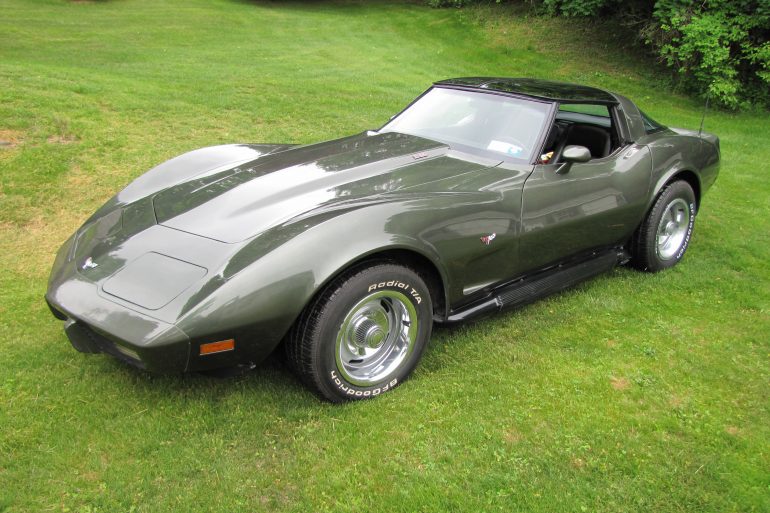
Ten colors, with Black on nearly one car in five: Black (10,465), Classic White (8,629), Silver (7,331), Red (6,707), Dark Blue (5,670), Dark Brown (4,053), Frost Blue (3,203), Frost Beige (2,951), Dark Green (2,426) and Yellow (2,357); six interior colors in standard leather or no-cost cloth and leather.


Market & Buying Guide
For Sale & What They Bring
The 1979 is the most common Corvette ever built, and its market behaves accordingly: plenty of choice, low prices, and a wide gap between the cars that were kept and the cars that were used up. The order is L82 four-speeds with FE7, spoilers and the 60-series tires first, then low-mileage L82 automatics, then the 39,000 L48s that most cars are, with original paint, the standard leather and glass roof panels counting for more than small mileage differences. Black, the year’s most popular color, and Red bring a premium; Dark Brown and Dark Green do not. A tidy L48 automatic is still one of the cheapest ways into a Corvette, and a good L82 four-speed is the best-driving C3 of the late 1970s for the price of a used sedan.
Results tracked by Classic.com from October 2025 through October 2026: L82 four-speeds sold for $24,200 at Mecum Fort Worth (34,000 miles, October 2025), $23,600 and $23,500 on Bring a Trailer and Hagerty for 8,000- and 7,000-mile cars in October 2026, and $14,300 at Mecum Nashville for a 60,000-mile car; L82 automatics with 3,000 to 19,000 miles made $20,250 and $20,750 on Bring a Trailer. Original L48s sold for $19,750 and $15,500 at GAA, $15,000 at GAA, $11,500 and $10,750 on Bring a Trailer, $11,000 and $10,450 at Mecum Kissimmee in January 2026 and $8,150 to $9,900 at Hagerty and Mecum for high-mileage cars; modified cars made $17,000 to $20,900 and customs up to $20,900, while a Pro-Street car was asked at $42,900 and a Mach 5 tribute bid to $21,000 without selling. Dealers’ last asking prices ran $13,500 to $19,995, and in autumn 2026 original coupes were offered at $16,500 to $24,900 and customs at $39,500 to $53,000. Check whether a result includes the buyer’s premium (Mecum and Barrett-Jackson results do, Bring a Trailer bids do not), and treat asking prices and unsold high bids separately from completed sales.
Verification is simple: the fifth VIN character is 4 on an L82 and 8 on a base car, so an L82 with an 8 in the VIN is a dress-up. The engine pad should carry a V prefix and ZBA or ZBB on a 3970010 block with the partial VIN matching the car for an L82, ZAA, ZAF, ZAB, ZAH, ZAC, ZAJ or ZAD for an L48, and the distributor should be the HEI unit. A 1979 should have crossed flags, not anniversary emblems, black rather than chrome trim around the rear glass, high-back seats and a radio in the dash; spoilers are correct only on the 6,853 D80 cars, and D80 is not recorded on the trim tag, so a build sheet or the tank sticker is the only proof. Original N90 wheels carry Kelsey-Hayes and Mexico markings; QBS cars should show the factory-trimmed fender lips.
The C3 body sits on the C2’s birdcage and rusts in the same places: the windshield frame, the door hinge pillars, the frame kickups over the rear wheels and around the trailing-arm mounts, the lower doors and the steel floor pan, which rusts where carpet holds water. The urethane covers at both ends crack and sag as the mounting hardware corrodes, the headlights still run on vacuum, which leaks at the actuators and check valves until nothing works, and the original catalytic converter is often long gone. The T-top seals leak, glass panels more than fiberglass ones, the bonded rear glass can delaminate at the edges, and the printed-circuit dash cluster fails in ways that need a specialist. Trailing-arm bushings, half-shaft U-joints and the four-piston calipers (weeping unless sleeved) are the usual mechanical work; the HEI, unleaded-fuel engines are easy to live with. Budget for the bumper covers, the vacuum system, seals and brakes on any 1979 that has sat.
MORE: THE MARKET


FAQs
How many 1979 Corvettes were built?
Chevrolet built 53,807 Corvettes for 1979 at St. Louis, Missouri, all fastback T-top coupes, the most Corvettes ever built in a single model year; the record still stands, and 5,227 of them went to Canada. Of the total, 14,516 had the L82, 41,454 the Turbo Hydra-Matic, 33,741 aluminum wheels, 14,480 glass roof panels, 12,321 the Gymkhana suspension and 6,853 the spoilers.
How much is a 1979 Corvette worth today?
In late 2025 and 2026, original 1979 Corvettes sold for $8,150 to $24,200 at auction, the top figures for low-mileage L82 four-speeds ($23,500 to $24,200) and L82 automatics ($20,250 to $20,750), with L48 automatics mostly $10,000 to $16,000; modified cars sold for $14,750 to $20,900. Dealers asked $16,500 to $24,900 for original coupes and $39,500 to $53,000 for customs. As the most-produced Corvette, the 1979 is one of the least expensive, priced with the 1976–78 standard coupes.
What engines did the 1979 Corvette have?
Two 350 small blocks, both hydraulic-lifter with a catalytic converter and unleaded fuel, each up five horsepower on new open-flow mufflers: the L48 at 195 hp, now with the dual-snorkel air cleaner, in 39,291 cars, and the L82 at 225 hp in 14,516, the most ever. The wide-ratio four-speed was standard, the close-ratio M21 came only with the L82 and a 3.70 axle, and the Turbo Hydra-Matic went into 77 percent of cars. Road & Track’s L82 four-speed did 0–60 in 6.6 seconds and 127 mph.
What colors did the 1979 Corvette come in?
Ten: Black (10,465 cars), Classic White (8,629), Silver (7,331), Red (6,707), Dark Blue (5,670), Dark Brown (4,053), Frost Blue (3,203), Frost Beige (2,951), Dark Green (2,426) and Yellow (2,357). Interiors came in oyster, black, dark blue, dark green, light beige and red leather, standard, or cloth with leather bolsters at no cost; the seats were the high-back design from the 1978 Pace Car.
How much did the 1979 Corvette cost when new?
The Sport Coupe was $10,220.23 once air conditioning, power windows and the tilt-telescopic column became standard on May 7, 1979, the first Corvette past $10,000; leather, an AM-FM radio, power steering and brakes and the transmission were included. The L82 added $565.00, aluminum wheels $380.00, glass roof panels $365.00, spoilers $265.00, the Gymkhana suspension $49.00, the 8-track $228.00, the new cassette deck $234.00 and the CB stereo $439.00. A typical automatic L48 with glass tops, aluminum wheels and a stereo came to about $11,700, and a loaded L82 four-speed to about $12,900.
What changed on the 1979 Corvette?
The 25th Anniversary emblems gave way to crossed flags, the trim around the rear glass and roof panels went black, halogen high beams arrived, and the 1978 Pace Car’s high-back seats became standard while its spoilers became option D80. An AM-FM radio was standard for the first time, a cassette deck joined the options, both engines gained 5 hp (195 and 225), shock rates were unified, the fuel filler was reshaped against leaded fuel and the ignition lock was shielded. From May 7 air conditioning, power windows and the tilt column were standard, taking the price past $10,000; late cars got the 85-mph speedometer.
Why is 1979 the record year for Corvette production?
Demand. By 1977 St. Louis was running two nine-hour shifts and Saturday overtime, the 1978 anniversary models had drawn a new wave of buyers, and most other American performance cars were gone. Chevrolet built 53,807 Corvettes for 1979 against 46,776 in 1978 and 49,213 in 1977. The 1984 C4 came closest at 51,547, and no year since has passed 40,000, so the 1979 remains the most-produced Corvette, which is also why it is one of the most affordable.
All The Research
1979 Corvette Advertisements / 1979 Corvette Colors / 1979 Corvette Engine / 1979 Corvette Factory Options / 1979 Corvette For Sale / 1979 Corvette Maintenance / 1979 Corvette Mods / 1979 Corvette Owners Manual / 1979 Corvette Performance / 1979 Corvette Posters / 1979 Corvette Pricing / 1979 Corvette Production / 1979 Corvette Recalls / 1979 Corvette Research / 1979 Corvette RPO Codes / 1979 Corvette Sales Brochures / 1979 Corvette Specifications / 1979 Corvette Technical Research / 1979 Corvette Service Bulletins / 1979 Corvette VIN Numbers
