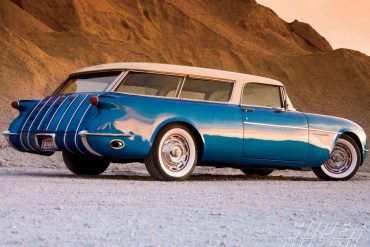
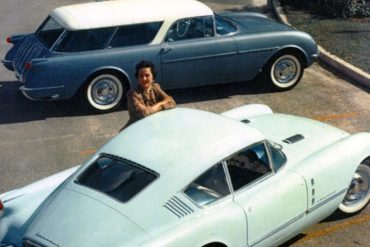
The Tri-Five Nomad began life as a Corvette. Five Corvette-bodied wagons toured the 1954 Motorama circuit before Harley Earl fast-tracked the design into Bel Air production, and only three survive today.



C1 CORVETTE - 1954
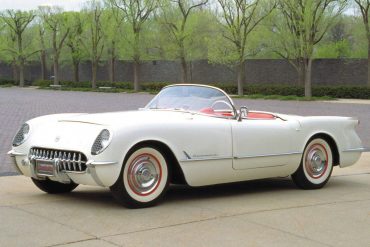
The first Corvette built to sell: 3,640 cars from a new St. Louis plant, four colors, a 155-hp Blue Flame six, and about 1,500 of them still unsold at year’s end.
Quick Nav: The Story · Specials · Price & Options · VIN · Specs · Technical · Pics & Videos · The Market · All Content · FAQs
Model & Gen: 1954 Corvette (C1)
Body Type: 2 Door Convertible
VIN: E54S001001 – E54S004640
Original Price: $2,774 base ($3,254.10 as delivered)
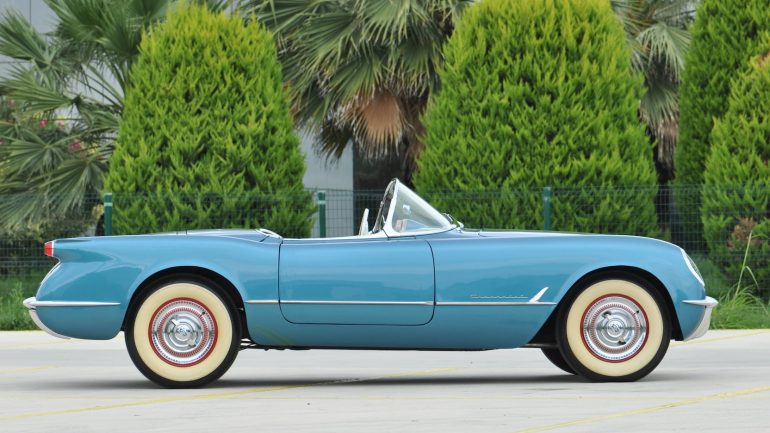
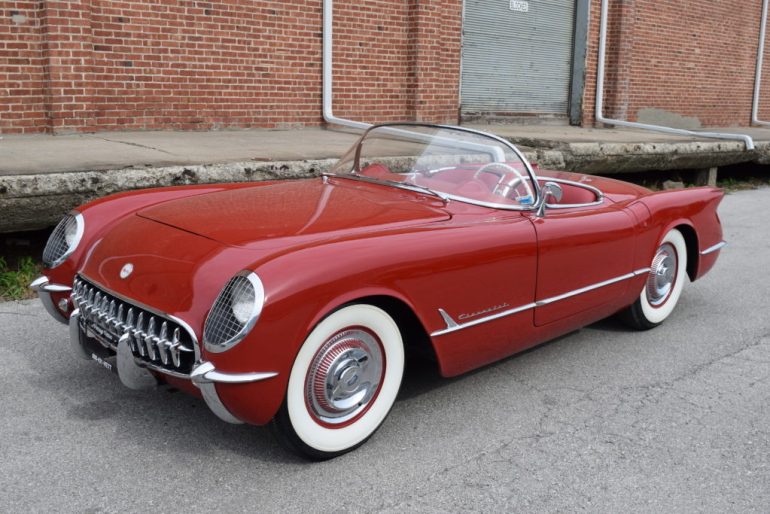
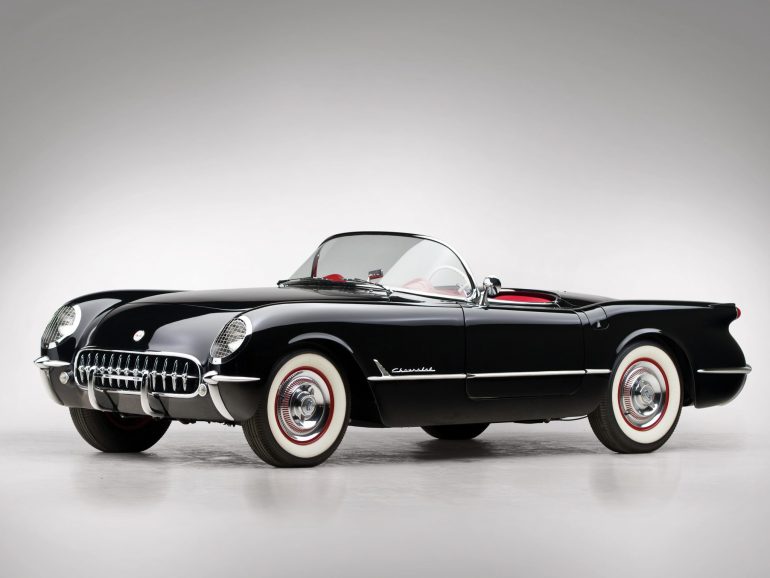
Colors: 4 (Polo White, Pennant Blue, Sportsman Red, Black)
Engine: “Blue Flame” Inline-6
Transmission: 2 Speed Powerglide Auto
Units Produced: 3,640
The 1954 Corvette was the car Chevrolet actually tried to sell. After 300 hand-built 1953 cars, production moved in December 1953 from Flint to a renovated plant in St. Louis, Missouri, designed for more than 10,000 Corvettes a year. Chevrolet built 3,640 of them.
The car itself changed only in the details: longer exhaust outlets that stopped staining the paint, a single-handle hood latch, a choke moved to the left of the column, a new camshaft that lifted the “Blue Flame” six from 150 to 155 horsepower, and, for the first time, a choice of colors. Polo White was joined by Pennant Blue, Sportsman Red and a handful of Black cars.
What did not change was the Powerglide automatic, or the car’s real cost. Chevrolet advertised a lower $2,774 base price, then listed the only available transmission, the heater and the windshield washers as options. The price actually charged was $3,254.10, buyers saw through it, and about 1,500 cars were still unsold at the end of the year.
The 1954 Corvette began production in December, 1953. Although the first fourteen or fifteen ‘54 Corvettes were built in Flint, Michigan (like all of the 1953 Corvettes) GM shifted Corvette’s production to a newly renovated assembly plant in St Louis, Missouri. This plant was designed to produce more than 10,000 Corvettes a year.
There were very few initial design changes between the 1953 and 1954 model Corvettes, although refinements would be made throughout the 1954 production year. For example, the 1953 Corvette had two short stainless-steel exhaust outlets protruding inboard of the rear fenders.
This design resulted in exhaust gases being sucked back against the rear end of the car, thereby staining the paint. As a result, the 1954 model had longer outlets that were run below the car’s body. Other changes included relocating the fuel and brake lines inboard of the right-hand main frame rail, providing them with additional protection. Also, the canvas tops and rails were changed from black to tan.
Some of the inconveniences of the 1953 model were also corrected in 1954. The original two-handle exterior hood latch was replaced by a single handle mechanism after the production of the first 300 (approximate) 1954 models. The choke control was moved from the right to the left of the steering column. This eliminated having to reach over or through the steering wheel to operate the choke control with the left hand while simultaneously attempting to turn the ignition key with the right.
Under the hood, some additional changes were also made to the engine and drivetrain. For one, the use of a new camshaft increased the total horsepower of the “Blue Flame” six cylinder to 155bhp (as compared to the 150bhp of the 1953).
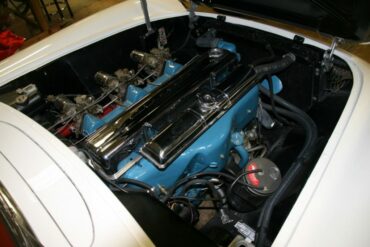
Other alterations included a new-style rocker arm (valve) cover (of which approximately 20% were finished in chrome - serial numbers 1363 through 4381 and of which all were now held down by four bolts through the outer lip of the cover instead of two center studs), a better designed wiring harness, dual air filters, a new type of starter and plastic insulated wire (instead of fabric insulated).
Perhaps the most notable change from the 1953 to 1954 models was the opportunity to purchase a Corvette with a choice of different color options. In 1954, General Motors offered the Corvette to consumers with the following color combinations:
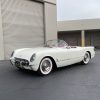
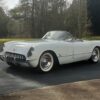
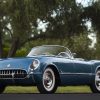
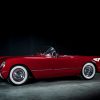
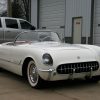
Pennant Blue with a Tan interior (which accounted for 16% of the production models made that year), Sportsman Red with a Red Interior (which accounted for a mere 4% of the production models), Polo White with a Red Interior (which accounted for about 80% of the production models).
A fourth color combination - Black with Red Interior - accounted for as few as six of the production models from that year.
Some ‘54 Corvette owners have claimed that they have factory paint on their vehicles that is different from the four choices listed above, although no factory records exist to verify this claim. Still, paint bulletins from that period are known to have listed a Metallic Green and a Metallic Bronze as well.
While Corvette was finally available for purchase by anyone who wanted one, the car was priced in such a way that many potential “younger” buyers were scared off by the price.
With a window sticker price of $3498.00, the car was considered too expensive for the youthful market at which the Corvette marketing was aimed. In an attempt to make the car appear more price competitive, Chevy lowered the advertised base price to $2774 (which was still more than the price of a Cadillac with a standard V-8 engine) for the 1954 models.
Did you know? In an attempt to make the purchase price more palatable to consumers, GM introduced the 1954 Corvette to the public as a base model that could be tailored to the needs and personal wants of consumers worldwide. One such option was the transmission: Although the two speed Powerglide transmission was listed as a $178 option, no other transmissions were available for the 1954 Corvette, making the optional transmission a necessity if you wanted an operational car.
However, potential customers were shocked to learn that the only available transmission for the Corvette (the 2 speed Powerglide) was listed as an option, as were the windshield wipers and the heater. Truth be told, the actual price for the 1954 Corvette was $3254.10. Most consumers saw through this marketing trickery and sales of the 1954 Corvette suffered as a result of it.
One of the best selling points of the 1954 Corvette was its reliability. It wasn’t prone to breaking down and it did not demand constant tuning and attention to keep running reliably. As with the 1953 Corvette before it, the 1954 did have a few quirks: the synchronizing of the triple carburetors for smooth idle and throttle response was tricky (to down-right difficult) to accomplish.
Also like the 1953, water leaks continued to be a problem, although mostly from the top and the side window curtains. None of these items were considered major issues. Besides, General Motors released service bulletins to cover them, ensuring that any issues that did arise were properly addressed and repaired.
At the same time, one of the biggest on-going issues that faced the 1954 Corvette had nothing to do with the mechanical, structural or cosmetic short-comings of the car itself - at least not directly. The bigger issue was an indirect combination of all these items and the general public perception of the car as a whole.
Simply put, Corvette was not a pure “sports car”. Some considered it a boulevard tourer that lacked the performance and handling of a true, out-and-out roadster. Purists sneered at the automatic 2-speed Powerglide transmission and the limited performance of the “Blue Flame” six-cylinder engine (especially when comparable cars (like the Jaguar XK-120) offered more performance and a 4-speed manual transmission for less money).
Cosmetic issues, such as the car’s dummy knock-off wheel covers, manual folding top, and a re-circulating heater that didn’t allow for windows-up ventilation also generated criticism of the car and were all likely contributed to the overall lack of Corvette sales.
While Chevrolet had hoped that Corvette’s production would be as many as 1,000 units per month, the actual number built for the model year was only 3,640 - less than a third of the projected total - and at year’s end the division found itself with a surplus of 1500 cars still sitting, unsold, in dealerships across the country.
Despite the initial, overwhelmingly positive response to the Corvette at the 1953 Motorama, it was becoming clear that Chevrolet’s sports car experiment was a failure. It wasn’t long before the rumors began circulating the Corvette was on the verge of extinction as corporate management argued about the car’s commercial viability.
 Credit: RK Motors
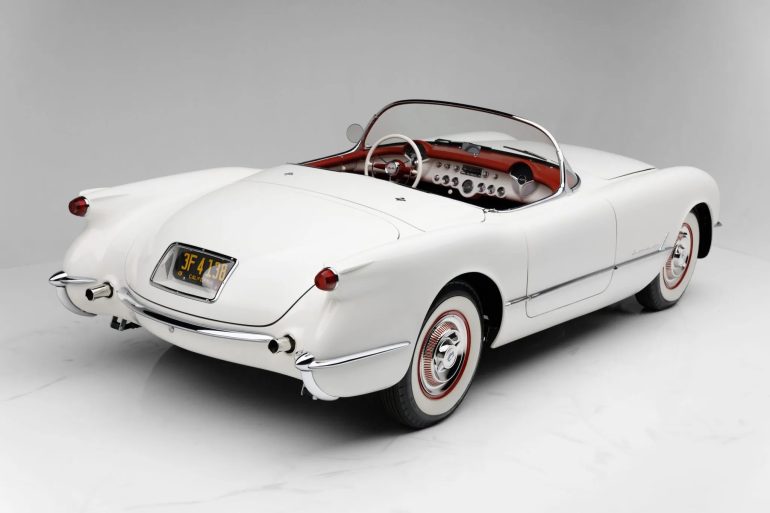
Chevrolet advertised the 1954 Corvette at $2,774, but the only transmission offered, the two-speed Powerglide, was listed as a $178.35 “option”, as were the heater and windshield washers. Every car got all three. The real price was $3,254.10.
DID YOU KNOW
1954 was the Motorama year for Corvette show cars: the fastback Corvair, the Nomad wagon and the hardtop coupe, all built on the production chassis.
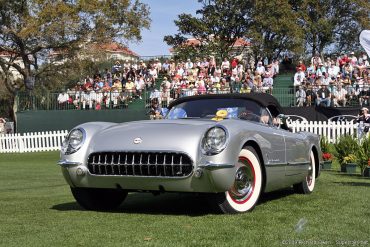
Chevrolet cut the advertised base price of the 1954 Corvette from $3,498 to $2,774, but the cut was mostly on paper. The two-speed Powerglide automatic, the only transmission offered, was listed as a $178.35 option, and the directional signals, heater, AM radio, whitewall tires, parking brake alarm, courtesy lights and windshield washers were all “optional” too. Every one of the 3,640 cars left St. Louis with all of them, so the real price of a 1954 Corvette was $3,254.10 before local taxes and dealer charges, and that is the price in the sales records.
The one real choice a 1954 buyer had was color. Polo White with a red interior was still the volume combination, Pennant Blue with a tan interior and Sportsman Red with a red interior were new, and factory records show a handful of Black cars. All four combinations came with a tan top, a change from the black top of 1953. Period paint bulletins also listed Metallic Green and Metallic Bronze, though no factory records show a car built in either.
MORE: PRICING, OPTIONS & COLORS / RPO CODES
| CODE | DESCRIPTION | QUANTITY | RETAIL PRICE |
|---|---|---|---|
| 2934 | Base Corvette Roadster | 3,640 | $2,774.00 |
| 100 | Directional Signal | 3,640 | $16.75 |
| 101A | Heater | 3,640 | $91.40 |
| 102A | AM Radio, signal seeking | 3,640 | $145.15 |
| 290B | Whitewall Tires, 6.70 x 15 | 3,640 | $26.90 |
| 313M | Powerglide Automatic Transmission | 3,640 | $178.35 |
| 420A | Parking Brake Alarm | 3,640 | $5.65 |
| 421A | Courtesy Lights | 3,640 | $4.05 |
| 422A | Windshield Washer | 3,640 | $11.85 |
| EXTERIOR | TOTAL | CONVERTIBLE TOP COLOR | INTERIOR COLOR OPTIONS |
|---|---|---|---|
| Polo White | 3,230 | Beige | Sportsman Red |
| Pennant Blue | 300 | Beige | Beige |
| Sportsman Red | 100 | Beige | Sportsman Red |
| Black | 4 | Beige | Sportsman Red |
The 1954 Corvette kept the 235.5-cubic-inch “Blue Flame” inline six with its three Carter sidedraft carburetors, cast-iron block and head and 8.0:1 compression. A new camshaft introduced during the year raised output from 150 to 155 horsepower at 4,200 rpm, with torque unchanged at 223 lb-ft at 2,400 rpm. Later cars also got a new rocker cover held down by four bolts through the outer lip (about one in five were chrome), dual air filters, a new starter, a redesigned wiring harness and plastic-insulated wiring in place of fabric.
The only transmission was the two-speed Powerglide automatic driving a 3.55:1 rear axle. On the 102-inch wheelbase, 2,851-pound car that was good for 0–60 mph in about 11.2 seconds, the quarter mile in 17.9 seconds at 77 mph and a top speed of 108 mph. Suspension was independent at the front with coil springs and an anti-roll bar, with a live axle on semi-elliptic leaf springs at the rear, and the brakes were drums all round. Reliability was a strong point; synchronizing the three carburetors for a smooth idle was not.
MORE: FULL SPECIFICATIONS / ENGINE
| SPEC | 1954 CORVETTE |
|---|---|
| Engine | 235.5 ci (3.85 L) “Blue Flame” OHV inline-6, cast iron block & head |
| Horsepower | 150/155 hp @ 4,200 rpm |
| Torque | 223 lb-ft @ 2,400 rpm |
| Fuel delivery | Three Carter Sidedraft carburetors |
| Compression ratio | 8.00:1 |
| Transmission | 2-speed Powerglide automatic (the only transmission offered; listed as a $178.35 option) |
| Axle ratio | 3.55:1 |
| Front suspension | Independent; upper and lower A-arms, coil springs, antiroll bar, tubular hydraulic shock absorbers |
| Rear suspension | Live axle on semi-elliptic leaf springs, tubular hydraulic shock absorbers |
| Tires | 6.0 x 15 inch, 22 psi |
| Wheelbase | 102 in |
| Overall length | 167 in |
| Curb weight | 2,851 lb / 1,293 kg |
| 0–60 mph | 11.2 sec |
| Quarter mile | 17.90 sec @ 77.0 mph |
| Top speed | 108 mph |
| Production | 3,640 |
| Assembly | St. Louis, Missouri |
The last four digits begin at 1001 and run through 4640, accounting for each of the 3,640 Corvettes built for 1954. Every Vehicle Identification Number is unique to one car. On all 1954 Corvettes the VIN plate is on the driver-side door post, and the number is also stamped in several places on the frame.
Production started in December 1953 at the St. Louis plant, with the first 14 or 15 cars assembled in Flint before the move; the last car built in December 1953 carried sequence number 001014. The fourth character, S, identifies St. Louis as the assembly plant, which is the easiest way to tell a 1954 VIN from the F (Flint) of 1953. Only one body style, the convertible, was built.
MORE: VIN DECODER / PRODUCTION
| POSITION | MEANING |
|---|---|
| E (First Digit) | General Motors Identification Code for Chevy Corvette |
| 54 (Second & Third Digits) | Model Year |
| S (Fourth Digit) | Location of the Assembly Plant. S - St. Louis, Missouri |
| 00XXXX (Fifth thru Tenth Digits) | Production Sequence Numbers |
The first Corvette offered in more than one color. Polo White still accounted for about 80 percent of the 3,640 cars, with Pennant Blue (300), Sportsman Red (100) and a few Black cars making up the rest.


The 1954 Corvette is the affordable way into first-generation, six-cylinder Corvette ownership. With 3,640 built against 300 for 1953, the market is a working one rather than a trophy one: there are usually several cars for sale at any time, and prices run a fraction of a 1953 car with essentially the same mechanical specification. The things that separate cars are originality, color and documentation. A Pennant Blue, Sportsman Red or, rarest of all, Black car with its original drivetrain and a believable history will always bring a premium over a white car with a replacement engine, and a car that has been upgraded with a later V-8 or a manual gearbox is a different, cheaper market altogether.
Recent results give a sense of the spread. In 2026, sales tracked by Classic.com for original or highly original cars ranged from about $39,000 to $55,000 on Bring a Trailer between June and September, $52,800 and $60,500 at Barrett-Jackson in Columbus and Las Vegas, and $80,000 at a Hagerty auction in Cincinnati in October. Project cars changed hands for $13,000 to $20,000, and modified or custom cars for $41,500 to $60,500. As always, check whether a published result includes the buyer’s premium, and treat asking prices and unsold high bids separately from completed sales.
Buying a good one starts with the paperwork. A 1954 car should carry a VIN beginning E54S and an engine with the correct 3835911 block casting and the 3836241 head; the “Blue Flame” was also used in Chevrolet passenger cars, so an engine swap is easy to make and easy to miss. Ask a specialist to check the castings, stampings and date codes, and to tell factory-installed parts from correct replacements. Ownership history, old photographs and restoration invoices all help, and NCRS judging sheets are useful evidence, provided you see the date and scores rather than just the award.
Inspect the car as a structure, not just a paint job. The fiberglass body sits on a steel frame whose boxed rails trap water and rust from the inside, so an inspection on a lift is essential, and look for old body repairs, cracked fiberglass around the headlight and door openings, and stress cracks under fresh paint. Water leaks at the top and side curtains were a known complaint when the cars were new. On the road, the three carburetors should idle smoothly and the Powerglide should shift cleanly; neither is hard to put right, but both tell you how the car has been looked after. Remember that most of these cars are driven rarely, so budget for tires, brakes and fuel-system work on anything that has sat.
MORE: THE MARKET
Get all the latest news stories, upcoming auctions, prices, videos and more about the 1954 Chevrolet Corvette! The latest headlines here.
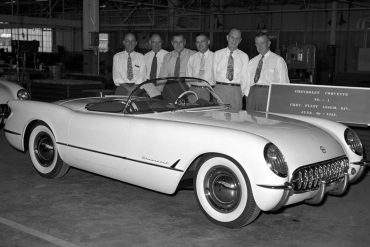


Chevrolet built 3,640 Corvettes for the 1954 model year, all convertibles. Production began in December 1953, with the first 14 or 15 cars assembled in Flint, Michigan, before the line moved to a renovated plant in St. Louis, Missouri. Sales fell well short of plan, and about 1,500 cars remained unsold at the end of the year.
A 1954 Corvette is a five-figure collector car, not a six-figure one like the 1953. In 2026, original or highly original cars sold for roughly $39,000 to $80,000 at auction, with most clustered between $40,000 and $60,000. Project cars have sold for $13,000 to $20,000. Color, originality of the engine and drivetrain, and documentation drive the spread.
Every 1954 Corvette used the 235.5-cubic-inch “Blue Flame” inline six with three Carter sidedraft carburetors, rated at 150 horsepower early in the year and 155 horsepower after a new camshaft was introduced. The only transmission was the two-speed Powerglide automatic, even though Chevrolet listed it as a $178.35 option.
Four. Polo White with a red interior accounted for about 3,230 cars, Pennant Blue with a tan interior for about 300, Sportsman Red with a red interior for about 100, and Black with a red interior for as few as four to six cars. All had a tan convertible top. Metallic Green and Metallic Bronze appeared in period paint bulletins, but no factory records show a car built in either color.
Chevrolet advertised a base price of $2,774, down from $3,498 in 1953, but the Powerglide transmission ($178.35), heater ($91.40), AM radio ($145.15), directional signals, whitewall tires, parking brake alarm, courtesy lights and windshield washers were all listed as options and fitted to every car. The price actually charged was $3,254.10 before local taxes and dealer charges.
Mechanically very little. The 1954 moved production from Flint to St. Louis, added three colors to Polo White, changed the top from black to tan, ran the exhaust outlets below the body so they stopped staining the paint, fitted a single-handle hood latch and moved the choke to the left of the steering column, and gained 5 horsepower from a new camshaft during the year. The body, chassis, Blue Flame six and Powerglide automatic carried over.
Chevrolet planned on up to 1,000 cars a month but built 3,640 for the year and still had about 1,500 unsold at the end of it. Buyers wanted a sports car and got a two-speed automatic, a six-cylinder engine and side curtains instead of roll-up windows, at a real price of $3,254.10 that bought a V-8 Cadillac. Water leaks, tricky carburetor tuning and the $2,774 pricing trick did not help. The poor showing nearly ended the Corvette before the V-8 arrived in 1955.
1954 Corvette Advertisements / 1954 Corvette Colors / 1954 Corvette Engine / 1954 Corvette Factory Options / 1954 Corvette For Sale / 1954 Corvette Maintenance / 1954 Corvette Owners Manual / 1954 Corvette Performance / 1954 Corvette Posters / 1954 Corvette Pricing / 1954 Corvette Production / 1954 Corvette Recalls / 1954 Corvette Research / 1954 Corvette RPO Codes / 1954 Corvette Sales Brochures / 1954 Corvette Special Model Overview / 1954 Corvette Specifications / 1954 Corvette Technical Research / 1954 Corvette Service Bulletins / 1954 Corvette VIN Numbers