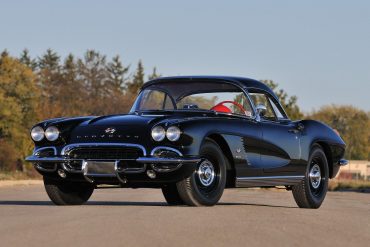
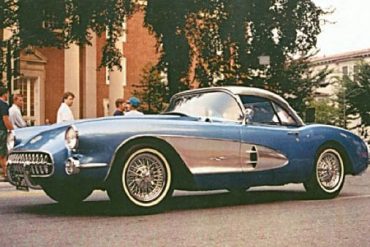
The only SR-2 built to be driven on the street belonged to GM's president. Car #1636 left the line in 1956 and came back with a fuelie 283, a 100-pound louvered hood and Curtice's own blue metallic paint.


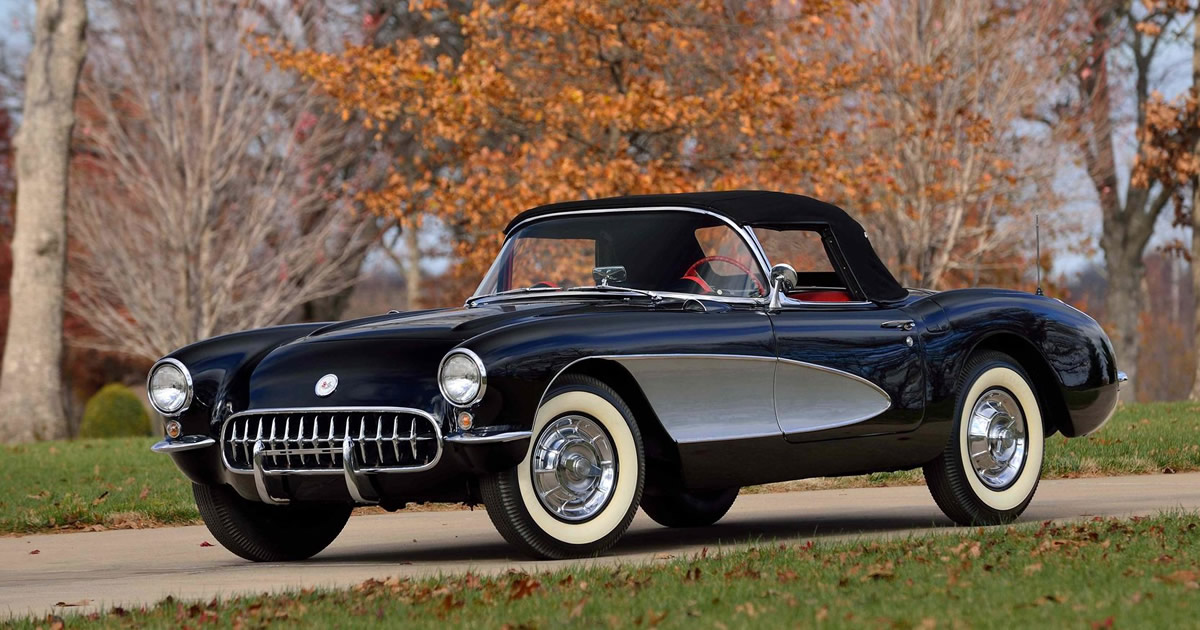
C1 CORVETTE - 1956
The first real Corvette: a new body with the side coves, roll-up windows, a 210-hp V-8 as standard, a three-speed manual, and 3,467 cars built as GM finally decided to make the Corvette a sports car.
Quick Nav: The Story · Specials · Price & Options · VIN · Specs · Technical · Pics & Videos · The Market · All Content · FAQs
Model & Gen: 1956 Corvette (C1)
Body Type: 2 Door Convertible (removable hardtop optional)
VIN: E56S001001 – E56S004467
Original Price: $3,120 base; $3,467 typical as equipped
Colors: 6 (Onyx Black, Aztec Copper, Cascade Green, Arctic Blue, Venetian Red, Polo White)
Engine: 265 ci V-8, 210 hp; 225/240 hp dual-quad optional
Transmission: 3-speed manual standard; 2-speed Powerglide optional
Units Produced: 3,467
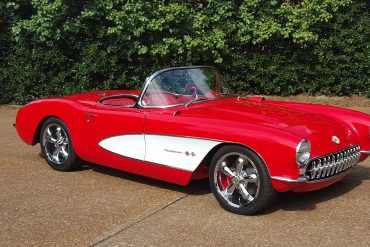
The 1956 Corvette is the car Chevrolet should have built in 1953. With the Thunderbird outselling the 1955 Corvette 23 to 1, Harley Earl gave the car an entirely new body: exposed headlights, the scalloped side coves that would define the C1 through 1962, roll-up glass windows in place of side curtains, outside door handles, and a removable hardtop. The chassis, wheelbase and dashboard carried over, but nothing about the car looked or felt half-finished any more.
Under the hood the 265 V-8 became standard at 210 horsepower, the three-speed manual replaced the Powerglide as the base transmission, and for $172.20 buyers could have dual four-barrel carburetors and 225 horsepower; 3,080 of the 3,467 cars built were ordered that way. A further 111 got Zora Arkus-Duntov’s high-lift camshaft, the engine that set a 150-mph two-way average on the sand at Daytona and took the SR cars racing at Sebring.
Six colors, two-tone cove paint, power windows and a power-operated top rounded out the first real option list a Corvette had ever had. Sales were still modest, but the car’s reputation turned around in a single year, and the 1957 that followed was essentially this car with fuel injection.
The end of the 1955 model year left Chevrolet executives questioning the direction in which they should take the Corvette. After all, they had addressed the issue of performance by introducing the small-block V-8 engine and a 3-speed manual transmission as options for consumers to include in their cars. Still, Corvette’s sales were far from the expectations that GM required to consider a car successful in the marketplace. While some critics of the car were already reporting that the Corvette’s demise was imminent, the reality of the situation was considerably different.
One of General Motors’ biggest competitors (and arch enemies) had launched a car campaign that seriously threatened Corvette’s corner on the marketplace. The Ford Thunderbird had met with resounding success, taking a firm foothold in the car market and proving without question that a car manufacturer could succeed by marketing a two-seat sports car (although Ford chose to refer to the Thunderbird as a “personal” car, thereby avoiding the criticism that cars like the Corvette received from racing/performance car purists).
It was clear that the Corvette, for better or worse, was going to be Chevrolet’s best shot at competing with the Thunderbird, but they also knew that, despite it’s recent mechanical improvements, it required a makeover - both cosmetic and functional - to truly become a world class contender.
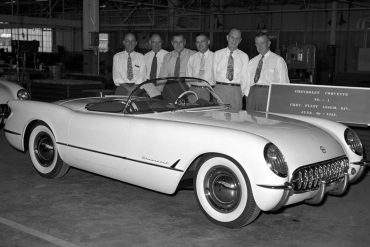
Truth be told, the 1953 - 55 Corvette was neither a serious performance sports car nor a small, fun-to-drive roadster that anyone could afford. Instead, it had gained a reputation as being an overpriced “image” car, though many questioned what that image was supposed to project.
In addition, the car was prohibitively expensive. With a price tag of approximately $3500.00, a Corvette cost nearly twice as much as a typical family sedan.
As the 1956 model year approached, all of these items were brought into question. What could Chevrolet do to make the Corvette more appealing? What would it take to make the Corvette superior to the Ford Thunderbird in every aspect? As the Thunderbird had outsold the 1955 Corvette at a ratio of 23-1, this was a challenge that Chevrolet was prepared to commit their best resources to, ensuring that Corvette would never again fall so short of the competition.
Harley Earl, who had been taking the many public criticisms about the Corvette to heart, dove headlong into the process of addressing them.
On February 1, 1955, just as the Ford Thunderbirds were beginning to make an appearance on the streets in serious numbers, Earl had all but finalized a full scale clay model of a new Corvette body. By Mid-April, having made a number of minor trim changes, Earl approached General Motors management with his model and, upon inspection, the new design was approved on the spot. The results of his new design was a 1956 Model Corvette that would change the direction of Corvette sales for all time. This “ second-generation ” styling was based on three concept cars that appeared at the 1955 Motorama: The Chevrolet Biscayne and a pair of showstoppers dubbed “LaSalle II”.
The Biscayne was a compact four-door hardtop with features that included “bugeye” headlamps that were set high and inboard of fender mounted parking lights, a grill that was made up of a series of vertical bars, shallow air-intake slots that were positioned in the cowl just ahead of and below a huge compound-curve windshield, and a flat bottom floor that was level with the bottom of the frame.
Did you know? One of the few ways to differentiate between a 1956 and a 1957 Corvette without opening the hood is to look at the inside rear view mirror. On the 1956 Corvette model, the mirror adjusts with a thumbscrew, whereas on the 1957, the rear view mirror adjustment requires a wrench to loosen the locknut.
The LaSalle II was a similar styled hardtop sedan and sporty roadster combo; both versions had prominent vertical-bar grilles as well but sported a styling touch the 1956 Corvette would inherit; an elliptical concave section at the rear of the lower bodysides that was swept back from the front wheel wells. These areas would come to be known as “coves” and would eventually be recognized as signature trademarks of the Corvette.
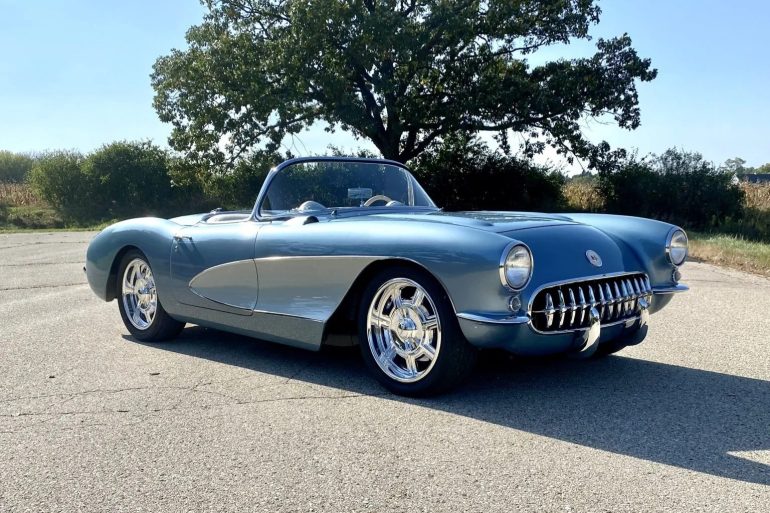
The bodyside “coves” gave the 1956 Corvette a truly unique styling personality. While the body stylings of the 1953 - 1955 Corvette had led the car to become mockingly called “the plastic bathtub”, this new look helped to correct the long, blocky look of the original ‘Vettes and gave the new design an aggressive look and flow that was clean and attractive. To further accentuate the overall styling of the car, the coves were outlined in chrome and were often painted a different color than the rest of the car.
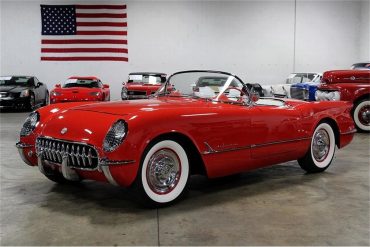
On the 1953-1955 Corvette, the front end or “face” of these cars was considered to be it’s most appealing element.
Many criticisms of the first generation C1 was that the headlight screens gave the Corvette’s face a veiled look, which was considered inappropriate for a “man’s” car. The 1956 Corvette design corrected this issue by bringing the headlights forward and uncovering them. Complementing this was a larger version of the round Corvette nose emblem, featuring the crossed-flags motif that continues to survive today. The grill, or “mouth” would remain unchanged for the 1956 model.
Rear end styling revisions to the Corvette were also performed. The 1953-1955 fenders and jet-pod tail lamps were minimized to more attractive French curves contoured to match the rear deck curvature. New taillights were neatly added above a vertical bumperette on each fender. The trunklid “shadow box” was discarded and the license plate was moved to below the trunk opening. In all, the result was a smooth, gently curved backend with slightly protruding fenders.
Aside from the dramatic improvements that were made to the Corvette’s appearance, the ‘56 model also marked another landmark change for not only Corvette, but for the design/styling staff of General Motors as a whole. The 1956 Corvette would be one of the last production cars to be designed before the styling staff was moved from Detroit to the new corporate Technical Center in Warren, Michigan.
The new Corvette was now largely devoid of any styling gimmicks, though two obvious ones remained: there were still two faux vent scoops atop the front fenders near the windshield and the car still continued to include the often-criticized wheel-knockoff hub covers (hubcaps). These hub covers would remain a standard feature on the Corvette until the 1963 model year. Ironically, the hubcaps have become known as some of the best covers in automotive history.
Finally, the Corvette had begun to come into it’s own both stylistically and functionally. Gone forever were the awkward and disliked side curtains of the 1953-55 models, replaced forevermore by roll up glass windows.
Chevrolet even went so far as to offer automatic roll-up windows as an option (for an additional cost). Outside door handles were also included in the redesigned door, allowing Corvette owners the ability to open the door without having to reach into the car to do so.
The car’s standard convertible top was improved upon, now providing a tighter fit that virtually eliminated leaks. It was also offered for the first time in beige and white in addition to the standard-issue black cloth top.
A power-operated convertible top was offered for the first time as an option (at a cost of $170.60). While the top was technically only partially automatic - it required the operator to first unlatch and partially collapse the top before activating the fold button - it was still a remarkable improvement over the original convertible tops of the earlier models.
Better still was the optional hardtop that was originally modeled on the production-based prototype seen at the 1954 Motorama Show. This hardtop was also a factory option available to consumers for an additional $215.20 (although it could be swapped for the factory soft top at no additional charge). One of the greatest benefits of the optional hardtop was that it offered superior visibility when compared to the factory soft top.
Little changed on the interior of the car itself from the 1955 model. The car retained the existing “twin cowl” dashboard with it’s awkward, full-width instrument panel.
A new spring-stroke steering wheel was included in the interior re-design as well a new waffle-pattern upholstery and revised door panels to go with the wind-up windows.
The car’s heater was changed from a recirculating variety to a new “fresh air” version after the first 145 production cars were built.
A transistorized signal-seek radio was also offered as an option (for an additional $198.90). Seatbelts were also offered for the first time as a dealer installed accessory kit.
From a performance base, the new, small block V-8 that had made it’s first appearance in the 1955 Corvette as an option was now standard for 1956. The small block contained more muscle than before and now featured a rated 210 bhp at 5200 rpm. The car now featured a single, four barrel carburetor and higher 9.25:1 compression.
Considering that just three years earlier, the Corvette was producing a mere 155 bhp, this was a considerable improvement. A special high lift camshaft was made available as an option for an additional $188.30, but was only available in tandem with the optional 225-bhp dual four-barrel carburetor equipped engine for another $172.20. Chevy recommended this combination for “racing purposes only”. It was said that, when running on premium fuel, this engine could produce around 240 bhp.
It was clear by these impressive improvements that the “Blue Flame” six cylinder was gone for good - and few were sad to see her go.
Like the small block V-8 engine, the 3 speed transmission was also standard in 1956. In a “role reversal”, the Powerglide 2 speed became the optional transmission for an additional $189.00. The manual transmission was tweaked with much closer gear ratios than in the 1955 version. In addition, the shifter was now attached directly to the transmission housing, which allowed for more positive shifts. A stronger clutch was added and the rear differential was also new for 1956.
Finally, Corvette began to emerge with growing acceptance from both consumers and critics alike. The consensus was that Chevrolet had finally presented a Corvette that was no longer “half finished” but rather offered genuine sports car performance with smart new styling and a full complement of options and amenities. Enthusiast magazines generally praised the new Corvette, stating that it’s manual shifter was race worthy and that the car’s handling was “good to excellent compared to other cars in it’s class” though it was identified that the car did have a tendency to under steer. The steering gear itself provided for quick and accurate steering - just 3.5 turns from lock to lock. Even weight distribution was close to perfect with a 52/48 percent distribution front/rear.
The one remaining problem that continued to present a challenge to the Corvette was that of brake fade. This single weak point did little to detract from the overall positive image this new Corvette portrayed, although testers did note that they “faded into oblivion” during hard braking conditions. In all, the critics agreed that the car offered greatly improved road behavior despite the fairly harsh, but controlled, ride.
Finally, there was no doubt that the true American sports car had come of age. While production numbers were still down from where GM would have hoped they would be, a total of 3,467 Corvettes rolled off the line that year, re-affirming to those within the General Motors family who doubted that the Corvette could ever be made commercially viable that this car was finally on it’s way - and prepared to do battle for the business that was currently being given to the Ford Thunderbird line.
Interestingly, in order to make the Corvette more commercially viable, members of the Corvette engineering and design teams began looking at other ways that they could utilize this car. After all, having a sports car was of little value if you couldn’t truly use it for sport.
Nobody knew this better than Zora Arkus-Duntov, as he had once been a respected and accomplished race car driver during the early years of his career. Duntov believed that having a race winning image was vital to the success of the Corvette. Duntov had developed a high lift camshaft specifically for the intent of making the Corvette a contender in racing circuits.
He believed that if the Corvette could set a few speed records and win some races, Chevrolet would be able to capitalize on these feats and thereby further promote their newly improved sports car. GM gave Duntov the “green light” to proceed with his plan and the Duntov camshaft was placed into a modified 1956 model Corvette that had been specifically prepared at GM’s Arizona proving grounds.
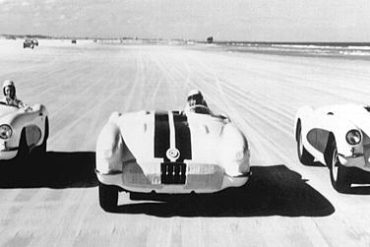
Following test runs in Arizona, the car was then shipped to Daytona Beach, Florida where Betty Skelton and John Fitch would drive it at the Daytona Speed Weeks trials in January. Their goal was to reach 150 miles per hour. Despite less than favorable beach conditions (remember that the Daytona Speedway was still several years in the future), the Corvette (with Duntov behind the wheel) managed an impressive two-way run of 150.583 miles per hour
By September of 1956, commercial advertisements were exclaiming that “The 1956 Corvette is proving - in open competition - that it is America’s only genuine production sports car.”
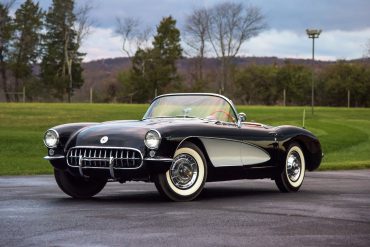
 '56-57 Corvette are distinguishable from later model C1s thanks to single headlight on either side of the front end.


The easiest way to tell a 1956 Corvette from a 1957 without opening the hood is the inside rear-view mirror: the 1956 mirror adjusts with a thumbscrew, the 1957 needs a wrench to loosen a locknut. Everything else on the body is the same.
DID YOU KNOW
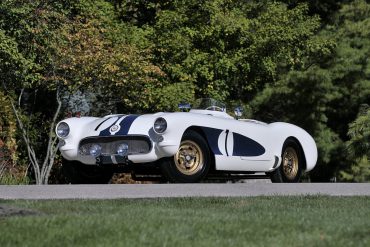
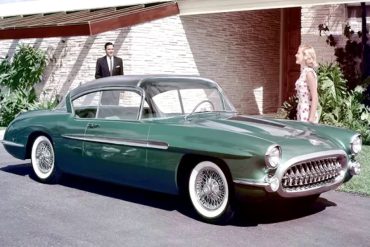
1956 is the year the Corvette went racing: Duntov’s Daytona record car, the SR and SR-2 Sebring cars, and the show cars that followed them.

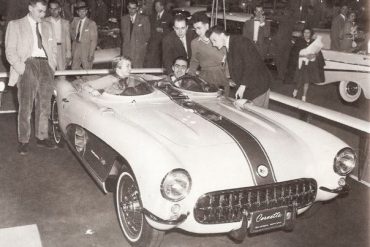
The base price rose to $3,120, and for the first time the option list meant something. The big one was RPO 469, the dual four-barrel 225-horsepower engine at $172.20, taken by 3,080 buyers, with the Duntov high-lift camshaft (RPO 449, $188.30, 111 cars) available only on top of it. The Powerglide automatic was now a $188.50 option rather than the only choice; the three-speed manual was standard. Comfort options were new to the Corvette: power windows (RPO 426, $64.60, 547 cars), a power-operated folding top (RPO 473, $107.60, 2,682 cars), a signal-seeking transistor radio ($198.90, 2,717 cars) and, most popular of all, the removable hardtop (RPO 419, $215.20, 2,076 cars), which could be swapped for the soft top at no charge.
Six exterior colors were offered, each with black or white soft tops and a choice of red or beige interiors, and 1,259 cars were ordered with the $19.40 two-tone paint that picked out the side coves in a contrasting color, usually silver or beige. Venetian Red was the most popular at 1,043 cars, followed by Onyx Black (810), Polo White (532), Aztec Copper (402), Arctic Blue (390) and Cascade Green (290). Those totals add up to exactly 3,467. Note that the guide’s text quotes the Powerglide at $189.00 and the power top at $170.60; the factory price list above is the better source.
MORE: PRICING, OPTIONS & COLORS / RPO CODES
| CODE | DESCRIPTION | QUANTITY | RETAIL PRICE |
|---|---|---|---|
| 2934 | Base Corvette Convertible | 3,467 | $3,120.00 |
| 101 | Heater | – | $123.65 |
| 102 | AM Radio, Signal Seeking | 2,717 | $198.90 |
| 107 | Courtesy Lights | 2,685 | $5.40 |
| 108 | Parking Brake Alarm | 2,775 | $8.65 |
| 109 | Windshield Washers | 2,815 | $11.85 |
| 290 | Whitewall Tires, 6.70 x 15 | – | $32.30 |
| 313 | Powerglide Automatic Transmission | – | $188.50 |
| 419 | Auxillary Hardtop | 2,076 | $215.20 |
| 426 | Power Windows | 547 | $64.60 |
| 440 | Two-Tone Paint Combination | 1,259 | $19.40 |
| 449 | Special High-Lift Camshaft | 111 | $188.30 |
| 469 | 265 Cubic Inch, 225 Horsepower Engine (2x4 Carbs) | 3,080 | $172.20 |
| 471 | Rear Axle 3.27:1 Ratio | – | $0.00 |
| 473 | Power Operated Folding Top | 2,682 | $107.60 |
| EXTERIOR | TOTAL | CONVERTIBLE TOP COLOR | INTERIOR COLOR OPTIONS |
|---|---|---|---|
| Onyx Black | 810 | Black/White | Red |
| Aztec Copper | 402 | Black/White | Beige |
| Cascade Green | 290 | Black/White | Beige |
| Arctic Blue | 390 | Black/White | Beige/Red |
| Venetian Red | 1,043 | Black/White | Red |
| Polo White | 532 | Black/White | Red |
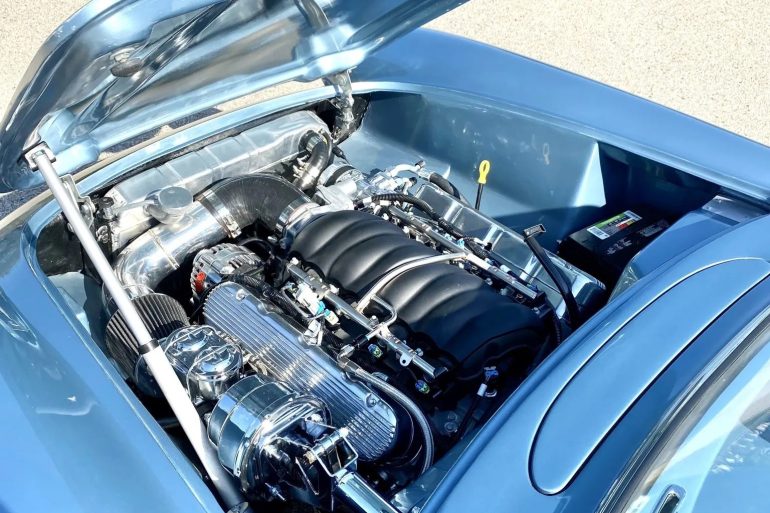
For 1956 the 265-cubic-inch small-block was standard, the Blue Flame six was gone for good, and the engine was stronger than the 1955 unit: 9.25:1 compression and a single Carter four-barrel gave 210 horsepower at 5,200 rpm and 270 lb-ft at 3,200. The dual four-barrel option (RPO 469) added a cast aluminum intake, two Carter WCFBs, a dual-point distributor and finned aluminum valve covers for 225 horsepower, and almost nine in ten buyers took it. Adding the Duntov high-lift camshaft (RPO 449) pushed the dual-quad engine to around 240 horsepower, though Chevrolet never published a figure; this is the engine that averaged over 150 mph at Daytona Speed Weeks in January 1956 and ran at Sebring.
The close-ratio three-speed manual became standard, now with the shifter on the transmission rather than a remote linkage, and the two-speed Powerglide was the option. The result was a transformed car: 0–60 in 7.4 seconds and the quarter mile in 15.9 seconds at 88 mph for a dual-quad manual car, with a top speed of 129 mph. Suspension and the 11-inch drum brakes carried over, and the brakes were the one weak point testers kept noting, fading badly in hard use. The heater changed from recirculating to fresh-air after the first 145 cars, the passenger seat gained fore-and-aft adjustment, and a 53-amp-hour battery became standard.
MORE: FULL SPECIFICATIONS / ENGINE
| SPEC | 1956 CORVETTE |
|---|---|
| Engine (standard) | 265 ci (4.3 L) OHV small-block V-8, cast iron block & heads, single Carter WCFB four-barrel |
| Engine (RPO 469) | 265 ci V-8 with dual Carter four-barrels on a cast aluminum intake, 225 hp; 3,080 of 3,467 cars |
| Engine (RPO 449) | Dual-quad 265 with the Duntov high-lift camshaft, approx. 240 hp; 111 cars |
| Horsepower | 210 hp @ 5,200 rpm (standard); 225 hp @ 5,200 rpm (dual-quad); 240 hp (Duntov cam) |
| Torque | 270 lb-ft @ 3,200 rpm (standard); 270 lb-ft @ 3,600 rpm (dual-quad) |
| Compression ratio | 9.25:1 |
| Transmission | 3-speed close-ratio manual standard, floor shift; 2-speed Powerglide automatic optional (RPO 313, $188.50) |
| Axle ratio | 3.55:1 standard; 3.27:1 optional (RPO 471, no charge) |
| Electrical | 12-volt, 53 amp-hour battery; dual-point distributor on optional engines |
| Front suspension | Independent; upper and lower A-arms, coil springs, anti-roll bar, tubular hydraulic shock absorbers |
| Rear suspension | Live axle on semi-elliptic leaf springs, tubular hydraulic shock absorbers |
| Brakes | 11-in drums front and rear (fade under hard use was the one consistent criticism) |
| Tires | 6.70 x 15 in, tubeless |
| Wheelbase | 102 in |
| Overall length | 168 in |
| Curb weight | 3,020 lb / 1,370 kg |
| 0–60 mph | 7.4 sec (dual-quad, manual) |
| Quarter mile | 15.9 sec @ 88 mph |
| Top speed | 129 mph |
| Production | 3,467, all convertibles; 2,076 with the removable hardtop |
| Assembly | St. Louis, Missouri |
The last four digits begin at 1001 and run through 4467, accounting for each of the 3,467 Corvettes built for 1956. The VIN plate is on the driver-side door post and the number is also stamped in several places on the frame. The 1956 VIN returns to ten characters: with the six gone, the V prefix used on 1955 V-8 cars was dropped, so every 1956 begins E56S.
The engine pad tells you which engine the car was built with: suffix FK for the 210-hp single-carb engine with Powerglide, GV for the same engine with the manual, FG for the dual-quad 225 with Powerglide, GR for the dual-quad with the manual, and GU for the dual-quad with the Duntov camshaft and manual. Only one body style, the convertible, was built, with the removable hardtop as an option on 2,076 of them.
MORE: VIN DECODER / PRODUCTION
| POSITION | MEANING |
|---|---|
| E (First Digit) | General Motors Identification Code for Chevy Corvette. |
| 56 (Second & Third Digits) | Model Year |
| S (Fourth Digit) | Location of the Assembly Plant. S - St. Louis, Missouri. |
| 00XXXX (Fifth thru Tenth Digits) | Production Sequence Numbers |
The new body came in six colors, and 1,259 of the 3,467 cars had the contrasting cove color: Venetian Red (1,043), Onyx Black (810), Polo White (532), Aztec Copper (402), Arctic Blue (390) and Cascade Green (290).
The 1956 is the first C1 that is bought to be driven as much as collected, and the market reflects it: more cars, a wider spread of condition, and real differences between specifications. The things that move the price are the engine (a documented dual-quad car over a single-carb car, and a genuine RPO 449 Duntov-cam car over both), the three-speed manual over the Powerglide, the hardtop, two-tone paint and the rarer colors, and above all whether the engine is the one the car was built with. An SR-2 tribute or a car with a later 283 or 327 is a different, cheaper market and should be priced as a driver.
Results tracked by Classic.com through the summer of 2026 put original or well-restored dual-quad cars mostly between $65,000 and $95,000: $69,300 at Mecum Houston in April, $65,000 and $95,000 on Bring a Trailer in April and July, $88,000 at Barrett-Jackson Columbus in June, and $71,500 and $93,500 at Mecum Monterey in August. Hardtop-equipped manual cars with strong documentation reach further, $134,400 at Kruse Auburn in April, and a modified car brought $165,000 at Barrett-Jackson Columbus. The floor is around $40,000 to $55,000 for sound but unexceptional cars, with a $60,500 SR-2 tribute and a $46,000 no-sale on a modified car marking the lower end. Dealer asking prices ran $80,000 to $95,000. Check whether a result includes the buyer’s premium, and treat asking prices and unsold high bids separately from completed sales.
Verification starts at the engine pad: the suffix code (FK, GV, FG, GR or GU) should match the car’s equipment, and the block date should precede the car’s build. Dual-quad cars should carry the cast aluminum intake, two Carter WCFB carburetors, a dual-point distributor and the nine-fin aluminum valve covers; all of these have been reproduced, so a specialist should look at casting numbers and dates rather than appearance. Power windows and the power top are easy to add later, so check the tank sticker or build records where they survive. NCRS judging sheets, old photographs and restoration invoices all help, and ask to see dates and scores rather than just the award.
The body is new for 1956 and the places it cracks are well known: around the headlight bezels, the door hinge pillars, the cove edges where the two-tone trim mounts, and the cowl. Door fit is the quickest guide to a restoration, since the roll-up windows and outside handles make the doors heavier than on the 1953–55 cars. Underneath, the boxed frame rails rust from the inside, so an inspection on a lift is essential. On the road, a dual-quad car should idle evenly on both carburetors and the three-speed should not jump out of second; expect the drum brakes to be adequate rather than good. Most of these cars see few miles, so budget for tires, brakes and fuel-system work on anything that has sat.
MORE: THE MARKET

Chevrolet built 3,467 Corvettes for 1956, all convertibles, at St. Louis, Missouri. Of those, 2,076 were ordered with the new removable hardtop, 3,080 with the dual four-barrel 225-horsepower engine and 111 with the Duntov high-lift camshaft. It was nearly five times the 700 cars of 1955 and the year the Corvette’s future stopped being in doubt.
In 2026, original or well-restored 1956 Corvettes have mostly sold for $65,000 to $95,000 at auction, with sound driver-quality cars from about $40,000 and the best documented hardtop manual cars reaching $130,000 or more. A verified dual-quad engine, a three-speed manual, the hardtop and rare colors all add value; a replacement engine or an SR-2 tribute build takes it away.
The 265-cubic-inch small-block V-8 was standard for the first time, rated at 210 horsepower with a single four-barrel carburetor. The dual four-barrel option gave 225 horsepower and was fitted to 3,080 of the 3,467 cars, and the Duntov high-lift camshaft raised that to around 240 horsepower on 111 cars. A three-speed manual was standard and the two-speed Powerglide automatic was a $188.50 option.
Six: Venetian Red (1,043 cars), Onyx Black (810), Polo White (532), Aztec Copper (402), Arctic Blue (390) and Cascade Green (290), with black or white soft tops and red or beige interiors. For $19.40, 1,259 buyers took the two-tone option that painted the side coves in a contrasting color, usually silver or beige.
The base price was $3,120 with the 210-horsepower V-8 and three-speed manual. Most buyers added the dual-quad engine ($172.20), the hardtop ($215.20), the power top ($107.60) and the radio ($198.90), which put a typical car around $3,800. The Ford Thunderbird, by comparison, started at about $3,150.
Almost everything you can see. The 1956 got a new body with exposed headlights, the scalloped side coves, roll-up glass windows, outside door handles, a tighter convertible top in three colors and an optional removable hardtop. Mechanically the V-8 became standard, the three-speed manual replaced the Powerglide as the base transmission, and dual four-barrel carburetors and the Duntov camshaft joined the option list. The chassis, 102-inch wheelbase and dashboard carried over from 1955.
Yes, and it was the first Corvette that did. In early 1956 a Duntov-cam car averaged over 150 mph on the sand at Daytona Speed Weeks, and in March the SR cars ran the 12 Hours of Sebring, with the best finishing ninth overall and winning its class. Chevrolet’s advertising that September called the Corvette “America’s only genuine production sports car.”
1956 Corvette Advertisements / 1956 Corvette Colors / 1956 Corvette Factory Options / 1956 Corvette For Sale / 1956 Corvette Maintenance / 1956 Corvette Owners Manual / 1956 Corvette Performance / 1956 Corvette Posters / 1956 Corvette Pricing / 1956 Corvette Production / 1956 Corvette Recalls / 1956 Corvette Research / 1956 Corvette RPO Codes / 1956 Corvette Sales Brochures / 1956 Corvette Special Model Overview / 1956 Corvette Specifications / 1956 Corvette SR-2 Sebring Racer / 1956 Corvette SS Show Car / 1956 Corvette Technical Research / 1956 Corvette Service Bulletins / 1956 Corvette VIN Numbers