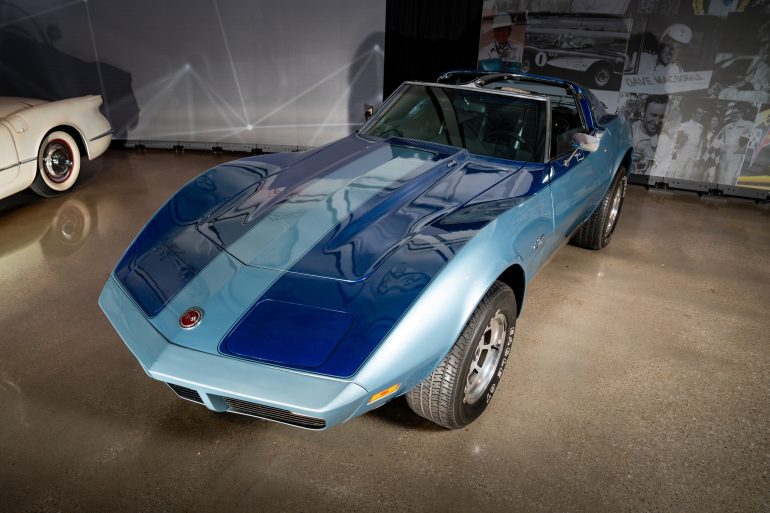
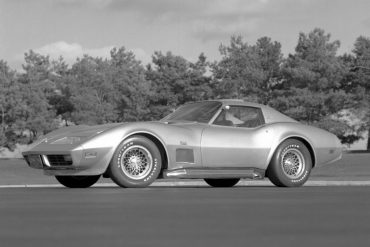
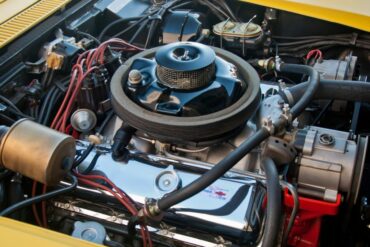
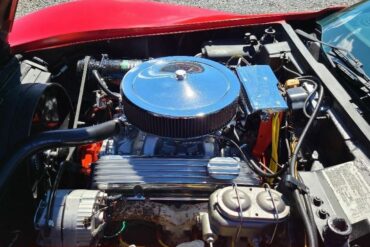
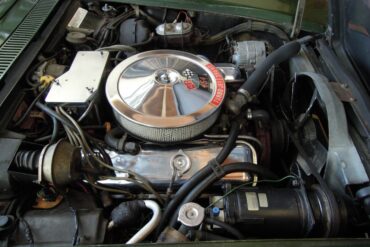
Chevrolet Corvette Mulsanne Showcar, 1974. Created by Bill Mitchell, the Mulsanne was a development of several previous Corvette “specials”, the 1969 Aero and the 1970 Scirocco. By 1974 it had been bored out to 454 ci and fitted with an experimental Rochester fuel injection system, it also had a periscope rearview mirror system.
Quick Nav: Story · Specials · Price & Options · VIN · Specs · Technical · Pics & Videos · The Market · All · FAQs
The Basics
Model & Gen: 1974 Corvette (C3)
Body Type: Sport Coupe (T-top) or Convertible
VIN: 1Z37J4S400001 – 1Z37J4S437502
Original Price: $6,001.50 coupe / $5,765.50 convertible
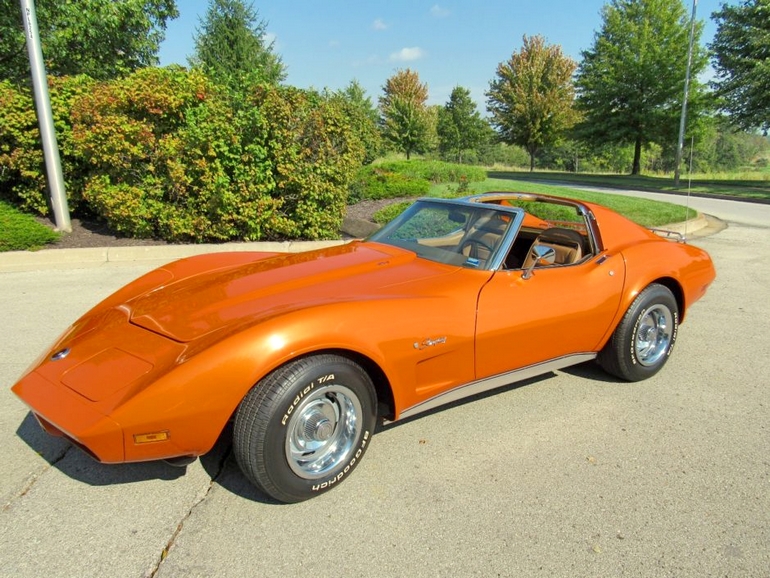
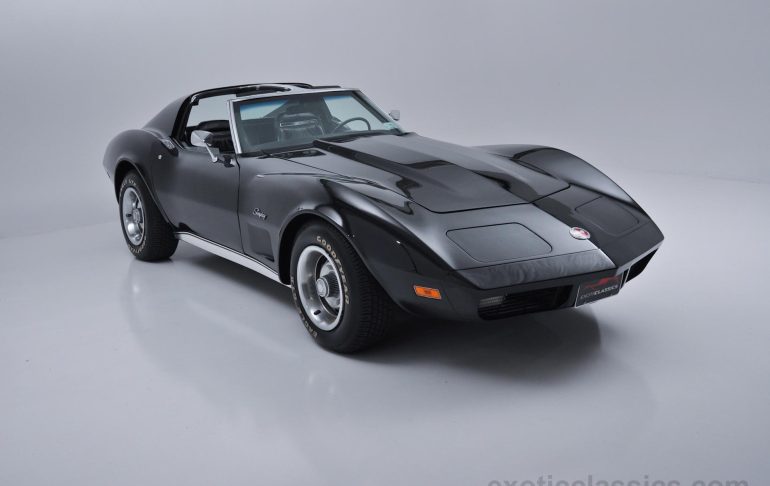
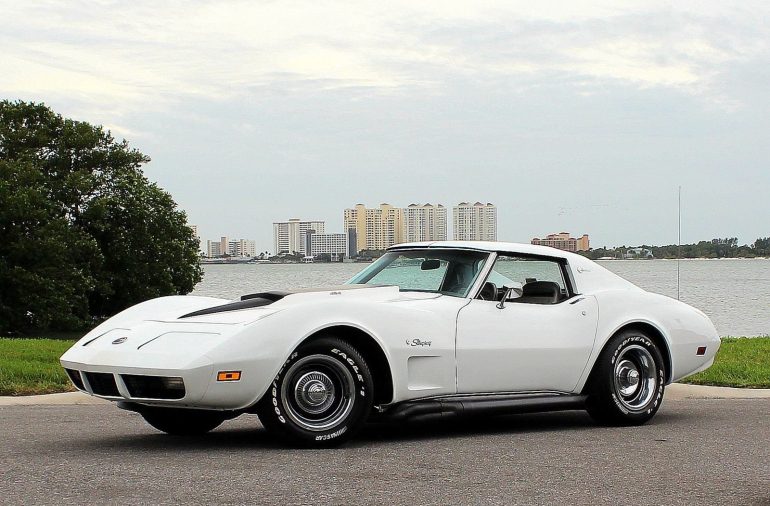
Colors: 10 (Classic White, Silver Mist, Corvette Gray, Corvette Medium Blue, Dark Green, Bright Yellow, Dark Brown, Medium Red, Mille Miglia Red, Corvette Orange)
Engine: 350 ci V-8, 195 hp (L48) or 250 hp (L82); 454 ci big block, 270 hp (LS4), the last big-block Corvette; all SAE net
Transmission: Muncie 4-speed standard (M20 wide or M21 close ratio at no charge); 3-speed Turbo Hydra-Matic (M40) at no charge, in two thirds of cars
Units Produced: 37,502
The Overview
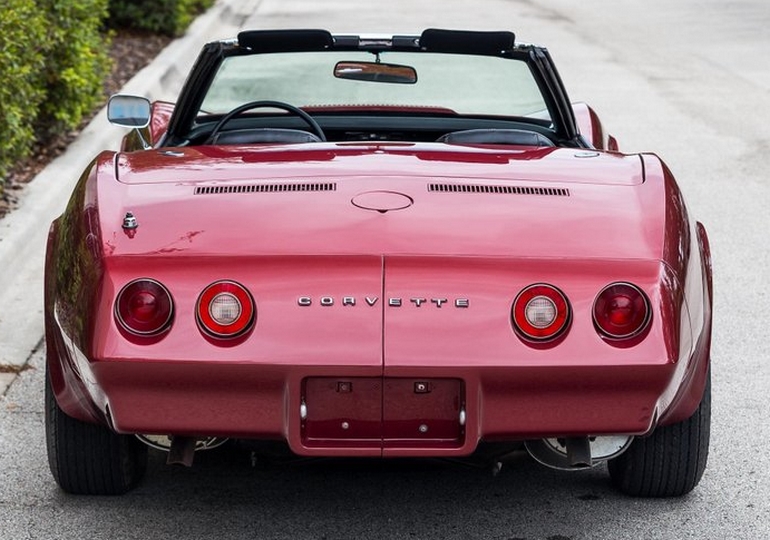
The 1974 Corvette finished what the 1973 started. The federal five-mph standard now applied at the back, and Chevrolet answered with a body-color urethane cover over an aluminum impact bar on telescoping brackets, tapering down instead of up like the old Kamm tail, with the license plate and taillights recessed into it and the exhaust moved below it. The cover was moulded in two halves with a vertical seam down the middle, which lasted one year and is the quickest way to spot a 1974. The alarm switch moved to the left front fender, coupes got integrated lap-and-shoulder belts with inertia reels, the inside mirror grew to ten inches, the radiator was redesigned, the power-steering pump got magnets to trap debris, and resonators quieted the exhaust. The Gymkhana suspension, RPO FE7, offered the F41 springs and shocks for seven dollars.
Under the hood it was the end of several things. The LS4 454 made its last appearance, 270 hp and 380 lb-ft for $250, in 3,494 cars, and no Corvette since has had a big block. The 1974 was also the last Corvette to run on leaded fuel and the last without a catalytic converter, which means the last with true dual exhaust; from 1975 both banks fed one converter. The base L48 crept up to 195 hp and the L82 stayed at 250, good for 0–60 in about 7.5 seconds and 125 mph on 14 miles to the gallon, which mattered when the Arab oil embargo of October 1973 to March 1974 had drivers queuing for rationed gasoline.
The embargo did not hurt the Corvette. Production rose to 37,502, 32,028 coupes and 5,474 convertibles, second only to 1969, with the strengthened Turbo Hydra-Matic in two thirds of the cars, air conditioning in 78 percent, power steering in 96 percent and the custom interior in more than half. Prices rose $440 to $6,001.50 and $5,765.50. The 1974 is the car Zora Arkus-Duntov chose for himself, a loaded 454 coupe he bought after retiring in 1975 and kept until 1989, now restored by the National Corvette Museum; for everyone else it is the last big-block Shark and the most affordable one.
The 1974 Corvette Story
The arrival of the 1974 Chevy Corvette occurred during an abysmal period in automotive history. The period in question actually began in October 1973 when OAPEC (the Arab members of OPEC, the Organization of Petroleum Exporting Countries, plus Egypt, Syria and Tunisia) proclaimed an oil embargo against the United States after the United States came to the aid of the Israelis during a military altercation between Egypt, Syria, and Israel.
While the actual embargo only lasted a few months (it ended in March 1974, after OPEC received considerable pressure from NATO), the impact the embargo had on the automotive community was detrimental. Gas prices had soared, and massive fuel shortages had occurred, leaving motorists waiting in long lines at the pumps. In some instances, gasoline was actually rationed, especially in more densely populated areas. While the embargo was short-lived, it made automotive manufacturers seriously question the value that heavy, fuel-thirsty cars were bringing to the marketplace.
In many ways, the 1974 Corvette would represent the end of an era. Perhaps because of the embargo, and certainly a byproduct of it, the 1974 model would be the last year to be offered with an optional big-block 454 cubic inch V-8 engine.
Additionally, all future engines offered with the Corvette would only run on unleaded gasoline – a decision that would come in conjunction with the industry-wide requirement to install catalytic converters in every 1975 (and later) model. For its own part, the 1974 Corvette required 91-octane leaded or low-lead fuel.
Lastly, true dual exhaust would give way to separate manifolds routed into a single catalytic converter and then out through separate pipes. In fact, the 1974 Corvette would be the last model year without a catalytic converter.
Did you know? RPO YJ8 Cast Aluminum Wheels appeared on early 1974 option lists, but records indicate that none were sold. Since RPO P02 Deluxe Wheel Covers were no longer available, there were no optional wheels or wheel-covers available for the 1974 Corvette.
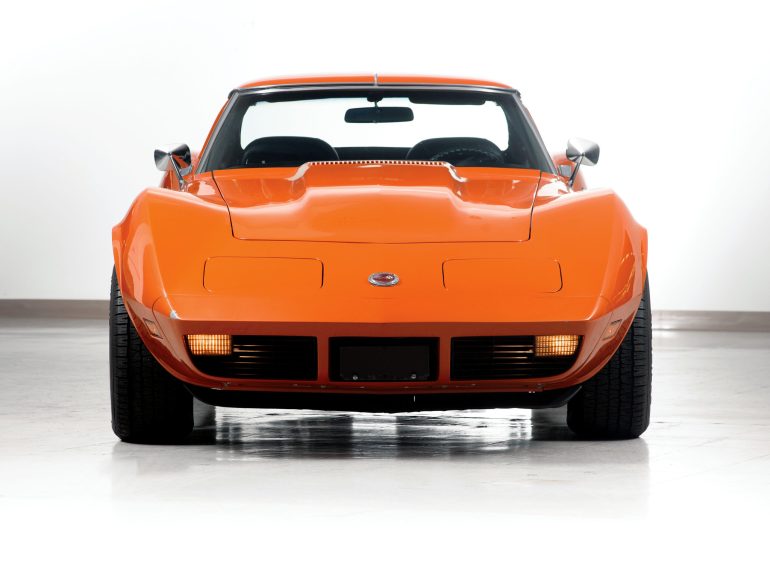
Cosmetically, the 1974 Corvette received a new body-color rear-end treatment that was made to comply with a new, federally imposed five-mile-per-hour impact standard.
Sheathed in urethane like the 1973’s front-bumper revision, the skin actually covered an aluminum impact bar that was mounted to the Corvette's chassis by two telescopic brackets.
The new rear bumper conveyed a smoother, more integrated look, and while it tapered downward instead of upward (as the previous Kamm-type rear end had done), it did not harm the car's aerodynamics. The urethane plastic skin had built-in recesses for the license plate and the taillights, and was actually assembled from two main sections that were divided by a vertical, center seam. This detail is unique to the 1974 model year and makes it easy to identify.
Turning to the interior, the 1974 Corvette received only minor enhancements. Perhaps the most notable improvement over the previous models was that the 1974 Coupe now featured an integrated shoulder belt/lap belt assembly for the first time. Shoulder belts remained optional in the convertible models, and if they were so equipped, continued to be a separate assembly from the lap belts. The locking mechanisms in the shoulder restraints also changed design from a pull-rate type (which would catch based on the amount of force applied to the belt) to a swinging-weight type that was activated by the car's deceleration. Elsewhere in the interior, the stock inside rearview mirror increased in width from 8 to 10 inches. Mechanically, a handful of improvements were made to the car. The standard L48 engine’s output increased slightly from the previous model year to 195 horsepower.
The market's growing preference for performance automatic transmissions resulted in a more durable Turbo Hydra-Matic. Designated by RPO M40, the transmission was a no-cost option and was installed in nearly two-thirds of all the Corvettes built that year.
The radiator was redesigned for more efficient cooling at low speeds. The power steering pump was made more durable via the use of magnets, which were installed to attract (and capture) debris in the power steering fluid. Downstream from the engine, resonators were added to the exhaust system, which enhanced the tone of the car during operation.
With the newly designed rear bumper in place, the exhaust pipes were re-routed to exit just below the bumper (instead of through the rear fascia as before). Lastly, the alarm activator was relocated from the rear of the car to the driver side front fender.
New for the 1974 Corvette was one of the most bargain-priced performance packages of all-time. The Gymkhana Suspension Package (RPO FE7) cost a mere seven dollars, featured a higher-rate spring assembly and firmer, specially calibrated shocks. This setup – which had been introduced and used since the mid-Sixties as part of Chevy's popular F41 Suspension Package – provided much improved handling on the 1974 Corvettes that were so equipped.
The F41 itself, which had begun with the Z06 racing option back in 1963, was still available as part of RPO Z07, and included the aforementioned suspension setup as well as heavy-duty brakes.
Given the performance constraints placed before it by Federal Emission Regulations, oil embargoes and a struggling economy, the 1974 Corvette still presented drivers with a respectable level of acceleration and performance. While it was hard to compare the 1974 Corvette to its slightly older, big-block brothers and sisters, its numbers spoke for themselves.
When equipped with the 250 brake horsepower L82 engine, the '74 Corvette could accelerate from 0 to 60 miles per hour in approximately 7.5 seconds and reach a top speed of 125 miles per hour while still averaging about 14-15 miles per gallon. Moreover, what it lacked in outright performance it made up for in luxury.
Production Volumes
The 1974 Corvette would become widely recognized as a very refined, grand touring car with plenty of creature comforts. The 1974 Corvette had a near-record sales year. In total, 37,502 Corvettes were sold – 32,028 coupes at a base price of $6,001.50, and a mere 5,474 convertibles at a base price of $5,765.50.


The rear fascia assembly of the 1974 Corvette was made of two separate urethane assemblies. Note the seam down the center of the rear fascia - it is a feature unique to the 1974 Corvette.


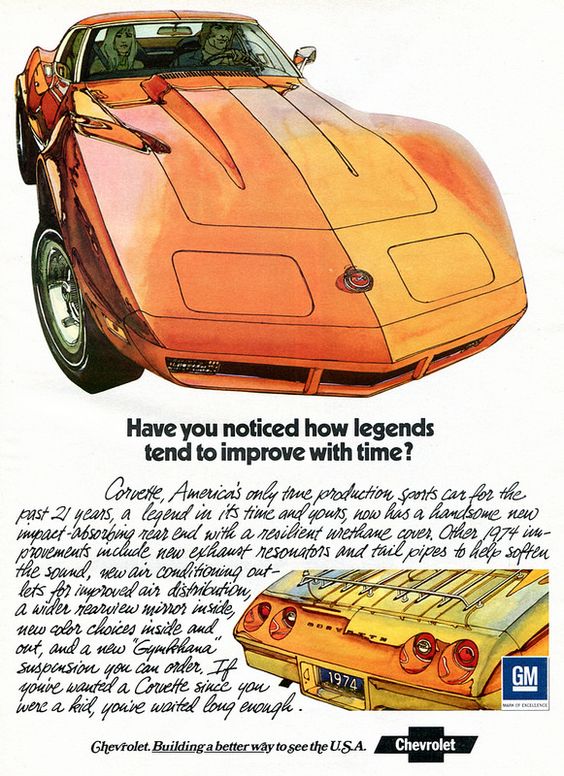
Original 1974 Chevy Corvette Advertisement. (Image courtesy of GM Media.)The only Corvette Zora Arkus-Duntov ever owned was a 1974: a loaded 454 coupe, originally Dark Green, that he bought after retiring in 1975, repainted two-tone with his initials on the doors, fitted with prototype wheels that did not reach production until 1976, and drove until 1989. The National Corvette Museum restored it in 2025 and it is now a permanent exhibit.
DID YOU KNOW
Price & Options
Core Features & Factory Options
The Sport Coupe listed at $6,001.50 and the convertible at $5,765.50, up $440 and $367 on 1973, the first Corvette over $6,000, with radial tires, the alarm, Positraction and the four-speed or Turbo Hydra-Matic included.
The engine list was three long for the last time: the 250-hp L82 at $299.00 went into 6,690 cars and the 270-hp LS4 454 at $250.00 into 3,494, leaving about 27,318 cars with the 195-hp L48. The strengthened Turbo Hydra-Matic went into 25,146 cars, 67 percent, the close-ratio M21 into 3,494 and the standard M20 into about 8,862.
The new Gymkhana suspension (RPO FE7, $7.00) went into 1,905 cars, the Z07 off-road package ($400.00) into 47, the optional axle ratio (RPO ZQ1, $12.00) into 1,219 and the California emission test (RPO YF5) cost $20.00.
Power steering (RPO N41, $117.00) reached 35,944 cars, 96 percent, power brakes (RPO J50, $49.00) 33,306, air conditioning (RPO C60, $467.00) 29,397, the tilt-telescopic column (RPO N37, $82.00) 27,700 and power windows (RPO A31, $86.00) 23,940. The stereo (RPO U58, $276.00) outsold the AM/FM radio (RPO U69, $173.00) for the first time, 19,581 to 17,374, and the map light (RPO UF1, $5.00) went into 16,101 cars, the new dual horns (RPO U05, $4.00) into 5,258.
The custom interior ($154.00) went into 19,959 cars, 53 percent, with saddle leather on 9,334, black on 7,828 and silver on 2,797. Raised-white-letter radials (RPO QRZ, $45.00) went on 24,102 cars against 9,140 white-stripes (RPO QRM, $32.00); there were no optional wheels or covers. The hardtop (RPO C07, $267.00) went onto 2,612 of the 5,474 convertibles and the vinyl-covered hardtop (RPO C08, now a complete unit at $329.00) onto 367, the rear defogger (RPO C50, $43.00) into 9,322 cars, shoulder belts (RPO A85, $41.00) into 618 convertibles and the heavy-duty battery (RPO UA1, $15.00) into 9,169 small-block cars.
Ten colors were offered with black or white tops; Chevrolet did not record production by color.
MORE: PRICING, OPTIONS & COLORS / RPO CODES
| CODE | DESCRIPTION | QUANTITY | RETAIL PRICE |
|---|---|---|---|
| 1YZ37 | Base Corvette Sport Coupe | 32,028 | $6,001.50 |
| 1YZ67 | Base Corvette Convertible | 5,474 | $5,765.50 |
| 404–416 | Custom Interior Trim (leather seats, cut-pile carpet, wood-grain trim) | 19,959 | $154.00 |
| A31 | Power Windows | 23,940 | $86.00 |
| A85 | Custom Shoulder Belts (standard on coupes; convertibles) | 618 | $41.00 |
| C07 | Auxiliary Hardtop (convertible) | 2,612 | $267.00 |
| C08 | Vinyl-Covered Auxiliary Hardtop | 367 | $329.00 |
| C50 | Rear Window Defogger | 9,322 | $43.00 |
| C60 | Air Conditioning | 29,397 | $467.00 |
| FE7 | Gymkhana Suspension (heavy-duty springs and shocks) | 1,905 | $7.00 |
| J50 | Power Brakes | 33,306 | $49.00 |
| L82 | 350ci, 250HP Engine | 6,690 | $299.00 |
| LS4 | 454ci, 270HP Engine (last year) | 3,494 | $250.00 |
| M21 | 4-Speed Manual Transmission, Close Ratio | 3,494 | no charge |
| M40 | Turbo Hydra-Matic 3-Speed Automatic | 25,146 | no charge |
| N37 | Tilt-Telescopic Steering Column | 27,700 | $82.00 |
| N41 | Power Steering | 35,944 | $117.00 |
| QRM | White Stripe Steel-Belted Radial Tires, GR70x15 | 9,140 | $32.00 |
| QRZ | White Letter Steel-Belted Radial Tires, GR70x15 | 24,102 | $45.00 |
| U05 | Dual Horns | 5,258 | $4.00 |
| U58 | AM-FM Radio, Stereo | 19,581 | $276.00 |
| U69 | AM-FM Radio | 17,374 | $173.00 |
| UA1 | Heavy Duty Battery (standard with LS4) | 9,169 | $15.00 |
| UF1 | Map Light on Rearview Mirror | 16,101 | $5.00 |
| YF5 | California Emission Test | – | $20.00 |
| Z07 | Off-Road Suspension and Brake Package (L82/LS4, 4-speed) | 47 | $400.00 |
| ZQ1 | Optional Rear Axle Ratio | 1,219 | $12.00 |
| CODE | EXTERIOR | SOFT TOP | INTERIOR |
|---|---|---|---|
| 910 | Classic White | Black, White | Black, Dark Blue, Dark Red, Neutral, Saddle, Silver |
| 914 | Silver Mist | Black, White | Black, Dark Blue, Dark Red, Saddle, Silver |
| 917 | Corvette Gray | Black, White | Black, Dark Blue, Dark Red, Neutral, Saddle, Silver |
| 922 | Corvette Medium Blue | Black, White | Black, Dark Blue, Silver |
| 948 | Dark Green | Black, White | Black, Neutral, Saddle, Silver |
| 956 | Bright Yellow | Black, White | Black, Neutral, Saddle, Silver |
| 968 | Dark Brown | Black, White | Black, Neutral, Saddle, Silver |
| 974 | Medium Red | Black, White | Black, Dark Red, Neutral, Saddle, Silver |
| 976 | Mille Miglia Red | Black, White | Black, Dark Red, Neutral, Saddle, Silver |
| 980 | Corvette Orange | Black, White | Black, Neutral, Saddle, Silver |
Specifications & Performance
Engine & Transmission
The engines were the 1973 engines with a few horsepower moved around.
The base L48 350 gained 5 hp to 195 at 4,400 rpm with 275 lb-ft on 8.5:1 compression; the L82 kept its forged crank, four-bolt mains and hotter hydraulic cam at 250 hp at 5,200 rpm and 285 lb-ft on 9.0:1; and the LS4 454 lost 5 hp to 270 at 4,400 rpm with 380 lb-ft on 8.25:1 in its final year. All three ran Quadrajets under the cowl-induction hood and on 91-octane leaded or low-lead fuel, with no catalytic converter and a true dual exhaust, now with resonators, exiting below the new bumper.
The Turbo Hydra-Matic was strengthened for 1974 and offered at no charge with every engine; the four-speed was standard in wide or close ratio.
The chassis carried over with a redesigned radiator for better low-speed cooling, magnets in the power-steering pump and two suspension options: the Gymkhana package, RPO FE7, put the F41-type higher-rate springs and firmer shocks under any car for $7.00, and the Z07 package ($400.00) added heavy-duty stabilizer bars and brakes for L82 and LS4 four-speed cars; 1,905 and 47 were built.
The radials, 15 x 8 Rally wheels and four-wheel discs were unchanged. An L82 ran 0–60 in about 7.5 seconds and 125 mph on 14 to 15 mpg, an LS4 a few tenths quicker, and a base automatic about 8 seconds and 16 in the quarter; the rear cover added about an inch of length, to 185.5 inches.
MORE: FULL SPECIFICATIONS / ENGINE
| SPEC | 1974 CORVETTE |
|---|---|
| Engines | 350 ci (5.7 L) small-block V-8 in two versions; 454 ci (7.4 L) Mark IV big-block V-8 as the LS4 for the last year; all hydraulic-lifter, SAE net ratings; 91-octane leaded or low-lead fuel, no catalytic converter, true dual exhaust for the last year |
| Base engine (L48) | 350/195 hp net @ 4,400 rpm, 275 lb-ft @ 2,800 rpm, 8.5:1, hydraulic lifters, Rochester Quadrajet, cowl-induction hood; about 27,318 cars; up 5 hp on 1973 |
| RPO L82 | 350/250 hp net @ 5,200 rpm, 285 lb-ft @ 4,000 rpm, 9.0:1, hydraulic lifters, forged crank, four-bolt mains, high-performance camshaft, Quadrajet, finned aluminum valve covers; 6,690 cars, $299.00 |
| RPO LS4 | 454/270 hp net @ 4,400 rpm, 380 lb-ft @ 2,800 rpm, 8.25:1, hydraulic lifters, Quadrajet; 3,494 cars, $250.00; heavy-duty battery standard; the last big-block Corvette |
| RPO FE7 / Z07 | Gymkhana suspension (RPO FE7, $7.00): higher-rate springs and firmer shocks, 1,905 cars; off-road suspension and brake package (RPO Z07, $400.00): the same plus heavy-duty stabilizer bars and brakes, L82 or LS4 with four-speed only, 47 cars |
| Transmission | Muncie 4-speed standard: wide-ratio M20 (about 8,862 cars) or close-ratio M21 (3,494) at no charge; 3-speed Turbo Hydra-Matic (RPO M40), strengthened for 1974, at no charge in 25,146 cars, 67 percent |
| Axle ratio | 3.36:1 standard with manuals, 3.08:1 with Turbo Hydra-Matic; Positraction standard; optional ratios (RPO ZQ1, $12.00) on 1,219 cars |
| Front suspension | Independent; short-long arm, coil springs, anti-roll bar; FE7 or Z07 heavy-duty |
| Rear suspension | Independent; frame-mounted differential, half-shafts, trailing arms, nine-leaf transverse spring; FE7 or Z07 heavy-duty |
| Brakes | Four-wheel disc, 11.75-in rotors, four-piston calipers, dual-circuit master cylinder; power assist (RPO J50, $49.00; 33,306 cars); heavy-duty with Z07 |
| Steering | Saginaw recirculating ball, 16.0:1; 15-in wheel; tilt-telescopic column (RPO N37, $82.00; 27,700 cars); power steering (RPO N41, $117.00; 35,944 cars), pump now fitted with magnets to trap debris |
| Body | Body-color urethane rear bumper cover over an aluminum impact bar on telescoping brackets, moulded in two halves with a vertical center seam (1974 only); exhaust tips moved below the bumper; alarm switch moved to the left front fender; redesigned radiator; exhaust resonators; integrated lap-and-shoulder belts on coupes; 10-in inside mirror |
| Wheels & tires | 15 x 8 in slotted steel Rally wheels with trim rings and caps, the only wheel offered (RPO P02 wheel covers dropped; YJ8 aluminum wheels listed but none sold); GR70 x 15 steel-belted radials, raised-white-letter (RPO QRZ, 24,102 cars) or white-stripe (RPO QRM, 9,140) |
| Fuel tank | 20 gal; 91-octane leaded or low-lead fuel, the last year before unleaded |
| Wheelbase | 98 in |
| Overall length / width / height | 185.5 in / 69.0 in / 48.0 in (coupe) |
| Track, front / rear | 58.7 in / 59.4 in |
| Curb weight | approx. 3,400 lb small block; 454 cars roughly 150 lb heavier |
| 0–60 mph | approx. 7.5 sec (L82); 7 sec (LS4); 8 sec (L48) |
| Quarter mile | approx. 15.5 sec (L82); 15.2 sec (LS4); 16 sec (L48) |
| Top speed | approx. 125 mph (L82); 120 mph (L48) |
| Fuel economy | approx. 14–15 mpg (L82) |
| Production | 37,502: 32,028 coupes and 5,474 convertibles; 3,494 big blocks; the Corvette’s second-best year to date |
| Assembly | St. Louis, Missouri; small blocks from Flint, big blocks from Tonawanda |
Vehicle Identification Numbers (VIN)
37,502 Cars, 1Z37J4S400001 TO 1Z37J4S437502
The 1974 Corvette carries a thirteen-character VIN: 1Z37J4S for the base Sport Coupe and 1Z67J4S for the convertible, followed by a sequence number from 400001 to 437502 shared by both bodies and accounting for all 37,502 cars. The 1 is Chevrolet, Z the Corvette series, 37 or 67 the body, the fifth character the engine (J for the 195-hp L48, T for the L82, Z for the LS4), 4 the model year and S the St. Louis plant. The VIN plate is on the left front hinge pillar, with the trim tag on the same pillar carrying the body build date, the trim code and the paint code; the number is stamped on the frame and as a partial VIN on the engine and transmission.
The engine pad on the right front of the block carries the plant prefix (V for Flint small blocks, T for Tonawanda big blocks), the build date and a suffix: CKZ and CLA for the L48 with manual and automatic (CLB and CLC with California emissions), CLR and CLD for the L82 with manual and automatic (CLS and CLH California), and CWM and CWR for the LS4 with manual and automatic (CWT and CWS California). The 350 block is casting 3970010 with 333881 or 333882 heads; the 454 is 3999289 with 336781 heads. All three engines run Quadrajets numbered 70442xx. The VIN engine letter, the pad suffix and the casting dates should agree, and the transmission, axle and distributor should all be dated before the build date.
MORE: VIN DECODER / PRODUCTION
| POSITION | MEANING |
|---|---|
| 1 (First Digit) | Manufacturer: 1 = Chevrolet |
| Z (Second Digit) | Series: Z = Corvette |
| 37 / 67 (Third & Fourth Digits) | Body: 37 = Sport Coupe, 67 = Convertible |
| J / T / Z (Fifth Digit) | Engine: J = 350/195 L48, T = 350/250 L82, Z = 454/270 LS4 |
| 4 (Sixth Digit) | Model year: 4 = 1974 |
| S (Seventh Digit) | Assembly plant: S = St. Louis, Missouri |
| 400001–437502 (Eighth through Thirteenth Digits) | Production sequence number, shared by coupes and convertibles |
Pictures, Videos, Wallpapers & Galleries
Ten colors, with Classic White, Dark Brown and Silver Mist the favorites: Classic White, Silver Mist, Corvette Gray, Corvette Medium Blue, Dark Green, Bright Yellow, Dark Brown, Medium Red, Mille Miglia Red and Corvette Orange, with black or white soft tops and six interior colors. Chevrolet did not record production by color.
Market & Buying Guide
For Sale & What They Bring
The 1974 is the cheapest big-block Corvette and one of the cheapest Sharks of any kind, and the market treats it as a 1973 with a softer tail: below the chrome-bumper cars, level with 1975–77, with the convertible and the LS4 carrying the premiums. The order is the 47 Z07 cars (rarely offered), then LS4 convertibles, LS4 coupes, the L82 and the L48 cars, four-speeds over automatics at every level. Because two thirds were automatics and more than half had the custom interior and air, a four-speed L82 or 454 with the Gymkhana suspension is the car collectors look for, and a documented one costs little more than a base car did a few years ago. Zora’s own 1974 is in the museum and not for sale.
Results tracked by Classic.com from October 2025 through October 2026: a custom 1974 sold for $51,700 at Mecum Kissimmee in January 2026 and an original four-speed car for $21,450 at Barrett-Jackson Scottsdale the same week; at Mecum Fort Worth in October 2025 a 9,000-mile L82 brought $25,300, a 14,000-mile original $18,700 and another original $9,900, and at Mecum Kansas City in December a modified L82 automatic made $19,800 and a modified four-speed $20,900. On Bring a Trailer an original automatic sold for $11,500 and others were bid to $10,600, $12,500 (an L82) and $13,250 without selling; a modified convertible made $17,250 at Hagerty and a private sale of a modified convertible closed at $15,000. Dealers’ last asking prices on cars that sold or were withdrawn ran $19,900 to $32,900, the top figure an LS4 four-speed. In autumn 2026 an LS4 convertible was offered at $69,000, convertibles at $17,999 to $46,900, original coupes at $16,500 to $30,394 and restomods at $44,900 to $49,999. Check whether a result includes the buyer’s premium (Mecum and Barrett-Jackson results do, Bring a Trailer bids do not), and treat asking prices and unsold high bids separately from completed sales.
Verification follows 1973: the fifth VIN character names the engine (J base, T L82, Z 454), so an L82 with a J in the VIN is a dress-up. The engine pad should carry a V prefix and CLR or CLD (CLS or CLH in California) on a 3970010 block with 333882 heads for an L82, and a T prefix with CWM, CWR, CWT or CWS on a 3999289 block with 336781 heads for an LS4, with the partial VIN beside the suffix matching the car. The two-piece rear cover with its center seam is correct for 1974 and wrong on any other year; a 1974 with a one-piece 1975-style cover has been repaired, which is common and not a crime but should be priced in. A Z07 car needs the heavy-duty bars and brakes with the L82 or LS4 and a four-speed, and the build sheet or tank sticker to prove it; FE7 is only springs and shocks and is easy to add later.
The C3 body sits on the C2’s birdcage and rusts in the same places: the windshield frame, the door hinge pillars, the frame kickups over the rear wheels and around the trailing-arm mounts, and now the lower doors behind the steel beams. The urethane covers at both ends crack and sag as the mounting hardware corrodes, the rear cover’s seam opens up, and the headlights still run on vacuum, which leaks at the actuators and check valves until nothing works. The cowl-induction flap solenoid and the T-top seals are the usual leaks. Trailing-arm bushings, half-shaft U-joints and the four-piston calipers (weeping unless sleeved) are the usual mechanical work, and the low-compression engines are happy on modern fuel even though the car was built for leaded. Budget for the bumper covers, the vacuum system, seals and brakes on any 1974 that has sat.
MORE: THE MARKET
FAQs
How many 1974 Corvettes were built?
Chevrolet built 37,502 Corvettes for 1974 at St. Louis, Missouri, 32,028 T-top Sport Coupes and 5,474 convertibles, the second-best year to that point after 1969. Of those, 3,494 had the last 454 LS4 and 6,690 the L82; 25,146 had the Turbo Hydra-Matic, 29,397 air conditioning, 35,944 power steering and 19,959 the custom interior. Only 47 had the Z07 package and 1,905 the $7 Gymkhana suspension.
How much is a 1974 Corvette worth today?
In late 2025 and 2026, original 1974 Corvettes sold for $9,900 to $25,300 at auction, the top figure a 9,000-mile L82, and a four-speed car brought $21,450 at Barrett-Jackson; modified cars sold for $15,000 to $20,900 and a custom for $51,700. Dealers asked $16,500 to $30,394 for original coupes, $17,999 to $46,900 for convertibles and up to $69,000 for a 454 convertible. The 1974 is the least expensive big-block Corvette.
What engines did the 1974 Corvette have?
Three, all hydraulic-lifter and rated in SAE net horsepower: the 350 L48 at 195 hp (base), the 350 L82 at 250 hp, and the 454 LS4 at 270 hp, the last big block offered in a Corvette. The four-speed was standard in wide or close ratio and the strengthened Turbo Hydra-Matic was a no-cost option that went into 67 percent of cars. The 1974 was also the last Corvette built for leaded fuel, without a catalytic converter and with true dual exhaust.
What colors did the 1974 Corvette come in?
Ten: Classic White, Silver Mist, Corvette Gray, Corvette Medium Blue, Dark Green, Bright Yellow, Dark Brown, Medium Red, Mille Miglia Red and Corvette Orange, with black or white soft tops. Interiors came in black, silver, neutral, dark blue, saddle and dark red vinyl, with black, silver or saddle leather in the custom interior that 53 percent of buyers chose. Chevrolet did not record production by color.
How much did the 1974 Corvette cost when new?
The Sport Coupe was $6,001.50 and the convertible $5,765.50, the first Corvette over $6,000, with radial tires, the alarm, Positraction and the four-speed or Turbo Hydra-Matic included. The L82 added $299.00, the LS4 454 $250.00, the Gymkhana suspension $7.00 and the Z07 package $400.00; power steering was $117.00, power brakes $49.00, air conditioning $467.00, the custom interior $154.00, the AM/FM radio $173.00 and the stereo $276.00. A typical automatic, air-conditioned L48 coupe with power steering and brakes, the custom interior and the stereo came to about $7,070.
What changed on the 1974 Corvette?
A body-color urethane rear bumper cover in two pieces with a center seam, over an aluminum impact bar, to meet the five-mph rule at the back; exhaust tips moved below it and the alarm switch to the front fender. Coupes got integrated lap-and-shoulder belts, the inside mirror grew, the radiator and power-steering pump were improved, the exhaust got resonators and the Turbo Hydra-Matic was strengthened. The base engine rose to 195 hp, the Gymkhana suspension arrived for $7, the wheel covers and aluminum wheels disappeared, and the 454 was offered for the last time.
Why is the 1974 Corvette’s rear bumper different?
Because it was the first body-color rear bumper and Chevrolet moulded it in two halves joined down the middle, the only year with the seam; from 1975 the cover was a single piece. The two-piece cover sits over an aluminum impact bar on telescoping brackets and tapers downward where the 1968–73 Kamm tail had kicked up. It is the easiest way to identify a 1974, and a 1974 wearing a seamless cover has had its bumper replaced with a later part.
All The Research
1974 Corvette Advertisements / 1974 Corvette Colors / 1974 Corvette Engine / 1974 Corvette Factory Options / 1974 Corvette For Sale / 1974 Corvette Maintenance / 1974 Corvette Mods / 1974 Corvette Owners Manual / 1974 Corvette Performance / 1974 Corvette Posters / 1974 Corvette Pricing / 1974 Corvette Production / 1974 Corvette Recalls / 1974 Corvette Research / 1974 Corvette RPO Codes / 1974 Corvette Sales Brochures / 1974 Corvette Special Model Overview / 1974 Corvette Specifications / 1974 Corvette Technical Research / 1974 Corvette Service Bulletins / 1974 Corvette VIN Numbers