

CORVETTE BUYER’S GUIDES
The C1 Corvette Buyer’s Guide:
1953–1962 Solid-Axle Corvettes
Buying a 1953–62 Corvette? This guide covers the ten years and four bodies, what each costs in today’s market from the results the site tracks, which solid-axle Corvette fits the budget and the purpose, how to verify a real fuelie or big-brake car, the structure and fiberglass inspection, and the cars for sale.
Quick Nav: Overview · Why Buy · Year by Year · Year Details · Variants · Values · Price Ladder · What Moves the Price · Specials · Driving · Costs to Own · Considerations · Problems · Inspection · Verification · Market Reports · For Sale · FAQs
The Basics
The Car: The first-generation Corvette, 1953–1962: Harley Earl’s Motorama two-seater with a fiberglass body on a steel X-braced frame and a solid rear axle, every one of them a convertible
Years and Built: 69,015 over ten model years: 300 (1953), 3,640 (1954), 700 (1955), 3,467 (1956), 6,339 (1957), 9,168 (1958), 9,670 (1959), 10,261 (1960), 10,939 (1961), 14,531 (1962)
The Four Bodies: 1953–55 (the original, single headlights, jet-pod taillights); 1956–57 (the side coves, roll-up windows); 1958–60 (quad headlights, the chrome year and the two cleaned-up years after it); 1961–62 (Bill Mitchell’s ducktail)
Engines: 235 ci Blue Flame six, 150–155 hp (1953–55); 265 ci V-8, 195–240 hp (1955–56); 283 ci V-8, 220–315 hp, Rochester fuel injection from 1957; 327 ci V-8, 250–360 hp (1962)
Transmissions and Brakes: Two-speed Powerglide only in 1953–54; three-speed manual from 1955; Borg-Warner T-10 four-speed from mid-1957; drum brakes throughout, with the RPO 684/687 metallic “big brakes” the racing option
What One Costs Today: Carbureted 1958–62 cars $55,000–$90,000 and 1956–57s $64,000–$95,000; fuel-injected 1957–62 cars $95,000–$121,000 at auction with the best bid to $170,000–$240,000; 1954s $39,000–$80,000, 1955 V-8s $70,000–$130,000; 1953s $150,000–$302,500 (results tracked through October 2026)
The Pick: A 1959–61 dual-quad four-speed with a sound frame and its original engine for a driver on a budget; the 1962 327 for the one to drive; a documented 1957 fuelie or 1953 for the collection
Related: The C1 hub, the ten year pages, the Corvette SS, race-car and concept guides, the colors, production, VIN and RPO pages
The Overview
Few Corvettes are more iconic than the first-generation cars of the late 1950s and early 1960s. Spot one on the road or at a show and you get an immediate rush of Americana: the chrome, the contrasting side coves, the bark of a cast-iron small block through glasspacks, the smell of fuel through a pair of four-barrels. For a lot of people that is the moment the idea arrives: I have to have one of my own.
The idea has often been thought out of reach, and some of these cars are: a 1953, a 1957 fuelie with the airbox, a car with racing history. But most of the 69,015 solid-axle Corvettes are 1958–62 cars with a carbureted 283 or 327, and those have sold for roughly $55,000 to $90,000 at auction in 2026, with the 1959–61 cars the sensible place to start. The newest C1 is now more than sixty years old, so age, structure, originality and paperwork decide what a car is worth and what it will cost to own, and alongside the well-kept cars there are plenty that have been abused, neglected or molested, and look right on the surface while being a disaster underneath.
This guide walks through all of it: the ten years and four bodies and what changed, the variants and specials, what each tier of the market costs from the results the site tracks, what moves the price, what the cars are like to drive and own, the problems a seventy-year-old fiberglass car on a steel frame has, the inspection step by step, how to verify each year’s engine, and the questions readers ask most. The year pages go deeper on each car; this page is where to start.
Why the Solid-Axle Corvette Is Worth Owning
Thinking of Buying a C1 Corvette? Here’s What You Need to Know
There are few Corvettes more iconic than the first-generation models from the late 1950s and early 1960s. Spot a C1 on the open road or at a local car show, and you get an immediate rush of Americana. Whether you are eight or eighty years old, the chrome trim and contrasting side coves exude an image of speed. The roar of the car's cast-iron engine through a set of wrapped headers and glass pack mufflers brings an undeniable smile to our faces as the exhaust note resonates deep within our guts. The smell of high-octane fuel pumping through a pair of four-barrel carburetors awakens memories of more carefree days and nights cruising with friends along the boulevard.
And then an idea hits you....I have to have one of my very own!!
Although the idea of purchasing a Corvette has been an aspiration for thousands of drivers of all ages, the idea of purchasing a first-generation Corvette has often been believed to be out of reach for many of us. While it's true that there are some early C1 Corvette out there that are exceedingly rare and therefore prohibitively expensive, the reality is that there are plenty of first-generation Corvettes - especially those built between 1959 and 1961 - that are well within the range of most budgets.
That said, there are a lot of things to consider when purchasing a C1 Corvette. Age, maintenance, and overall condition all play into the car's value. Considering that the newest C1 Corvette (a 1962 model year example) is still nearly sixty-years old, it is important to know as much about a potential purchase as you can before ponying up the money and making the purchase. The old saying forewarned is forearmed definitely holds true here. While you might think you've found the best deal on the planet, there's a lot of cars out there that look good on the surface but are a complete disaster beneath the hood.
It is with this thought in mind that we bring you our C1 Corvette Buyers Guide. Unlike some of the other buyer's guides on our website, this one will not dive as deeply into the common issues or available options of any given model year, but will instead focus on the items most critical to consider when considering the purchase of a first-generation Corvette. Our hope is that this guide will help future buyers navigate the classic Corvette market so that you'll find a car that'll bring you a lifetime of enjoyment without breaking the bank.
Introducing the C1 Corvette
The first-generation (C1) Corvette was introduced in January 1953 in the lobby of the Waldorf-Astoria Hotel in New York City as part of General Motors Motorama show. The car, which was the brainchild of Harley Earl, had been developed by Earl when he took note of U.S. servicemen purchasing small, two-seat sports cars from overseas after returning home from World War II. Earl, who recognized that the American Automotive Industry lacked an automobile that could compete with the European sports cars he was seeing with increased regularity, set to work on his own sports coupe. In less than two-years time, Earl had fully realized his Corvette.
From show car to sports car
The C1 is the Corvette that went from a show car to a sports car in public. It was introduced in January 1953 in the lobby of the Waldorf-Astoria in New York as part of the GM Motorama, the brainchild of Harley Earl, who had watched servicemen come home from the war with small two-seat European sports cars and decided America should build one; in under two years he had it. The first cars were hand-built in Flint with a six-cylinder engine and a two-speed automatic, and they nearly killed the idea: 1954 left a third of its 3,640 cars unsold and 1955 built 700.
Saved by a V-8 and an engineer
Ed Cole’s 265-cubic-inch small block arrived in 1955 and Zora Arkus-Duntov had arrived in 1953; between them and the 1956 body, with its coves, roll-up windows and three-speed manual, the Corvette became what Earl had meant it to be. 1957 brought the 283, Rochester fuel injection at one horsepower per cubic inch, the four-speed, Positraction and a racing suspension package; 1958 the quad-headlight nose and the first profitable year; 1961 Bill Mitchell’s ducktail; 1962 the 327 with up to 360 horsepower and 14,531 cars, the most of any C1. Every one is a convertible, and every one rides on a live axle on leaf springs, which is why enthusiasts call them the solid-axle cars.
Four cars in one generation
The ten years divide into four bodies and four kinds of ownership. The 1953–55 cars are collector pieces: the 300 hand-built 1953s, the 1954s that are the affordable way into one, the 700 1955s with the first V-8. The 1956–57 cars are the enthusiast’s C1, the cleanest shape of the run with the first real performance options. The 1958–60 cars are the volume cars and the entry point, the 1958 with all its chrome and the two cleaned-up years after it. The 1961–62 ducktails are the ones to drive, the best built of the generation with the strongest engines, the four-speed in most cars and, in 1962, the 327.
A market that rewards the right car
The C1 has appreciated steadily for decades at the documented end, and the 1953s, the 1957 fuelies and the race cars keep setting records, the 1957 Corvette SS at $7.7 million in 2025 above them all. The carbureted 1958–62 cars that make up most of the supply are driver’s cars that track the wider collector market, which means a sound one bought at the tracked prices is unlikely to lose money and easy to resell. The cars that disappoint are the ones bought as something they are not: a replacement-engine car at a matching-numbers price, a “fuelie” without the paperwork, a restomod bought as an investment. The rest of this guide is about buying the right one.
MORE: THE C1 HUB / THE CORVETTE SS / THE C1 RACE CARS / ALL THE GENERATIONS
 1953 Corvette

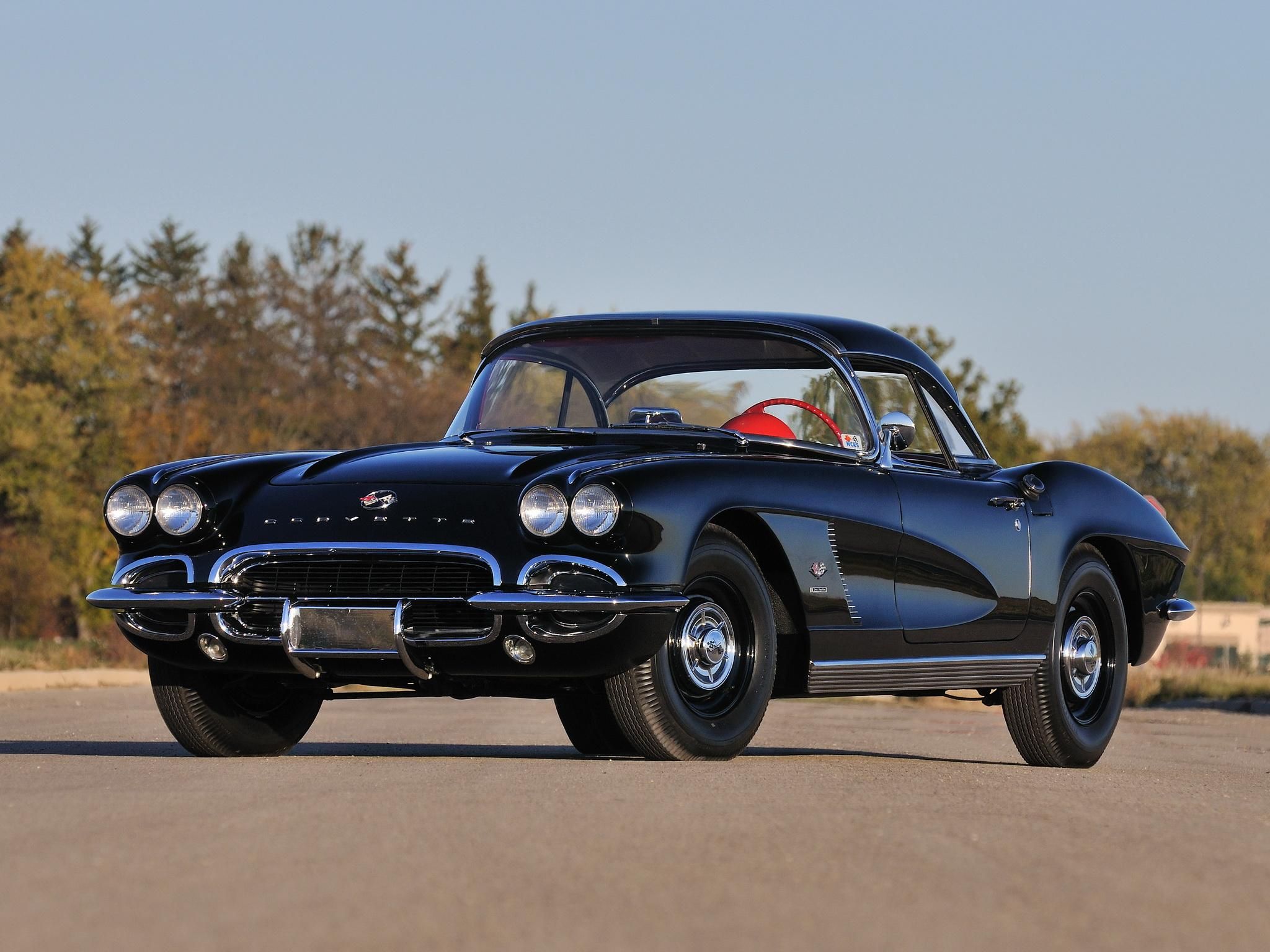
 1958 Corvette Convertible (Image courtesy of Barrett-Jackson.com)

Which C1 to Buy: The Ten Years Compared
The first-generation Corvette changed more than any Corvette since, from a six-cylinder automatic with side curtains to a 360-horsepower fuel-injected four-speed, and the four bodies sort the market: the 1953–55 cars for the collectors, 1956–57 for the enthusiasts, 1958–60 as the volume cars and the entry point, 1961–62 as the ones to drive. The table gives the changes, the production, the engines and the verdict for each year; the year pages carry the full story, specs, options, colors and the current market for that year.
Three rules hold across all ten. The engine sets the price within a year, fuel injection and the big brakes at the top, the 230- and 250-horsepower Powerglides at the bottom. A four-speed is worth more than a Powerglide in every year it was offered, and a 1955 three-speed is a rarity to be proved. And because every C1 is a convertible, body style is not a variable: the auxiliary hardtop (from 1956) is an option that adds value when original to the car.
MORE: 1953 / 1954 / 1955 / 1956 / 1957 / 1958 / 1959 / 1960 / 1961 / 1962 / THE C1 HUB
| YEAR | WHAT CHANGED | BUILT | ENGINES | THE VERDICT |
|---|---|---|---|---|
| 1953 | The first Corvette: Earl’s EX-122 Motorama car put into production in Flint. Fiberglass body on a 102-inch X-braced frame, the 235 Blue Flame six with three Carter sidedrafts and 150 hp, Powerglide only, side curtains, a 5,000-rpm tachometer with a total-revolutions counter. All Polo White with Sportsman Red interiors and black tops. | 300 | 235 ci Blue Flame six, 150 hp | A collector car at any price: 300 built, every one documented, most trading at $150,000–$250,000 and a six-mile car at $302,500 in January 2026. Bought on provenance. |
| 1954 | Production moves to St. Louis after the first 14 or 15 cars; four colors (Polo White, Pennant Blue, Sportsman Red, Black), tan tops; a new camshaft takes the six to 155 hp; longer exhaust outlets under the body, fuel and brake lines moved inboard of the frame rail, single hood latch, choke moved left, chrome rocker covers on about 20 percent of cars, 12-volt wiring harness improvements. | 3,640 | 235 ci Blue Flame six, 150 then 155 hp | The affordable six-cylinder C1 and the way into the 1953–55 look: $39,000–$80,000 in 2026 for original cars, projects from $13,000. Buy on color, originality and documentation. |
| 1955 | Ed Cole’s 265 V-8 at 195 hp, $135 extra and in 693 of 700 cars, with a gold “V” in the CheVrolet script; the first manual, a close-ratio three-speed on about 75 cars; 12-volt electrics on V-8 cars, automatic choke, electric wipers, tubeless tires. Zora Arkus-Duntov on the payroll. | 700 | 265 ci V-8, 195 hp (7 sixes) | The first V-8 and far rarer than the 1954; a documented numbers-matching car in a rare color is a six-figure car, a replacement-engine driver is not. The three-speeds and the seven sixes need factory proof. |
| 1956 | The second body: side coves outlined in chrome and often two-toned, exposed headlights moved forward, roll-up windows and outside door handles, a hardtop option, French-curve rear fenders with taillights above bumperettes; the 265 in 210, 225 and 240-hp (Duntov cam) form; three-speed standard. | 3,467 | 265 ci V-8, 210 / 225 / 240 hp | The first C1 bought to drive as much as to collect and the cleanest shape of the run; $65,000–$95,000 for original dual-quad cars, a floor around $40,000–$55,000. A dual-quad or Duntov-cam car over a single carb. |
| 1957 | The 283 (the 265 bored to 3.875 in): 220 hp single carb, 245 and 270 dual quads, Ramjet fuel injection at 250 and 283 hp, one horsepower per cubic inch; the T-10 four-speed from April; Positraction; RPO 684 racing suspension with metallic brakes and quick steering at $780.10. Production doubles. | 6,339 | 283 ci V-8, 220 to 283 hp (FI optional) | The most valuable of the 1956–57 pair and the most varied: a 220-hp Powerglide and a 283-hp fuelie are the same body several multiples apart. The 43 airbox and 51 RPO 684 cars are their own tier. “Fuelie” is a claim to prove. |
| 1958 | The third body: quad headlights in chrome bezels, fake hood louvers, chrome trunk spears, nine grille teeth instead of thirteen, 9.2 in longer and 2.3 in wider, over 3,000 lb for the first time; Duntov’s instrument binnacle with the 160-mph speedometer and column tachometer; 230 to 290 hp. | 9,168 | 283 ci V-8, 230 to 290 hp (FI optional) | A buyer’s C1: the most built to that point, styling that divides opinion, prices below a 1957 for the same car. The sensible entry to a 283-era Corvette; check that body, frame and VIN belong together, since it is the favorite restomod base. |
| 1959 | The 1958 cleaned up: louvers and spears gone; repositioned door handles and armrests, a storage bin under the passenger grab bar, better seats, 7,000-rpm tachometers, concave instrument lenses, sun visors optional; the first black interior and the only turquoise top; rear radius rods to tame axle hop. | 9,670 | 283 ci V-8, 230 to 290 hp (FI optional) | The quiet middle of the market with 1960: cleaner than a 1958, cheaper than a ducktail, mechanically identical to the year after. Carbureted cars $55,000–$82,000 in 2026; the recommended place to start with 1960 and 1961. |
| 1960 | Same body and interior as 1959; the fuelies raised to 275 hp (hydraulic lifters) and 315 hp (solid lifters, 11.0:1); a larger front anti-roll bar and a new rear bar, an extra inch of rebound travel, aluminum clutch housing; nylon tires; a new twelve-character VIN; the first year past 10,000 cars. | 10,261 | 283 ci V-8, 230 to 315 hp (FI optional) | The sleeper: the 1959 body with the 1961 fuelie’s engines, prices between the two. A documented 315-hp four-speed is the car to have; the one-year colors (Tasco Turquoise, Horizon Blue, Cascade Green) add appeal. |
| 1961 | The fourth body: Mitchell’s ducktail from the Sting Ray racer and the XP-700, four round taillights, 20 percent more luggage room; headlight bezels painted body color, a mesh grille in argent, block letters and bigger flags on the nose; a narrower transmission tunnel; the last 283, the last dual quads, the last two-tone coves and wide whitewalls. | 10,939 | 283 ci V-8, 230 to 315 hp (last 283) | With the 1962 the C1 the market likes best after the 1957: the ducktail, the strongest engines and the best build quality. Dual-quad four-speeds are often the better value than the fuelies at $65,000–$105,000. |
| 1962 | The 327 (4.00 x 3.25 in): 250, 300, 340 and the 360-hp fuelie; the chrome cove outlines and the two-tone option deleted, the cove vent spears replaced by black-finished aluminum blades; the four-speed in nearly eight of ten cars and Positraction in almost all. The most C1s built, and the end of the generation. | 14,531 | 327 ci V-8, 250 to 360 hp (FI optional) | The one to drive: the 327, the four-speed and Positraction on nearly every car, the cleanest late body and the largest supply. Carbureted cars $58,000–$88,000, fuelies $84,500–$99,500 in 2026; the 340-hp RPO 396 is the enthusiast’s pick. |
The Model-Year Changes in Detail, 1953–1962
The table gives the headlines; this is the detail a buyer uses at the viewing, because the small changes are how you tell a 1956 from a 1957 without opening the hood, a 1958 hood from a 1959, and a car that is what it claims to be from one that has been dressed. The year pages carry the full specifications, options, colors and production for each.
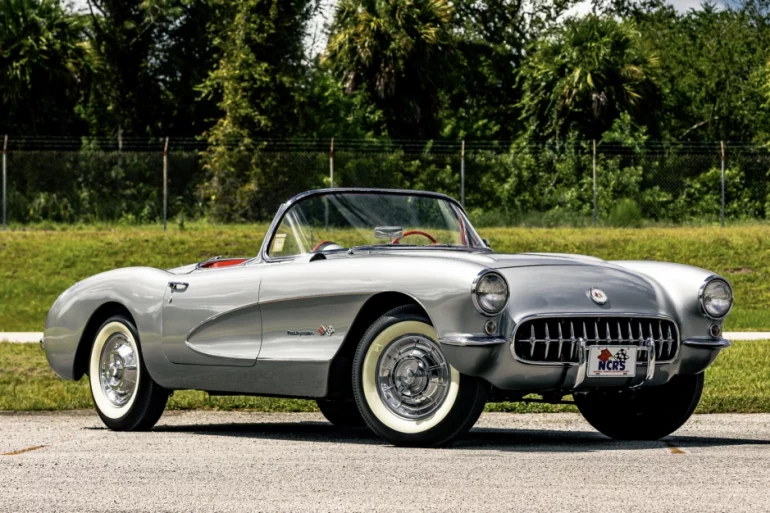
1953 Corvette
The 1953 Corvette is probably more desirable today than it was when it was new. Because the first MY Corvette was limited to a production run of just 300 units, combined with the fact that 1953 was the first year the car was produced, it is one of the rarest and most sought after / collectible first-generation Corvettes of then all. Of the first 300 1953 Corvettes, approximately 225 are still known to exist today.
All of the 1953 Corvettes produced that first year were painted Polo White and featured a Sportsman Red interior with a black, collapsable top, 6.70 x 15 four ply whitewall tires, a Delco signal-seeking radio, a standard array of analog instruments which included a 5000-rpm tachometer and a counter for total engine revolutions (a feature that would continue through 1959).
The 1953 Corvette featured the “Blue Flame” six-cylinder engine (also known as the “Stovebolt Six“ by the engineering teams at GM). The Stovebolt six-cylinder donor engine was renowned for its reliability but with an engine rating of only 105 horsepower, it lacked the performance and sportiness that people expected from a two-seat sports car. A more radical camshaft, solid lifters, dual valve springs, and a higher compression ratio cylinder head was installed. All of these items contributed to an increased engine output of 150 brake horsepower.
1954 Corvette
The 1954 Corvette began production in December, 1953. Although the first fourteen or fifteen ‘54 Corvettes were built in Flint, Michigan, GM shifted Corvette’s production to a newly renovated assembly plant in St Louis, Missouri.
There were very few initial design changes between the 1953 and 1954 model Corvettes, although refinements would be made throughout the 1954 production year. The 1954 model had longer exhaust outlets that were run below the car’s body. Other changes included relocating the fuel and brake lines inboard of the right-hand main frame rail, providing them with additional protection. Also, the canvas tops and rails were changed from black to tan. The original two-handle exterior hood latch was replaced by a single handle mechanism after the production of the first 300 (approximate) 1954 models. The choke control was moved from the right to the left of the steering column.
Some additional changes were also made to the engine and drivetrain. The use of a new camshaft increased the total horsepower of the “Blue Flame” six-cylinder engine to 155bhp. Other alterations included a new-style rocker arm (valve) cover (of which approximately 20% were finished in chrome – serial numbers 1363 through 4381 and of which all were now held down by four bolts through the outer lip of the cover instead of two center studs), a better-designed wiring harness, dual air filters, a new type of starter and plastic insulated wire (instead of fabric insulated).
Perhaps the most notable change from the 1953 to 1954 models was the opportunity to purchase a Corvette with a choice of different color options.In 1954, General Motors offered the Corvette to consumers with the following color combinations: Pennant Blue with a Tan interior (which accounted for 16% of the production models made that year), Sportsman Red with a Red Interior (which accounted for a mere 4% of the production models), Polo White with a Red Interior (which accounted for about 80% of the production models).
1955 Corvette
In 1955, GM introduced the new 265-cid small-block V-8 engine. This engine would become the “heart and soul” of the 1955 Corvette. The inclusion of a short-stroke crankshaft allowed the engine to rev to 6,000rpm. Optioned for an extra $135, all but six of the 1955 Corvettes built included this bigger, stronger engine. As an identifier that these new Corvettes contained the larger engine, an exaggerated gold “V” was overlaid on the existing “CheVrolet” logo on the lower front fenders. The car also included a broader radiator grille. The engine featured a special camshaft that produced an additional 33 horsepower above standard tune – resulting in a total of 195 bhp at 5000 rpm.
The Powerglide two-speed automatic remained for most of the 1955 model year. However, approximately 75 cars were built that year with Corvette’s first manual gearbox. This was a new close-ratio three-speed manual transmission which was shifted via a stubby chrome shifter rod capped by a small, white ball and surrounded by a boot that was clamped to the floor by a bright metal ring showing the shift pattern.
Other changes to the car included: an automatic choke as well as a modern 12 volt electrical system, though the older 6-volt system was retained for the few six-cylinder Corvettes that were built that year. Electric wipers replaced vacuum-operated units and foot-operated windshield washers were included. Tires changed from tube type to the tubeless variety and were available in both white wall and black wall versions.
1956 Corvette
On February 1, 1955, just as the Ford Thunderbirds were beginning to make an appearance on the streets in serious numbers, Earl had all but finalized a full-scale clay model of a new Corvette body. The result of his new design was a 1956 Model Corvette that would change the direction of Corvette sales for all time.
Bodyside “coves” were first introduced on the 1956 Corvette. These coves gave the 1956 Corvette a truly unique styling personality. This new look helped to correct the long, blocky look of the original ‘Vettes and gave the new design an aggressive look and flow that was clean and attractive. To further accentuate the overall styling of the car, the coves were outlined in chrome and were often painted a different color than the rest of the car.
The 1956 Corvette moved the car's headlights forward and now left them exposed. A larger version of the round Corvette nose emblem was introduced featuring the crossed-flags motif that continues to survive today. The grill would remain unchanged for the 1956 model.
Rear end styling revisions to the Corvette were also performed. The 1953-1955 fenders and jet-pod tail lamps were minimized to more attractive French curves contoured to match the rear deck curvature. New taillights were neatly added above a vertical bumperette on each fender. The trunklid “shadow box” was discarded and the license plate was moved to below the trunk opening. In all, the result was a smooth, gently curved backend with slightly protruding fenders.
1957 Corvette
One of the few ways to differentiate between a 1956 and a 1957 Corvette without opening the hood is to look at the inside rearview mirror. On the 1956 Corvette model, the mirror adjusts with a thumbscrew, whereas in 1957, the rearview mirror adjustment requires a wrench to loosen the locknut.
A new, larger 283-CID engine was placed under the hood, Mechanically, it was really still the existing 265-CID engine, though it had been bored out 1/8-inch (to 3.875 inches). This modified engine delivered an impressive 220 horsepower when coupled with a four-barrel carburetor. Dual four-barrels took it to 245 horsepower (and 270bhp.) Better still, consumers could now also purchase GM‘s newly developed “Ramjet” fuel injection system which yielded 259 horsepower (or 283 bhp).
To provide greater handling and stability, Chevrolet also issued RPO 684 – a heavy-duty racing suspension package. This option, priced at $780.10, included heavy-duty springs, a thicker front anti-sway bar, the aforementioned Positraction rear end, larger piston shock absorbers, a tighter steering ratio that reduced turns lock-to-lock from 3.7 turns to only 2.9, and ceramic/metal brake linings with finned ventilated drums.
1958 Corvette
The 1958 Corvette was far more excessive than any of its predecessors. While the car still reflected the design changes implemented in the 1956 and 1957 models, the ‘58 Corvette now sported simulated louvers on its bonnet (hood), non-functional air intake scoops on either side of the grille, and phony vents in the bodyside “coves”. It also featured twin, chrome “suspenders” that ran from the base of the rear window down the trunk lid, before ending abruptly at the rear fender. Another notable departure from the earlier models was the addition of quad headlamps wrapped in a thick chrome bezel.
Much like the chrome “suspenders” featured on the trunk lid, a chrome strip ran along the tops of the fenders, accentuating the appearance of the headlamps and giving an overall “swept back “ appearance. Lastly, the chrome “teeth” in the front grille itself were reduced from thirteen (as had been the standard in all Corvettes prior to 1958) to only nine. The 1958 Corvette not only looked heavier with its many new additions and design changes, but it had actually gotten heavier.
For the first time in Corvette history, the car exceeded 3,000 pounds, which was an increase of 200 pounds over the 1957 model. However, the increase in weight was not merely due to the excesses that were included in the car’s makeover but was the result of the increased size of the car. The 1958 Corvette had 9.2 inches of added length and 2.3 inches of added width, bringing the car’s overall dimensions to 177.2 by 72.8 inches.
A significant redesign of the instrument cluster at the request/direction of Zora Arkus-Duntov resulted in all of the gauges (save for the clock) to be placed directly in front of the driver in a binnacle. The new cluster consisted of a 160-mph speedometer which dominated most of the dashboard, while a smaller 6000 rpm tachometer was placed ahead of it on the steering column. Flanking the tachometer on each side was a pair of standard instrument gauges that monitored fuel levels, oil pressure, engine temperature, and battery charge.
Now officially rated at 290 horsepower (at 6,200 rpm’s), the fuel-injected, Duntov-cam 283 continued to flourish beneath the hood of the 1958 Corvette as the top-level engine for that year’s model run. A twin-carburetor version of the engine continued to be offered as an option, offering drivers an uncompromising 270 horsepower engine. Despite this fact, few buyers opted for the carbureted version of this engine. Surprisingly, it was the base level 230 horsepower V-8 engine that buyers sought out.
1959 Corvette
The 1959 Corvette was “cleaned up” considerably. For one, the chrome “suspenders” were removed from the design, providing Corvette with a more swept-back look that was synonymous with speed. For another, it was decided that the faux hood louvers would be eliminated, returning the Corvette to a semblance of its former self.
The interior received minor, but significant updates. Both the door handles and the armrests were repositioned and a small-item storage compartment was added beneath the passenger side grab bar. Both the driver and passenger seats were redesigned to offer increased lateral support to their occupants. All tachometers now indicated up to 7,000 rpm and offered redline and safe limit indicators. Sun visors were introduced to the 1959 Corvette as a new option and concave instrument lenses replaced the flat covers of the 1958 Corvette to reduce sun glare.
The 1959 Corvette was the only production year where Chevrolet included an option of purchasing a turquoise soft top. Also, the 1959 Corvette marked the first year where consumers could purchase an all-black interior.
1960 Corvette
From a design standpoint at least, the 1960 Corvette is virtually indistinguishable from 1959. The body lines and chrome trim is nearly identical on both models. The interiors have virtually no distinguishable differences. In short, the 1960 Corvette was, for all design purposes, a continuation of the 1959 production model.
However – the top two engines, both fuel injected or “fuelie” engines, received an increase in their overall horsepower. The addition of solid lifters and a higher, 11.0:1 compression ratio boosted the strongest of the fuelie engines to 315-bhp at 6,200 rpms. The second most powerful engine included hydraulic lifters (which made for easier maintenance) and pumped out an impressive 275-bhp at 5,200 RPMs.
Standard options for the 1960 Corvette included the introduction of a larger-diameter front anti-roll bar matched and a new, heavier duty rear bar. These changes, plus an extra inch of rear-wheel travel in rebound produced a smoother riding, more neutral handling Corvette than ever before.
The 1960 Corvette was the first Corvette to use Nylon Belted Tires (a type of tire that is still sometimes used today, though not as durable as a steel-belted tire).
1961 Corvette
General Motors executives decided to “green light” a restyling of the Corvette for the 1961 model year. The most pronounced change was the introduction of a freshened rear-end design. The “ducktail” design (as it has become known amongst Corvette enthusiasts) was virtually lifted from the Stingray race car as well as Bill Mitchell’s XP-700 show car. The redesign of the rear end of the Corvette enabled an increase in available luggage space by twenty percent (20%). The new rear end also showcased a pair of small, round taillights on each side of the license plate recess.
On the front end of the car, Chevrolet introduced a redesign of the dual headlamp system, providing Corvette with a more streamlined version of the existing four lamp nose. Headlight bezels were no longer available in chrome but instead were painted to match the rest of the body. Likewise, the chrome “teeth” grill was replaced with a fine wire mesh insert that was finished in argent silver.
The round Corvette emblem that resided on the front nose of the car was replaced with individual block letters that spelled out the car’s name. This was topped with a larger version of the Corvette’s crossed-flags insignia.
The interior of the 1961 Corvette went virtually unchanged from its predecessors. To increase space within the two-seat cockpit, the transmission tunnel was slightly narrowed, though this single change did little to affect the overall appearance of the car‘s interior.
The 1961 Corvette would be the last Corvette to offer a consumer the option of purchasing bodyside coves in contrasting paint colors. The 1961 Corvette was also the last model year to offer the option of “wide” whitewall tires as well as the last model year to offer the 283 cubic inch V-8 that helped launch Corvette into stardom!
1962 Corvette
The 1962 model year represents the end of the first-generation era for the Chevrolet Corvette.
The 1962 Corvette was the first model year to incorporate the 327 cubic-inch V-8 engine in place of the smaller 283 cubic inch engine. Though technically the same engine block as the 283, the smaller engine was bored and stroked to bring its cylinder dimensions to 4.00 x 3.25 inches and it’s displacement up to 327 cubic inches.
The 1962 Corvette was stripped of any of the remaining excesses that had plagued it’s earlier counterparts. The most obvious of these deletions was the removal of the chrome outlines that had framed the body side coves since 1956. Further, the chrome accent spears (that had accentuated the side vents within the coves) were also removed, replaced instead by more conservative aluminum blades that were finished in black. Another omission which added to the more cohesive look of the car was the deletion of the option to have the coves painted in a different color than the rest of the car.
MORE: 1953 / 1954 / 1955 / 1956 / 1957 / 1958 / 1959 / 1960 / 1961 / 1962 / THE C1 TIMELINE
1953 Corvette

 1961 Chevrolet Corvette | Image Courtesy of FavCars
Models, Variants and Specials: What You Are Actually Buying
Chevrolet sold one model, a convertible, for ten years, and the body, the engine and the option sheet made everything else. There were no factory special editions, so a C1 is bought by its year, its engine code and its RPOs, and the paperwork matters because the parts that separate a $60,000 car from a $150,000 one, the injection unit, the metallic brakes, the airbox, the four-speed, have all been reproduced. The table sorts what was built into the tiers the market uses; the engine list on the C1 hub has every engine with its output and years, and the Corvette SS, race-car and concept guides cover the specials.
A word on names. “Solid-axle” and “straight-axle” both mean the 1953–62 cars; “fuelie” means a Rochester fuel-injected car, 1957–62; “big brake” or “684 car” means the heavy-duty racing suspension and metallic brake package, RPO 684 in 1957–59, RPO 687 in 1960–62; “airbox” means the 43 1957 fuelies with the cold-air plenum.
MORE: THE CORVETTE SS / THE C1 RACE CARS / THE C1 CONCEPTS / EVERY C1 ENGINE / RPO CODES BY YEAR
| VARIANT | WHAT IT IS | BUILT | WHAT A BUYER SHOULD KNOW |
|---|---|---|---|
| 1953–55 six-cylinder cars | The original body with the 235 Blue Flame six, three sidedrafts and the Powerglide | 300 · 3,640 · 7 | The 1953s are documented car by car and trade on provenance; the 1954 is the affordable six and the market is a working one; the seven 1955 sixes are claims that need factory proof. The six is a passenger-car engine, so swaps are easy to make and easy to miss. |
| 1955 V-8 | The first small block: the 265 at 195 hp, with the gold “V” and, on about 75 cars, the three-speed manual | 693 | The car most buyers want from the first three years and far rarer than the 1954. A VIN beginning VE55S, the 3703524 block and a date before the build; a manual needs a specialist to confirm it is factory rather than a conversion. |
| 1956–57 cars | The second body: coves, roll-up windows, the hardtop, the three-speed; the 265 (1956) and the 283 (1957) | 3,467 · 6,339 | The enthusiast’s C1 and the cleanest shape. Dual-quad cars over single carbs, a Duntov-cam car over both, the four-speed (from April 1957) over the three-speed; a 1957 four-speed in an early VIN is a conversion. |
| Fuel injection | Rochester Ramjet mechanical injection on the 283 and 327: 250/283 hp (1957), 250/290 (1958–59), 275/315 (1960–61), 360 (1962) | 1,040 (1957) to about 1,900 (1962) a year | The top of every year’s market and the most faked C1. Dealers removed many units when new; every part has been reproduced. The unit’s serial must be the right series for the year, the pad suffix must match, and a unit that starts and idles cleanly hot and cold is a sorted one. An original working unit is worth real money on its own. |
| RPO 684 / 687 “big brake” cars | The racing package: heavy-duty springs and shocks, the big front bar, Positraction, quick steering, ceramic-metallic linings in finned drums with cooling ducts; 684 in 1957–59, 687 in 1960–62 | 51 (1957) · 144 (1958) · 142 (1959) · 119 (1960) · 246 (1962) | A collector tier of its own, usually with a fuelie and a four-speed. The brakes, ducts and 24-gallon tank are easy to add, so the axle code and documentation decide it. The metallic linings are poor cold and need warming to work. |
| 1957 airbox | The 283-hp fuelie with the cold-air plenum feeding the injection from the cowl and a column-mounted tachometer | 43 | The rarest production C1 and bought on paperwork: the box and tachometer are simple to add. Tank sticker or NCRS history, not the parts. |
| 1958–60 cars | The third body: quad headlights; the chrome 1958, the cleaned-up 1959 and the mechanically updated 1960 | 9,168 · 9,670 · 10,261 | The volume cars and the entry to the generation, and the favorite restomod base, so body, frame and VIN must belong together. A 290-hp (1958–59) or 315-hp (1960) fuelie four-speed is the car to have; a 230 Powerglide is the entry point. |
| 1961–62 ducktails | The fourth body: Mitchell’s tail, four taillights, the mesh grille; the last 283 (1961) and the first 327 (1962) | 10,939 · 14,531 | The C1s the market likes best after the 1957 and the ones to drive. A 315- or 360-hp fuelie four-speed at the top; the 1962 340-hp RPO 396 the enthusiast’s value; the 1961 dual-quad four-speeds often the better buy than the fuelies. |
| Hardtop (RPO 419) | The removable fiberglass auxiliary hardtop, 1956–62, often in place of the soft top | Common from 1958 | Adds value when original to the car and documented; hardtop-equipped cars have led several years’ results. Check the fit at the windshield and the deck, and the rear window for crazing. |
| Big tank (RPO 1625) | The 24-gallon fiberglass fuel tank for endurance racing, 1959–62; no soft top possible | 65 (1962) | A racing option that puts a car in the collector tier when documented and is easy to reproduce. Build records and the tank’s construction, not the badge. |
| Powerglide cars | The two-speed automatic: every 1953–54, most 1955s, and a shrinking minority after (1,532 of the 14,531 in 1962) | A majority to 1955; 10–20 percent later | The entry point to every year from 1956 on, correct only behind the lower-horsepower engines (the aluminum-case Powerglide behind the 250 and 300 in 1962). Fine for a cruiser, a discount at resale. |
| SR-2, Corvette SS and the race cars | The 1956–57 SR-2s built for the Earl and Mitchell sons, Duntov’s 1957 Corvette SS, the Purple People Eater and the Cunningham Le Mans cars | A handful | Museum pieces and headline-auction cars: the Corvette SS sold for $7.7 million in 2025. SR-2 and race-car tributes exist and trade as tributes. The guides linked below have each car’s history. |
| Restomods | A C1 body on a modern chassis (Art Morrison and others) with an LS engine, discs and modern suspension | Thousands | A different market that sells on the build rather than the year: custom cars brought $46,000 to $165,000 in 2026. The 1958–62 bodies are the usual donors, which is why a “numbers-matching” late C1 needs its chassis checked. |
What a C1 Corvette Is Worth in 2026
The C1 market sorts by year first and engine second. The 1953 is a collector car at any price; the 1954 and 1955 are rare but drive like what they are; the 1956 and 1957 are the cars the enthusiasts want, the 1957 fuelie and airbox cars above all; the 1958 to 1962 cars are plentiful by C1 standards and are the entry to the generation, and within them a fuel-injected engine, the heavy-duty brakes, the four-speed, a hardtop and documentation each move a car up a tier. Every C1 is a convertible, so body style is not a variable, and a replacement engine or a color change moves a car down a tier whatever the year.
The results the site tracked on Classic.com in 2026 show the ladder. A six-mile 1953, number 186 of 300, sold for $302,500 at Mecum Kissimmee in January, and most 1953s trade at $150,000 to $250,000. 1954s sold for $39,000 to $80,000, 1955 V-8s for $70,000 to $132,000 with a 19,000-mile car at $247,500 at Barrett-Jackson West Palm Beach, and 1956s for $65,000 to $95,000. Carbureted 1957s brought $64,500 to $83,000; carbureted 1958 to 1962 cars roughly $55,000 to $90,000; fuel-injected 1958–62 cars $84,500 to $121,000 sold, with a 1961 fuelie at $242,000 at Kissimmee and the best 290- and 315-horsepower cars bid to $140,000 to $200,000 without selling. Modified and restomod cars ran $42,000 to $165,000 on their builds, and projects from about $13,000 for a 1954 to $27,000 for a 1961 and $38,000 for a 1962. Above all of it, the 1957 Corvette SS at $7.7 million in 2025.
Two cautions that apply to every figure on this page. Check whether an auction result includes the buyer’s premium, and treat asking prices and unsold high bids separately from completed sales: a 1958 fuelie bid to $200,000 and unsold is not a $200,000 car, and dealers were asking $190,000 for 1958s that were selling for half that. The year pages carry each year’s results and are updated as the site tracks new sales; the price ladder below puts the whole generation in five tiers.
MORE: 1954 MARKET / 1957 MARKET / 1958 MARKET / 1960 MARKET / 1962 MARKET / CORVETTE AUCTION COVERAGE
The C1 Price Ladder: Five Tiers
What the money buys at each level of the 1953–62 market, from the results above. The ranges are for the generation as a whole: a 1957 sits a tier above the same condition of 1958, a fuelie a tier above the same car with carburetors, and a 1953 or 1955 a tier above where its condition alone would put it. Where a car is modified, the build sets the price more than the year.
Projects and Non-Runners
$13,000 – $40,000
Disassembled restorations, long-stored cars with the wrong engine, bodies off frames and frames with rot in the rails. Recent sales: 1954 projects at $13,000 to $20,000, a 1961 roadster with hardtop at $27,000, 1958–59 projects from $28,000, a 1962 from $38,000. For someone who will do or oversee a restoration; the structure and body work costs more than the car at this level.
Driver-Quality Cars
$40,000 – $65,000
Sound but unexceptional 1956–62 cars: older restorations, replacement engines, repaints in a non-original color, 230- and 250-horsepower Powerglides, mild restomods that run and drive. Recent sales: 1959s at $55,000 and $55,500, a 1962 327/340 at $58,000, 1956 floor cars at $40,000 to $55,000, original 1954s at $39,000 to $55,000. The way into a C1 for someone who wants to drive one.
Originals & Quality
$65,000 – $105,000
Original or well-restored carbureted cars with their engines and some paperwork: dual-quad four-speeds of every year, documented single-carb 1957–62 cars, the better 1954s and the lower end of the 1955 V-8s and 1956s. Recent sales: 1957 dual quads at $64,500 to $83,000, 1958s at $74,000 to $90,000, 1960s at $66,000 to $83,000, 1961s at $64,900 to $104,500. Where most serious buyers end up.
Collector-Grade Cars
$95,000 – $250,000
Documented fuel-injected 1957–62 cars, the big-brake cars, hardtop-equipped manual cars with strong paperwork, the best 1955 V-8s and 1956s, with NCRS Top Flight or Bloomington Gold history. Recent sales: fuelies at $95,700 to $121,000, a 1961 fuelie at $242,000, a 1955 at $247,500, a 1956 at $134,400. Bought on the engine pad, the injection serial, the axle code and the judging sheets; every one has been faked.
Blue-Chip and Record Cars
$150,000 – $7.7 million
The 300 1953s ($150,000 to $302,500), the 43 1957 airbox cars, the 1957 and 1962 RPO 684/687 fuelie four-speeds, the SR-2s and the cars with period racing history, and above them the 1957 Corvette SS at $7.7 million in 2025. These trade privately or at the headline auctions, and the work is done before the car is seen: the production records, the registry, the history and the restorer.
What Moves the Price of a C1
Year and body. The 1953 above everything, then 1957 and 1955, then 1956 and the 1961–62 ducktails, then 1958–60, with the 1954 the affordable six. The same engine and condition in a 1957 brings a tier more than in a 1958; the 1959–61 cars are the value years.
Engine code. Fuel injection at the top of every year from 1957, the Duntov-cam solid-lifter engines next, dual quads above single carbs, the 230- and 250-horsepower Powerglides at the bottom. A documented fuelie is worth roughly double a base car of the same year; a “fuelie” without the paperwork is a dual-quad car with an expensive intake.
Transmission and options. The four-speed over the three-speed over the Powerglide; RPO 684/687 brakes, the airbox and the big tank when documented; the hardtop, power windows and the power top when original to the car; two-tone coves (1956–61) and the rare colors (Cascade Green in 1960, Jewel Blue in 1961, Black in 1954).
Documentation and judging. Matching numbers (the pad’s suffix and VIN derivative, the casting dates before the build), the trim tag agreeing with the paint and interior, tank stickers and build records where they survive, and NCRS Top Flight or Bloomington Gold sheets with dates and scores. A documented car brings 20 to 30 percent more than the same car without, and on a fuelie or a big-brake car the paperwork is most of the value.
Originality versus modification. An original-color car with its original drivetrain leads; a correct restoration follows; a color change costs real money at resale however well done; a restomod is priced on its build and sells to a different buyer. The late C1s are the favorite restomod donors, so a late car’s chassis and VIN need checking before its paint.
Condition of the steel. A sound frame, windshield frame and birdcage are worth more than fresh paint, because the paint is a cost and the structure is a project. The inspection section explains where to look.
MORE: C1 COLORS BY YEAR / RPO CODES & OPTIONS / PRODUCTION NUMBERS
The Investment Case, With Realistic Expectations
The best C1s have appreciated steadily for decades and the ingredients do not change: the first Corvette, ten years of hand-finished fiberglass cars, 300 1953s and a few hundred airbox and big-brake cars, and a supply of real, documented examples that shrinks as more become restomods and more tributes are exposed. The 1953s, the 1957 fuelies and the race cars keep setting records, and the Corvette SS at $7.7 million in 2025 is the top of the whole Corvette market after the Grand Sports.
The realistic expectation below that tier is stability. The carbureted 1958–62 cars that make up most of the supply are driver’s cars whose prices track the wider collector market; they rose through the 2010s, paused in 2023–24 and have held in 2025–26, and a sound one bought at the tracked prices is unlikely to lose money and is easy to resell. Documented fuelies and big-brake cars have the best risk-and-reward in the generation, real cars with real paperwork at a fraction of a 1953 or an airbox car.
The buyers who get hurt are the ones who pay a matching-numbers price for a replacement-engine car, a fuelie price for a dual-quad with an injection unit added, or an investment price for a restomod, which sells on taste and never follows the collector market. The 1953–55 cars carry one more caution: they are collector pieces that drive like 1950s cars, and the buyer who wants to drive should look at a 1961 or 1962.
Buy the car you want to own and drive and let the market be a bonus. The site’s auction coverage and market reports track every notable C1 sale; the year pages are updated as they come in.
MORE: AUCTION RESULTS / WHOLESALE MARKET REPORTS / BARGAIN HUNTING
Recent C1 Values & Market Trends
The charts below from our friends at Classic.com track recent sales and trends in the 1953–62 Corvette market: the generation as a whole, then the 1953, the 1957 and the 1962. For any other year or engine, the year pages carry the results the site tracks and Classic.com has the rest.
The C1 Specials and Race Cars
There were no factory special editions in 1953–62, so the specials are the show cars, the prototypes and the race cars. The guides below carry each car’s history, and the C1 hub has the engines, the year pages and the research for every year.
The 1957 Corvette SS — Duntov’s magnesium-bodied Sebring racer, 1,850 pounds and a fuel-injected 283; sold for $7.7 million in 2025
The C1 Race Cars — The SR-2s, the Purple People Eater, the Cunningham Le Mans cars and the privateers who raced after the AMA ban
The C1 Concepts and Show Cars — The EX-122 Motorama car, the Corvair fastback and Nomad, the Q-Corvette and the XP-700 whose tail became the 1961
The C1 Corvette Hub — The story, the year-by-year table, every engine, the race cars and the research for 1953–1962
C1 Special Model Guides — Every C1 special, prototype and race car the site has written up
Driving a C1 Corvette: What to Expect
A solid-axle Corvette drives like a 1950s car with a lot of engine, because that is what it is: a 102-inch wheelbase, a live rear axle on leaf springs, a steel X-frame, recirculating-ball steering at 3.7 turns lock to lock (2.9 with the RPO 684 quick ratio), drum brakes at all four corners and, on anything with a dual quad or better, enough torque to hop the axle off the line until the 1959 radius rods arrived. The ride is firm, the seating upright, the cockpit snug, and the windshield and wipers are from another age. None of that is a complaint; it is the character buyers pay for, and the four bodies deliver it in four flavors.
1953–55. The Blue Flame six with the Powerglide is a cruiser: smooth, quiet, 0–60 in about eleven seconds, happy at 60 mph and no faster, with side curtains instead of windows and a top that leaks. The 1955 V-8 transforms it, nearly three seconds quicker to 60, but still through the two-speed automatic in all but 75 cars. These are cars for parades, concours fields and Sunday mornings, and they are bought as such.
1956–57. The first C1 that drives like a sports car: roll-up windows, the three-speed and from April 1957 the four-speed, a 265 or 283 that pulls from 2,000 rpm, and with the dual quads or the injection real pace. A 283/283 fuelie four-speed was a seven-second car to 60 in 1957 and still feels quick. The injection wants warm-up discipline and clean fuel; the dual quads want a correct setup to idle evenly; the drums fade on a hard run and the metallic RPO 684 linings do nothing until warm.
1958–60. Heavier and more comfortable, with the binnacle instruments in front of the driver and, from 1959, seats with some lateral support and radius rods that stop the hop. The 230-horsepower Powerglide is a relaxed cruiser; a 270 dual quad four-speed is the sweet spot for a driver; the 290- and 315-horsepower fuelies are the fast ones, with solid lifters to adjust and a lumpy idle that is correct. The 1960’s anti-roll bars make it the best-handling of the three.
1961–62. The best-built and most usable C1s. The 1961 283s are the familiar engines in a tighter car; the 1962 327 changes it, with the 300-horsepower hydraulic engine the all-rounder, the 340 RPO 396 the enthusiast’s choice with its Duntov cam and 11.25:1 compression, and the 360 fuelie the fast one. The four-speed is on nearly every car and Positraction on almost all. A 1962 327/300 four-speed keeps up with modern traffic, stops adequately on good linings and is the C1 to drive regularly.
Daily driver or weekend car? A 1958–62 car with a hydraulic-cam engine, a four-speed and sorted brakes can be driven as often as you like within the limits of drums and bias-ply or period-size radial tires; a solid-lifter or fuel-injected car is a weekend car that wants a specialist; a 1953–55 is a collector’s car that gets driven to shows. Every C1 is a convertible with a top that was never watertight, so plan on a hardtop or dry weather.
Drive several before buying one. The ten years feel different, a 1954 six and a 1962 fuelie most of all, and the car that suits you is as likely to be a quiet 1959 270 four-speed as the airbox you came for.
MORE: C1 PERFORMANCE FIGURES / SPECS BY YEAR / EVERY C1 ENGINE
Getting Real: What a C1 Costs to Own
A sorted solid-axle Corvette is cheap to keep running and expensive to put right, and the gap between the two is where buyers get hurt. Routine costs are low: a small block or the Blue Flame six takes ordinary oil and tune-up parts, tires are period sizes available as bias-ply or radial, and brakes, suspension, weatherstrips, trim and most body hardware are reproduced and in stock, because the C1 has one of the deepest restoration-parts markets of any American car. In owners’ experience a driven car on a modest budget runs $1,500 to $3,000 a year in parts and labor at an independent shop that knows the cars, plus insurance and storage.
The large bills are structural and specialist. A frame repair at the rails or kickups is a body-off job; a windshield-frame or birdcage repair means the glass out and new steel let in; a correct repaint on fiberglass that has been prepared properly is $20,000 and up, and the early bodies, with their bonding-strip seams, need more preparation than later Corvettes; a Rochester fuel-injection rebuild by one of the few specialists is several thousand dollars; a numbers-correct rebuild of a Duntov-cam 283 or a 327/360 is more; and reproduction 1958 trim rarely fits like the original. None of this is a reason not to buy a C1; all of it is a reason to buy one that has had the work done, with the receipts, rather than the cheaper one that will need it.
Insurance is the easy part: a classic-car policy on an agreed value, with mileage limits most owners never reach, costs a fraction of insuring a modern Corvette. Get the agreed value right, because a documented fuelie is a six-figure car, and revisit it every couple of years. Storage matters more than on any later Corvette: a C1 that lives outside loses its top, its interior and its weatherstrips first and its frame afterwards.
Budget, in other words, for the car plus the inspection, plus whatever the inspection finds, plus a first-year refresh of tires, brakes, fuel system and fluids on any car that has sat. Most of these cars see a few hundred miles a year, and that is what wears them.
MORE: C1 MAINTENANCE SCHEDULES / C1 COMMON ISSUES / OWNER’S MANUALS
Other Key Buying Considerations
Which C1 is right for you, and whether the one in front of you is what it claims to be
Beyond price, condition and mileage, a C1 purchase turns on a handful of judgments the inspection alone cannot make: which of the four bodies is yours, what the car is for, whether the specialist support exists where you live, how much of the value is paperwork, where the steel stands, and where the car sits in a market that has already decided what it likes. Think these through before the first viewing.
As you can probably distinguish from the images above, the first-generation Corvette can be further divided into four, unique subdivisions - 1953 to 1955, 1956 to 1957, 1958 to 1960, and 1961 to 1962. While we've already covered the unique features of each model year, one of the first considerations someone thinking of buying a C1 Corvette should make is which version of the car is right for you? Are you a fan of the original design? If so, then you also need to be aware that many of the earliest Corvettes only came equipped with a 150HP six-cylinder engine. Are you looking for bigger horsepower and a more track-capable example? You'll want to consider some of the latter year models.
Regardless of which example of the car you decide to consider, there are certain items that remained virtually unchanged from 1953 to 1962. Even those elements that have changed, such as the contour of certain body panels, the number of headlights, etc., most of the information contained in this buyer's guide is designed to give you key items that you'll want to closely examine before making a purchase. This guide is not all-inclusive, but rather a good starting point for getting familiar with your future first-generation Corvette. As always, we strongly encourage you to have any car you're thinking of purchasing looked at by a professional mechanic. This holds especially true on vintage cars of this nature - while there are many amazing examples available, there are just as many that have been molested, abused, and not well-maintained. Because of this, and because cars from the 1950s and 60s aren't as well documented as cars of today, being vigilant during the buying process will save you a lot of time and money later on.
Which C1, and what for
The first question is which of the four cars you want: the original 1953–55 design, with the six-cylinder Powerglide in all but the 1955 V-8s, is a collector’s car; the 1956–57 is the purist’s C1; the 1958–60 is the affordable one; the 1961–62 is the one to drive, with the strongest engines and the best build. Then decide whether it is a car to drive, to show or to hold. A driver wants a hydraulic-cam 283 or 327 four-speed with a sound frame and the engine code barely matters; a show car wants originality, matching numbers and judging history; an investment wants the documented fuelie, big-brake car or 1953 and the patience to find the right one. Most regrets come from buying one kind of car for the other purpose.
Mechanical condition and specialist support
The small block is the easiest engine in the world to service and any competent shop can keep a carbureted C1 running, but the Rochester injection, the three-carburetor six, the metallic brakes and the early fiberglass are specialist work, and the specialists are not everywhere. Before buying a fuelie, know who will look after it. Ask what has been done rather than what has been “gone through”: a receipts file for the brakes, the fuel system, the cooling system and the suspension is worth more than a seller’s description, and a weeping wheel cylinder, a hard-starting injection unit or an axle that clunks each has a known cause and a known cost. Cars from the 1950s are far less documented than modern ones, so vigilance now saves money later.
Chassis
One of the most common items overlooked by prospective Corvette owners is the fact that all Corvette bodies are made of fiberglass. Because of this, the outward appearance of a Corvette - even one that is decades old - may look much newer than cars with conventional steel bodies. While the bodies of Corvettes may be made of fiberglass, the underpinnings of the car are not.
When inspecting a Corvette for purchase, take time to get the car on a lift and carefully examine the frame assembly for rust. Look at any points where two or more pieces of the frame are welded together. Make sure the welds are solid (not cracking) and that they appear free of pitting or rush. Be thorough in this inspection process. Even if just one section of the frame is rusted/corroded away, it can be a costly repair.
In addition to corrosion, look for damage to the frame. If it has been bent, crushed, twisted, or damaged in any way, this should be readily apparent during the inspection. Look for sections of the frame that mismatch one another. This could indicate that the frame was previously repaired/modified.
Body Panel Bonding Strips
While you've got the car up on a lift, take time to inspect the internal side of the car's fiberglass body panels. Also, take time to inspect the body panel bonding strips. When the fiberglass body of the Corvette is assembled, many of the body pieces are held together via the use of lengths of fiberglass commonly referred to as bonding strips. Inspection of the bonding strips is another easy way to determine if a car has had bodywork done to it. In such cases, the strips holding the panels together will appear mismatched and/or you'll see areas where bonding strips may have been removed entirely.
In addition to the bonding strips, look closely at the interior of the body panels. If you see a discrepancy between the fit and finish of the fiberglass, it could be an indicator that the car has had some bodywork done. This doesn't necessarily mean its been in an accident, but it is worth investigating further if your findings do indicate that panels have been removed and replaced.
Body Panel Fitment - Hood, Trunk, Doors and Fenders
Moving to the exterior of the car, look closely at the gaps between various body panels. Uneven gaps between doors and fenders, fenders and hood, etc., are strong indicators that the car has had bodywork done to it. It is often an indicator that the car has been involved in an accident.
That said, it is equally important to remember that these cars are 60+ years old. Many of the precision standards used in manufacturing today did not exist when these cars were being assembled. It is possible that the individual Corvette you are looking to purchase may have variances in the width of the body panel gaps. It is also possible that, over the course of time, panels have shifted due to less dramatic events - heat expansion (from sitting in the sun), contraction (from exposure to cold), aging of the bonding strips, etc. Anyone or more of these can cause panel fitment to shift over time.
Additionally, the current owner of the car may not know the complete history of the vehicle (especially if he/she is not the original owner.) It is important not to accuse the owner of misconduct as they may be unaware of any bodywork ever being done to the car since it came into their possession. As most owners take great pride in their Corvettes, it is important to remember to address these types of items with a degree of discretion when questioning the history of the car.
Fiberglass Stress Cracks
We mentioned the impact that environmental factors can have on body panel fitment above. The same holds true for the aging of fiberglass. Like all materials, fiberglass is prone to age over time. Due to the chemicals available at the time the early Corvettes were being produced, the ability to seal fiberglass was also limited, meaning it was more prone to pitting and cracking than more contemporary examples of the car.
When inspecting any C1 Corvette, look closely for pitting, cracking, or other imperfections in the fiberglass body. Be thorough and look underneath the lips of the cars wheel wells, along the leading edges of the doors, windshield posts, underneath the rear decklid, etc. Take time to examine every component thoroughly.
Keep in mind that some aging is bound to occur on any car from this era. Even cars stored in climate-controlled environments could show indications of body panel aging. It should definitely not be a deal-breaker. Where caution comes into play is directly related to the number of stress cracks or blemishes that are found during an inspection. Should an inspection reveal the significant deterioration of the car's body, it could indicate that the car was exposed to the elements for a prolonged period of time. Long exposure to UV radiation, extreme heat and cold, even prolonged exposure to moisture (over years) can lead to the eventual deterioration of the car's body panels and, as such, it is important to be thorough in your examination of the car.
Authenticity, documentation and option history
These next two items are more subjective to the buyer's individual preference. However, they are worth considering. First, verify engine casting numbers, transmission casting numbers and VIN numbers.
If you are looking for a numbers-matching car or, put another way, an original, unmolested example of a particular Corvette, this will be of particular importance to you. Because so many Corvettes have had engines swapped, replaced, modified, etc., many of the early examples of these cars now feature a powertrain that is different from what originally came in the car. Even if the engine is the same displacement, it could be a crate engine that replaced an engine that failed sometime in the past.
A numbers matching car (the VIN and engine serial numbers match) is worth 20-30 percent more than a Corvette that has been altered. It is important to keep this in mind when negotiating a price for your would-be Corvette.
Second, keep in mind that many vintage Corvettes will NOT be numbers-matching, and that's also completely okay! Number matching Corvettes became a bigger deal as the NCRS (National Corvette Restorers Society) began judging Corvette restorations based on their completeness. Over time, the stigma of a numbers matching car became one of the highest judging criteria of that organization.
It is important to remember the reason YOU are purchasing a Corvette. If you are looking for a car strictly to compete in car shows or the like, then having a numbers-matching car may be the way to go. However, if you are looking for a weekend cruiser, or a project car to restore and call your own, then the significance of having a numbers-matching car goes down appreciably. There are plenty of non-numbers matching cars out there that are well-built cars that promise an amazing driving experience that will bring a smile to your face for many years to come.
One item that tends to cause issue/concern among Corvette enthusiasts is coming across a Corvette that has been re-painted a different color. Once again, this is not necessarily a deal-breaker, but color change on a Corvette is a major detractor from the standpoint of re-sale, so it should be taken into consideration prior to purchasing.
Get a Used Car Check
Take time to have the car checked by a reputable mechanic (either at a dealership or a trusted service garage). Ask them to check the vehicle’s fluids, perform a compression test on each of the cylinders, check the brakes, the steering linkage, the cooling, and electrical systems, and the safety restraint/airbag systems to ensure that everything on the car is as it should be. While you’ll probably have already inspected a number of these items yourself, having a trained professional verify your findings will provide you with greater peace of mind before handing over your hard-earned dollars for a used sports car – even one as nice as a Corvette!
Take It For a Test Drive
After you’ve done all of your homework, its time to get your prospective Corvette out on the open road. The test drive will allow you to experience the car in a way that no inspection ever could. It will help you determine whether or not the car is a good fit for you as a driver. Even a perfectly maintained Corvette isn’t going to be of value (or enjoyment) to you if you aren’t comfortable driving it. For some perspective owners, a first-generation Corvette might sit too-low-to-the-ground, or the cockpit might seem too compact (keep in mind these cars are all two-seat sports car with no backseat and limited storage space, especially in the convertible models.) For others, the ride may be too harsh, or the exhaust and/or road noise might be too loud.
It is important to remember that the C1 Corvette evolved considerably from its introduction in 1953 to the end of its production in 1962. We recommend you drive several different examples – while they’re all based on the same platform, you’ll be surprised how different each year is from the others.
Also, the test drive is another means of checking the car’s operability. When driving the car, don’t allow the passenger (which will probably be the car’s current owner) spend the entire drive talking at you or with you. It is important that you listen to the car. Pay attention to any clunks, engine or transmission noises. Also, take enough time to really put the car thru its paces. Observe if the car wants to pull to the left or right. Be intentional about testing the brakes and the steering. If it is a manual transmission, pay attention to when the clutch begins to catch – if it’s got a high clutch pedal, it could indicate that the clutch is worn out. Look for smoke coming from the exhaust or beneath the hood and pay attention for any unusual smells – such as burning oil or engine coolant.
Be Patient - Take Your Time!
For most of us, buying a Corvette is an emotional experience. It’s a promise that many of us make to ourselves when we see our first Corvette that “someday I’m going to have one of my own.”
If you are in the market to buy your first (or next) Corvette – CONGRATULATIONS! This is an exciting time for you, and it is understandable that you’d want to find the “perfect” car to bring home and have forevermore. However, you must practice patience when shopping for a used Corvette. Just as you dream of countless hours enjoying the back countryside and the open road, the people who purchased the car you are now looking at dreamed the same dreams. As such, finding the right Corvette is a little different than buying a “daily driver” that you’d use for your commute back and forth to work. These cars are driven harder, faster, and often with less regard to the wear and tear than to the exhilarating experience of flying thru a sharp turn just a little too fast.
Because of this, you’ll want to follow all the steps we outlined in this article. You’ll want to keep emotion out of the decision-making process as much as is humanly possible. That’s not to say you shouldn’t enjoy the experience, but be informed and purchase a Corvette that passes all these search criteria so you’ll have as much enjoyment with your Corvette after you make the purchase as you did finding it in the first place. It is also worth noting that shopping for a Corvette can be a lot of fun! You’ll definitely get to drive some amazing cars along the way…and here’s where you should embrace and enjoy the journey of finding the “perfect Corvette.” If nothing else, you can be certain that when you do finally make your big purchase, you’ll have found a Corvette that is perfect for YOU.
Anticipate Ownership Costs
There is one other item worth considering when purchasing a 60-year old Corvette. This car is likely not going to be your primary means of transportation and, as such, this car will not be driven daily. Make sure you’ve got sufficient space to store your automobile. Additionally, you’ll want to contact your insurance provider to determine the cost of insuring a Corvette. Keep in mind that the amount of anticipated mileage to be driven each year will influence the cost of insuring the car. Lastly, remember that even the best-maintained Corvettes will require some amount of maintenance, so evaluate the costs associated with vehicle maintenance and verify the affordability of the car before committing to its purchase.
Market position and future value
Know where the car sits before you pay for it. Carbureted 1958–62 cars are the stable, liquid end of the market and the easiest to resell; documented fuelies and big-brake cars are the tier with the best risk-and-reward; 1953s, airbox 1957s and race cars are fully priced and move with the top of the market; tributes, color changes and replacement-engine cars sell at a discount to the car they imitate and always will; restomods sell on taste. Price against the site’s tracked results and the year pages, not the asking prices around it, remember that an unsold high bid at auction is a ceiling the market declined to pay, and remember that a C1 priced well below the market usually has a reason.
Common C1 Corvette Problems: What Buyers Should Know
Seventy-year-old cars have seventy-year-old problems, and the solid-axle Corvette’s are well known, well documented and, with one exception, all fixable at a known price. The exception is structure: a rotten frame, windshield frame or birdcage is the one fault that turns a purchase into a restoration. Everything else on this list should be on the inspection checklist and in the negotiation, and a car with paperwork for the fixes is the one to buy.
The year pages carry the common-issues posts for each year; the list below is the generation’s.
MORE: C1 COMMON ISSUES / C1 RECALLS / C1 SERVICE BULLETINS
| PROBLEM | YEARS | WHAT HAPPENS | THE FIX AND THE COST |
|---|---|---|---|
| Frame rust | 1953–62 | The boxed rails of the X-frame trap water and rust from inside, worst under the doors, at the rear kickups and around the spring and radius-rod mounts; cars from the salt states and the coasts worst. The outside can look fine while the inside is gone. | Section-and-weld repair or a replacement frame, a body-off job well into five figures. Inspect on a lift, tap for scale and look for plating and fresh undercoat; a repaired frame should be disclosed and photographed. |
| Windshield frame, birdcage and hinge pillars | 1953–62 | The steel the body is bonded to rusts where water sits: the windshield frame and posts, the door hinge pillars and the cowl structure. Bubbling at the pillars, doors that sag and water in the footwells are the signs. | Cut-and-weld with the glass out and the body partly lifted; expensive. Look under the windshield trim and inside the door posts with a light and a magnet. |
| Fiberglass cracks and crazing | 1953–62 | Early resin was hard to seal and the panels pit, craze and crack with age and UV: at the headlight openings, the door edges, the cove edges, the cowl, under the deck lid and inside the wheel wells. The 1958 trim mounts through the panels and cracks around the holes. | Grind, re-glass and repaint; a few cracks are normal on a car this old, a car covered in them has lived outside or been repaired badly. Cheap in parts, expensive in labor and paint. |
| Bonding strips and panel repairs | 1953–62 | The body is a dozen panels glued to fiberglass bonding strips; accident repairs show as mismatched or missing strips, filler at the seams, uneven gaps and doors that need lifting. The 1961–62 rear clip seam shows when it has been repaired. | Cosmetic if the structure is sound, a body job if not. Inspect the strips from below and inside the wheel wells, the gaps from outside, and ask about the history with discretion; the owner may not know. |
| Engine originality | 1953–62 | The Blue Flame six and the 265/283 are passenger-car engines, so swaps are easy to make and to miss; pads have been restamped, injection units added to dual-quad cars, 283s replaced by 327s and later crate engines. | Casting dates before the build date, the right suffix on the pad, the right carburetors or injection unit for the year; the year pages give the codes. A non-original engine is fine at a non-original price (20 to 30 percent less). |
| Fuel injection | 1957–62 | The Rochester unit floods, runs rich or lean, starts hard hot and stalls when its diaphragms, cranking-signal valve and plunger wear or when it is fed ethanol fuel; many were pulled by dealers when new and replaced with carburetors. | A specialist rebuild, several thousand dollars, and ethanol-free fuel; a unit that starts and idles cleanly hot and cold is sorted. A correct, working original unit is worth real money. |
| Dual quads and the three-carburetor six | 1953–61 | Two WCFBs or three Carter YH sidedrafts go out of sync and idle unevenly, flood or hesitate when the linkage, floats and gaskets age. | A proper setup by someone who knows them; inexpensive in parts. An even idle and a clean pull are the test. |
| Drum brakes | 1953–62 | Wheel cylinders weep, the drums fade on a hard run and pull when the shoes are mismatched or out of adjustment; the RPO 684/687 metallic linings do little until warm. Fluid that has sat corrodes the system. | Rebuild the cylinders and master, match and adjust the shoes, replace old lines; a few hundred to a couple of thousand. A firm pedal and a straight stop are the test. |
| Axle hop and rear suspension | 1953–58 | On anything with a dual quad or better the solid axle hops under power and the leaf springs and shackles wear; 1959 added radius rods. | Rods, bushings, shackles and shocks are reproduced; a modest job. Radius rods on a 1958 are a period or later addition; their absence on a 1959 means a swap. |
| Soft tops, side curtains and leaks | 1953–62 | The tops were never watertight and the 1953–55 side curtains were poor when new; weatherstrips harden, the top frame bends and the hardtop seals crumble, and water gets to the floors and the birdcage. | Tops, frames, curtains and seals are all reproduced; a top and seals are a few thousand installed. Wet carpet is a structure question before it is a top question. |
| Electrics and instruments | 1953–62 | Six-volt systems on 1953–55 sixes are slow to crank; cloth-insulated wiring on the earliest cars is brittle; gauges, the column tachometer and the signal-seeking radio fail; headlight and wiper switches tire. | Reproduction harnesses and rebuilt instruments are available and not expensive; run everything at the viewing. |
| Cooling | 1955–62 | A tired radiator, a wrong fan or a missing shroud lets a V-8 run hot in traffic, worst on the solid-lifter and fuel-injected engines; the 1960–61 aluminum radiators corrode. | A recored or correct radiator and shroud; a car that holds its temperature in traffic has a healthy system. |
| Trim and reproduction parts | 1953–62 | Chrome pits, the 1958 louvers and spears and the cove trim are often reproduction that does not fit like original, and knock-off hubcaps and emblems are frequently wrong for the year. | Original or NOS trim is worth paying for; budget for refitting reproduction pieces. A concours car with mismatched trim has been restored to a budget. |
| Re-bodied, tribute and restomod cars | 1953–62 | Late C1 bodies on modern chassis, 1958–60 cars with later engines, SR-2 and airbox tributes, dual-quad cars dressed as fuelies, 1954s with V-8s. | The VIN plate and its rivets, the trim tag, the frame numbers, the castings and the paperwork. A tribute or restomod sold as one is a fine car; sold as the real thing it is fraud. |
The C1 Inspection, Step by Step
Take your time, bring a flashlight, a mirror, a magnet and a camera, and see the car on a lift. Most of what follows takes an hour; the rest is paperwork you can do before you travel. The guide is not all-inclusive, but it is the list the site uses, and on a car from the 1950s, which is far less documented than anything modern, vigilance now saves time and money later.
1. Start with the paperwork. The title and the VIN plate (on the 1953–55 cars on the driver’s door post, from 1956 on the steering column or the door post, and from 1960 a twelve-character number) with its rivets; the trim tag with its paint and trim codes against the car; any tank sticker, build record, window sticker or dealer paperwork; the ownership history; NCRS or Bloomington judging sheets with dates and scores; restoration photographs and receipts. For a 1953 or an early 1954, the production records exist car by car. The VIN decoder, production and RPO pages tell you what the numbers should be for the year.
2. The engine pad and the castings. On a V-8 the machined pad on the front of the block ahead of the passenger-side head carries the assembly date and suffix code and, from 1960, a VIN derivative; the suffix must match the engine the car claims, the pad should show its original broach marks (a smooth, bright pad has been decked), and the block casting date on the bellhousing flange must precede the car’s build date. Then the heads, the intake, the carburetors or the injection unit (with its own serial, correct for the year), the distributor and the exhaust manifolds, each with a casting number and date. On a six, the 3835911 block and 3836241 head, and three Carter YH sidedrafts. The year pages list the codes.
3. The frame. On the lift, go along the boxed side rails under and behind the doors, the rear kickups over the axle, the X-member and the spring, shackle and radius-rod mounts. Tap for scale, probe soft spots, look for plating, fresh undercoat and mismatched sections that mean a repair or a replacement frame, and check the welds for cracks and pitting. Look for bends, crush damage and twist; a frame that has been hit is readily apparent from below. Photograph everything. Even one rotten section is a costly repair.
4. The windshield frame, birdcage and hinge pillars. With the car on the ground, look under the windshield trim at the base of the pillars and along the cowl for bubbling, scale or fresh paint; open the doors and look at the hinge pillars and lower posts with a light and a mirror; run a magnet along the frame to find filler. Doors that drop when opened or need lifting to latch are telling you about the pillars.
5. The body. From below and inside the wheel wells, look at the bonding strips where the panels join: mismatched, missing or filled strips mean repairs, and a discrepancy in the fit and finish of the inside fiberglass means panels have been off. Outside, sight down the panels and check the gaps at the doors, hood and deck lid, remembering that these cars were never built to modern tolerances and that heat, cold and aging bonding strips move panels over sixty years, so ask about the history with discretion rather than accusation. Look for pitting, crazing and stress cracks under the wheel-well lips, along the door edges, at the windshield posts, around the headlight bezels, at the cove edges where the trim mounts, under the deck lid and, on a 1958, around every louver and spear. Some aging is normal, even on a car that has lived in a climate-controlled garage; a car covered in cracks has been outside for years or repaired badly.
6. The drivetrain. Start it cold if you can: a V-8 should fire quickly on the automatic choke and settle, a solid-lifter engine idles lumpily but evenly, a fuelie should start without flooding and idle cleanly hot and cold, a dual quad or the three-carburetor six should idle evenly on all barrels. Look for blue smoke, oil at the rear main and valve covers, coolant weeping at the pump and heater core. Check the transmission (the T-10 should not jump out of gear, the three-speed should not jump out of second, the Powerglide should shift cleanly) and the rear-axle code on the housing against the Positraction and big-brake claims. A compression and leak-down test by a shop that knows the cars is money well spent.
7. Brakes, steering and suspension. Look for fluid at the wheel cylinders and the master, feel for a firm pedal and a straight stop; metallic linings will feel dead until warm. Check the steering box for leaks and play, the idler arm and tie-rod ends, the front coil springs and the rear leaves and shackles, and on a 1959-on car that the radius rods are present and their mounts sound.
8. Top, interior and electrics. Raise and lower the top and look at the frame, the seals and the rear window; fit the hardtop if there is one and check its fit at the windshield and deck. Lift the carpet and check the floors for damp and rust; check the seats, the dash and the door panels; run every gauge, light, the wipers, the heater, the radio and, if fitted, the power windows and power top. Water in the footwells is a structure question before it is a weatherstrip question.
9. The test drive. Drive it yourself and make the owner stop talking. Listen for clunks from the rear on and off the throttle and feel for axle hop under power, feel for wander and for brake pull, work the gearbox through every gear and reverse, watch the temperature in traffic, and take it to highway speed. A high, soft clutch pedal means a clutch; smoke or the smell of oil or coolant means a job. The ten years feel very different and the car that suits you may not be the one you came to see, so drive several.
10. Get a second opinion and keep your head. A pre-purchase inspection by a Corvette specialist or an NCRS judge who knows the year is a few hundred dollars against a five- or six-figure purchase, and on a fuelie, a big-brake car or anything with a story it is not optional. Then price the car against the site’s tracked results, not the asking prices, keep the emotion out of the decision as far as is humanly possible, and be prepared to walk away: there is always another solid-axle Corvette, and half the fun is the hunt.
MORE: THE VIN DECODER / PRODUCTION NUMBERS / RPO CODES / COLORS & TRIM CODES
Verifying a C1, Year by Year
What the engine pad, the block and the parts should say for each year, and the thing most often faked. The year pages carry the full code lists and the verification notes for every engine; this is the short version to take to the viewing. In every year the block casting date must precede the car’s build date, the suffix must match the equipment, and the trim tag must agree with the paint and interior.
MORE: 1954 VERIFICATION / 1955 VERIFICATION / 1957 VERIFICATION / 1958 VERIFICATION / 1962 VERIFICATION / THE VIN DECODER
| YEAR | THE PAD, THE CASTINGS, THE PARTS | WHAT IS FAKED MOST, AND WHAT TO CHECK |
|---|---|---|
| 1953 | VIN E53F001001–001300; the 235 six with the 3835911 block and 3836241 head, three Carter YH sidedrafts, Powerglide only; two-handle hood latch, black top, 6.70 x 15 whitewalls. | A 1954 presented as a 1953: the production records document every 1953 by number, so check the car against them. The six is a passenger-car engine, so look for the Corvette-specific cam, head and carburetion rather than a sedan transplant. |
| 1954 | VIN E54S; the 3835911 block and 3836241 head, 150 then 155 hp; four-bolt rocker cover (chrome on about 20 percent, serials 1363–4381), single hood latch after about the first 300, tan top, lines inboard of the frame rail. | Engine swaps for a later six or a V-8, and Polo White cars repainted Pennant Blue, Sportsman Red or Black for the premium; the trim tag and the paint under the dash decide the color. A V-8 or manual in a 1954 is a conversion. |
| 1955 | VIN VE55S on a V-8 (E55S on the seven sixes); the 3703524 block with 3703523 heads and a date before the build, a Carter WCFB; the gold “V” in the script; 12-volt electrics on V-8 cars. | The three-speed manual (about 75 cars) and the six-cylinder cars (seven) are the claims to prove with factory documentation; both are easy to fake with period parts. A specialist should confirm a manual is factory rather than a conversion. |
| 1956 | Suffixes FK, GV, FG, GR or GU to match the equipment; dual-quad cars with the cast-aluminum intake, two WCFBs, a dual-point distributor and the nine-fin aluminum valve covers; thumbscrew mirror; three-speed standard. | Single-carb cars dressed as dual quads and RPO 449 Duntov-cam claims; every dual-quad part has been reproduced, so casting numbers and dates, not appearance. Power windows and the power top are easy to add, so check the tank sticker or build records. |
| 1957 | Suffixes EF, EH, EG, EM, EL, EN, FH, FG or FK; the 3731539 block on a 283-hp fuelie and 3740997 on everything else; a Rochester unit with a 1957-series serial; the locknut mirror; the T-10 four-speed only from April. | The fuelie and the airbox: dealers removed many units when new and the parts are all reproduced, so the unit’s serial, the pad and the paperwork decide it, and an airbox needs its documentation since the plenum and column tachometer are simple to add. A four-speed in a pre-April VIN is a conversion. |
| 1958 | Suffixes CQ, CT, CU, CR, CS, DG, DJ or DH; a 1958-series Rochester (7014800, 7014900, 7014960 or 7017200, R suffix on 290-hp units); the axle code against Positraction and RPO 684; a T-10 rather than a later Muncie on a four-speed car. | The most common restomod base and the most common year for a body on the wrong chassis: confirm the frame number, the VIN plate and its rivets and the trim tag belong together before anything else. 684 claims need the axle code and paperwork. |
| 1959 | Suffixes as 1958; a 1959-series Rochester unit; trailing radius rods present (their absence means a 1958 chassis or a swap); a hood without louvers (a louvered hood is a 1958 replacement); the first black interiors. | RPO 684 and the 24-gallon tank (RPO 1625): the metallic brakes and the tank are easy to add, so the axle code and documentation must back them. Also the favorite 1959 restomod base; check body, frame and VIN belong together. |
| 1960 | Suffixes CQ, CT, CU, CR, CS, DG or DJ; a 1960-series Rochester unit; a 315 with solid lifters and the Duntov cam; the aluminum clutch housing, the rear anti-roll bar and, on Duntov-cam cars, the aluminum radiator; the twelve-character VIN. | Aluminum-head claims: almost none were delivered, so they need extraordinary proof. Two-tone coves are easy to add in paint, so check the trim tag and build records; RPO 687 claims need the axle code. |
| 1961 | Suffixes as 1960; a 1961-series Rochester unit and the seven-fin aluminum valve covers on a 315 (stamped covers on a base car); the aluminum-case four-speed and the aluminum radiator; the ducktail clip bonded to the old body. | Dual quads dressed as fuelies, and the ducktail seam hiding a rear-clip repair. Two-tone coves are the last year and easy to add in paint; check the trim tag. Jewel Blue is a one-year color worth verifying. |
| 1962 | Suffixes RC, RD, RE, RF, SC or SD; a 340 or 360 with solid lifters and the Duntov cam, a fuelie with a 1962-series Rochester unit, a 300 with the large AFB rather than the base WCFB; the aluminum-case Powerglide correct only behind the 250 and 300; body-color coves with the black vent blades and rocker moldings present. | The C1 most often turned into a restomod and the 340 most often dressed as a 360: confirm body, frame and VIN belong together, then the pad and the injection serial. The 246 RPO 687 cars and 65 big-tank cars need the axle code and build records. |
The Site’s C1 Market Reports and Auction Coverage
What CorvSport has written about buying, selling and valuing the 1953–62 Corvette: the auction results, the wholesale lanes, the 1953 and fuelie stories and the common-issues posts, newest first. The year pages carry the current results for each year.
C1 Recalls, Service Bulletins and Maintenance Schedules
The site’s recall, service-bulletin and maintenance-schedule posts for the 1953–62 Corvette.


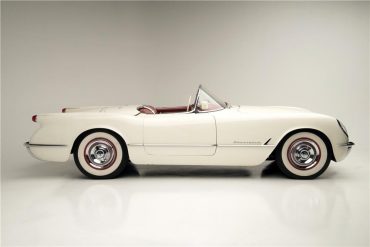


1953–62 Corvettes For Sale
The C1s the site has listed for sale, newest first: owners’ cars, dealer stock and the auction consignments worth watching, with the asking price and what we make of it. The for-sale page has every Corvette the site is following and the auctions tag the results.
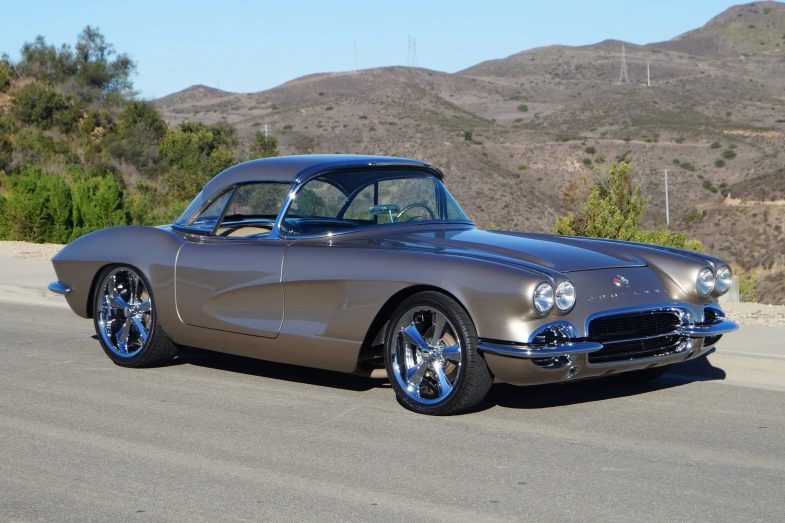


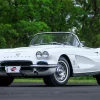
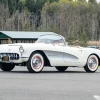


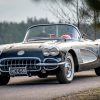
FAQs
Which C1 Corvette year is the best to buy?
It depends on what the car is for. For a driver, a 1962: the 327 in four versions to 360 horsepower, the four-speed in most cars, Positraction in nearly all, the cleanest late body and the largest supply. The 1961 is the same car with the 283 and the two-tone coves; the 1959 and 1960 are the value years, cleaner than a 1958 and cheaper than a ducktail, and with 1961 the place this guide recommends starting. For the purist, a 1956 or 1957; for the collection, a documented 1957 fuelie, a 1955 V-8 or a 1953.
If you want one answer: a 1959–61 dual-quad four-speed with a sound frame, its original engine and some paperwork. It is the C1 that does most things, it is the easiest to resell, and it costs a third of a fuelie and a fifth of a 1953.
How much is a 1953–62 Corvette worth?
From about $13,000 for a 1954 project to $7.7 million for the Corvette SS, which is why the price ladder on this page has five tiers. In the results the site tracked in 2026, carbureted 1958–62 cars sold for roughly $55,000 to $90,000, 1956–57 carbureted cars for $64,500 to $95,000, 1954s for $39,000 to $80,000, 1955 V-8s for $70,000 to $132,000, fuel-injected 1957–62 cars for $84,500 to $121,000 with the best bid to $140,000 to $242,000, and 1953s for $150,000 to $302,500.
Every figure moves and every figure depends on documentation, so use the year pages, which carry the current results for each year, and check whether an auction result includes the buyer’s premium.
How do I know a C1 Corvette is a real fuelie or big-brake car?
Start at the engine pad on the front of the block: the suffix code must match the engine the car claims, the pad should show its original broach marks rather than a smooth decked surface, and the block casting date on the bellhousing flange must come before the car’s build date; a 1957 283-hp fuelie also needs the 3731539 block. Then the unit: a Rochester injection unit carries its own serial number and must be the right series for the year. For a big-brake car the axle code on the housing must agree with the Positraction and RPO 684/687 claims, because the finned drums, metallic linings, ducts and 24-gallon tank are all easy to add; for an airbox the plenum and column tachometer are simple to install, so only documentation proves one.
Then the paperwork: the trim tag, a tank sticker or build record, NCRS judging sheets with dates and scores. Dealers removed many injection units when new and every part has been reproduced since, so “fuelie” is a claim to be proven, not a description to be accepted. The verification table above gives the codes year by year, and when in doubt pay an NCRS judge for an afternoon.
What are the most common problems with a C1 Corvette?
Rust in the steel under the fiberglass: the boxed frame rails, which trap water and rot from inside under the doors and at the rear kickups, and the windshield frame, birdcage and door hinge pillars where the body meets the steel. Those are the expensive ones and the first things to inspect. After them: pitting, crazing and stress cracks in the early fiberglass at the headlight openings, door edges, cove edges and cowl; accident repairs hidden in the bonding strips; fuel-injection units that need a specialist; dual quads out of sync; weeping wheel cylinders and drums that fade; axle hop on pre-1959 cars with a strong engine; tops and side curtains that leak; tired six-volt and cloth-insulated electrics on the earliest cars; and reproduction trim that does not fit.
All of them are known, documented and fixable at a known price except the structure, which is why the inspection on this page starts there. The common-issues posts for each year go deeper.
Is a C1 Corvette a good investment?
The best ones have been for decades and the ingredients have not changed: the first Corvette, 300 1953s, a few hundred airbox and big-brake cars, the race cars, and a supply of real documented examples that only shrinks. The 1953s, the 1957 fuelies and the race cars keep setting records, with the Corvette SS at $7.7 million in 2025.
Realistic expectations below that tier: the carbureted 1958–62 cars that make up most of the supply are driver’s cars whose prices track the wider collector market, stable rather than rising, and easy to resell; documented fuelies and big-brake cars have the best risk-and-reward in the generation; tributes, replacement-engine cars and restomods bought as investments disappoint. Buy the car you want and let the market be a bonus.
Should I buy a numbers-matching C1 or a modified one?
Buy for how you will use it. A numbers-matching car with its original drivetrain and color is the one collectors, judges and the resale market want, and it brings 20 to 30 percent more than the same car altered; on a fuelie or a big-brake car the originality is most of the value. Numbers matching became the standard when the NCRS began judging restorations on completeness, and it is now one of that organization’s highest criteria. But many solid-axle Corvettes are not numbers-matching, and that is fine: a driver with a later 283 or 327, a well-done restomod with a modern chassis, discs and an LS, or a 1958 with a replacement engine is a better car to drive for less money, as long as it is priced as what it is.
The two mistakes are paying a matching-numbers price for a car that is not, which the pad and the castings will tell you, and buying a restomod as an investment, because restomods sell on taste to a different buyer and do not follow the collector market. A color change is the one modification that hurts resale on every C1, however well done.
Is a 1953 Corvette worth the premium over a 1954?
As a collector piece, yes: 300 hand-built cars, every one documented, about 225 surviving, the first Corvette of all, and a market that has sat at $150,000 to $250,000 with a six-mile car at $302,500 in January 2026. As a car, no: the 1954 is mechanically the same six-cylinder Powerglide with the same side curtains and leaky top, 3,640 were built, and original cars sold for $39,000 to $80,000 in 2026. A 1954 in Pennant Blue or Sportsman Red with its original drivetrain gives you the 1953 experience for a fifth of the money.
If you buy a 1953, buy it against the production records, which document every car by number, and expect to pay for provenance rather than condition. If you want to drive a first-body Corvette, buy a 1955 V-8 instead.
What is the difference between the four C1 bodies, and which should I pick?
The 1953–55 cars have the original design: single headlights in mesh stone guards, jet-pod taillights, a toothed grille, side curtains and a two-speed automatic (the 1955 V-8 and its 75 three-speeds excepted). The 1956–57 cars have the side coves, exposed headlights, roll-up windows, a hardtop option and the three-speed, with the 283, injection and the four-speed arriving in 1957. The 1958–60 cars have quad headlights, the 1958 with its louvers, spears and extra chrome and the two years after it cleaned up. The 1961–62 cars have Mitchell’s ducktail with four round taillights, the mesh grille and, in 1962, the 327 and body-color coves.
Pick the 1953–55 to collect, the 1956–57 for the purest shape, the 1958–60 for the money and the 1961–62 to drive. Within any body the engine and transmission matter more than the year, and a hydraulic-cam V-8 with a four-speed is the car for someone who wants to use it.
What should I budget to run a C1 Corvette?
A sorted car on a few thousand miles a year costs $1,500 to $3,000 in parts and labor at an independent shop that knows the cars, plus a classic-car policy on an agreed value, which is cheap, and dry storage, which is not optional with a top that was never watertight. Nearly every part is reproduced and a carbureted small block is as easy to service as any engine ever built; a fuelie, a solid-lifter engine or the three-carburetor six wants a specialist and costs more to keep right.
The big bills are structural and specialist: a frame or windshield-frame repair, a correct repaint on properly prepared early fiberglass, a Rochester injection rebuild, a numbers-correct engine rebuild, and refitting reproduction 1958 trim. Buy the car that has had them done with the receipts rather than the cheaper one that will need them, and budget a first-year refresh of tires, brakes, fuel system and fluids on anything that has sat.
Where can I find 1953–62 Corvettes for sale and check the prices?
The for-sale section above and the site’s for-sale page gather the C1s we are following from owners, dealers and the auctions, newest first, with what we make of each asking price. The year pages carry the current tracked results for each year, the auctions tag has the sale-by-sale coverage, and the wholesale market reports follow what dealers pay in the lanes. Classic.com, Bring a Trailer, Mecum, Barrett-Jackson, Hagerty and the NCRS classifieds are the places the cars change hands, and the Corvette-specialist dealers carry the documented fuelies.
Use the results, not the asking prices, and remember that a solid-axle Corvette listed at a number is not one worth the number: dealers were asking up to $190,000 for 1958s in 2026 while comparable cars sold for $74,000 to $112,750 at auction. A car priced well below the market usually has a reason, so proceed with care rather than haste.
