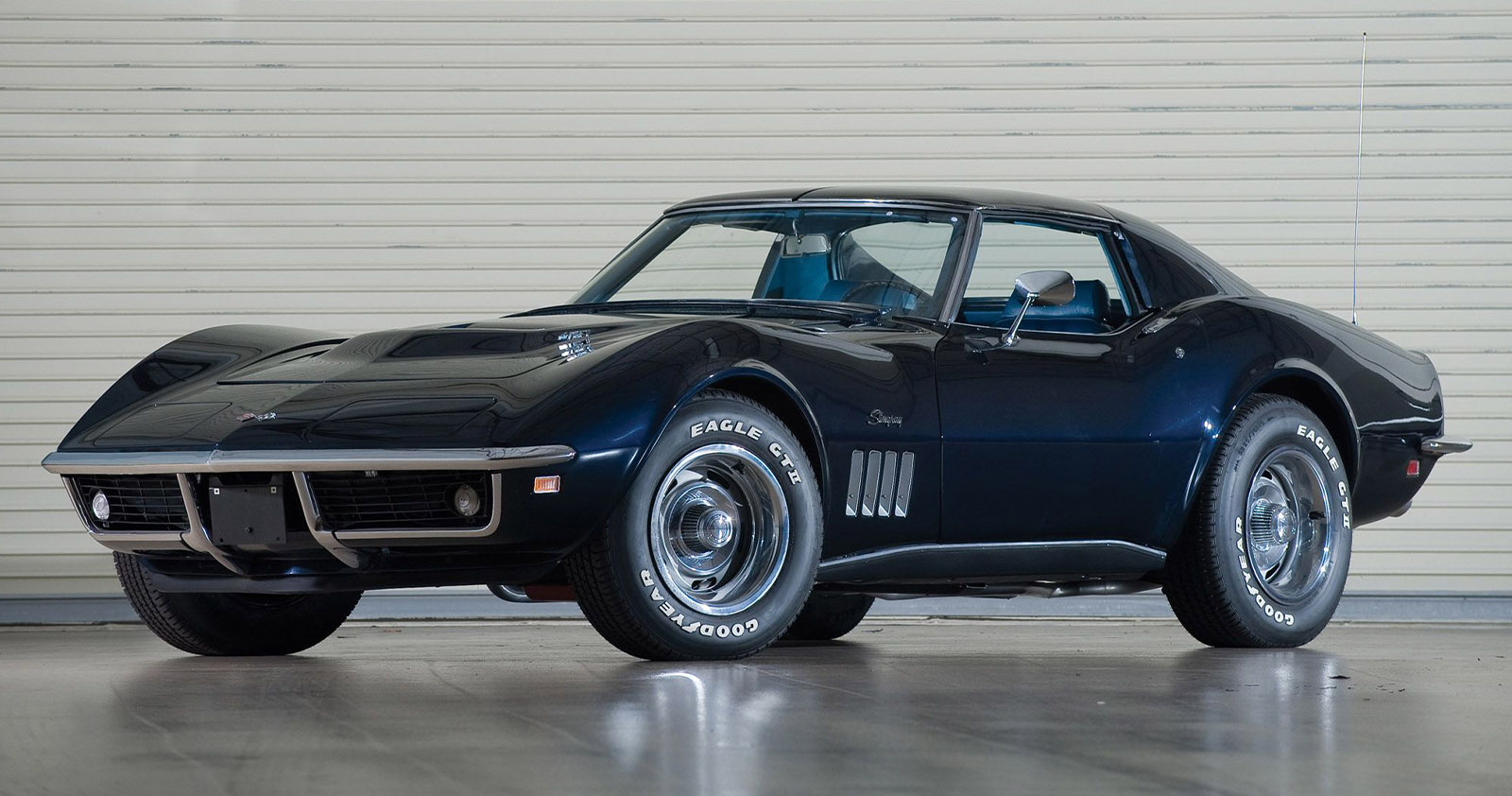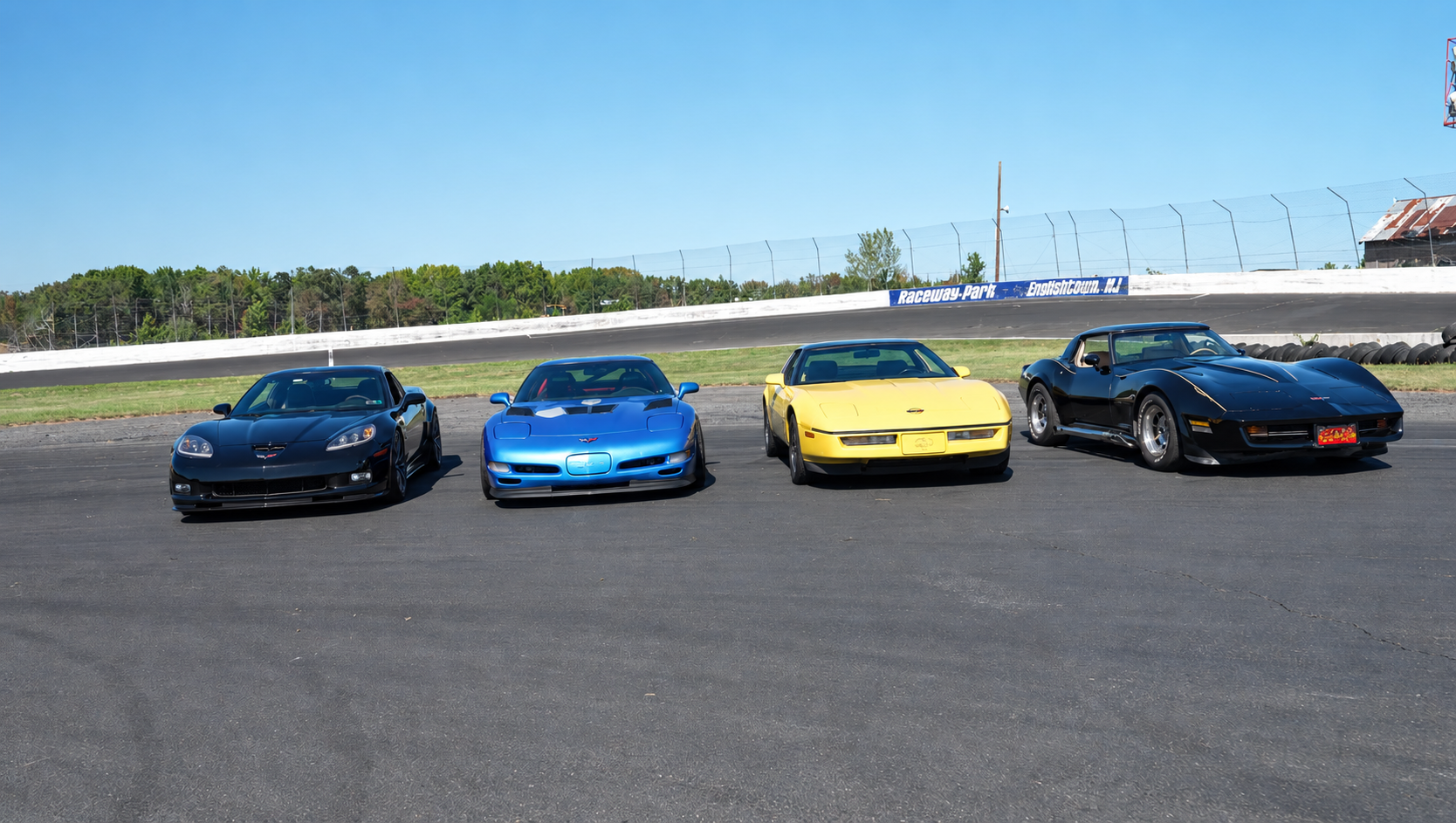
Tony Angelo and the Stay Tuned crew took four generations of modified Chevrolet Corvettes to Englishtown Raceway Park for an unconventional performance shootout. Instead of comparing showroom-stock cars, the team focused on what could be achieved with affordable Corvettes and carefully chosen modifications, with roughly $20,000 invested in each car.
The lineup covered four distinct eras: a 1980 C3, a 1987 C4, a heavily modified C5, and a C6 Z06. The cars were subjected to acceleration testing, road-course driving and a subjective “vibe check” designed to measure the character and personality of each machine.
The 1980 C3: Classic Corvette Meets Hot-Rod Engineering
Mike Coons’ 1980 C3 represented the traditional American hot rod. Purchased for approximately $5,000, the Corvette received a substantial top-end build, including an Edelbrock package, Holley 4150 carburetor and supporting ignition components.
The chassis was upgraded with tubular control arms, QA1 coilovers, a larger front sway bar and Wilwood brakes at both ends. A Hurst shifter and side pipes completed the transformation.
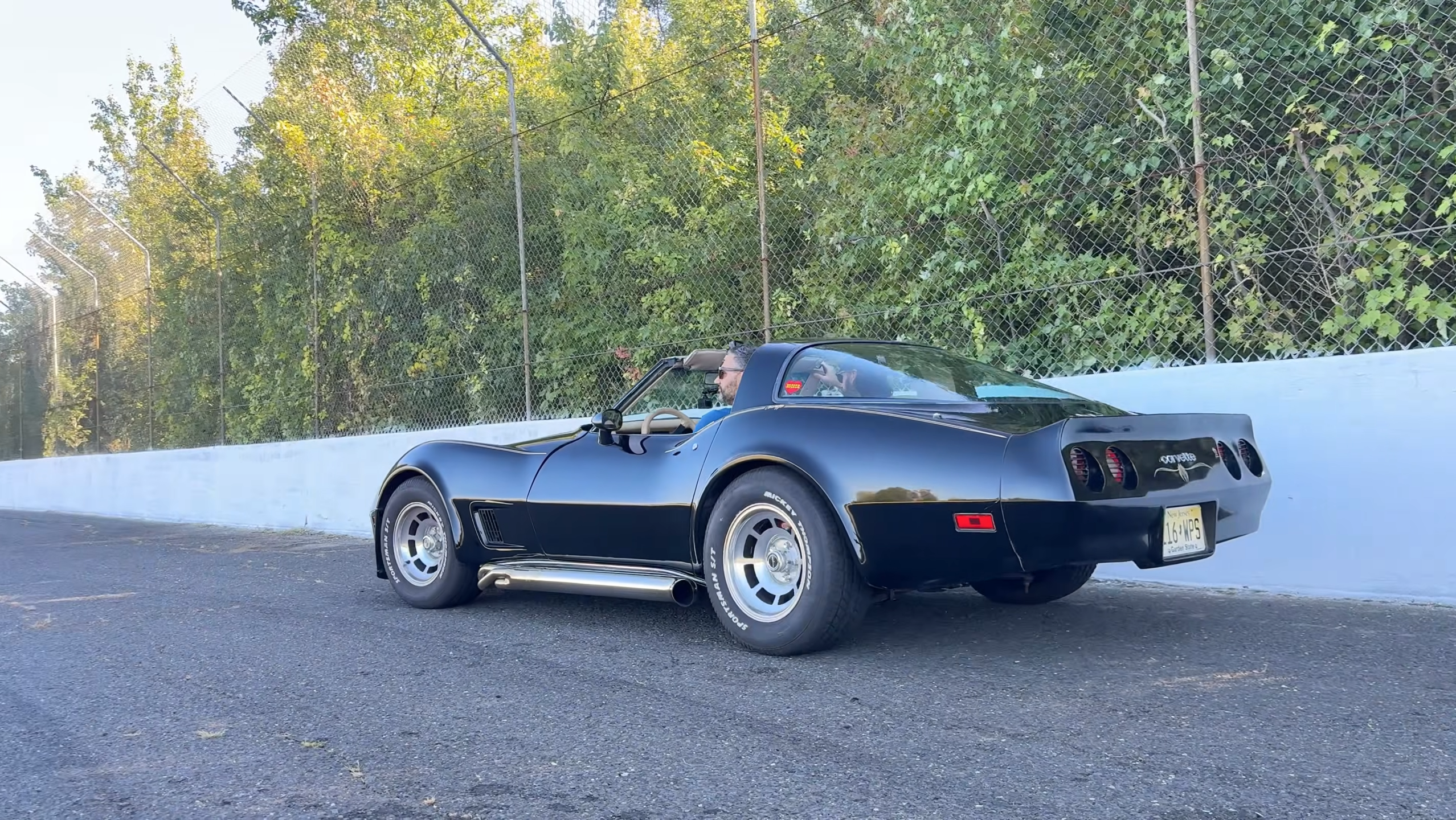
The result was a Corvette that retained the unmistakable character of the C3 while gaining substantially more performance. Its biggest limitation was the underlying architecture. The older perimeter-frame design and relatively loose steering were apparent when Angelo pushed it around Englishtown’s road course.
Yet the C3 produced the shootout’s biggest acceleration surprise, recording the quickest 0–60-mph time at 5.46 seconds. The crew acknowledged that track conditions may have contributed, but the result demonstrated how effective a relatively simple C3 build could be.
The 1987 C4: An Unexpectedly Capable Chassis
Declan’s 1987 C4 took a different approach. Its 5.7-liter V8 received a roller camshaft, aluminum cylinder heads, Holley Terminator X EFI, a custom intake and long-tube headers, producing roughly 335–350 horsepower at the wheels.
The C4 immediately demonstrated why this generation remains attractive to budget-minded enthusiasts. Although the car’s interior and controls showed their age, its chassis felt dramatically more sophisticated than the C3.
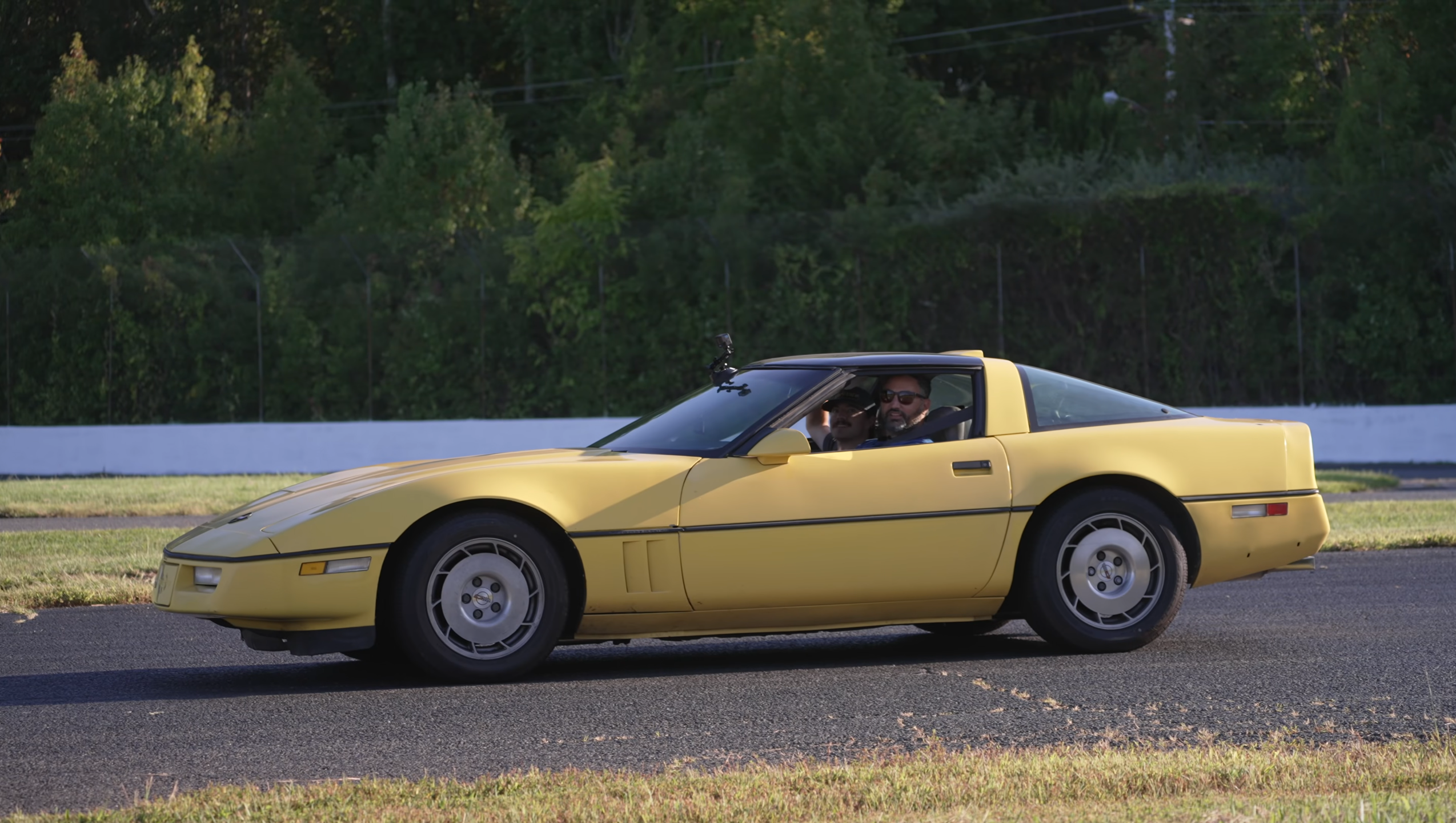
Angelo found the C4 lighter and more nimble, with substantially better stability and driveability near the limit. The steering lacked feel and the car would have benefited from more tire, but its basic chassis proved far more capable than expected. The crew specifically noted its potential for autocross use with better rubber.
The C5: Affordable Modern Corvette Performance
Angelo’s C5 represented the bridge between classic Corvette affordability and modern performance. He purchased the car for approximately $6,000 with a failed LS1, then replaced it with an inexpensive 6.0-liter truck-derived engine purchased for only a few hundred dollars.
The engine received a camshaft, long-tube headers and Holley engine management, ultimately producing approximately 410 wheel horsepower. The car also received extensive suspension modifications, coilovers, race seats, a roll bar and Nitto NT05 tires.
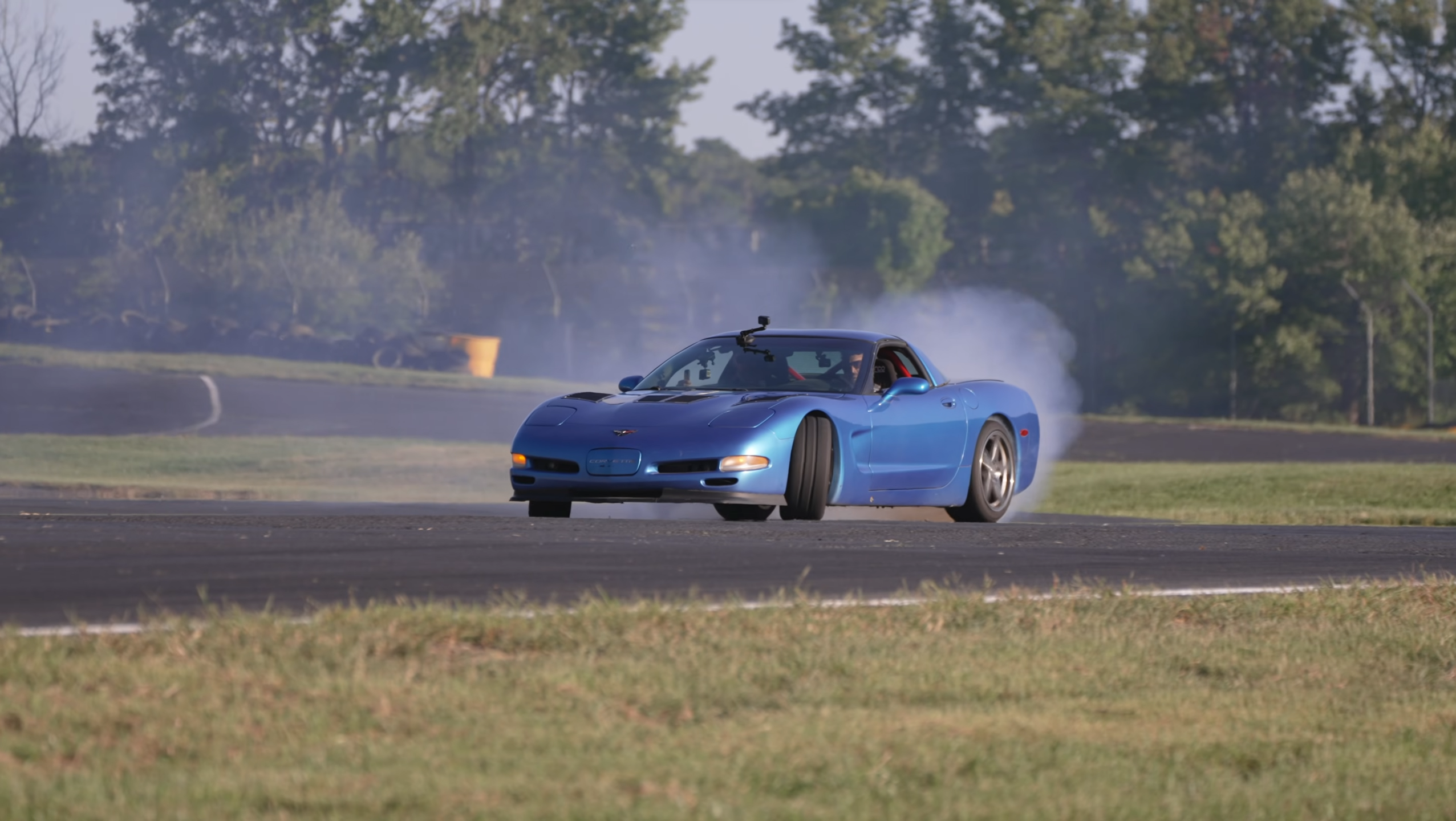
The C5’s architecture gave it a major advantage. Its stiff chassis, torque tube and rear-mounted transaxle provided the foundation for a much more sophisticated performance machine than its purchase price suggested.
Rather than simply making power, the build concentrated on making the chassis exploit that power. The result was a lightweight, highly responsive Corvette that Angelo considered exceptionally fun to drive.
The C6 Z06: Factory Hardware on a Budget
Barb’s C6 Z06 was the most technically advanced car in the comparison and arguably the most unusual purchase. Angelo acquired it for $17,000 despite approximately 270,000 miles and a history involving flood damage. The engine had subsequently been rebuilt.
The C6 Z06 brought serious factory hardware to the fight. Its 7.0-liter LS7 produced 505 horsepower in stock configuration, while the car’s lightweight construction, aluminum frame, magnesium components and wide-body architecture gave it a substantial performance advantage over earlier generations.
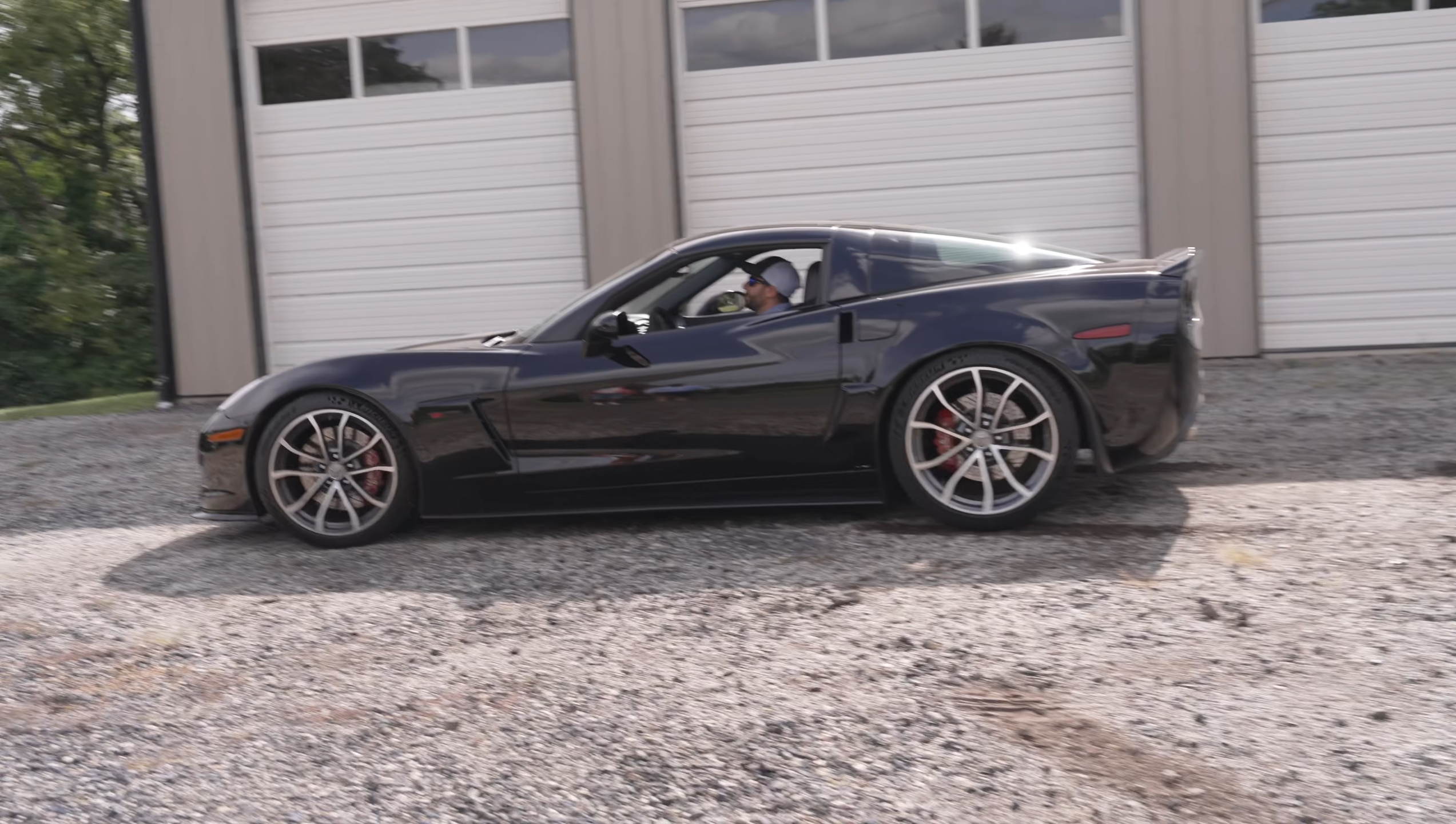
Additional modifications included coilovers, upgraded braking components, long-tube headers, a full exhaust and performance tires.
The result was an exceptionally fast Corvette that required comparatively little modification to deliver serious track performance. Its enormous factory capability made it the benchmark against which the other three budget builds were measured.
Englishtown Raceway Park: Four Generations on Track
With Englishtown Raceway Park available exclusively for the test, the crew began with warm-up and familiarization laps before moving into more serious driving.
The road-course testing highlighted the evolution of Corvette chassis engineering. The C3 was entertaining but required more work from its driver. The C4 felt significantly more stable and nimble, while the C5 delivered a modern combination of stiffness, power and balance. The C6 Z06 ultimately demonstrated the highest level of factory-developed performance.
Interestingly, the road-course results did not simply follow engine output. Chassis setup, tire selection, driver confidence and the character of each build played major roles.
The 0–60 Surprise
Acceleration testing produced one of the day’s most unexpected outcomes. The modified C3 recorded the fastest 0–60-mph run at 5.46 seconds, beating the newer C5 and C6.
The crew suspected the track surface played a role, but the result still illustrated one of the central themes of the test: performance does not always correspond directly with vehicle age, factory specifications or engine output. A relatively inexpensive older Corvette can become surprisingly quick when its powertrain and chassis are properly developed.
The Corvette Vibe Check
The final test was less scientific but deliberately important to the Stay Tuned approach. Each participant dressed in period-appropriate or character-matching clothing and presented the personality of his Corvette.
The exercise recognized something conventional performance testing cannot measure: Corvettes are not purchased solely for acceleration or lap times. Each generation carries a distinct identity, from the C3’s classic hot-rod presence to the C4’s unmistakable 1980s character and the increasingly modern performance of the C5 and C6.
The Final Results
After combining the acceleration, road-course and subjective portions of the challenge, the results were remarkably close. The C5 and C6 finished tied with five points apiece, while the C3 and C4 each recorded four points.
The narrow margins were appropriate for a comparison built around four very different approaches to Corvette performance. The C3 proved that an old-school build could still surprise on the drag strip. The C4 demonstrated that its chassis remained highly exploitable. The C5 showed how cheaply modern Corvette performance could be assembled, while the C6 Z06 demonstrated the enormous capability already engineered into a factory performance model.
Source: Stay Tuned