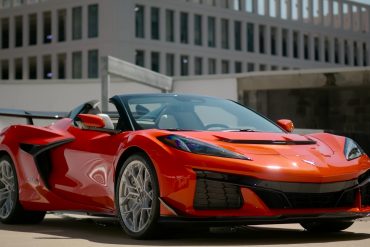
CORVETTE LISTS
The Fastest Corvettes Ever Made
Every factory Corvette ranked by top speed, with its 0–60 and quarter-mile times, from the 150-mph fuelies of 1962 to the 233-mph ZR1 and the 1,250-hp ZR1X. Plus the modified Corvettes that beat them all.
Quick Nav: At A Glance · The Ranking · The Cars · By Generation · Quarter Mile · Modified · Slowest · Methodology · FAQs · More Lists
At A Glance
Top speed: 233 mph — 2025 Corvette ZR1 (and the 2026 ZR1X)
Quickest 0–60: 1.68 seconds — 2026 Corvette ZR1X
Quickest ¼ mile: 8.675 s @ 159 mph — 2026 Corvette ZR1X
Most powerful: 1,250 hp — 2026 Corvette ZR1X
Fastest front-engine: 212 mph — 2019 Corvette ZR1
First past 200 mph: 205 mph — 2009 Corvette ZR1
Fastest naturally aspirated: 198 mph — 2006–13 Corvette Z06
Fastest Corvette of any kind: 254.76 mph — 1988 Callaway Sledgehammer
The Overview
Each generation of Corvette has brought a step up in performance, but the past twenty years turned America’s sports car from a largely overlooked muscle car into a world-class supercar. Since the LT1 and LT4 of the fourth generation, the engineers behind the Corvette have raised its power and performance with every successive generation.
The fifth-generation Corvette re-introduced the Z06. It was the first model to cross the 400-horsepower threshold since the big-block cars of the late sixties and early seventies, and it became the fastest production Corvette of its time. By the time the C6 arrived in 2005, Corvette Racing had already won Le Mans three times (2001, 2002 and 2004), and the sixth generation took the brand from sports car to supercar: first with the 505-horsepower Z06 of 2006, then with the 638-horsepower ZR1 of 2009, the first production Corvette past 200 mph.
The seventh generation went further still. The 2014 Stingray was rated at 455 horsepower; the 2015 Z06 brought the supercharged LT4 at 650 horsepower and 650 lb-ft; and in 2019 the ZR1 returned with 755 horsepower and 715 lb-ft, the most powerful and fastest Corvette ever built at the time. Then the engine moved behind the driver. The C8 Stingray matched the old ZR1’s acceleration on 495 horsepower, the 670-horsepower Z06 brought the most powerful naturally aspirated V8 ever put in a production car, the 1,064-horsepower ZR1 ran 233 mph, and the 1,250-horsepower ZR1X became the quickest American production car ever built: 0–60 in 1.68 seconds and the quarter mile in 8.675 seconds.
This page ranks every factory Corvette by its top speed, with the 0–60 and quarter-mile figures alongside, then looks at each car in turn. Chevrolet’s own certified numbers are used from 2006 on; the older cars carry the best period road-test figures, and the table says which is which. The modified Corvettes that outran the factory have their own section, and so do the slowest Corvettes ever built.
The Fastest Corvettes, Ranked
Every factory production Corvette by top speed. The quickest cars by acceleration follow in the second table.
| # | CORVETTE | YEARS | HP | 0–60 MPH | ¼ MILE | TOP SPEED | FIGURES |
|---|---|---|---|---|---|---|---|
| 1 | C8 Corvette ZR1X | 2026– | 1,250 | 1.68 s | 8.675 s @ 159 mph | 233 mph* | Chevrolet |
| 2 | C8 Corvette ZR1 | 2025– | 1,064 | 2.3 s | 9.6 s @ 150 mph | 233 mph | Chevrolet |
| 3 | C7 Corvette ZR1 | 2019 | 755 | 2.85 s | 10.6 s @ 134 mph | 212 mph | Chevrolet |
| 4 | C6 Corvette ZR1 | 2009–13 | 638 | 3.4 s | 11.3 s @ 131 mph | 205 mph | Chevrolet |
| 5 | C6 Corvette Z06 | 2006–13 | 505 | 3.7 s | 11.7 s @ 125 mph | 198 mph | Chevrolet |
| 6 | C7 Corvette Z06 | 2015–19 | 650 | 2.95 s | 10.95 s @ 127 mph | ≈196 mph† | Chevrolet (acceleration) |
| 7 | C8 Corvette Z06 | 2023– | 670 | 2.6 s | 10.6 s @ 131 mph | 195 mph (189 w/ Z07) | Chevrolet |
| 8 | C8 Corvette Stingray | 2020– | 490–495 | 2.9 s | 11.2 s @ 123 mph | 194 mph (184 w/ Z51) | Chevrolet |
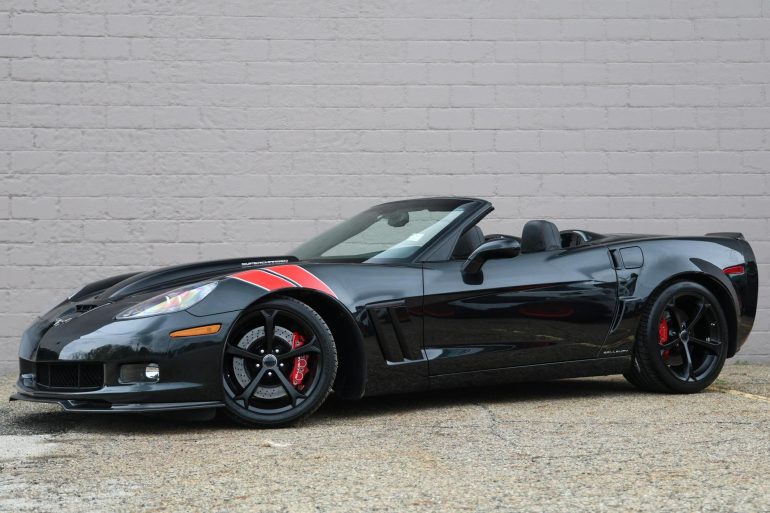
| 9 | C6 Corvette Grand Sport | 2010–13 | 430–436 | 4.0 s | 12.3 s @ 116 mph | 190 mph | Chevrolet |
| 10 | 2013 Corvette 427 Convertible | 2013 | 505 | 3.8 s | 11.8 s | 190 mph | Chevrolet |
| 11 | C8 Corvette E-Ray | 2024– | 655 | 2.5 s | 10.5 s @ 130 mph | 183 mph | Chevrolet |
| 12 | C7 Corvette Stingray | 2014–19 | 455–460 | 3.8 s | 12.0 s @ 119 mph | ≈181 mph† | Chevrolet (acceleration) |
| 13 | C4 Corvette ZR-1 | 1990–95 | 375–405 | 4.4 s | 12.9 s @ 111 mph | 180 mph | Chevrolet / period tests |
| 14 | C5 Corvette Z06 | 2001–04 | 385–405 | 3.9 s | 12.4 s @ 116 mph | 171 mph | Chevrolet |
| 15 | C3 Corvette ZL1 | 1969 | 430 (adv.) | ≈4.5 s | ≈12.1 s @ 116 mph | ≈170 mph | Period tests |
| 16 | C2 Corvette L88 | 1967 | 430 (adv.) | ≈5.0 s | ≈13.5 s @ 111 mph | 171 mph (claimed) | Period tests |
| 17 | C1 Corvette 327 Fuelie | 1962 | 360 | 5.9 s | 14.2 s @ 104 mph | ≈150 mph | Period tests |
* Chevrolet has not published a measured top speed for the ZR1X; it carries the ZR1’s certified 233 mph. † Chevrolet never certified a top speed for the C7 Z06 or Stingray; the figures are Chevrolet estimates (the Z07 aero package limits the Z06 to about 185 mph).
The Quickest Corvettes: 0–60 and the Quarter Mile
| # | CORVETTE | 0–60 MPH | ¼ MILE |
|---|---|---|---|
| 1 | 2026 ZR1X | 1.68 s | 8.675 s @ 159 mph |
| 2 | 2025 ZR1 | 2.3 s | 9.6 s @ 150 mph |
| 3 | 2024 E-Ray | 2.5 s | 10.5 s @ 130 mph |
| 4 | 2023 Z06 | 2.6 s | 10.6 s @ 131 mph |
| 5 | 2019 ZR1 | 2.85 s | 10.6 s @ 134 mph |
| 6 | 2020 Stingray Z51 | 2.9 s | 11.2 s @ 123 mph |
| 7 | 2015 Z06 (Z07, auto) | 2.95 s | 10.95 s @ 127 mph |
| 8 | 2009 ZR1 | 3.4 s | 11.3 s @ 131 mph |
The Fastest Corvettes, One By One
In ranking order, from the newest hypercar to the first fuel-injected small block.
1. C8 Corvette ZR1X (2026– )
1,250 hp / 0–60 mph: 1.68 seconds / ¼ mile: 8.675 s @ 159 mph / Top speed: 233 mph
The Corvette has always been about punching above its weight, but the ZR1X feels like Chevy threw the whole rulebook out the window. This isn’t just another fast Corvette: it is a 1,250-horsepower, all-wheel-drive rocket that blurs the line between supercar and science experiment.
At the heart of it sits the 5.5-liter twin-turbo LT7, a hand-built engine with a flat-plane crank and a pair of big turbos tucked in close for instant response. On its own it makes 1,064 horsepower, already more than any Corvette before it, but Chevy didn’t stop there. A front-axle electric motor adds another 186 horses, bringing the total to that staggering 1,250. The setup doesn’t need a wall plug; the battery recharges on the go, so you get the instant shove of electric torque without any extra hassle.
In October 2025 Chevrolet put the numbers on paper. On a prepped surface at US 131 Motorsports Park in Martin, Michigan, with development engineer Stefan Frick driving a production car on pump gas, standard aero and Michelin Pilot Sport 4S tires, the ZR1X ran the quarter mile in 8.675 seconds at 159 mph and reached 60 mph in 1.68 seconds, hitting 1.75 g and passing 60 mph in under 100 feet. Even on an unprepped surface with the ZTK package it ran 8.99 seconds and 1.89 to 60. That makes it the quickest American production car ever built. Top speed hasn’t been officially run yet; expect it to match the ZR1’s 233 mph.
Stopping and turning matter too. The ZR1X gets massive carbon-ceramic brakes with 10-piston front calipers, magnetic ride control and an optional aero kit that can generate up to 1,200 pounds of downforce. It has already proven itself on the world’s toughest track: at the Nürburgring it laid down a 6:49.275 lap, dethroning the Mustang GTD as the fastest American car ever to lap the Green Hell.

2. C8 Corvette ZR1 (2025– )
1,064 hp / 0–60 mph: 2.3 seconds / ¼ mile: 9.6 s @ 150 mph / Top speed: 233 mph
Chevrolet’s ZR1 used to be the Corvette’s endgame. Then the ZR1X showed up with electric assist and stole the acceleration crown. That doesn’t diminish the ZR1. If the ZR1X is the ultimate weapon, the ZR1 is the rear-drive purist’s blade: lighter, simpler and utterly vicious.
The heart is the LT7, the Z06’s 5.5-liter flat-plane V8 reimagined with twin turbos. It is hand-built, dry-sumped and eager to rev, but now it brings brute force: 1,064 hp and 828 lb-ft, sent exclusively to the rear wheels through an eight-speed dual-clutch. Traction control earns its keep, because the shove is immediate and immense. Chevrolet’s own figures, published in December 2024, are 0–60 mph in 2.3 seconds and the quarter mile in 9.6 seconds at 150 mph. In October 2024, at the Papenburg oval in Germany a production ZR1 ran 233 mph, the highest top speed ever recorded by a car from an American manufacturer.
The rest of the car is built to cash those checks. Wider bodywork feeds the intercoolers and cleans up airflow; Magnetic Ride Control keeps the ride calm on the street and taut on track. Tick the ZTK Performance Package and you get Michelin Pilot Sport Cup 2R rubber, stiffer spring rates and the Carbon Aero kit (dive planes, underbody strakes and a rear wing good for around 1,200 pounds of downforce at speed). Braking can be upgraded with the J59 package, pairing carbon-ceramic rotors with Alcon 10-piston front and 6-piston rear calipers for repeatable, race-length stops.
Proof? At the Nürburgring a pre-production ZR1 stopped the clocks at 6:50.763, a tick behind its all-wheel-drive ZR1X sibling. Different philosophies, same obsession with speed. Inside, the 2026 cockpit updates bring a cleaner multi-screen layout and better data via the Performance app, and the usual Corvette practicality. That is the ZR1’s charm: everyday livable, track lethal, and the rear-drive zen master that sits just under the ZR1X on the Corvette food chain.
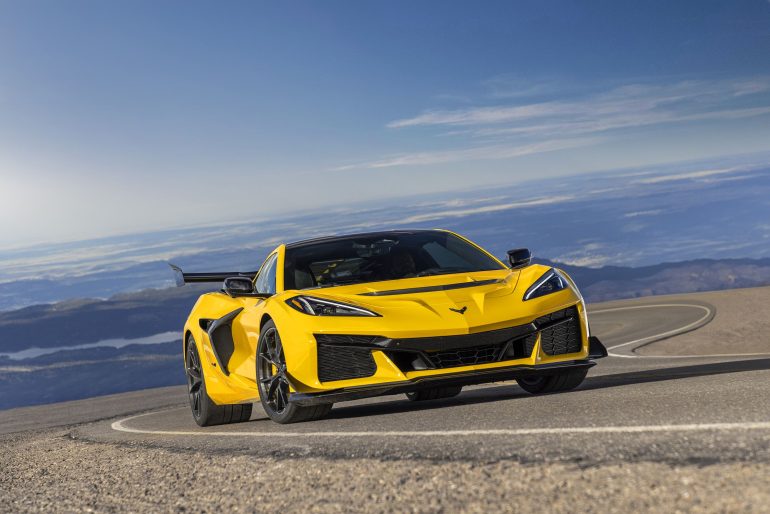
3. C7 Corvette ZR1 (2019)
755 hp / 0–60 mph: 2.85 seconds / ¼ mile: 10.6 s @ 134 mph / Top speed: 212 mph
“I’ve never driven a Corvette like this before, and nobody else has either, because there’s never been one like this before. Its unprecedented performance puts all other global supercars on notice that the ZR1 is back.” — Mark Reuss, GM executive vice president, Global Product Development.
On November 12, 2017, Chevrolet unveiled the 2019 Corvette ZR1, a variant that pushed the front-engine Corvette’s performance to levels of power, track capability and technology it had never seen. The ZR1’s supercharged 6.2-liter LT5 dramatically advanced the supercharging first introduced on the 2009 C6 ZR1 and continued on the 2015 Z06. Officially SAE-rated at 755 horsepower (563 kW) and 715 lb-ft of torque (969 Nm), it set an entirely new benchmark for Chevrolet performance, and remains the most powerful front-engine Corvette ever built.
The LT5 brought GM’s first dual-fuel-injection system, primary direct injection with supplemental port injection, and despite its output it managed 15 city / 22 highway mpg with the seven-speed manual or 13 / 23 with the eight-speed automatic.
The numbers were spectacular. With a GM Performance driver at the wheel, the 2019 ZR1 ran 0–60 in 2.85 seconds, the quarter mile in 10.6 seconds at 134 mph, a standing mile at 190 mph (with the rear spoiler removed), and in April 2018 posted an official two-way average top speed of 212 mph at the Papenburg test track, peaking at 214.88 mph in one direction. From 214 mph it came to a dead stop in 8.17 seconds. In stock trim the ZR1 also completed a 24-hour run at Virginia International Raceway, stopping only for fuel and tires, and in the process set a production-car lap record 1.37 seconds quicker than the Ford GT had managed one week earlier.
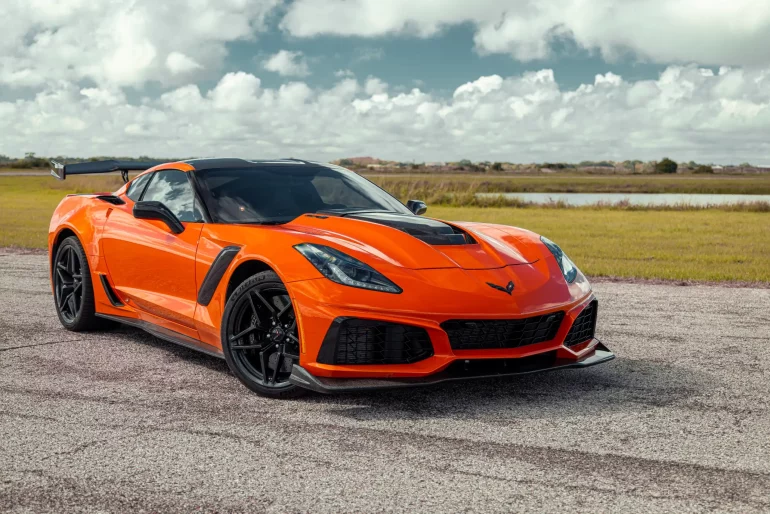
4. C6 Corvette ZR1 (2009–2013)
638 hp / 0–60 mph: 3.4 seconds / ¼ mile: 11.3 s @ 131 mph / Top speed: 205 mph
“Chevrolet’s goal with the new ZR1 is to show what an American supercar can deliver, at a price that trumps exotics that cost two, three or four times as much – and does so with exceptional driveability.” — Ed Peper, Chevrolet General Manager.
Introduced for 2009, the ZR1 was designed and marketed as “an American supercar that brings the technology and engineering refinement of carbon-fiber, ceramics and electronics together in a distinctive design.” The intent was a car that could out-power the Ferraris and Lamborghinis that cost two, three or four times as much.
Power came from the all-new LS9, a 6.2-liter small block with a large positive-displacement Roots-type supercharger featuring a new four-lobe rotor design. It produced 638 horsepower and 604 lb-ft of torque, mated to a six-speed manual with a twin-disc clutch developed to provide exceptional clamping power while keeping a manageable pedal. The rear axle was bolstered with asymmetrical axle-shaft diameters developed for optimal torque management.
The car was built on the Z06’s aluminum chassis with specially tuned suspension including Magnetic Selective Ride Control, and massive 15.5-inch front and 15-inch rear Brembo carbon-ceramic rotors with six-piston front and four-piston rear calipers. A raised all-carbon-fiber hood, roof, roof bow, rocker moldings, front splitter, front fenders and full-width body-color rear spoiler kept the curb weight to 3,324 pounds (1,508 kg). The hood’s clear polycarbonate window exposed the top of the intercooler, “LS9 SUPERCHARGED” embossed on either side.
The real measure of the C6 ZR1 is in its numbers. Zero to 60 took 3.4 seconds, achieved while battling wheelspin in first and second gears; the quarter mile took 11.3 seconds, on par with some of the fastest cars in the world at the time. The most impressive number of all was its top speed, documented at 205 mph, which made the ZR1 the first production Corvette to break the 200-mph barrier.
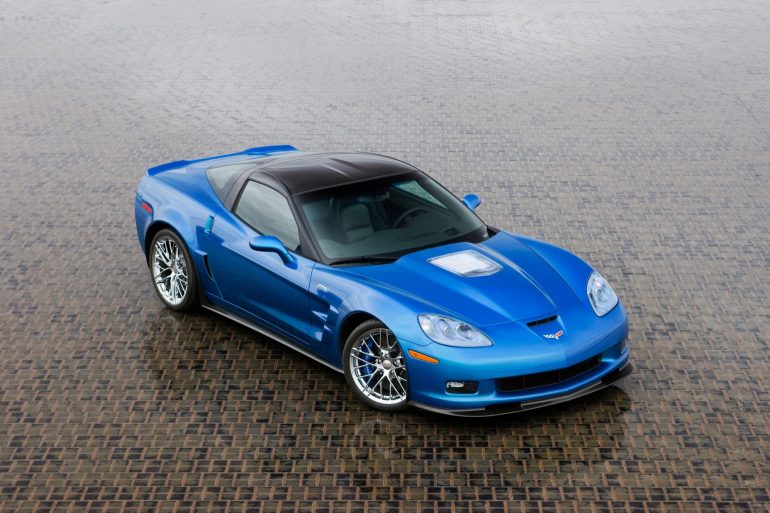
5. C6 Corvette Z06 (2006–2013)
505 hp / 0–60 mph: 3.7 seconds / ¼ mile: 11.7 s @ 125 mph / Top speed: 198 mph
The C6 Z06 is still the fastest naturally aspirated Corvette ever built, and the fastest by top speed of any Z06. Its hand-assembled 7.0-liter LS7, the largest small block ever offered in a production car, made 505 horsepower and 470 lb-ft of torque, breathing through titanium connecting rods and intake valves and a dry-sump oiling system taken straight from Corvette Racing. On an aluminum frame some 136 pounds lighter than the steel one under a base C6, it weighed about 3,130 pounds. Chevrolet’s numbers: 0–60 in 3.7 seconds, the quarter mile in 11.7 seconds at 125 mph and a top speed of 198 mph.
To commemorate the 50th anniversary of the Corvette first competing in the 24 Hours of Le Mans, Chevrolet introduced the Z06 Carbon Limited Edition in 2011. Although the ZR1 was already the fastest and most advanced car in the Corvette paddock, the Carbon Limited Edition was quickly identified as the best balanced, most track-capable car of the sixth-generation lineup. It was positioned to “bridge the gap” between the Z06 and ZR1: the ZR1’s 15-inch carbon-ceramic brakes, driver-adjustable magnetorheological shocks, black 19-inch front and 20-inch rear wheels with Michelin Pilot Sport PS2 rubber, carbon-fiber ZR1 rocker extensions and front splitter, a raised carbon-fiber hood, a carbon roof panel and a body-color full-width rear spoiler.
The Carbon was limited to two colors, Supersonic Blue and Inferno Orange, each with a numbered door decal. GM claimed the Carbon was lighter than a standard Z06, but because it carried more robust equipment it weighed in at about 3,150 pounds, virtually the same as any other Z06 and roughly 200 pounds lighter than a ZR1. With the added grip and stability of its equipment, the Carbon proved a full three seconds faster than a standard Z06 around Mazda Raceway Laguna Seca, and in testing it accelerated from zero to 60 in 3.7 seconds and ran the quarter mile in 11.6 seconds at 123.6 mph. For those looking for near-ZR1 performance without the ZR1’s cost, the Z06 Carbon was a worthy contender.
 Credit: Bring a Trailer
6. C7 Corvette Z06 (2015–2019)
650 hp / 0–60 mph: 2.95 seconds / ¼ mile: 10.95 s @ 127 mph / Top speed: ≈196 mph
“The Corvette Z06 is a great example of the technology transfer between racing and production Corvettes. First, we took what we learned on the Corvette Racing C6.R and applied that to the all-new Corvette Stingray. Then, using the Stingray as a foundation, the Z06 and C7.R were developed to push the envelope of performance on the street and the track.” — Corvette Chief Engineer Tadge Juechter.
The Z06 rejoined the lineup in 2015 as “the most capable model in the iconic car’s 62-year history.” Developed directly alongside the C7.R race car, it pushed the Corvette platform’s performance envelope with unprecedented levels of aerodynamic downforce. It was also the first Z06 with a supercharged engine, an eight-speed automatic transmission and a removable roof panel, made possible by a far stronger aluminum frame.
At its heart is the supercharged 6.2-liter LT4, SAE-certified at 650 horsepower (485 kW) at 6,400 rpm and 650 lb-ft (881 Nm) at 3,600 rpm. It displaced the C6 ZR1 as the most powerful production Corvette ever, a record that stood until the 2019 ZR1. With the Z07 Performance Package the Z06 was capable of 0–60 in 2.95 seconds with the eight-speed automatic (3.2 with the seven-speed manual), a quarter mile of 10.95 seconds at 127 mph (11.2 with the manual), 1.2 g of lateral acceleration, and 60–0 mph braking in 99.6 feet, the best of any production car General Motors had tested. Chevrolet never certified a top speed; the standard car is good for about 196 mph, the Z07’s aero trims that to around 185.
Another milestone: the C7 Z06 was offered as both a coupe and a convertible. Per Juechter: “Simply put, until recently it was not possible to create an open-roof structure strong enough to meet Corvette’s highest performance levels. It required advancements in computer-aided engineering, metallurgy and manufacturing – many of which did not exist five years ago – to make a frame strong enough for a Z06 Convertible.”
 The 2016 Corvette Z06 C7.R Edition pays homage to the Corvette Racing race cars. Offered in coupe and convertible models, only 500 will be built – each with a unique, sequential VIN.
7. C8 Corvette Z06 (2023– )
670 hp / 0–60 mph: 2.6 seconds / ¼ mile: 10.6 s @ 131 mph / Top speed: 195 mph (189 with Z07)
Chevy didn’t just build another Corvette when it rolled out the C8 Z06; it built a statement piece. Moving the Corvette’s engine behind the driver was already a seismic shift, but the Z06 sharpened the idea into something that feels every bit as exotic as its European rivals. It was designed and engineered as a “precision tool” for the race track, and it has blurred the lines between street car and race car to such an extent that it is hard to say which environment it suits best.
The centerpiece is the LT6, a 5.5-liter flat-plane-crank V8 that screams to 8,600 rpm: the most powerful naturally aspirated V8 ever put in a production car, cranking out 670 horsepower and 460 lb-ft of torque. Developed alongside the GT3.R race engine, it trades low-end thump for razor-sharp throttle response and a soundtrack more Ferrari than farm boy. Where past Z06s relied on superchargers for this kind of output, Chevrolet’s engineers returned to natural aspiration without compromising horsepower or responsiveness, and all that fury funnels through an eight-speed dual-clutch to the rear wheels.
Chevrolet’s numbers: 0–60 in 2.6 seconds, the quarter mile in 10.6 seconds at 131 mph, and a top speed of 195 mph (189 mph with the Z07 package’s downforce). Not the wildest top speed in Corvette history, but that’s not the point: this car is built to carve corners, not win highway dares. The Z06 sits wider than the base C8, wears 345-section rear tires, and can be optioned with carbon-ceramic brakes. Tick the Z07 package and you get Michelin Pilot Sport Cup 2R tires, stiffer suspension and a carbon-fiber aero kit that generates 734 pounds of downforce at speed. Slide into the cockpit and it feels more like a fighter jet than a muscle car.
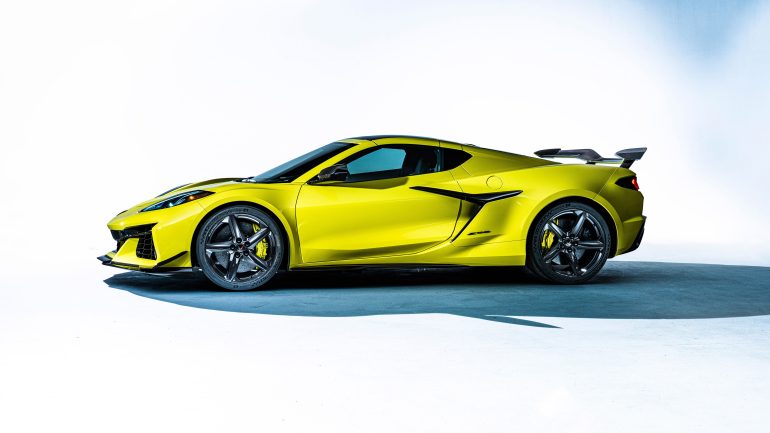
8. C8 Corvette Stingray (2020– )
490–495 hp / 0–60 mph: 2.9 seconds / ¼ mile: 11.2 s @ 123 mph / Top speed: 194 mph (184 with Z51)
With supercar performance, an affordable price tag and flashy styling, the C8 Stingray honors the nameplate’s decades-old status as an automotive icon with a mid-engine twist. It is the first generation to mount its naturally aspirated V8 behind the passenger compartment, which pushed Chevy’s halo sports car into the realm of exotic machinery. Its sharp handling and explosive acceleration match sports cars costing tens of thousands more, yet it is comfortable and refined enough to drive cross-country, with a removable roof panel on the coupe and adequate trunk space for luggage.
The engine is still a 6.2-liter V8, the LT2, making 490 horsepower and 465 lb-ft of torque, or 495 horsepower with the dual-mode performance exhaust that comes with the Z51 package. Z51 also adds an electronic limited-slip differential, bigger brakes, summer tires and a front splitter and rear spoiler. An eight-speed dual-clutch automatic, a Corvette first, is the only transmission, controlled by a push-button selector or the steering-wheel paddles; no manual is offered.
Chevrolet rates the Z51 Stingray at 0–60 in 2.9 seconds and the quarter mile in 11.2 seconds at 123 mph, numbers that matched the 2009 ZR1’s and beat the C7 Z06 in independent tests (Car and Driver recorded 2.8 seconds to 60). The base car’s top speed is 194 mph; the Z51’s aero adds downforce and trims that to 184 mph. Even in base form, the C8 delivers heroic handling and big thrills on both road and track.
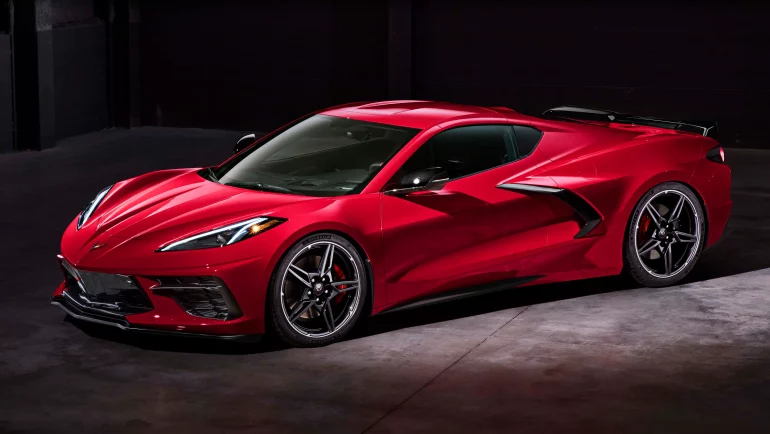
9. C6 Corvette Grand Sport (2010–2013)
430–436 hp / 0–60 mph: 4.0 seconds / ¼ mile: 12.3 s @ 116 mph / Top speed: 190 mph
When Chevrolet introduced the Grand Sport in 2010, some questioned the decision to add another variant of the C6 so soon after the ZR1. But Chevrolet recognized that the Grand Sport would give buyers a more affordable Corvette that blended the styling and handling of the Z06 with the still-powerful engine of the base car.
The Grand Sport came with the 6.2-liter LS3 producing 430 horsepower and 424 lb-ft of torque (436 hp and 428 lb-ft with the dual-mode exhaust). It lacked the supercharger and displacement of its big brothers, but it could still jump from zero to 60 in four seconds flat and reach a top speed of 190 mph, and the manual coupes got the Z06’s dry-sump oiling.
Many critics argued the Grand Sport was slightly more enjoyable than the ZR1 on public roads, its power more usable. Where the ZR1 produced rubber-melting horsepower, the Grand Sport balanced power and handling into an exhilarating but more manageable drive, with razor-sharp steering and brakes and suspension capable of the most extreme driving conditions.
 Credit: Bring a Trailer
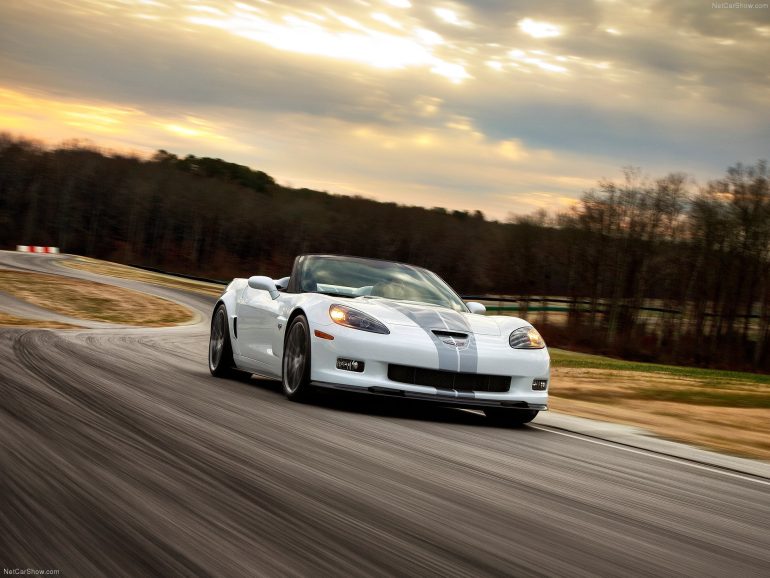
10. 2013 Corvette 427 Convertible Collector Edition
505 hp / 0–60 mph: 3.8 seconds / ¼ mile: 11.8 seconds / Top speed: 190 mph
“The 2013 model year will be historic for Corvette, marking its 60th Anniversary and the final year for the current ‘C6’ generation... We couldn’t think of a more fitting way to celebrate these milestones than bringing back one of the most-coveted combinations in the brand’s history – the Corvette convertible and a 427 cubic-inch engine.” — Chris Perry, Vice President, Global Marketing and Strategy for Chevrolet.
In 2013 Chevrolet introduced the 427 Convertible Collector Edition to celebrate Corvette’s 60th anniversary and give the C6 a proper send-off. It blended elements of the Z06 and ZR1 to create the fastest convertible in the brand’s history: the 7.0-liter LS7 rated at 505 horsepower and 470 lb-ft, the most powerful engine ever installed in a production Corvette convertible, with a six-speed manual as the only transmission. It carried the Z06’s driveline and rear axle, standard Magnetic Selective Ride Control, 19-inch front and 20-inch rear wheels on ZR1-style Michelin PS2 tires, and several carbon-fiber components to cut weight: the raised hood first seen on the 2011 Z06 Carbon, Z06-style fenders, floor panels and an optional front splitter and rocker panels.
The diet brought the curb weight down to 3,355 pounds (1,522 kg). Combined with 505 horsepower that gave a power-to-weight ratio of one horsepower for every 6.64 pounds, better than the Audi R8 Spyder and Ferrari California of the day, and made the 427 Convertible one of the fastest convertibles in the world at the time: zero to 60 in 3.8 seconds, the quarter mile in 11.8 seconds and a top speed of 190 mph.
11. C8 Corvette E-Ray (2024– )
655 hp / 0–60 mph: 2.5 seconds / ¼ mile: 10.5 s @ 130 mph / Top speed: 183 mph
The E-Ray, launched for 2024, brought the first hybrid powertrain and the first all-wheel drive in the Corvette’s history. An electric motor powers the front wheels while the Stingray’s 6.2-liter LT2 V8 is on duty out back. Together they develop 655 combined horsepower, within 15 horsepower of the range-topping Z06, and the E-Ray wears the same wide-body kit and front-end treatment as the Z06.
The V8 makes its usual 495 horsepower and drives the rear wheels through the eight-speed dual-clutch; a 160-hp electric motor on the front axle drives those wheels, and a small 1.9-kWh battery lets the E-Ray creep along at up to 45 mph on electric power alone in Stealth Mode, so you can sneak out of your neighborhood without waking anyone.
With both halves at full chat, Chevrolet says the E-Ray reaches 60 mph in 2.5 seconds and covers the quarter mile in 10.5 seconds at 130 mph, which made it the quickest Corvette ever built until the ZR1 arrived, and quicker off the line than the rear-drive 670-hp Z06. Top speed is 183 mph, limited by the Z06-style aero and the hybrid hardware rather than the engine.
 Front 3/4 view of a 2024 Corvette E-Ray 3LZ coupe in Riptide Blue Metallic crossing the finish line on a track. Pre-production model shown. Actual production model may vary. Model year 2024 Corvette E-Ray available 2023.
12. C7 Corvette Stingray and Grand Sport (2014–2019)
455–460 hp / 0–60 mph: 3.6–3.8 seconds / ¼ mile: 11.8–12.0 s @ 118–119 mph / Top speed: ≈181 mph (Stingray), ≈175 mph (Grand Sport)
The 2014 Stingray put 455 horsepower (460 with the performance exhaust) and 460 lb-ft under the hood of the base Corvette, with a seven-speed manual with rev matching or an eight-speed automatic from 2015. Chevrolet quoted 0–60 in 3.8 seconds (3.7 with the automatic and Z51) and a quarter mile of 12.0 seconds at 119 mph, and the car was good for about 181 mph.
The seventh-generation Grand Sport, introduced for 2017, was developed as a true, track-capable sports car: a “pure expression of the car’s motorsports-bred pedigree.” It featured the Stingray’s naturally aspirated 6.2-liter LT1 rated at 460 horsepower, a lightweight architecture, a track-honed aerodynamics package shared with the Z06, Michelin tires and heritage-inspired design cues such as the double hash marks on the driver’s front fender that paid homage to the earlier Grand Sports.
The C7 Grand Sport was capable of 0–60 in 3.6 seconds and the quarter mile in 11.8 seconds at 118 mph, times achieved with the available paddle-shift eight-speed automatic. It inherited the Brembo braking system introduced on the C7 Z06, and so equipped could decelerate from 60 to zero in less than 100 feet. The Z06’s aero trimmed its top speed to about 175 mph.
 Credit: Car and Driver
13. C4 Corvette ZR-1 (1990–1995)
375–405 hp / 0–60 mph: 4.4 seconds / ¼ mile: 12.9 s @ 111 mph / Top speed: 180 mph
The “King of the Hill” was the first Corvette engineered from the outset to run with the European exotics. Its 5.7-liter LT5, designed by Lotus and built by Mercury Marine in Stillwater, Oklahoma, was an all-aluminum, four-cam, 32-valve V8 with a Lotus-designed three-stage intake rated at 375 horsepower, lifted to 405 horsepower and 385 lb-ft for 1993–95. It needed a wider rear body to clear its 315-section rear tires, which is why every ZR-1 wears convex tail lamps and a three-inch-wider tail.
Chevrolet quoted 0–60 in 4.4 seconds, the quarter mile in 12.9 seconds at 111 mph and a top speed of 180 mph, which made the ZR-1 the fastest Corvette ever built when it appeared, and in March 1990 a stock ZR-1 set world records at the Fort Stockton test track, averaging 175.885 mph for 24 hours and covering 5,000 miles at 173.791 mph. 6,939 were built over six years, at a price that reached $68,603 by 1995.
14. C5 Corvette Z06 (2001–2004)
385–405 hp / 0–60 mph: 3.9 seconds / ¼ mile: 12.4 s @ 116 mph / Top speed: 171 mph
The Z06 returned for 2001 on the C5’s lightweight fixed-roof hardtop body, and it was the first production Corvette past 400 horsepower since the big blocks of 1971. Its 5.7-liter LS6 made 385 horsepower in 2001 and 405 horsepower and 400 lb-ft from 2002, with a six-speed manual as the only transmission, a stiffer FE4 suspension, lighter titanium exhaust and wider wheels on Goodyear Eagle F1 Supercar tires, all on a car that weighed about 3,118 pounds.
Chevrolet’s figures for the 405-horsepower car were 0–60 in 3.9 seconds and the quarter mile in 12.4 seconds at 116 mph, and the Z06 was good for 171 mph. At $47,500 it was, as the magazines never tired of saying, the performance bargain of its era, and the car that set up everything the Z06 badge became on the C6 and C7.
15. C3 Corvette ZL1 (1969)
430 hp advertised (560+ actual) / 0–60 mph: ≈4.5 seconds / ¼ mile: ≈12.1 s @ 116 mph / Top speed: ≈170 mph
The ZL1 was the L88 taken to its logical conclusion: the same 427-cubic-inch big block with an all-aluminum block and heads, a race engine sold to the public through a $4,718.35 option that nearly doubled the price of the car. Chevrolet advertised 430 horsepower to keep the insurance companies calm; dyno tests put the real figure well past 500. Only two factory ZL1 Corvettes were built in 1969, which makes it both the fastest and one of the rarest C3s.
Period tests of lightly prepared ZL1s ran the quarter mile in the low 12s at around 116 mph, with Hot Rod recording 10.89 seconds with headers and slicks, and the gearing made 170 mph possible. No figures were ever certified by Chevrolet, and the car was never meant for the street in any real sense.
16. C2 Corvette L88 (1967)
430 hp advertised (≈560 actual) / 0–60 mph: ≈5 seconds / ¼ mile: ≈13.5 s @ 111 mph / Top speed: 171 mph (claimed)
The 1967 L88 was a race car with license plates: a 427-cubic-inch big block with a 12.5:1 compression ratio, aluminum heads, a radical cam and a single 850-cfm Holley, rated at a deliberately modest 430 horsepower (five less than the L71 tri-power) so that nobody would buy one by mistake. It required 103-octane fuel, came without a radio or heater, and only 20 were built in 1967.
In period testing the L88 ran the quarter mile in the mid-13s at around 111 mph in street trim, and Chevrolet’s own engineers claimed 171 mph flat out. Properly prepared, L88 Corvettes ran at Le Mans, Sebring and Daytona, and the 1967 L88 remains the most valuable production Corvette ever sold at auction.
17. C1 Corvette 327 Fuel-Injected (1962)
360 hp / 0–60 mph: 5.9 seconds / ¼ mile: 14.2 s @ 104 mph / Top speed: ≈150 mph
The fastest of the first-generation cars was the last one. For 1962 the small block grew to 327 cubic inches, and with Rochester mechanical fuel injection it made 360 horsepower, the most powerful engine the C1 ever had. On a car that weighed under 3,000 pounds it was enough for 0–60 in under six seconds and a quarter mile of 14.2 seconds at 104 mph in period magazine tests, with a top speed around 150 mph with the tall 3.08 axle.
The lineage started with the 1957 283 fuelie, the first American production engine to make one horsepower per cubic inch, which ran 0–60 in 5.7 seconds and a 132-mph top speed on its way to winning its class at Sebring. By 1962 the fuel-injected Corvette was the quickest production car built in America, and the Sting Ray that followed inherited its engine.
The fastest Corvette of any kind is still a 1988 model. The Callaway Sledgehammer, a twin-turbo C4 built in Old Lyme, Connecticut, was driven to Ohio’s Transportation Research Center, ran 254.76 mph, and was driven home again. Thirty-eight years later no production Corvette has matched it, and Chevrolet has yet to run the ZR1X flat out.
DID YOU KNOW
The Fastest Corvette Of Every Generation
| GENERATION | FASTEST MODEL | HP | 0–60 MPH | ¼ MILE | TOP SPEED |
|---|---|---|---|---|---|
| C1 (1953–62) | 1962 327 Fuel-Injected | 360 | 5.9 s | 14.2 s | ≈150 mph |
| C2 (1963–67) | 1967 L88 | 430 (adv.) | ≈5.0 s | ≈13.5 s | 171 mph (claimed) |
| C3 (1968–82) | 1969 ZL1 | 430 (adv.) | ≈4.5 s | ≈12.1 s | ≈170 mph |
| C4 (1984–96) | 1993–95 ZR-1 | 405 | 4.4 s | 12.9 s | 180 mph |
| C5 (1997–04) | 2002–04 Z06 | 405 | 3.9 s | 12.4 s | 171 mph |
| C6 (2005–13) | 2009–13 ZR1 | 638 | 3.4 s | 11.3 s | 205 mph |
| C7 (2014–19) | 2019 ZR1 | 755 | 2.85 s | 10.6 s | 212 mph |
| C8 (2020– ) | 2026 ZR1X | 1,250 | 1.68 s | 8.675 s | 233 mph |
MORE: C1 HUB / C2 HUB / C3 HUB / C4 HUB / C5 HUB / C6 HUB / C7 HUB / C8 HUB
How The Quarter Mile Fell
The quarter mile tells the story of the Corvette better than any other number. The 1953 Blue Flame six needed 18 seconds. The 1957 fuelie got it under 15, the 1962 327 to 14.2, and the big blocks of 1967–69 into the 13s and, with a ZL1, the 12s. The emissions era took it all back: a 1975 base car ran the quarter in the 17s again, and it took until the 1990 ZR-1 to see 12.9.
From there the fall was steady. The 2002 Z06 ran 12.4, the 2006 Z06 11.7, the 2009 ZR1 11.3, the 2015 Z06 10.95, and the 2019 ZR1 10.6 at 134 mph. Then the C8 Stingray did 11.2 on 495 horsepower, the E-Ray 10.5, the ZR1 9.6 at 150 mph, and in October 2025 the ZR1X ran 8.675 seconds at 159 mph, nearly ten seconds quicker than the first Corvette and the quickest quarter mile any American production car has ever run.
The Modified Corvettes That Beat The Factory
Factory Corvettes have never been the whole story. Since the 1960s, tuners have taken the Corvette past where Chevrolet was willing to go, and a few of their cars belong in any honest list of the fastest Corvettes. They are not production cars and are not ranked above, but here are four that outran the factory.
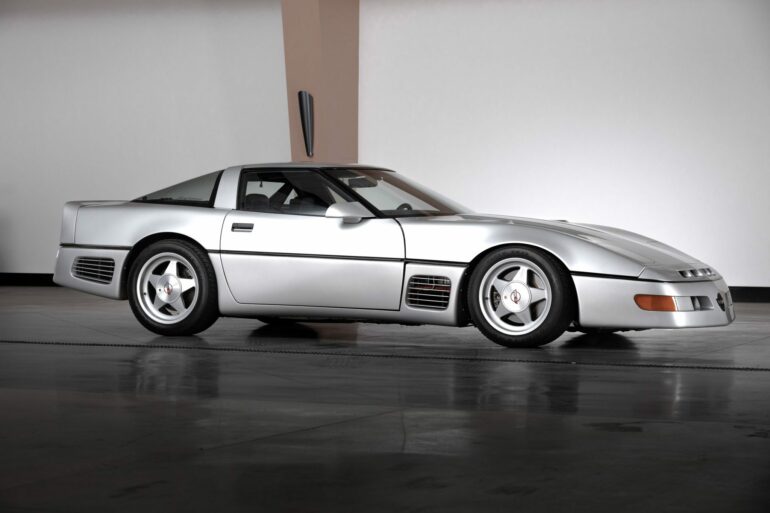
Callaway Sledgehammer Corvette (1988)
898 hp / 0–60 mph: 3.9 seconds / Top speed: 254.76 mph
Back in 1988, when Ferrari and Lamborghini were still fighting for bragging rights on Europe’s autostradas, a small shop in Old Lyme, Connecticut, decided to throw a sledgehammer at the whole idea of speed. The car was literally called the Callaway Sledgehammer Corvette, and it wasn’t just another tuned Vette: it was a record breaker that changed what people thought an American sports car could do.
Reeves Callaway had already been building twin-turbo Corvettes through Chevrolet’s B2K option, but the C4 Sledgehammer was in another league. John Lingenfelter built a reinforced 350-cubic-inch small block with race-spec internals (a Cosworth crank, custom pistons, Pontiac Motorsports heads with Inconel valves, a hydraulic roller cam) and added twin AiResearch turbos pushing 22 pounds of boost, special Rochester injectors and a Zytek Formula 1 EFI system. The result was 880 horsepower and 772 lb-ft of torque, fed through a Doug Nash five-speed, a Centerforce clutch and a blueprinted Dana 44, on experimental Goodyear Eagles mounted on 17-inch Dymag wheels. The sleek “Aerobody” kit, penned by Paul Deutschman and molded from GE’s then-new Xenoy resin, meant the car needed far less power to push past 200 mph.
The payoff came at Ohio’s Transportation Research Center, where John Lingenfelter buried the needle at 254.76 mph. More incredible, the car wasn’t trailered: it was driven to the track, set the record, and driven home. The Sledgehammer held the title of world’s fastest street car for 11 years, and it is still faster than any Corvette Chevrolet has ever sold.
Callaway Corvette SC606 (2012)
606 hp / 0–60 mph: 3.5 seconds / ¼ mile: 11.7 s @ 125 mph / Top speed: ≈200 mph
By the late 2000s the C6 was already a performance bargain, but Callaway figured it could give Chevy’s sports car a sharper edge. The SC606 was a supercharged take on the C6 Grand Sport that blended everyday drivability with Z06-level speed, and then some. An Eaton TVS2300 Roots-type blower sat atop the 6.2-liter LS3; at 7.0 psi of boost the output rose from 430 horsepower to 606 hp and 553 lb-ft, all delivered with Callaway’s signature polish: 0–60 in 3.5 seconds, the quarter mile in 11.7 at 125 mph and a top speed just over 200 mph. It was the equal of a Z06 in raw pace but available in body styles and transmissions Chevy didn’t offer, including convertibles and automatics.
Callaway didn’t stop at power. The SC606 could be optioned with Recaro-based seats, a $5,760 suspension package with adjustable Eibach coil-overs, remote-reservoir shocks and bigger anti-roll bars, a carbon-fiber hood with integrated blower shroud, an Alcantara steering wheel and StopTech brakes; on Michelin PS2s it pulled 1.07 g on the skidpad, right in ZR1 territory. At around $118,000 fully loaded it wasn’t the obvious choice over a Z06, but it offered something the factory couldn’t: Corvette performance, turned up with bespoke flair.
Pratt & Miller Corvette C6RS (2007)
600 hp / 0–60 mph: 3.4 seconds / Top speed: ≈198 mph
Most people would be more than satisfied with a standard Corvette, and plenty would call the 505-hp Z06 or 638-hp ZR1 more than enough. But for the rare few who looked at those cars and still thought “not quite,” Pratt & Miller, the builders of Corvette Racing’s Le Mans winners, had the answer: the C6RS, a Corvette reimagined from the ground up into a $260,000, carbon-fiber-clad supercar with the soul of a C6.R.
The base LS3 was swapped for a hand-built, 8.2-liter naturally aspirated V8 tuned by Katech, good for 600 horsepower and 600 lb-ft, enough for 0–60 in about 3.4 seconds and a top speed of roughly 200 mph. The bodywork, nearly all carbon fiber, widened and sharpened the Corvette’s stance with cues taken straight from the race car: vented fenders, a sculpted hood, center-lock wheels and a full carbon rear diffuser. The suspension was dropped 1.5 inches, with a lift system to keep it livable, and the cabin was retrimmed in leather and Alcantara. Built in tiny numbers, each one was a showcase of what happens when racing engineers are let loose on a road car.
 Credit: Bring a Trailer
Hennessey H700 Corvette (2020– )
708 hp / 0–60 mph: ≈2.6 seconds / ¼ mile: 10s / Top speed: 200+ mph
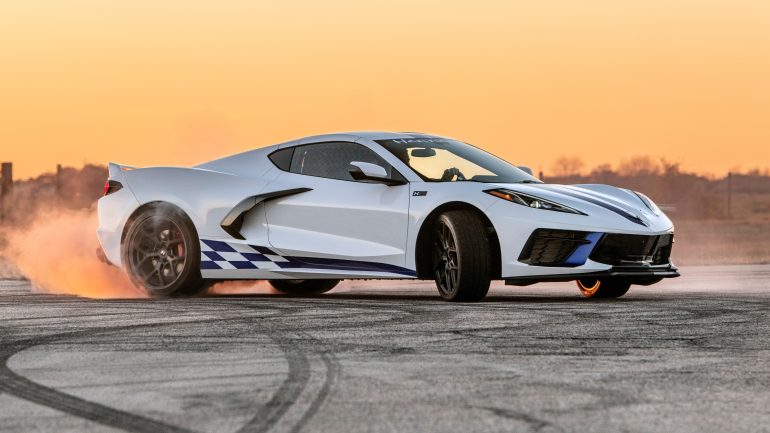
The C8 Corvette was already a game-changer when it went mid-engine, but Hennessey figured Chevy had left a lot on the table. Enter the H700, a supercharged version of the Stingray that cranks the volume to eleven. From the factory the 6.2-liter LT2 makes 490 horsepower and 465 lb-ft; Hennessey bolted on a belt-driven supercharger, tucked an air-to-water intercooler into the tight engine bay, added a freer-breathing exhaust and recalibrated the engine and transmission software. The once-tame Stingray makes 708 horsepower and 638 lb-ft, a leapfrog over Chevy’s own Z06, rockets from 0–60 in around 2.6 seconds, storms through the quarter mile in the 10s, and will run out of road somewhere past 200 mph.
The H700 package is designed to be turnkey, fitted to any 2020–2024 C8 Stingray coupe or convertible, with options for an active-valve exhaust, forged wheels and a Heritage livery, and every car gets Hennessey badging, a numbered plaque and a three-year/36,000-mile warranty. It’s loud, it’s fast, and it’s proof that in the age of hybrids there is still room for a good old-fashioned V8 with a blower strapped to it.
…And The Slowest Corvettes Ever Made
America’s sports car wasn’t always fast. The same lineage that produced the 233-mph ZR1 also produced cars that took eleven seconds to reach 60 mph, and the emissions-strangled C3s of the mid-1970s were barely quicker than the family sedans parked next to them. For the record, here are the five slowest Corvettes ever to leave the factory.
| CORVETTE | ENGINE | HP | 0–60 MPH |
|---|---|---|---|
| 1953–54 Corvette | 235-ci Blue Flame six | 150 | 11.0 s |
| 1975 Corvette (base L48) | 350-ci V8 | 165 | 7.7 s |
| 1976–78 Corvette (base L48) | 350-ci V8 | 180–185 | 7.7 s |
| 1980 Corvette (California LG4) | 305-ci V8 | 180 | 7.3 s |
| 1981 Corvette (L81) | 350-ci V8 | 190 | 7.2 s |
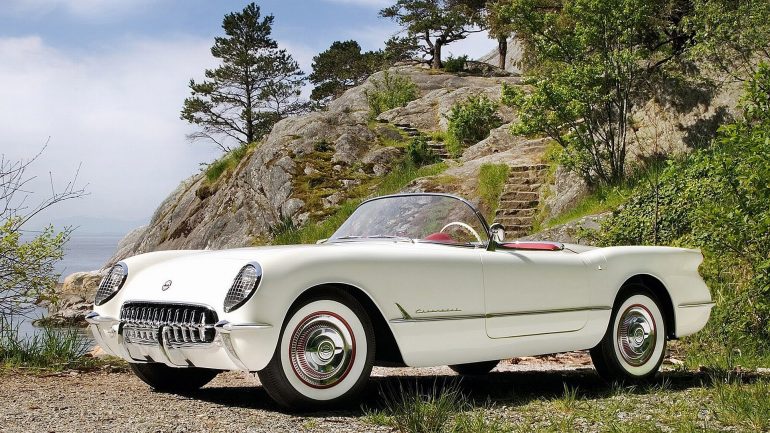
The original 1953–54 Corvette carried the 235-cubic-inch Blue Flame six with triple Carter carburetors, 150 horsepower and a two-speed Powerglide automatic, because Chevrolet had nothing else to give it. It needed about 11 seconds to reach 60 mph and topped out around 107 mph, and sales collapsed until the V8 arrived for 1955 and saved the car.
Twenty years later the Corvette was slow again for a different reason. Emissions rules, catalytic converters and the end of the big block cut the base 1975 L48 to 165 horsepower, the lowest V8 rating in Corvette history; the 1976–78 cars crept back to 180–185. In 1980, California buyers could not even get the 350: the state’s emissions rules forced a 305-cubic-inch V8 with 180 horsepower and a mandatory automatic. The 1981 L81, at 190 horsepower, was the last of the slow ones. The 1984 C4’s Cross-Fire 205-horsepower L83 was hardly a rocket either, but from the 1985 L98 onward the Corvette never looked back.
MORE: THE 5 SLOWEST CORVETTES
How We Ranked Them
The ranking is by top speed, because that is what “fastest” means to most people; the 0–60 and quarter-mile columns show the quickest cars, which since the E-Ray and ZR1X are not the same thing. Only factory production Corvettes are ranked; the tuner cars above and one-offs like the 1990 ZR-1 record cars are not.
From 2006 onward every figure is Chevrolet’s own: SAE-certified horsepower, and acceleration and top speed recorded by GM’s drivers and published in its press material (the 2019 ZR1’s 212 mph and the 2025 ZR1’s 233 mph were two-way averages at Papenburg; the ZR1X’s 8.675-second quarter was run at US 131 Motorsports Park). Where Chevrolet published no top speed (the C7 Z06 and Stingray) the figure is marked as an estimate. For the C5 and earlier the acceleration figures are the best period road tests (Car and Driver, Motor Trend, Road & Track) and the top speeds are either Chevrolet’s claims or the gearing math, and the table says so. Horsepower for the 1967–69 big blocks is the advertised SAE gross figure; the L88 and ZL1 made far more.
Where one model was built for several years at different outputs (the C4 ZR-1, C5 Z06, C7 Stingray) the car is listed once at its best. The page is updated whenever Chevrolet publishes a new figure; the ZR1X top speed and the 2027 Grand Sport X are the next entries to watch.
FAQs
What is the fastest Corvette ever made?
The 2025 Corvette ZR1, which ran 233 mph at the Papenburg test track in October 2024, the highest speed ever recorded by a car from an American manufacturer. The 2026 ZR1X shares its 233-mph rating and is the quickest Corvette: 0–60 in 1.68 seconds and the quarter mile in 8.675 seconds at 159 mph.
What is the fastest front-engine Corvette?
The 2019 Corvette ZR1. Its 755-hp supercharged LT5 took it to an official two-way average of 212 mph (214.88 mph in one direction) at Papenburg in April 2018, with 0–60 in 2.85 seconds and the quarter mile in 10.6 seconds at 134 mph.
Which Corvette was the first to go 200 mph?
The 2009 C6 ZR1. Its 638-hp supercharged LS9 gave it a documented top speed of 205 mph, making it the first production Corvette past the 200-mph barrier. No production Corvette before it had exceeded about 190 mph.
What is the fastest naturally aspirated Corvette?
By top speed, the 2006–2013 C6 Z06: its 505-hp 7.0-liter LS7 was good for 198 mph. By acceleration, the C8 Z06: its 670-hp flat-plane LT6, the most powerful naturally aspirated V8 ever fitted to a production car, runs 0–60 in 2.6 seconds and the quarter mile in 10.6 seconds, with a 195-mph top speed.
What is the fastest Corvette with a manual transmission?
The 2019 ZR1 with the seven-speed manual, rated at 212 mph. No C8 Corvette has been offered with a manual; every mid-engine Corvette uses the eight-speed dual-clutch automatic.
How fast is the base Corvette?
The C8 Stingray’s 490-hp LT2 (495 with the Z51 exhaust) gives it a 194-mph top speed, or 184 mph with the Z51 package’s aero, and 0–60 in 2.9 seconds: as quick as the 2009 ZR1 and quicker than a C7 Z06. The 2027 Stingray’s new 6.7-liter LS6 raises output to 535 hp.
Has any Corvette gone faster than 233 mph?
Not a production one. The 1988 Callaway Sledgehammer, a twin-turbo C4 built by Callaway Cars with an engine by John Lingenfelter, ran 254.76 mph at the Transportation Research Center in Ohio and held the title of world’s fastest street car for eleven years. Chevrolet has not yet published a top-speed run for the ZR1X.
More Corvette Lists
The best of every generation, the rarest, the most expensive, the most famous and the ones we would buy with our own money. All of CorvSport’s lists and rankings.