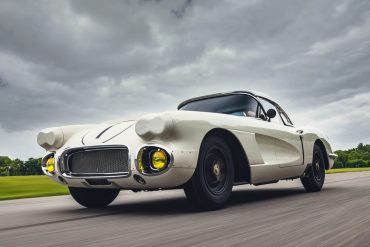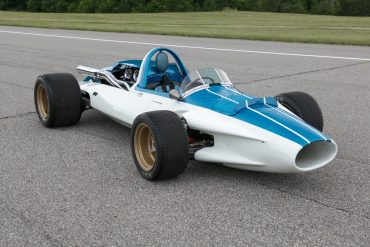
Duntov's first mid-engine argument weighed 1,450 pounds and made 352 hp from an aluminum 283. The CERV I ran Pikes Peak, Riverside and 206 mph at Milford, then GM bought it back for $1.32 million.



C1 CORVETTE - 1960
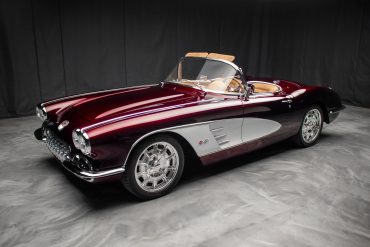
The first Corvette to pass 10,000 cars: a 1959 body with the fuelies raised to 275 and 315 hp, an aluminum clutch housing and new anti-roll bars underneath, eight colors, and a new twelve-character VIN.
Quick Nav: The Story · Specials · Price & Options · VIN · Specs · Technical · Pics & Videos · The Market · All Content · FAQs
Model & Gen: 1960 Corvette (C1)
Body Type: 2 Door Convertible (removable hardtop optional)
VIN: 00867S100001 – 00867S110261
Original Price: $3,875 base
Colors: 8 (Ermine White, Roman Red, Tuxedo Black, Honduras Maroon, Sateen Silver, Horizon Blue, Tasco Turquoise, Cascade Green)
Engine: 283 ci V-8, 230 to 315 hp (fuel injection optional)
Transmission: 3-speed manual standard; 4-speed manual and 2-speed Powerglide optional
Units Produced: 10,261
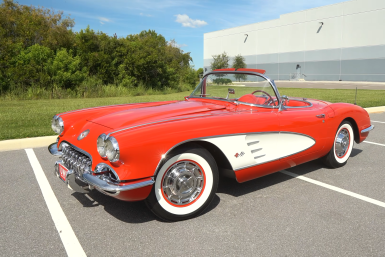
The 1960 Corvette looks like a 1959 and is the first Corvette to sell more than 10,000 cars: 10,261, enough to keep the body unchanged while Bill Mitchell’s studio worked on what came next. The differences are under the skin. The two fuel-injected 283s went to 11.0:1 compression, raising them to 275 horsepower with hydraulic lifters and 315 with solid lifters and the Duntov camshaft, and the Powerglide was no longer offered behind either. Chevrolet had planned aluminum cylinder heads for the 315, but casting problems killed them before production.
The chassis changes were the ones a driver would notice: a larger front anti-roll bar, a rear bar for the first time, an extra inch of rear rebound travel, and an aluminum clutch housing that took 18 pounds off the manual cars. Engines with the Duntov cam got an aluminum radiator to cope with their heat, and a thermostatic fan clutch joined the option list. The racing package was split into stand-alone metallic brakes (RPO 686) and heavy-duty brakes with quick steering (RPO 687), and the four-speed went into more than half the cars for the first time.
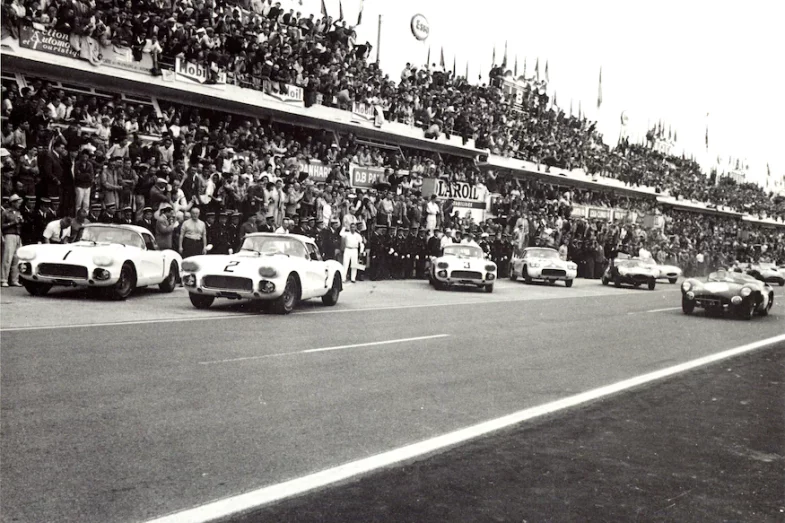
It was also the year a Corvette went to Le Mans: Briggs Cunningham’s three cars ran the 24 Hours in June 1960, with John Fitch and Bob Grossman finishing eighth overall and first in class. Eight colors, including the one-year-only Tasco Turquoise, Horizon Blue and Cascade Green, and the new twelve-character VIN make the 1960 easy to date despite the carryover body.
It is said that when you find something that works, don’t change it. For Chevrolet, this sentiment resonated amongst the senior designers of the Corvette. Despite the conceptual changes that Bill Mitchell had been toying with since 1958, the reality was that the Corvette was going to be around in its current form for a few more years. From a sales standpoint, this seemed to sit just fine with GM executives, who had watched Corvette’s financial successes gain more ground with each passing year. Even in 1958, when an economic recession impacted so many manufacturers, the Corvette had succeeded in turning a profit.
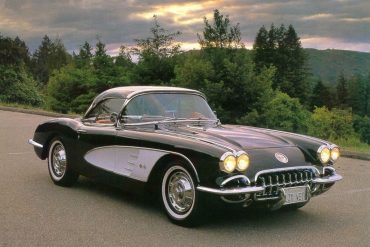
Surely, the Corvette still had room to grow - even if that growth meant staying the same from 1959 to 1960, stay the same it did. From a design standpoint at least, the 1960 Corvette is virtually indistinguishable from 1959. The body lines and chrome trim is nearly identical on both models. The interiors have virtually no distinguishable differences. In short, the 1960 Corvette was, from all design purposes, a continuation of the 1959 production model.
However - the engineers behind the power plant that gave the Corvette its heart and soul had something new in mind for the 1960 model year. The top two engines, both fuel injected or “fuelie” engines, received an increase in their overall horsepower. The addition of solid lifters and a higher, 11.0:1 compression ratio boosted the strongest of the fuelie engines to 315-bhp at 6,200 rpms. The second most powerful engine included hydraulic lifters (which made for easier maintenance) and pumped out an impressive 275-bhp at 5,200 rpms.
Because of these performance increases, the Powerglide automatic transmission was no longer available with them, as it simply could not handle the torque these new powerhouse engines generated. The carbureted engines that were also included as optional engines for the 1960 model remained the same as they had on earlier models.
The most conservative of these engines was a 230 horsepower engine that included a single, four-barrel carburetor. Next in succession of horsepower was a 245-bhp, hydraulic lifter version of the same engine that included a dual-quad carburetor. Topping these was the 270-bhp engine with twin four-barrel carburetors.
The refinements to the 1960 Corvette did not end with the engine. In 1956, Zora Arkus-Duntov developed the “Duntov Cam”, a high lift camshaft that was intended to help make Corvette a contender in the international racing circuit.
While this cam proved most effective in generating the extra performance necessary to produce a car capable of winning against the staunchest of competitors, it also caused engine temperatures to rise far above similar engines with more conventional cams. To compensate for this, aluminum radiators were introduced in the 1960 Corvettes for anyone ordering a Corvette with the Duntov Cam option.
Aluminum clutch housings for the manual transmissions were also introduced, which helped to drop the Corvette’s overall weight by eighteen pounds (18 lb). A power-saving, thermostatically controlled cooling fan was introduced as a new option, as was a long range, 24 gallon fuel tank.
Standard options for the 1960 Corvette included the introduction of a larger-diameter front anti-roll bar matched with a new, heavier duty rear bar. These changes, plus an extra inch of rear-wheel travel in rebound produced a smoother riding, more neutral handling Corvette than ever before.
Although Chevrolet shied away from advertising the Corvette as a performance car after a ban on racing had been put into place by the Automobile Manufacturers Association (or “AMA” for short), Chevrolet continued to offer many performance options for the 1960 model year.
Aside from the optional, “beefed up”, 315 horsepower engine which carried an additional cost of $484.20, there was also the option of ordering Positraction for $43.05 and a four-speed gearbox for $188.30. Additionally, the metallic brake linings were again made available as a $26.90 option.
Whereas a few short years ago the Corvette was railed by critics for it’s lack of performance, the Corvette had come into it’s own as a genuine sports car both in the United States as well as around the world.
It’s on road abilities were no longer questioned. It had been accepted as a serious contender in many racing circuits, despite the decision made by the AMA. In fact, 1960 saw three Corvettes run at the famous “24 Hours of Le Mans”. Owned by yachtsman and one-time car builder Briggs Cunningham, the Corvette proved it’s mettle against some of the staunchest competitors in the world. Drivers Bob Grossman and John Fitch drove one of these Corvettes to a respectable eighth place overall finish. It was privately owned without formal manufacturer’s support and that it was competing against factory racing prototypes from some of Europe’s most illustrious manufacturers, it makes the measure of their success that much greater.
Did you know? While steel-belted tires are common today, back in the 1950's, they were unheard of. In fact, the 1960 Corvette was the first Corvette to use Nylon Belted Tires (a type of tire that is still sometimes used today, though not as durable as a steel belted tire). Prior to 1960, the Corvette (along with most other production cars), used cotton ply tires. A cotton ply was the cross layering of cotton fabric on the interior of a tire to provide adequate wall strength to hold the pressurized air when the tire was inflated.
After the run at LeMans, where Cunningham’s Corvette achieved a top speed of 151 miles per hour down the Mulsanne Straight, Chevrolet began to offer Cunningham cylinder heads cast from a high-silicon aluminum alloy. The heads, (based on a design that was first introduced to the 1957 Sebring Corvette SS prototype racer,) maintained the stock 11.0:1 compression ratio but featured improved intake and exhaust flow. Although the use of aluminum heads was fine in theory, the reality of these heads were that they tended to warp if the engine overheated.
Further, Chevrolet had quality control issues with the castings used to create these aluminum heads. The belief is that these heads, which provided proven performance, were never made available to retail customers.
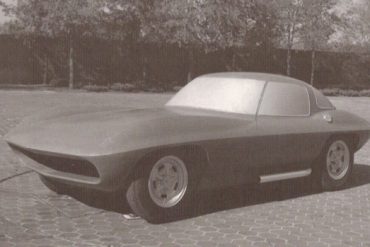
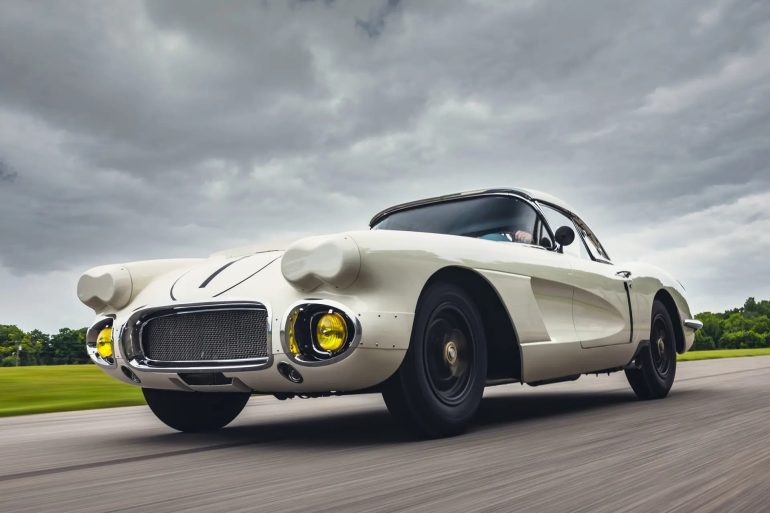
The ongoing debate about a second generation Corvette continued to be a topic of much discussion throughout 1960. However, unlike previous years where prototype designs and rumored modeling ended up abandoned without the funding to become anything more than design sketches or clay models, 1960 saw the debut of a dramatic, new special edition Corvette called simply “Stingray” that was “privately” campaigned by GM Design Chief Bill Mitchell.
The fact alone that Bill Mitchell had succeeded Harley Earl ’s position upon his retirement in 1958 led many Corvette enthusiasts to believe that this “track edition” Stingray Corvette would guide the shape of things to come.
In addition to the dramatic, bold look of the Stingray, Mitchell also continued to work on breathing new life into the existing Corvette styling, which had gone virtually unchanged since 1956. However, despite an abundance of design ideas from the team of designers in his studios, the Corvette would continue to remain mostly unchanged until 1962.
While individuals like Mitchell were envisioning a new Corvette on the horizon, Chevrolet had it’s priorities set on other ventures, including the Corvair. Although Ed Cole ’s technically advanced, compact Corvair was considered one of the most interesting of the Big Three’s new 1960 small cars, it was plagued with service issues including oil leaks, thrown fan belts, and tuning difficulties, among others.

 The 270 Horsepower, Twin Four-Barrel Carbureted 283 Cubic Inch V-8 Engine.
 The 1960 “Stingray” Corvette.

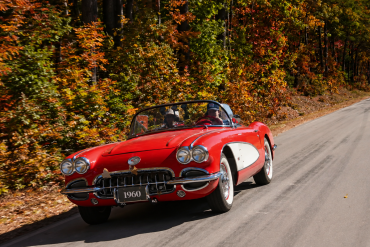
The 1960 is the first Corvette to pass 10,000 cars in a year, and the first to race at Le Mans: a Cunningham-entered 1960 driven by John Fitch and Bob Grossman finished eighth overall and won its class in June 1960. Three of the eight colors, Tasco Turquoise, Horizon Blue and Cascade Green, were offered this year only.
DID YOU KNOW
1960 is the Le Mans year: the three Cunningham cars, the Camoradi Corvette and the XP-700 all ran or showed under the AMA ban that was supposed to stop them.
The base price held at $3,875 and the option list was a reshuffled 1959’s.
The engines kept their prices: the 245-hp dual-quad (RPO 469, $150.65, 1,211 cars), the 270-hp dual-quad with the Duntov camshaft (RPO 469C, $182.95, 2,364 cars), and fuel injection at $484.20, now in 275-hp (RPO 579, 100 cars) and 315-hp (RPO 579D, 759 cars) forms, so 859 of the 10,261 cars were fuelies.
The four-speed (RPO 685, $188.30) went into 5,328 cars and the Powerglide (RPO 313, $199.10) into 1,766. Positraction (RPO 675) dropped to $43.05 and went into 5,231 cars. The metallic brakes stayed at $26.90 (RPO 686, 920 cars), and the racing package became RPO 687, heavy-duty brakes and special steering at $333.60, on 119 cars. The thermostatic fan clutch (RPO 121, $21.55) was chosen by 2,711 buyers, and the 24-gallon tank and blackwall nylon tires remained for racers.
The comfort options were unchanged: the removable hardtop ($236.75) on 5,147 cars, the heater ($102.25) on 9,808, the signal-seeking radio ($137.75) on 8,166, sun visors ($10.80) on 5,276, power windows ($59.20) on 544 and the power top ($139.90) on 512.
Eight colors were offered, with Ermine White the most popular at 3,717 cars, and 3,312 buyers paid $16.15 for the two-tone coves: 779 Roman Red/White, 572 Honduras Maroon/White, 488 Ermine White/Silver, 386 Tuxedo Black/Silver, 383 Tasco Turquoise/White, 359 Horizon Blue/White, 280 Sateen Silver/White and 65 Cascade Green/White. The color totals add up to 10,246, 15 short of production; the rest were delivered in non-standard colors or primer.
MORE: PRICING, OPTIONS & COLORS / RPO CODES
| CODE | DESCRIPTION | QUANTITY | RETAIL PRICE |
|---|---|---|---|
| 867 | Base Corvette Convertible | 10,261 | $3,875.00 |
| 101 | Heater | 9,808 | $102.25 |
| 102 | AM Radio, signal seeking | 8,166 | $137.75 |
| 107 | Parking Brake Alarm | 4,051 | $5.40 |
| 108 | Courtesy Lights | 6,774 | $6.50 |
| 109 | Windshield Washers | 7,205 | $16.15 |
| 121 | Temperature Controlled Radiator Fan | 2,711 | $21.55 |
| 261 | Sunshades | 5,276 | $10.80 |
| 276 | Wheels, 15 x 5.5 (5) | 246 | $0.00 |
| 290 | Whitewall Tires, 6.70 x 15 | 9,104 | $31.55 |
| 313 | Powerglide Automatic Transmission | 1,766 | $199.10 |
| 419 | Auxiliary Hardtop | 5,147 | $236.75 |
| 426 | Power Windows | 544 | $59.20 |
| 440 | Two-Tone Paint Combination | 3,312 | $16.15 |
| 469 | 283ci, 245HP Engine (2x4 Carburetors) | 1,211 | $150.65 |
| 469C | 283ci, 270HP Engine (2x4 Carburetors) | 2,364 | $182.95 |
| 473 | Power Operated Folding Top | 512 | $139.90 |
| 579 | 283ci, 275HP Engine (Fuel Injection) | 100 | $484.20 |
| 579D | 283ci, 315HP Engine (Fuel Injection) | 759 | $484.20 |
| 675 | Positraction Rear Axle | 5,231 | $43.05 |
| 685 | 4-Speed Manual Transmission | 5,328 | $188.30 |
| 686 | Metallic Brakes | 920 | $26.90 |
| 687 | Heavy Duty Brakes and Special Steering | 119 | $333.60 |
| 1408 | Blackwall Tires, 6.70 x 15 Nylon | – | $15.75 |
| 1625A | 24 Gallon Fuel Tank | – | $161.40 |
| EXTERIOR | TOTAL | COVE (OPTIONAL) / CARS | SOFT TOP | WHEELS | INTERIOR |
|---|---|---|---|---|---|
| Ermine White | 3,717 | Sateen Silver / 488 | Blue, Black, White | White | Black, Turquoise |
| Roman Red | 1,529 | Ermine White / 779 | Blue, White | Red | Black, Red |
| Tuxedo Black | 1,268 | Sateen Silver / 386 | Blue, Black, White | Black | Blue, Black, Red, Turquoise |
| Honduras Maroon | 1,202 | Ermine White / 572 | Blue, White | Maroon | Black |
| Sateen Silver | 989 | Ermine White / 280 | Blue, Black, White | Silver | Black, Turquoise |
| Horizon Blue | 766 | Ermine White / 359 | Blue, Black, White | Blue | Blue, Black, Red |
| Tasco Turquoise | 635 | Ermine White / 383 | Blue, Black, White | Turquoise | Black, Turquoise |
| Cascade Green | 140 | Ermine White / 65 | Blue, Black, White | Green | Black |
The 283 came five ways for 1960, and the fuel-injected pair were new. Compression rose to 11.0:1 on both: the hydraulic-lifter RPO 579 made 275 horsepower at 5,200 rpm, and RPO 579D, with solid lifters and the Duntov high-lift camshaft, 315 at 6,200 rpm, the strongest Corvette engine yet and the one that carried over into 1961.
Chevrolet had intended to fit aluminum cylinder heads to the 315 and advertised them, but casting problems meant almost none reached customers. The carbureted engines were unchanged: the 230-hp single four-barrel, which still went into more than half the cars, and the 245 and 270-hp dual-quads. The Powerglide was no longer available with fuel injection; the torque was more than it could take.
The Duntov cam engines ran hot, so they got an aluminum radiator, and every buyer could add a thermostatic fan clutch that only engaged when needed. Manual cars got an aluminum clutch housing, saving 18 pounds.
The suspension was retuned with a larger-diameter front anti-roll bar, a rear bar for the first time and an extra inch of rebound travel at the back, which gave a smoother ride and more neutral handling.
Period road tests of 1960 cars are thin; the 1961 tests of the same engines recorded 5.5 seconds to 60 mph for the 315-hp fuelie and 5.9 for the 270-hp four-speed car. The metallic brakes could be ordered alone (RPO 686) or with the heavy-duty springs, shocks and quick steering of RPO 687.
MORE: FULL SPECIFICATIONS / ENGINE
| SPEC | 1960 CORVETTE |
|---|---|
| Engine | 283 ci (4.6 L) OHV small-block V-8, 3.875 x 3.00 in, cast iron block & heads |
| Base engine | 230 hp @ 4,800 rpm, 300 lb-ft @ 3,000 rpm, single four-barrel, 9.5:1; 5,827 cars |
| RPO 469 | 245 hp @ 5,000 rpm, 300 lb-ft @ 3,800 rpm, dual four-barrels, 9.5:1; 1,211 cars, $150.65 |
| RPO 469C | 270 hp @ 6,000 rpm, 285 lb-ft @ 4,200 rpm, dual four-barrels with the Duntov camshaft, 9.5:1; 2,364 cars, $182.95 |
| RPO 579 | 275 hp @ 5,200 rpm, 305 lb-ft @ 4,400 rpm, Rochester fuel injection, hydraulic lifters, 11.0:1; 100 cars, $484.20 |
| RPO 579D | 315 hp @ 6,200 rpm, 295 lb-ft @ 4,700 rpm, fuel injection with the Duntov camshaft and solid lifters, 11.0:1; 759 cars, $484.20 |
| Transmission | 3-speed manual standard (3,167 cars); Borg-Warner T-10 4-speed (RPO 685, 5,328 cars, $188.30); 2-speed Powerglide (RPO 313, 1,766 cars, $199.10), not available with fuel injection. Aluminum clutch housing on manual cars |
| Axle ratio | 3.70:1 standard; Positraction (RPO 675, $43.05, 5,231 cars) in 3.70, 4.11 or 4.56:1 |
| Suspension | Independent front with coil springs and a larger-diameter anti-roll bar; live axle on semi-elliptic leaf springs with trailing radius rods and a new rear anti-roll bar; an extra inch of rear rebound travel |
| Brakes | 11-in drums; sintered-metallic linings (RPO 686, $26.90, 920 cars); heavy-duty brakes and special steering (RPO 687, $333.60, 119 cars) |
| Cooling | Aluminum radiator on engines with the Duntov camshaft; thermostatic fan clutch optional (RPO 121, $21.55, 2,711 cars) |
| Tires | 6.70 x 15 in; blackwall nylon (RPO 1408, $15.75) and 15 x 5.5 in wheels (RPO 276, 246 cars) optional |
| Fuel tank | 16.4 gal; 24-gallon fiberglass tank (RPO 1625A, $161.40) |
| Wheelbase | 102 in |
| Overall length | 177.2 in |
| Curb weight | 2,985 lb / 1,354 kg (3-speed); 3,090 lb (Powerglide) |
| 0–60 mph | approx. 8.4 sec (270 hp, per Corvette: An American Classic); the same engines in 1961 tests recorded 5.5–5.9 sec |
| Top speed | approx. 124–130 mph (270 / 315 hp) |
| Production | 10,261, all convertibles; 5,147 with the removable hardtop; 859 fuel-injected |
| Assembly | St. Louis, Missouri |
The 1960 Corvette introduced the twelve-character VIN that lasted through 1962: 00867S followed by the sequence number, which begins at 100001 and runs through 110261, accounting for each of the 10,261 cars built. The leading 0 is the model year, 08 the Corvette series, 67 the convertible body style and S the St. Louis plant. The VIN is stamped on a stainless steel tag fastened to the steering column in the engine compartment, and the number is also stamped on the frame.
The engine pad suffix identifies the engine: CQ (230 hp, manual), DG (230 hp, Powerglide), CT (245 hp, manual), DJ (245 hp, Powerglide), CU (270 hp, manual), CR (275-hp fuel injection, manual) and CS (315-hp fuel injection, manual). The axle code on the housing records the ratio and whether the car had Positraction. Only one body style, the convertible, was built.
MORE: VIN DECODER / PRODUCTION
| POSITION | MEANING |
|---|---|
| 0 (First Digit) | Model year: 0 = 1960 |
| 08 (Second & Third Digits) | Chevrolet Corvette series code |
| 67 (Fourth & Fifth Digits) | Body style: 67 = convertible, the only body built in 1960 |
| S (Sixth Digit) | Assembly plant: S = St. Louis, Missouri |
| 100001–110261 (Seventh through Twelfth Digits) | Production sequence number |
Eight colors in the last year of the unchanged 1958 body, with 3,312 two-tone cars: Ermine White (3,717), Roman Red (1,529), Tuxedo Black (1,268), Honduras Maroon (1,202), Sateen Silver (989), Horizon Blue (766), Tasco Turquoise (635) and Cascade Green (140).
The 1960 is the sleeper of the late C1s: the same body as the 1959, the same engines as the 1961 fuelie, and prices that sit between them. The ranking is the familiar one. A documented 315-hp fuelie four-speed is the car to have, with the 119 RPO 687 cars and any car with Le Mans or Cunningham history in a tier of their own; 270-hp dual-quad four-speed cars are the volume collector choice; 245 and 230-hp cars and the 1,766 Powerglides are the entry point. The one-year-only colors, Tasco Turquoise, Horizon Blue and Cascade Green, add appeal, and a Cascade Green car is one of only 140.
Results tracked by Classic.com for 2026 put original or well-restored carbureted cars between about $66,000 and $83,000: $66,000 at Mecum Lebanon in September, $73,000 on Bring a Trailer in July, $82,000 and $82,500 for 283 dual-quads on Bring a Trailer in May and at Mecum Indianapolis, and $82,500 at Barrett-Jackson Columbus in June. Fuel-injected cars sold for $95,700 at Mecum Harrisburg in July and $121,000 at Barrett-Jackson Las Vegas in September for an original car carrying VIN 002, while a big-brake fuelie was bid to $140,000 at Mecum Indianapolis without selling. Modified cars ranged from $49,000 to $79,500, projects from about $26,000, and dealer asking prices ran $62,500 to $140,000. Check whether a result includes the buyer’s premium, and treat asking prices and unsold high bids separately from completed sales.
Verification starts at the engine pad: the suffix (CQ, CT, CU, CR, CS, DG or DJ) must match the equipment and the block date must precede the car’s build. A 1960 fuelie should carry a 1960-series Rochester unit; a 315 should have solid lifters and the Duntov cam, and claims of aluminum heads need extraordinary proof, since almost none were delivered. The aluminum clutch housing, the rear anti-roll bar and, on Duntov-cam cars, the aluminum radiator should all be present. Two-tone coves are easy to add in paint, so check the trim tag and build records. NCRS judging sheets, old photographs, ownership records and restoration invoices all help, and ask to see dates and scores rather than just the award.
The body is the 1959 shell in its second year, and it cracks in the same places: around the headlight bezels, the door hinge pillars, the cove edges where the trim mounts, and the cowl. Underneath, the boxed frame rails rust from the inside, so an inspection on a lift is essential; look at the radius-rod and rear anti-roll bar mounts. On the road a fuelie should start hot and cold without drama, the four-speed should not jump out of gear, and with metallic brakes the pedal should firm up once warm. Most of these cars see few miles, so budget for tires, brakes and fuel-system work on anything that has sat.
MORE: THE MARKET

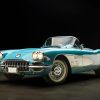

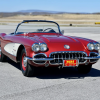
Get all the latest news stories, upcoming auctions, prices, videos and more about the 1960 Chevrolet Corvette! The latest headlines here.
Chevrolet built 10,261 Corvettes for 1960, all convertibles, at St. Louis, Missouri, the first time the Corvette passed 10,000 cars in a model year. Of those, 859 had fuel injection, 5,328 had the four-speed, 5,231 had Positraction, 5,147 had the removable hardtop and 3,312 had two-tone coves. Only 119 had the RPO 687 heavy-duty brake and steering package.
In 2026, original or well-restored carbureted 1960 Corvettes have mostly sold for $66,000 to $83,000 at auction, with fuel-injected cars from about $95,000 to $121,000 and a big-brake fuelie bid to $140,000. Modified cars range from $49,000 to $80,000 and projects start around $26,000. The engine, its paperwork and the four-speed decide the price.
The 283-cubic-inch small-block V-8 in five versions: 230 hp with a single four-barrel, 245 or 270 hp with dual four-barrels, and, new for 1960 at 11.0:1 compression, 275 or 315 hp with Rochester fuel injection. A three-speed manual was standard; the four-speed ($188.30) went into 5,328 cars and the Powerglide automatic ($199.10) into 1,766, though it was no longer offered with fuel injection.
Eight: Ermine White (3,717 cars), Roman Red (1,529), Tuxedo Black (1,268), Honduras Maroon (1,202), Sateen Silver (989), Horizon Blue (766), Tasco Turquoise (635) and Cascade Green (140). Horizon Blue, Tasco Turquoise and Cascade Green were offered this year only. For $16.15, 3,312 buyers had the coves painted silver or white.
The base price was $3,875 with the 230-hp engine and three-speed manual, unchanged from 1959. Fuel injection added $484.20, the four-speed $188.30, the hardtop $236.75, Positraction $43.05 and the heavy-duty brakes and steering $333.60. A 315-hp fuelie with the four-speed, Positraction, hardtop and RPO 687 came to about $5,150.
Nothing you can see: the body and interior carried over. Underneath, the fuel-injected engines went to 11.0:1 compression and 275 or 315 hp, the Powerglide was dropped for fuelies, manual cars got an aluminum clutch housing, the front anti-roll bar grew and a rear bar was added, Duntov-cam engines got an aluminum radiator, and the VIN changed to the twelve-character 00867S format. The racing package was split into RPO 686 metallic brakes and RPO 687 heavy-duty brakes with special steering.
Yes. Briggs Cunningham entered three 1960 Corvettes in the 24 Hours of Le Mans in June 1960, prepared with the RPO 687 package, fuel injection and 24-gallon tanks. The car driven by John Fitch and Bob Grossman finished eighth overall and first in the GT class over 5,000 cc, the Corvette’s first result at Le Mans and the beginning of a history that continued with the C5-R, C6.R, C7.R and C8.R.
1960 Corvette Advertisements / 1960 Corvette CERV I / 1960 Corvette Colors / 1960 Corvette Factory Options / 1960 Corvette For Sale / 1960 Corvette Italia / 1960 Corvette Owners Manual / 1960 Corvette Performance / 1960 Corvette Posters / 1960 Corvette Pricing / 1960 Corvette Production / 1960 Corvette Research / 1960 Corvette RPO Codes / 1960 Corvette Sales Brochures / 1960 Corvette Special Model Overview / 1960 Corvette Specifications / 1960 Corvette Technical Research / 1960 Corvette VIN Numbers