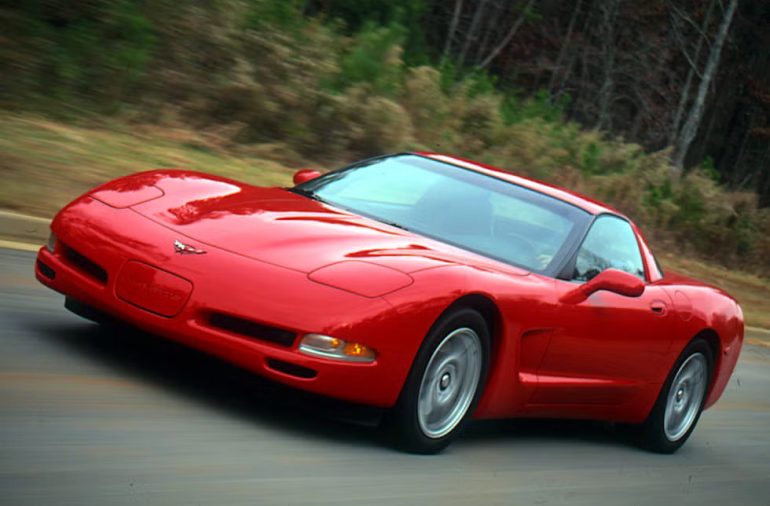
The Fifth-Generation Corvette as photographed by Jim Frenak and as featured in the February 1997 Issue of Car and Driver Magazine. (Image courtesy of Car and Driver Magazine)
It might be difficult to imagine today, but there was a period during one of General Motors’ more challenging financial eras that nearly saw the deliberate discontinuation of the Corvette – the C5 Corvette in particular – long before its eventual arrival in the final years of the twentieth century.
Although it has proudly carried the title of “America’s Sports Car” from its very beginning, the history of the Chevy Corvette is replete with long and challenging intervals of genuine crisis, often resulting in periods throughout the brand’s (more than) seventy-year dynasty that were plagued with significant political, socio-economic, and even legislative landmines that challenged the brand’s long-term commercial viability. When Harley Earl introduced the original Corvette as a “sporty” concept car in January 1953, there was no way he could have predicted the volatile, often uncertain future history his two-seat sports car would encounter throughout its next seven decades of production.
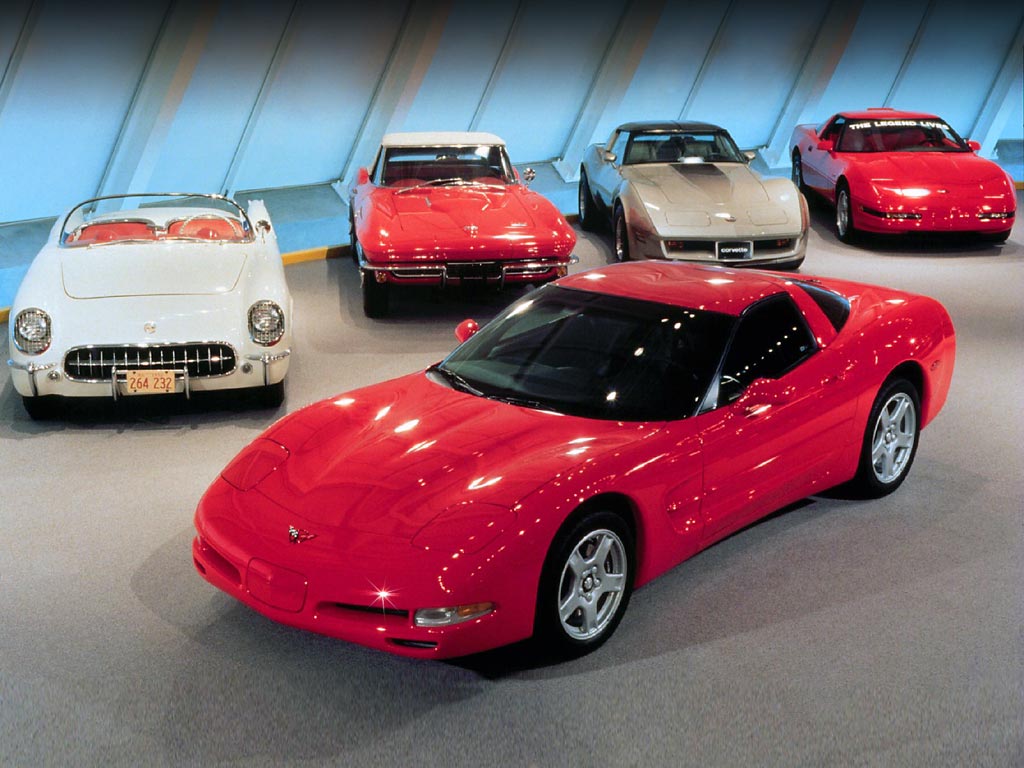
The C5 Corvette coupe joined the decades-long lineage of Corvette in 1997 – becoming part of a legacy that dates back to 1953 when Harley Earl introduced the original Corvette (seen far left) in 1953. (Image courtesy of the National Corvette Museum.)
Earl’s original Corvette was hailed by the press as a “masterpiece” at its unveiling in New York City at the 1953 Motorama Show but was soon dismissed by the automotive community at large, garnering the unpopular nickname “the rolling bathtub,” which was not-at-all surprising given that the car had been hastily transformed from a “turnstile queen” to a production vehicle in just six, short months. Despite being a spectacle on the car show circuit, the production car that consumers received was underpowered (equipped with a stock GM “Stovebolt” inline six-cylinder engine), handled poorly, and was slapped together using a variety of existing “parts bin” components to help manage production cost. Within three years of its introduction, GM executives were prepared to cut its funding and halt production entirely. Fortunately, Harley Earl (with considerable direction and support from Zora Arkus-Duntov and Ed Cole) recognized the areas where the Corvette was lacking (namely, power and handling) and worked quickly to transform Chevrolet’s struggling two-door coupe into something that would excite consumers: namely, a track-capable sports car that performed as well as it looked.
By the sixties, the Corvette had established a stronger following, especially after the introduction of the second-generation, split-window Corvette Sting Ray in 1963. For the next decade, the Corvette would flourish, moving from a second to a third-generation model under the watchful eye of GM’s (then) current VP of Design, Bill Mitchell, and through the brilliant artistry of Chevrolet staff designer Larry Shinoda. But even as brand popularity continued to increase, the 1973 OPEC oil embargo and the ever-increasing Federal emission regulations being placed on all automobile manufacturers throughout the seventies put a serious strain on the Corvette’s continued development. By the time Corvette chief engineer Dave McLellan replaced Duntov on January 1, 1975, it seemed as though the Corvette was once more doomed to disappear into the annals of history. Although McLellan and Mitchell were ultimately able to convince GM executives to continue production of the Corvette, its engine size and horsepower were dramatically reduced. By the late seventies and early eighties, the third-generation Corvette had become a dated, bloated, underpowered shadow of its former self. Fortunately, despite these deficits, ongoing popular public opinion of the Corvette kept the brand relevant long enough for GM to green-light a fourth-generation model.
Join 45,000+ Corvette Owners Who Read Our Newsletter
Our newsletter delivers all the Vette news, rumors, deals and events directly to you each week
Members only$35 / year
Keep going. This is where it gets good.
CorvSport Membership is for people who'd rather spend an hour inside one engine option than skim ten headlines. The rest of this story — and every other one like it — is a few seconds away.
Every members-only story
Deep history, market reports, buyer's guides, and the full archive back to 2010.
No ads. None.
The whole site reads like a magazine, on every device.
Every model year, 1953 to today
Production numbers, VINs, RPO codes, colors, options — one page per year.
30% off the shop
Every CorvSport shirt and piece of merch, all year.