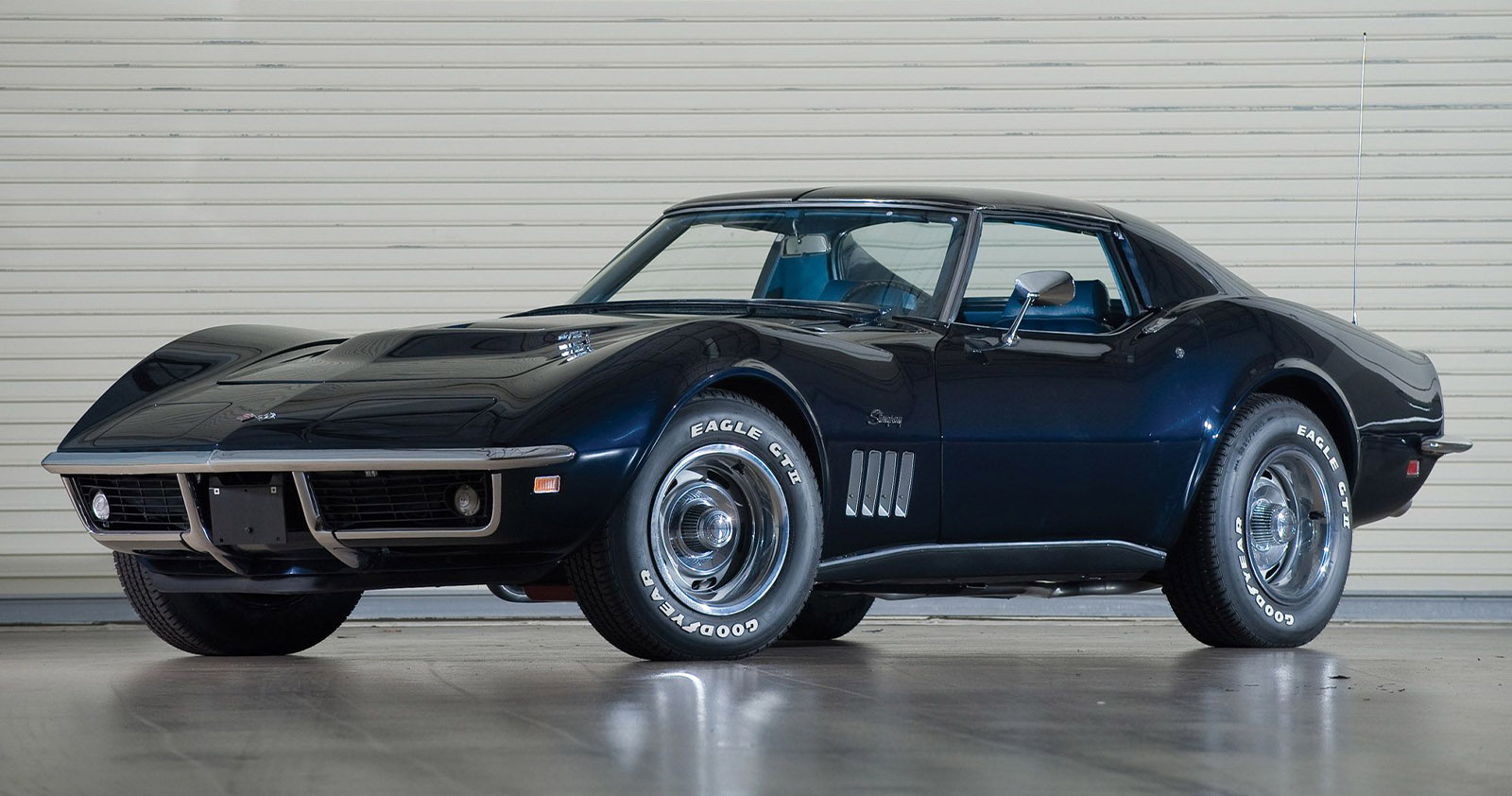
A Corvette with cargo space? Greenwood took Chuck Miller's Kammback kit, added a working glass hatch and a 22-gallon fuel cell, and created the rarest C3 body style of all.


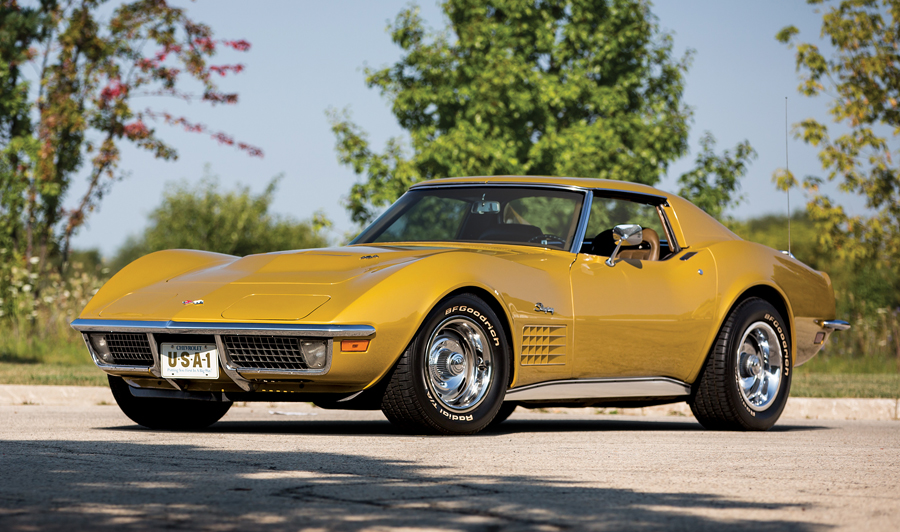
C3 CORVETTE - 1971
The year the compression came out: 91-octane rules cut the base 350 to 270 hp and the LT-1 to 330, while the aluminum-head LS6 454 made 425 for 188 buyers and the ZR2 put it in twelve race-ready cars. Otherwise a 1970 with 21,801 built.
Quick Nav: Story · Specials · ZR1 · ZR2 · Price & Options · VIN · Specs · Technical · Pics & Videos · The Market · All · FAQs
Model & Gen: 1971 Corvette (C3)
Body Type: Sport Coupe (T-top) or Convertible
VIN: 194371S100001 – 194371S12180
Original Price: $5,496.00 coupe / $5,259.00 convertible
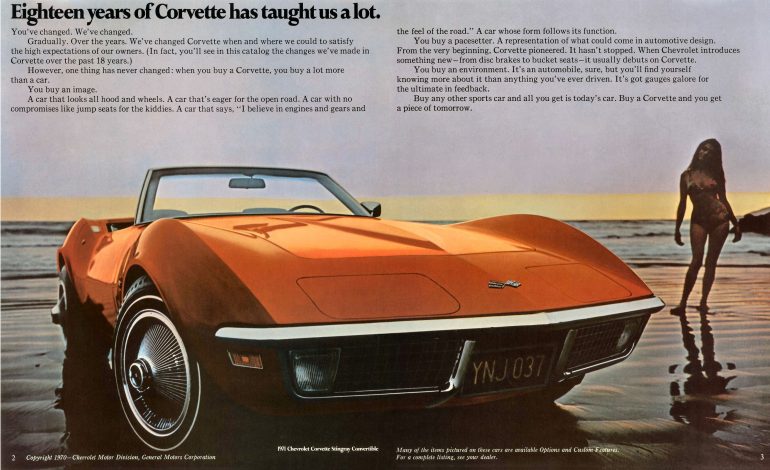
Colors: 10 (War Bonnet Yellow, Brands Hatch Green, Mulsanne Blue, Ontario Orange, Mille Miglia Red, Classic White, Steel Cities Gray, Bridgehampton Blue, Nevada Silver, Sunflower Yellow)
Engine: 350 ci V-8, 270 hp, or 330 hp solid-lifter LT-1; 454 ci big block, 365 hp (LS5) or 425 hp aluminum-head LS6 (188 built)
Transmission: Muncie 4-speed standard (M20 wide or M21 close ratio at no charge); M22 heavy-duty $100; 3-speed Turbo Hydra-Matic (M40) at no charge, now available with the LS6
Units Produced: 21,801
The 1971 Corvette is the 1970 again, and on purpose. The strike and the late 1970 launch left Chevrolet no time or appetite for change, so the body, the interior and the chassis carried over with a few details: an easier fuel-filler door, a lit shift quadrant for the automatic, amber parking-lamp lenses in the specifications (most cars still got clear lenses and amber bulbs), and the fiber-optic lamp monitors in their last year, missing from many late cars. The St. Louis plant, finally building one car for two years, used the breathing room to fix the fit and finish the magazines had been complaining about since 1968, and the 1971 is a better-built car than the two before it.
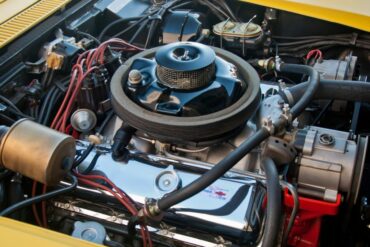
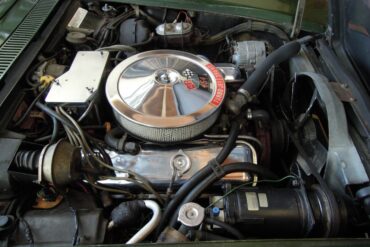
What changed was under the hood. Ed Cole, now president of General Motors, ordered every 1971 GM engine to run on 91-octane low-lead fuel ahead of catalytic converters, and the Corvette’s engines were detuned in weeks: the base 350 fell from 10.25:1 and 300 hp to 8.5:1 and 270, the solid-lifter LT-1 from 370 hp to 330 on 9.0:1, and the 454 LS5 from 390 hp to 365. The exception was the LS6, the cancelled 1970 LS7 reworked for low-lead fuel: aluminum heads, solid lifters, 9.0:1 compression and 425 hp, the last Corvette engine rated above 400 horsepower until the 2002 Z06. It cost $1,221 and 188 buyers paid it, 12 of them as the ZR2 package with the M22 gearbox, heavy-duty brakes and suspension and no radio or air conditioning. The ZR1 returned on the LT-1 for 8 cars.
Production recovered to 21,801, 14,680 coupes and 7,121 convertibles, the coupe now outselling the open car two to one, and the Turbo Hydra-Matic went into nearly half of them. Prices rose to $5,496 and $5,259. For buyers the 1971 is the last year of the LS6 and the big-block Corvette as a serious performance car, the second of three LT-1 years, and a cheaper way into a 1970-spec Shark than the 1970 itself; the LS6 and ZR2 are the blue chips, and the 1971 ZR2 convertibles are among the most expensive C3s ever sold.
The 1971 Chevy Corvette remains one of the least changed models in design (when compared to the preceding model year) in Corvette’s entire production history.
The United Auto Workers (UAW) labor dispute that occurred in May 1969, which had caused the 1969 model year to run over by two months, had also shortened production of the 1970 Corvette by over four months.
Because of this, it was decided by Chevrolet management that they should treat the 1971 model year as an extension of the 1970 line, which meant that the Corvette – for better or worse – would remain essentially unaltered between the two model years.
Because the production of the cars would remain virtually unchanged from 1970 to 1971, production lines in the St. Louis Corvette plant were able to work in earnest to produce a more trouble-free car. In fact, the (more than) 500 men and women that worked each shift at the Corvette plant were highly motivated to build a better machine, knowing that they were fortunate not to be part of the many facilities across the country that mass-produced “faceless utility cars”, but rather a well-respected, much sought after sports car. Vince Shanks, the plant manager of the St. Louis Corvette Manufacturing Plant, was quoted as saying “When you ask a guy where he works in St. Louis, he’ll tell you ‘Corvette’ rather than ‘Chevrolet.’ Every Corvette he sees on the road is one he’s worked on. That’s quite an incentive.”
The 1971 Corvette’s arrival also came in conjunction with a flurry of new federal regulations that forced manufacturers to reassess the types of cars they were producing.
In addition to the Federally sanctioned mandates on reducing exhaust emission outputs, Edward Cole (who was now president of General Motors) had decreed that all 1971 GM cars would be capable of running on fuel with a Research Octane Number (RON) no higher than 91 Octane.
According to Cole’s calculations, this octane rating was low enough for the fuel companies to begin marketing the lead-free regular gasoline needed to avoid fouling catalytic “reactors” (known as converters today) that were going to be required on automobile engines. This reduction in fuel octane rating would translate into a reduction in engine compression (now just 8.5:1) and horsepower (a mere 270 bhp in the stock 350 engine).
Somewhat surprisingly, these sanctioned emissions and fuel requirement changes didn’t only impact Corvette’s base engine. To the contrary, a notable reduction in compression – and power – was seen on almost all of the engines offered in the 1971 Corvette. The solid lifter, small block LT1 engine, which had boasted 370 horsepower in 1970, was now rated at a more modest 330 horsepower with a 9.0:1 compression ratio. The big-block engines also received the same treatment. The LS5 454 cubic inch big-block came equipped with 365 horsepower at 4,800 rpm, and a new aluminum-head big-block engine identified as the LS6 was rated at 425 horsepower at 5,600 rpm. Given the output numbers of these engines, there were few who would argue that the 1971 Corvette was weak, although most would agree that it was a far cry from the Corvettes that emerged in the unregulated era of muscle car performance.
Interestingly, the 1971 454 LS6 engine was actually a detuned version of 1970’s planned but cancelled 460 horsepower LS7. While the engines were fundamentally the same, the LS6 was developed to operate on low-lead, lower-octane fuel, giving it the clear marketing advantage over its never-to-be LS7 predecessor, despite its lower horsepower rating.
The LS6 engine featured aluminum heads, and its pistons were modestly domed, which helped it achieve the slightly higher 9.0:1 ratio. One unique feature for this high-performance big-block engine was that it could be ordered with an automatic transmission, although not when it was combined with the ZR2 package. Still, the option cost $1,220.70, and only 188 were ever sold. Even Duntov, who had pushed for the development of the LS6, had later been quoted in Car & Driver as saying, “Maybe I make mistake. Aluminum heads are expensive and that weight (reduction) doesn’t matter on the street.”
Still, it was the right kind of engine to lead the Corvette lineup, and that was where its real marketing value mattered most.
Because of Cole’s far reaching directive, Chevrolet engineers had only a matter of weeks rather than months to adjust all of their engines – and not just those for the Corvette. Because of this, very few changes were made to the 1971 Corvette – other than those made to the engines.
Did you know? The 1971 Corvette production specs called for the use of amber parking light lenses. However, most 1971 Corvettes came equipped with clear lenses and amber bulbs, which was a carry-over from the 1970 model year. Additionally, the 1971 Corvette included an optional custom interior trim package which included leather seat trim, wood-grain accents, and lower carpet trim on interior door panels, wood grain accents on the console and special cut-pile carpeting.
There were minor advances made, such as an easier-to-open fuel filler door, and an automatic transmission selector quadrant that illuminated during night time operation, but nothing that really separated the 1971 model from earlier years. However, the 1971 Corvette would be the last Corvette model to feature the fiber-optics light monitoring system, and it is believed that many late model 1971 Corvettes were actually manufactured without the fiber optics. (While not a notable change to the 1971 Corvette, the removal of the fiber-optic system allowed Chevrolet to make the optional anti-theft alarm system (RPO UA6) standard equipment for the 1972 model.)
For 1971, Chevrolet offered consumers not one, but two special purpose (racing) packages. The first of these was the RPO ZR1 package which utilized the aforementioned LT1 engine, and also included a heavy-duty, four-speed, close ratio transmission (RPO M22), heavy-duty power brakes, a special aluminum radiator, a metal fan shroud, a transistor ignition, and a revised suspension with special springs, shocks, spindle-strut shafts, and front and rear stabilizer bars (though it has since been determined that the 1971 ZR1 has appeared with and without rear stabilizers). When equipped with the ZR1 package, consumers were unable to include many of the more “luxurious” amenities available, including power windows, a rear window defroster, air conditioning, power steering, deluxe wheel covers, an alarm system, and any type of AM/FM radio.
The second special purpose package that Chevrolet offered was RPO ZR2. This second special purpose package was identical to the ZR1, except that instead of a small block LT1 engine, the ZR2 came equipped with the aforementioned 454 cubic inch LS6 engine. Like the ZR1, the ZR2 package also included the same ordering restrictions – namely none of the “creature comfort” amenities that were appealing to many consumers.
It may be for that very reason – or perhaps that combined with the substantial cost increase that each option carried with it - that so few of either performance package were ordered during that model year. In total, only eight Corvettes were ordered with the ZR1 option, and only twelve were ordered with the ZR2.
Beyond these items, the 1971 Corvette carried on much as its 1970 predecessor had. Pricing for the 1971 Corvette increased, though only modestly, to $5,259 for a convertible, and $5,496 for the coupe.
With production now recovered from the UAW strike, sales of the 1971 Corvette improved, resulting in a total of 21,801 Corvettes sold for that model year, with the coupe taking a 2 to 1 sales lead over the convertible – a result which many believed was the result of the C3’s introduction of T-tops in 1968. Prior to that point, Corvette convertibles had actually dominated sales, but starting in 1969, more coupes than convertibles were sold with each model year that passed.
In 1971, the result was 14,680 coupes to just 7,121 convertibles – a fact that GM would take under serious consideration in the years to come, and also a fact that would lead to a shocking, and some consider controversial, decision for the 1976 model year.
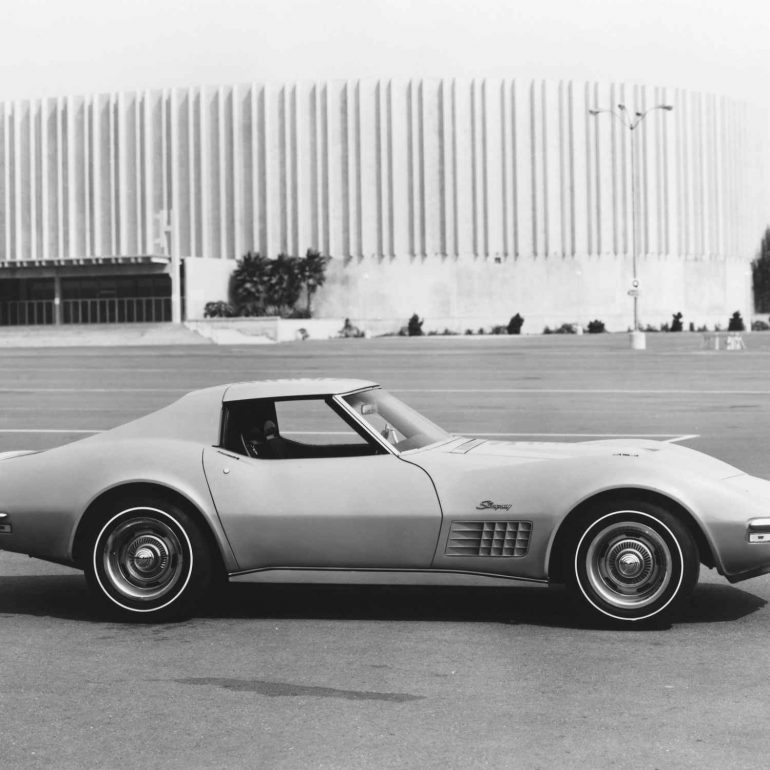
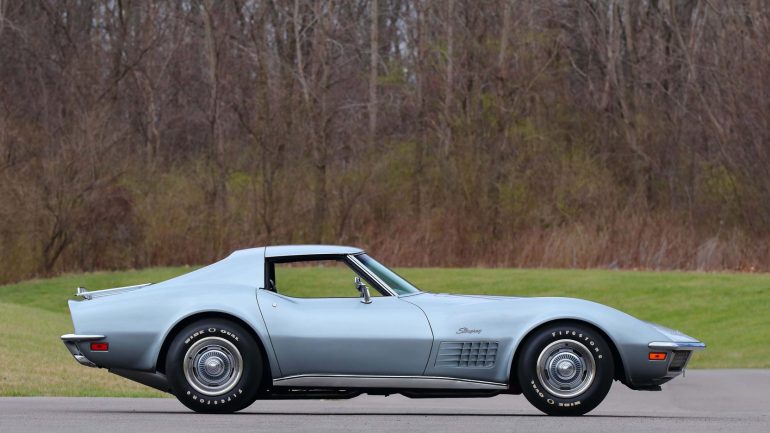
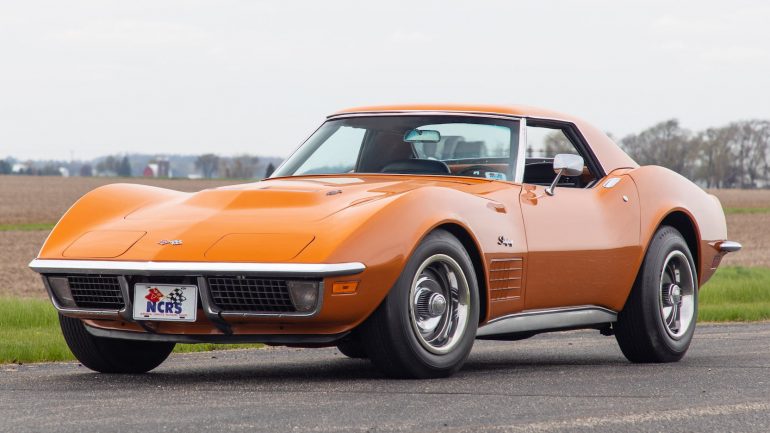
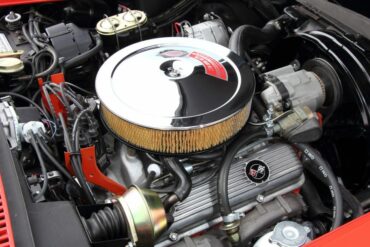
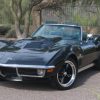
 The special air-intake hood of the ZR2 Corvette included the "454" designation, denoting the presence of the LS6 engine.

Zora Arkus-Duntov pushed the aluminum-head LS6 into the 1971 Corvette and then told Car and Driver, “Maybe I make mistake. Aluminum heads are expensive and that weight doesn’t matter on the street.” Only 188 buyers paid the $1,221, but one of the two ZR2 convertibles built with it sold for $962,500 at Mecum Indianapolis in 2022 and the other for $863,500 at Monterey in 2023.
DID YOU KNOW
1971’s specials are the 12 ZR2s and 8 ZR1s, the 188 LS6 cars, the LT-1, the Baldwin-Motion Phase III and the mid-engine XP-882 and two-rotor studies that were shaping the Corvette’s future while the production car stood still.

The ZR1 returned for 1971 at $1,010 on the detuned 330-hp LT-1: M22 Rock Crusher four-speed, J56 heavy-duty power brakes, F41 springs, shocks and stabilizer bars, K66 transistor ignition and an aluminum radiator with a metal shroud, with power windows, power steering, air conditioning, rear defroster, wheel covers, alarm and radio all locked out. Eight were built, the rarest of the three ZR1 years, and most are in the registries.
MORE: ALL 1971 ZR1 POSTS
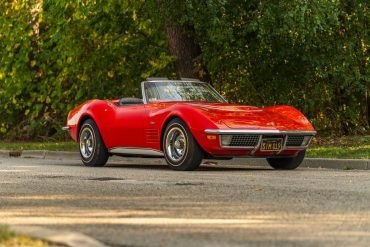

RPO ZR2 was the ZR1 package built around the 425-hp aluminum-head LS6 454 for $1,747: M22 four-speed, J56 brakes, F41 suspension, K66 ignition and the aluminum radiator, no comfort options and no automatic. Twelve were built in 1971, the only year, ten coupes and two convertibles. The convertibles sold for $962,500 at Mecum Indianapolis in 2022 and $863,500 at Monterey in 2023, and the export coupe for $650,000 at Indianapolis in 2023, which makes the ZR2 the most valuable Corvette of the 1970s.
MORE: ALL 1971 ZR2 POSTS


The Sport Coupe listed at $5,496.00 and the convertible at $5,259.00, up $304 and $410 on 1970, with tinted glass, Positraction and the four-speed or Turbo Hydra-Matic still included.
The engine list was the 1970 list with new ratings: the 454/365 LS5 at $295.00 went into 5,097 cars, the 330-hp LT-1 at $483.00 into 1,949 and the 425-hp LS6 at $1,221.00 into 188, with 8 LT-1s and 12 LS6s leaving as the $1,010 ZR1 and $1,747 ZR2 packages; the 350-hp L46 was gone. That left about 14,567 cars with the 270-hp base engine, and 5,285 of the 21,801 were big blocks. The Turbo Hydra-Matic went into 10,060 cars, 46 percent and its highest share yet, the close-ratio M21 into 2,387 and the M22 ($100.00) into 130, the ZR cars and the LS6 buyers who wanted it; about 9,224 kept the standard M20. An optional axle ratio (RPO ZQ1, $12.65) went into 2,395 cars.
Power steering (RPO N40, $115.90) reached 17,904 cars, 82 percent, power brakes (RPO J50, $47.00) 13,558, air conditioning (RPO C60, $459.00) 11,481, more than half the cars for the first time, the tilt-telescopic column (RPO N37, $84.30) 8,130, the alarm (RPO UA6, $31.60) 8,501 and power windows (RPO A31, $79.00) 6,192. The AM/FM radio (RPO U69, $178.00) went into 18,078 cars and the stereo (RPO U79, $283.00) into 3,431. Raised-white-letter tires (RPO PU9, $42.00) went on 12,449 cars against 6,711 white-stripes (RPO PT7, $28.00), and the deluxe wheel covers (RPO P02, $63.00) on 3,007.
The custom interior ($158.00) went into 2,602 cars, the hardtop (RPO C07, $274.00) onto 2,619 of the convertibles with 832 vinyl-covered (RPO C08, $63.00), the rear defroster (RPO C50, $42.00) into 1,598 and the heavy-duty battery (RPO T60, $15.80) into 1,455 small-block cars.
Ten colors were offered with black or white tops; the color totals add up to 21,302, 499 short of production, for reasons Chevrolet never recorded.
MORE: PRICING, OPTIONS & COLORS / RPO CODES
| CODE | DESCRIPTION | QUANTITY | RETAIL PRICE |
|---|---|---|---|
| 19437 | Base Corvette Sport Coupe | 14,680 | $5,496.00 |
| 19467 | Base Corvette Convertible | 7,121 | $5,259.00 |
| 403–420 | Custom Interior Trim (leather seats, cut-pile carpet, wood-grain trim) | 2,602 | $158.00 |
| A31 | Power Windows | 6,192 | $79.00 |
| A85 | Custom Shoulder Belts (standard on coupes; convertibles) | 677 | $42.00 |
| C07 | Auxiliary Hardtop (convertible) | 2,619 | $274.00 |
| C08 | Vinyl Covering for Auxiliary Hardtop | 832 | $63.00 |
| C50 | Rear Window Defroster | 1,598 | $42.00 |
| C60 | Air Conditioning (not with LT-1) | 11,481 | $459.00 |
| J50 | Power Brakes | 13,558 | $47.00 |
| LS5 | 454ci, 365HP Engine | 5,097 | $295.00 |
| LS6 | 454ci, 425HP Engine (aluminum heads) | 188 | $1,221.00 |
| LT1 | 350ci, 330HP Engine (solid lifters) | 1,949 | $483.00 |
| M21 | 4-Speed Manual Transmission, Close Ratio | 2,387 | no charge |
| M22 | 4-Speed Manual, Close Ratio, Heavy Duty | 130 | $100.00 |
| M40 | Turbo Hydra-Matic 3-Speed Automatic | 10,060 | no charge |
| N37 | Tilt-Telescopic Steering Column | 8,130 | $84.30 |
| N40 | Power Steering | 17,904 | $115.90 |
| P02 | Deluxe Wheel Covers | 3,007 | $63.00 |
| PT7 | White Stripe Tires, F70x15, nylon | 6,711 | $28.00 |
| PU9 | White Letter Tires, F70x15, nylon | 12,449 | $42.00 |
| T60 | Heavy Duty Battery (standard with LS5) | 1,455 | $15.80 |
| U69 | AM-FM Radio | 18,078 | $178.00 |
| U79 | AM-FM Radio, Stereo | 3,431 | $283.00 |
| UA6 | Alarm System | 8,501 | $31.60 |
| ZQ1 | Optional Rear Axle Ratio | 2,395 | $12.65 |
| ZR1 | Special Purpose LT-1 Engine Package (M22, J56, F41, K66, aluminum radiator) | 8 | $1,010.00 |
| ZR2 | Special Purpose LS6 Engine Package (M22, J56, F41, K66, aluminum radiator) | 12 | $1,747.00 |
| CODE | EXTERIOR | TOTAL | SOFT TOP | INTERIOR |
|---|---|---|---|---|
| 989 | War Bonnet Yellow | 3,706 | Black, White | Black, Dark Green, Saddle |
| 983 | Brands Hatch Green | 3,445 | Black, White | Black, Dark Green |
| 976 | Mulsanne Blue | 2,465 | Black, White | Black, Dark Blue |
| 987 | Ontario Orange | 2,269 | Black, White | Black, Dark Green, Saddle |
| 973 | Mille Miglia Red | 2,180 | Black, White | Black, Red |
| 972 | Classic White | 1,875 | Black, White | Black, Dark Blue, Dark Green, Red, Saddle |
| 988 | Steel Cities Gray | 1,591 | Black, White | Black, Saddle |
| 979 | Bridgehampton Blue | 1,417 | Black, White | Black, Dark Blue |
| 905 | Nevada Silver | 1,177 | Black, White | Black, Dark Blue, Dark Green, Red |
| 912 | Sunflower Yellow | 1,177 | Black, White | Black, Dark Green, Saddle |
Every engine lost compression for 1971 so that it could run on 91-octane low-lead fuel. The base 350 went to 8.5:1 and 270 hp at 4,800 rpm with 360 lb-ft; the LT-1 kept its solid lifters, forged crank, aluminum intake, Holley four-barrel and 6,500-rpm redline but dropped to 9.0:1 and 330 hp at 5,600, still four-speed only and still without air conditioning.
The LS5 454 went to 8.5:1 and 365 hp at 4,800 with 465 lb-ft, and for the first time the automatic could be had behind a solid-lifter engine, the LS6. That engine was the LS7 Chevrolet had promised and cancelled for 1970, rebuilt for low-lead fuel: aluminum heads, 9.0:1 compression on domed pistons, solid lifters, a forged bottom end and a Holley four-barrel, rated at 425 hp at 5,600 rpm and 475 lb-ft at 4,000. Car Craft ran one through the quarter in 13.7 seconds at 102 mph; Popular Hot Rodding’s LS5 did 14.0 at 95.6.
The two special-purpose packages were identical except for the engine. ZR1 ($1,010) put the LT-1 with the M22 close-ratio heavy-duty four-speed, J56 heavy-duty power brakes, F41 springs, shocks, spindle struts and front and rear stabilizer bars, K66 transistor ignition and an aluminum radiator with a metal fan shroud; ZR2 ($1,747) did the same with the LS6. Neither could be ordered with power windows, power steering, air conditioning, a rear defroster, wheel covers, the alarm or a radio, and the ZR2 could not have the automatic.
Eight ZR1s and twelve ZR2s were built, the ZR2 in 1971 only, and the ZR1 would return once more in 1972. The rest of the car was the 1970: 98-inch wheelbase, 15 x 8 Rally wheels, F70 x 15 tires, four-wheel discs, and a frame and birdcage unchanged since 1968.
MORE: FULL SPECIFICATIONS / ENGINE
| SPEC | 1971 CORVETTE |
|---|---|
| Engines | 350 ci (5.7 L) small-block V-8 in two versions; 454 ci (7.4 L) Mark IV big-block V-8 in two versions, including the aluminum-head LS6; all detuned to run on 91-octane low-lead fuel |
| Base engine (ZQ3) | 350/270 hp @ 4,800 rpm, 360 lb-ft @ 3,200 rpm, 8.5:1, hydraulic lifters, Rochester Quadrajet; about 14,567 cars |
| RPO LT-1 | 350/330 hp @ 5,600 rpm, 360 lb-ft @ 4,000 rpm, 9.0:1, solid lifters, forged crank, Holley four-barrel on aluminum intake, transistor ignition, 6,500-rpm redline, LT-1 striped hood; 1,949 cars, $483.00; four-speed only, no air conditioning |
| RPO LS5 | 454/365 hp @ 4,800 rpm, 465 lb-ft @ 3,200 rpm, 8.5:1, hydraulic lifters, Quadrajet; 5,097 cars, $295.00; heavy-duty battery standard |
| RPO LS6 | 454/425 hp @ 5,600 rpm, 475 lb-ft @ 4,000 rpm, 9.0:1, aluminum cylinder heads, solid lifters, forged crank and pistons, Holley four-barrel on aluminum intake, transistor ignition; 188 cars, $1,221.00; the detuned LS7, available with the Turbo Hydra-Matic except in the ZR2 |
| RPO ZR1 | LT-1 engine with the M22 heavy-duty four-speed, J56 heavy-duty power brakes, F41 springs, shocks and stabilizer bars, K66 transistor ignition and an aluminum radiator with metal shroud; comfort options not available; 8 cars, $1,010.00 |
| RPO ZR2 | LS6 engine with the same M22, J56, F41, K66 and aluminum radiator package; comfort options not available; 12 cars (10 coupes, 2 convertibles), $1,747.00; 1971 only |
| Transmission | Muncie 4-speed standard: wide-ratio M20 (about 9,224 cars) or close-ratio M21 (2,387) at no charge; heavy-duty M22 (130 cars, $100.00); 3-speed Turbo Hydra-Matic (RPO M40) at no charge (10,060 cars), not with LT-1 |
| Axle ratio | 3.36:1 standard with manuals, 3.08:1 with Turbo Hydra-Matic; Positraction standard; optional ratios (RPO ZQ1, $12.65) on 2,395 cars |
| Front suspension | Independent; short-long arm, coil springs, anti-roll bar; F41 heavy-duty springs, shocks and bars with ZR1 and ZR2 |
| Rear suspension | Independent; frame-mounted differential, half-shafts, trailing arms, nine-leaf transverse spring; rear stabilizer bar with F41 |
| Brakes | Four-wheel disc, 11.75-in rotors, four-piston calipers, dual-circuit master cylinder; power assist (RPO J50, $47.00; 13,558 cars); J56 heavy-duty brakes with ZR1 and ZR2 |
| Steering | Saginaw recirculating ball, 16.0:1; 15-in wheel; tilt-telescopic column (RPO N37, $84.30; 8,130 cars); power steering (RPO N40, $115.90; 17,904 cars) |
| Exhaust | Dual, rectangular tips recessed into the lower rear panel; 2.5-in system with LT-1 and LS6 |
| Wheels & tires | 15 x 8 in slotted steel Rally wheels with trim rings and caps; F70 x 15 bias-ply tires, with raised-white-letter (RPO PU9, 12,449 cars) or white-stripe (RPO PT7, 6,711); deluxe wheel covers (RPO P02, $63.00; 3,007 cars) |
| Fuel tank | 20 gal; 91-octane low-lead fuel |
| Wheelbase | 98 in |
| Overall length / width / height | 182.5 in / 69.0 in / 47.8 in (coupe) |
| Track, front / rear | 58.7 in / 59.4 in |
| Curb weight | approx. 3,300 lb small block; 454 cars roughly 150 lb heavier |
| 0–60 mph | approx. 5.7 sec (LS6); 6.5 sec (LS5); 6.5–7 sec (LT-1) |
| Quarter mile | 13.7 sec @ 102 mph (LS6, Car Craft); 14.0 sec @ 95.6 mph (LS5, Popular Hot Rodding); approx. 14.6 sec (LT-1) |
| Top speed | approx. 120–125 mph (LT-1); 135–145 mph (454) |
| Production | 21,801: 14,680 coupes and 7,121 convertibles; 5,285 big blocks; the coupe outsold the convertible two to one |
| Assembly | St. Louis, Missouri; small blocks from Flint, big blocks from Tonawanda |
The 1971 Corvette carries a thirteen-character VIN: 194371S for the Sport Coupe and 194671S for the convertible, followed by a sequence number from 100001 to 121801 shared by both bodies and accounting for all 21,801 cars; the sequence restarted at 100001 after 1970’s 400001 series. The 1 is Chevrolet, 9 the Corvette series, 4 the V-8, 37 or 67 the body, 1 the model year and S the St. Louis plant. The VIN plate is on the left front hinge pillar, with the trim tag on the same pillar carrying the body build date (A for August 1970 through L for July 1971), the trim code and the paint code; the number is stamped on the frame and as a partial VIN on the engine and transmission.
The engine pad on the right front of the block carries the plant prefix (V for Flint small blocks, T for Tonawanda big blocks), the build date and a suffix: CJL and CJK for the 270-hp 350 with manual and automatic (CGT also automatic), CGY for the LT-1 and CGZ for the LT-1 in a ZR1, CPH and CPJ for the LS5 with manual and automatic, CPW for the LS6 with the four-speed and CPX for the LS6 with the Turbo Hydra-Matic. The 350 block is casting 3970010 with 3973487 heads; the 454 is 3963512, with 3993820 iron heads on the LS5 and 3994026 or 3946074 aluminum heads on the LS6. The LT-1 and LS6 run Holleys (list R4489A and R4555A), the others Quadrajets numbered 70412xx. Axle codes begin with C as in 1970, and the transmission, axle and distributor should all be dated before the build date.
MORE: VIN DECODER / PRODUCTION
| POSITION | MEANING |
|---|---|
| 1 (First Digit) | Manufacturer: 1 = Chevrolet |
| 9 (Second Digit) | Series: 9 = Corvette |
| 4 (Third Digit) | Engine: 4 = V-8 |
| 37 / 67 (Fourth & Fifth Digits) | Body: 37 = Sport Coupe, 67 = Convertible |
| 1 (Sixth Digit) | Model year: 1 = 1971 |
| S (Seventh Digit) | Assembly plant: S = St. Louis, Missouri |
| 100001–121801 (Eighth through Thirteenth Digits) | Production sequence number, shared by coupes and convertibles |
Ten colors, with War Bonnet Yellow and Brands Hatch Green the favorites: War Bonnet Yellow (3,706), Brands Hatch Green (3,445), Mulsanne Blue (2,465), Ontario Orange (2,269), Mille Miglia Red (2,180), Classic White (1,875), Steel Cities Gray (1,591), Bridgehampton Blue (1,417), Nevada Silver (1,177) and Sunflower Yellow (1,177), with black or white soft tops and five interior colors.
The 1971 trades a step below the 1970 for the same car with less compression, except at the top, where it has the two most expensive C3s outside the L88s. The order is the ZR2s (12 built, Classic.com benchmark about $543,000), the 188 LS6 cars (benchmark about $160,000), the 8 ZR1s, then the LT-1, the LS5, and the 270-hp cars that two thirds of the 21,801 are. Convertibles carry a premium over coupes at each level, and an LS6 with the automatic is worth less than a four-speed. Because the 1971 looks like a 1970 and costs less, it is the sensible way into a chrome-bumper Shark for someone who does not need the last 30 horsepower.
The ZR2 results set the ceiling: the Brands Hatch Green ZR2 convertible, one of two, sold for $962,500 at Mecum Indianapolis in May 2022, the other convertible, an 8,796-mile unrestored car, for $863,500 at Mecum Monterey in August 2023, and the export ZR2 coupe for $650,000 at Mecum Indianapolis in May 2023. LS6 cars tracked by Classic.com sold for $136,000 (an M22 coupe on Bring a Trailer, June 2026) and $112,750 (an automatic at Mecum Kissimmee, January 2026), with convertibles bid to $100,000 at Kissimmee and $110,000 at Mecum Indianapolis in May 2026 without selling; the seven highest LS6 sales on record run from $140,000 to $214,500. 1971 LT-1s have been soft: $35,027 on Bring a Trailer in October 2026, $33,000 at GAA and $25,500 on Bring a Trailer in November 2025, and a convertible bid to $45,000 at Hagerty in September 2026 without selling, while dealers asked $46,950 to $72,997; the 1970–72 LT-1 benchmark is about $54,000. LS5 convertibles were offered at $43,500 to $88,968 in 2026, original automatic coupes at $30,995 to $33,576, convertibles at $46,900 to $52,000, and restomods at $84,000 to $100,399; a modified car sold for $32,000 at AutoHunter in October 2025. Check whether a result includes the buyer’s premium (Mecum and Barrett-Jackson results do, Bring a Trailer bids do not), and treat asking prices and unsold high bids separately from completed sales.
Verification follows the 1970 drill with the 1971 codes: a V-prefix 3970010 block with a CGY suffix (CGZ for a ZR1), 3973487 heads, the Holley and aluminum intake and the 2.5-inch exhaust make an LT-1; a T-prefix 3963512 block with CPW (four-speed) or CPX (automatic), aluminum 3994026 or 3946074 heads and the Holley make an LS6, and CPH or CPJ with iron 3993820 heads an LS5. The partial VIN stamped beside the suffix must match the car. An LS6 is the most valuable engine of the year and the easiest to fake with a set of aluminum heads on an LS5, so the suffix, the casting dates and the build sheet or tank sticker matter more than the badges, and a ZR2 or ZR1 needs the M22, J56 brakes, F41 bars, K66 distributor and aluminum radiator and no factory radio or air; all twenty are known to the registries. NCRS and Bloomington Gold judging sheets, Protect-O-Plates and old photographs help with all of them.
The C3 body sits on the C2’s birdcage and rusts in the same places: the windshield frame, the door hinge pillars and the frame kickups over the rear wheels and around the trailing-arm mounts. The 1971 keeps the vacuum system for the headlights and wiper door, which leaks at the actuators and check valves until nothing works, the fiber-optic lamp monitors (where fitted) that go dark, and T-top and rear-window seals that leak. An LT-1 or LS6 wants its solid lifters adjusted and its Holley set up properly or it will not idle; a 454 that runs hot has a radiator, shroud or timing problem; and the low-compression engines are happy on modern fuel, which is one argument for a 1971 over a 1970. Trailing-arm bushings, half-shaft U-joints and the four-piston calipers (weeping unless sleeved) are the usual mechanical work. Budget for the vacuum system, seals and brakes on any 1971 that has sat.
MORE: THE MARKET
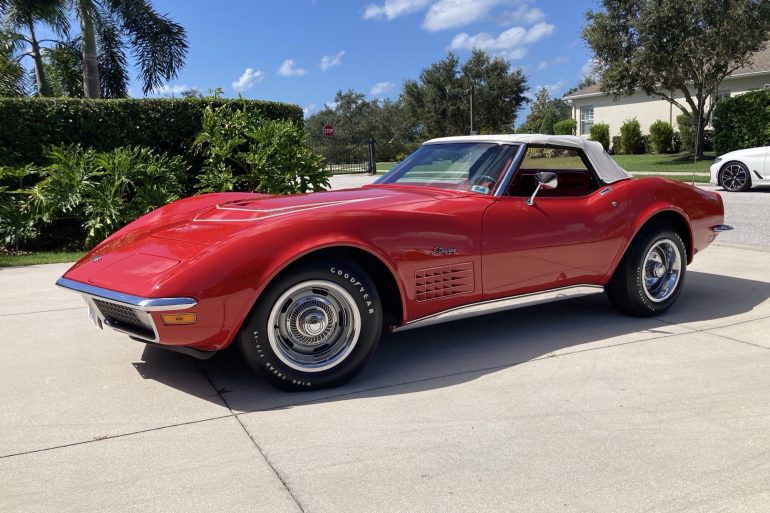

Chevrolet built 21,801 Corvettes for 1971 at St. Louis, Missouri, 14,680 T-top Sport Coupes and 7,121 convertibles, up from 17,316 in the strike-shortened 1970 year. Of those, 5,097 had the 454 LS5, 188 the aluminum-head LS6 (12 of them ZR2s) and 1,949 the LT-1 (8 of them ZR1s); 10,060 had the Turbo Hydra-Matic, 11,481 air conditioning and 17,904 power steering.
In 2026, 1971 LS6 cars sold for $112,750 to $136,000 at auction with a Classic.com benchmark around $160,000; LT-1s sold for $25,500 to $35,027 with dealers asking $46,950 to $72,997; LS5 convertibles were offered at $43,500 to $88,968, original automatic coupes at $31,000 to $33,600 and restomods at $84,000 to $100,000. The twelve ZR2s are the blue chips: the two convertibles sold for $962,500 (2022) and $863,500 (2023) and a coupe for $650,000 (2023).
Four, all detuned for 91-octane low-lead fuel: the 350 small block at 270 hp (base, 8.5:1) or 330 hp as the solid-lifter LT-1 (9.0:1), and the 454 big block at 365 hp as the LS5 (8.5:1) or 425 hp as the aluminum-head, solid-lifter LS6 (9.0:1), the last Corvette engine rated above 400 hp until the 2002 Z06. The four-speed was standard in wide or close ratio, the Turbo Hydra-Matic was a no-cost option on everything but the LT-1 and the ZR2, and the ZR1 and ZR2 packages added the M22 heavy-duty gearbox.
Ten: War Bonnet Yellow (3,706 cars), Brands Hatch Green (3,445), Mulsanne Blue (2,465), Ontario Orange (2,269), Mille Miglia Red (2,180), Classic White (1,875), Steel Cities Gray (1,591), Bridgehampton Blue (1,417), Nevada Silver (1,177) and Sunflower Yellow (1,177), with black or white soft tops. Only Classic White, Mulsanne Blue, Bridgehampton Blue and Ontario Orange carried over from 1970. Interiors came in black, dark blue, dark green, red and saddle vinyl, with black or saddle leather in the custom interior.
The Sport Coupe was $5,496.00 and the convertible $5,259.00, with tinted glass, Positraction and the four-speed or Turbo Hydra-Matic included. The LS5 454 added $295.00, the LT-1 $483.00, the LS6 $1,221.00, the ZR1 package $1,010.00 and the ZR2 package $1,747.00; power steering was $115.90, power brakes $47.00, air conditioning $459.00, the custom interior $158.00 and the AM/FM radio $178.00. An LS6 coupe with power brakes and steering came to about $6,880, and a ZR2 coupe to $7,243 before tires.
Almost nothing you can see: the body, interior and chassis are the 1970’s, with an easier fuel-filler door, a lit automatic shift quadrant, amber parking lenses specified (most cars still got clear lenses) and the fiber-optic lamp monitors in their last year. The changes were in the engines, all cut to run on 91-octane fuel: the base 350 fell to 270 hp, the LT-1 to 330 and the LS5 to 365, while the new 425-hp aluminum-head LS6 replaced the never-built LS7 and the ZR2 package joined the ZR1. The L46 was dropped and the automatic became available with the solid-lifter LS6.
RPO LS6 was a 454 big block with aluminum cylinder heads, solid lifters, 9.0:1 compression, a forged bottom end and a Holley four-barrel, rated at 425 hp at 5,600 rpm and 475 lb-ft, the detuned, low-lead version of the 460-hp LS7 Chevrolet had cancelled for 1970. It cost $1,221 and went into 188 cars, in 1971 only. RPO ZR2 ($1,747) wrapped the LS6 in the racing package, the M22 heavy-duty four-speed, J56 heavy-duty brakes, F41 suspension, transistor ignition and an aluminum radiator, with no radio, air conditioning or power assists allowed. Twelve were built, ten coupes and two convertibles; the convertibles sold for $962,500 in 2022 and $863,500 in 2023.
1971 Corvette Advertisements / 1971 Corvette Colors / 1971 Corvette Common Issues / 1971 Corvette Engine / 1971 Corvette Factory Options / 1971 Corvette For Sale / 1971 Corvette Maintenance / 1971 Corvette Mods / 1971 Corvette Owners Manual / 1971 Corvette Performance / 1971 Corvette Posters / 1971 Corvette Pricing / 1971 Corvette Production / 1971 Corvette Recalls / 1971 Corvette Research / 1971 Corvette RPO Codes / 1971 Corvette Sales Brochures / 1971 Corvette Special Model Overview / 1971 Corvette Specifications / 1971 Corvette Stingray / 1971 Corvette Technical Research / 1971 Corvette Service Bulletins / 1971 Corvette VIN Numbers / 1971 Corvette ZR1 / 1971 Corvette ZR2